

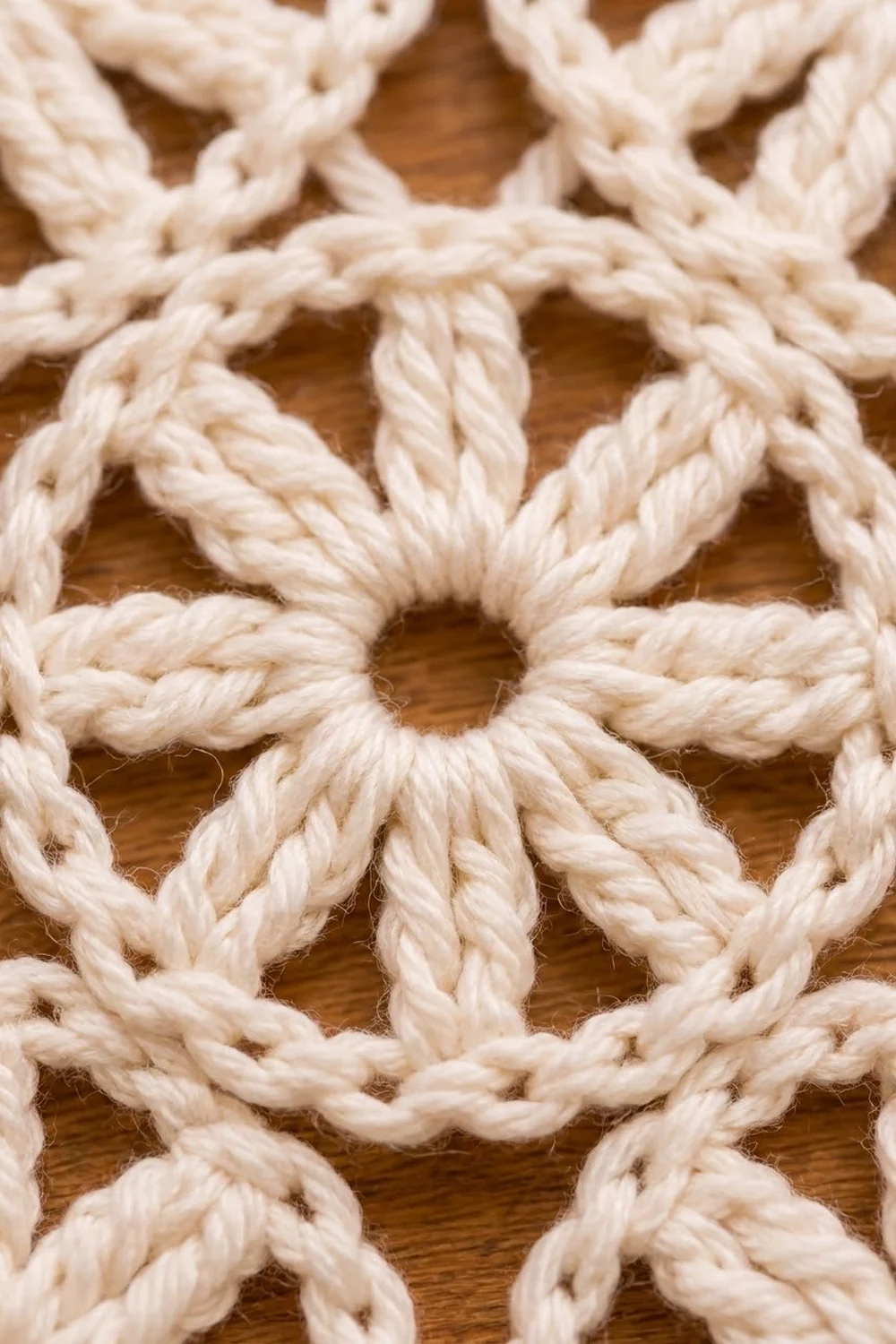
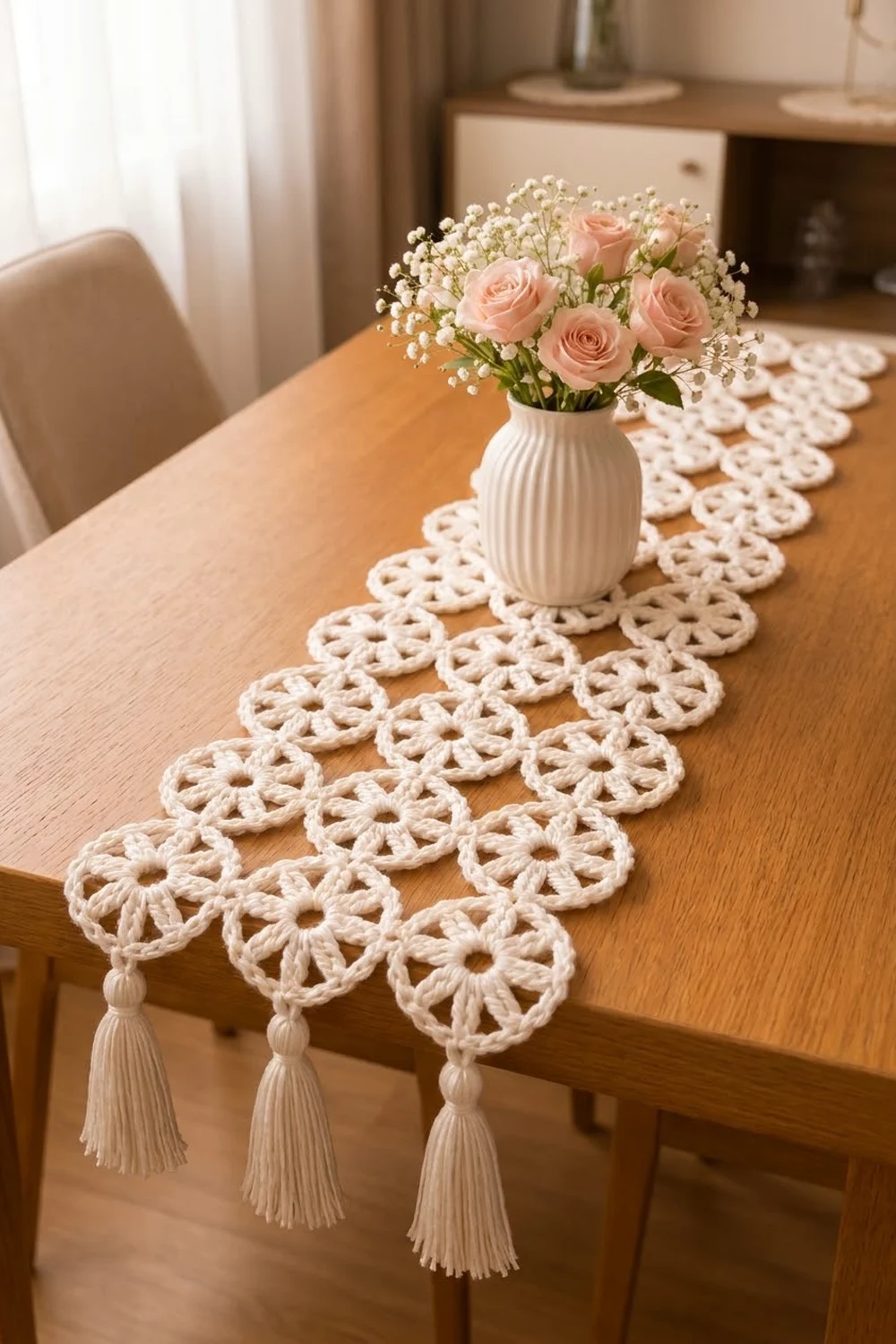
This runner is made from simple wheel motifs. Each one has an open center ring, eight solid spokes and a smooth single crochet rim. Joined in a tidy grid of three across, the circles leave small diamond-shaped windows between them, so the wood of your table shows through. Each short end finishes with three plump tassels.
The whole piece is worked in one color, a soft cream or ivory cotton. The look is light, classic and a little bit farmhouse. It works as everyday decor under a vase of roses, and it suits weddings and holiday tables too.
All instructions use US crochet terms. The finished runner measures 11.25 in (28.6 cm) wide by 45 in (114.3 cm) long, or 53 in (134.6 cm) long including the tassels at both ends.
Construction is easy to follow. You make one complete motif. Then you work each of the other 35 motifs and join it to its neighbors on its last round with a drop-loop join, which adds no stitches. There are no border rounds; the scalloped rims of the motifs form the edge. The tassels are tied on last.
Finished Size and Construction
- Finished size: 11.25 in x 45 in (28.6 cm x 114.3 cm), plus 4 in (10.2 cm) tassels at each end
- Skill level: Easy
- Terminology: US crochet terms
- Yarn weight: Worsted weight (#4) cotton
- Hook: 5 mm (US H-8)
- Number of pieces: 36 wheel motifs joined as you go, plus 6 tassels
- Layout: 3 motifs wide x 12 motifs long
- Piece size: 3.75 in (9.5 cm) diameter per motif
- Size before border: 11.25 in x 45 in (28.6 cm x 114.3 cm)
- Border depth: 0 in (0 cm). There are no border rounds; the motif rims are the edge.
Materials
Yarn: Choose a smooth, mercerized or soft-twist worsted weight cotton. Cotton keeps the spokes crisp and the circles round after blocking. Acrylic also works, but it relaxes more and may need firmer blocking.
- Cream / ivory: about 160 g, 300 m (328 yd)
Each motif uses about 5.5 m (6 yd), so the 36 motifs need about 198 m. The 6 tassels use about 45 m. These quantities include a margin of roughly 20% for your test motif, tails and small gauge differences.
Tools:
- 5 mm (US H-8) crochet hook
- Tapestry needle
- Scissors
- Stiff card cut 4.5 in (11.4 cm) tall, for the tassels
- Rustproof pins and a blocking mat or folded towel
- Spray bottle
- Ruler or measuring tape
- Stitch marker (optional)
Abbreviations (US Terms)
- ch: chain
- sl st: slip stitch
- sc: single crochet
- tr: treble crochet
- sp: space
- st(s): stitch(es)
- rep: repeat
- RS: right side
Special stitch: drop-loop join (DLJ). Take the hook out of the working loop. Insert the hook from front to back through the top of the named stitch on the neighboring motif. Pick up the dropped loop and pull it through, then work the next stitch. The DLJ is not a stitch and does not change any stitch count.
Spoke tops: On Round 3, the 2 sc worked into the 2 tr of each spoke form a “spoke top.” The spoke tops are numbered 1 to 8 in the order you work them.
Gauge and Checkpoints
Gauge: 18 sc = 4 in (10.2 cm), worked in rows. Exact gauge doesn’t matter much for a runner, but it controls the final size and how much yarn you use.
Make one full motif first and check it against these measurements:
- After Round 1: the ring is about 1.25 in (3.2 cm) across, with an open center hole about 0.5 in (1.3 cm) wide.
- After Round 2: the spokes measure 3.25 in (8.3 cm) from one tip to the opposite tip.
- After Round 3: the motif is 3.75 in (9.5 cm) across and lies flat, without cupping or ruffling.
If your motif is too big (over 3.875 in / 9.8 cm), go down to a 4.5 mm hook. If it is too small (under 3.625 in / 9.2 cm), go up to a 5.5 mm hook.
If the rim ruffles, your sc are looser than your tr. Tighten your sc tension or go down one hook size for Round 3 only. If the rim cups, your sc are too tight; go up one hook size for Round 3 only.
Wheel Motif
Make 36. Leave a 6 in (15.2 cm) tail at the start and end of each motif.
Round 1: Ch 8, sl st in first ch to form a ring. Ch 1, 16 sc in ring, sl st in first sc to join. (16 sc)
Round 2 (spokes): Ch 4 (counts as first tr), tr in same sc as the join. Ch 3, skip next sc, 2 tr in next sc; rep from * 6 more times. Ch 3, skip last sc, sl st in top of beginning ch-4 to join. (8 spokes of 2 tr = 16 tr, plus 8 ch-3 sps)*
The two tr in each pair sit side by side and read as one thick spoke. The skipped sc and the ch-3 create the open wedges between spokes.
Round 3 (rim, conversion round): Ch 1. Sc in each of next 2 tr (spoke top made), 4 sc in next ch-3 sp; rep from * 7 more times. Sl st in first sc to join. (16 sc worked 1 per tr + 32 sc added in the 8 ch-3 sps = 48 sc)*
Each eighth of the rim has 6 sc: 2 on the spoke top and 4 over the space. Spoke tops 1, 3, 5 and 7 are spaced 90 degrees apart, and these four are the join points. Hold the motif with spoke top 1 at the top. Spoke top 3 is then on the left, 5 at the bottom and 7 on the right.
Fasten off the first motif after Round 3. Work Round 3 of every other motif with joins, as described in Joining.
Make All Pieces
Make 36 motifs in cream / ivory: 1 worked complete and 35 joined on Round 3.
Layout grid (columns A to C, 12 rows), viewed from the RS:
Row 1:  A1  B1  C1
Row 2:  A2  B2  C2
Row 3:  A3  B3  C3
 ...
Row 12: A12 B12 C12
Work each row from left to right, then start the next row at column A. The tassels hang from the top of Row 1 and the bottom of Row 12.
Joining
Method: Join as you go on Round 3 using the DLJ. Each new motif joins only to motifs that are already made: the one to its left and the one above it.
Stitch-to-stitch logic: Every join happens between the 2 sc of a spoke top. Work the first sc of your spoke top. DLJ into the second sc of the matching spoke top on the neighbor. Then work the second sc of your spoke top. There is one join point per shared edge and no extra stitches anywhere, so every motif keeps exactly 48 sc.
Hold every motif the same way, with spoke top 1 at the top.
- Joining to the left neighbor: at spoke top 3, DLJ into the neighbor’s spoke top 7.
- Joining to the motif above: at spoke top 1, DLJ into the upper motif’s spoke top 5.
So A1 has no joins, B1 and C1 join at spoke top 3, A2 joins at spoke top 1, and every other motif joins at both spoke tops 1 and 3. That gives 24 side-to-side joins (2 per row x 12 rows) and 33 top-to-bottom joins (3 per gap x 11 gaps), for 57 joins in total.
Tension: Pull the dropped loop through snugly, but don’t tug the motifs together. The circles should just touch at each join point, without puckering. Keep the motifs flat on your lap or table while you join.
Size checkpoint: After Row 2, the piece should be 11.25 in (28.6 cm) wide and 7.5 in (19.1 cm) long. After Row 6, it should be 22.5 in (57.2 cm) long. If either measurement is off by more than 0.25 in (0.6 cm), check your hook size before you continue.
Weave in the tails along the back of the rim sc as you finish each row of motifs.
Border
This runner has no crocheted border. The edge is the scalloped Round 3 rim of the outer motifs, which gives the open, circle-by-circle outline.
Border gauge: The same as the motifs, 18 sc = 4 in (10.2 cm). No border rounds are added, so every edge stitch comes from the motifs.
Edge counts per side:
- Each motif’s rim has four quarters of 12 sc, one between each pair of neighboring join points.
- Long sides: each non-corner edge motif (10 per side) shows 2 quarters, or 24 sc.
- Short ends: the middle motif (B1 or B12) shows 24 sc.
- Corners: each corner motif (A1, C1, A12, C12) shows 3 quarters, or 36 sc.
- Total edge: (20 x 24) + (2 x 24) + (4 x 36) = 480 + 48 + 144 = 672 sc.
Why the math works: The 36 motifs have 144 quarters in total. The 22 inner diamond windows (2 per row gap x 11 gaps) use 4 quarters each, or 88 quarters. That leaves 56 quarters x 12 sc = 672 sc, which matches the count above. The DLJ adds nothing, so you never need to add or subtract stitches at a seam.
Tassels (make 6)
- Wrap yarn 30 times around the 4.5 in (11.4 cm) card.
- Slide a 10 in (25.4 cm) tie strand under the wraps at the top edge and knot it tightly.
- Cut the wraps along the bottom edge and remove the card.
- Wrap a 12 in (30.5 cm) strand 6 times around the tassel, 0.75 in (1.9 cm) below the top. Knot it, then use the needle to thread the ends down into the tassel.
- Trim the skirt evenly so the tassel is 4 in (10.2 cm) from top to tips.
Attach: Thread the tie ends through spoke top 5 on A12, B12 and C12, between the 2 sc. Knot them on the back so the tassel head sits right against the rim. Repeat at spoke top 1 on A1, B1 and C1. Weave the tie ends into the rim.
Final Blocking
- Soak the runner in cool water for 10 minutes, then gently squeeze out the water. Do not wring it.
- Roll it in a towel and press to remove more moisture.
- Lay it RS up on your blocking surface.
- Pin the corner motifs first, so the runner is 11.25 in (28.6 cm) wide and 45 in (114.3 cm) long.
- Pin the outer rim of every edge motif into a smooth circle, with one pin at each spoke top.
- Straighten each spoke with your fingers so it points to the center.
- Comb the tassels straight with your fingers.
- Let the runner dry completely, at least 24 hours, before you unpin it.
Final Quality-Control Checklist
- Every motif has 16 sc, 8 spokes and 48 rim sc.
- Every motif measures 3.75 in (9.5 cm) across.
- All 57 join points sit between the 2 sc of a spoke top.
- The diamond windows are all the same size and shape.
- The runner measures 11.25 in x 45 in (28.6 cm x 114.3 cm).
- All tails are woven in invisibly on the back.
- All 6 tassels are 4 in (10.2 cm) long and hang straight.
Troubleshooting
Spokes lean or twist: You may be working the 2 tr into different sc. Both tr of a spoke go into the same sc.
Center hole closes up: Your ring is too tight. Make the ch 8 loosely, or ch 9 if needed, and keep 16 sc.
Motifs pull into ovals: A join was made at the wrong spoke top. Count the spoke tops from 1 every time and redo the join.
Joins pucker or the diamond windows look distorted: The DLJ loop is pulled too tight. Redo the join with a relaxed loop.
Edge is wavy: Your Round 3 tension is too loose. Block firmly, and tighten your sc on future motifs.
Tassels look thin: Add 5 to 10 more wraps on the card.
Care
Hand wash in cool water with mild soap and lay flat to dry, reshaping the circles. If needed, press on low heat under a pressing cloth.
Final Notes
The measurement chain is simple. A 1.25 in (3.2 cm) ring grows to 3.25 in (8.3 cm) with the spokes and finishes at 3.75 in (9.5 cm) with the rim. Three motifs across give 11.25 in (28.6 cm), and twelve motifs along give 45 in (114.3 cm). With no border and no seam stitches, those numbers stay exact, and the tassels bring the full length to 53 in (134.6 cm).
Check your first motif, keep your joins relaxed and take your time blocking. The result is a light, airy runner that frames a vase of flowers beautifully.
Happy crocheting!