

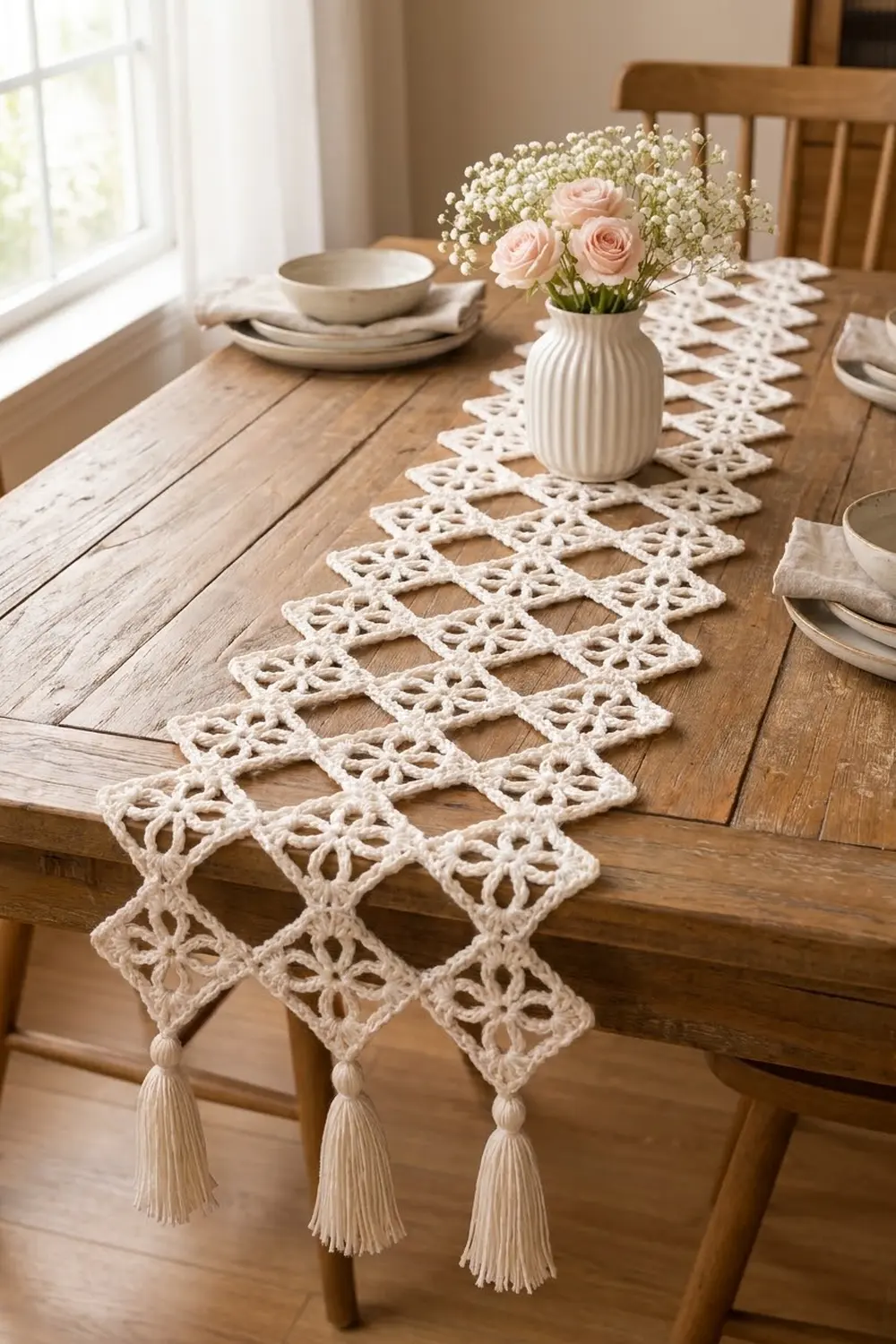
This runner is built from small ivory lace squares turned on point so they read as diamonds. Each motif has a tiny open center ring, four oval chain petals pointing to the four corners, a solid fan of double crochets at each corner, and a firm single crochet outline. The diamonds are joined point to point, which leaves open diamond-shaped windows between them where the table shows through.
The look is light, clean, and a little vintage. Using a single ivory cotton keeps the focus on the geometry. Six full tassels, three at each end, hang from the outer points and give the piece weight and a finished drape.
The pattern uses US crochet terms. The finished runner measures about 15 in (38.1 cm) wide and 45 in (114.3 cm) long before tassels. With the tassels it is about 53 in (134.6 cm) long.
The construction is simple. You make one 4-round motif, then add the rest with a join-as-you-go method on the final round: 3 motifs across and 9 down. A slip stitch border firms the outer zigzag edge, and the tassels go on last.
Finished Size and Construction
- Finished size: about 15 in (38.1 cm) x 45 in (114.3 cm), plus 4 in (10.2 cm) tassels at each end
- Skill level: Easy to Intermediate
- Terminology: US crochet terms
- Yarn weight: Worsted weight (#4) cotton
- Hook: 4.5 mm (US 7)
- Number of pieces: 27 motifs + 6 tassels
- Layout: 3 motifs across x 9 motifs long, set on point, joined at corners only
- Motif size: 3.5 in (8.9 cm) per side; about 5 in (12.7 cm) point to point
- Size before border: about 15 in (38.1 cm) x 45 in (114.3 cm)
- Border depth: slip stitch edge only; adds no measurable width
Materials
Yarn: Choose a smooth worsted weight cotton, either mercerized or soft-twist. Cotton gives crisp stitch definition, blocks flat, and survives washing after spills. Avoid fuzzy or splitty yarns, because the chain petals need clean edges.
- Ivory / cream: about 200 g, approximately 360 m (394 yd); for example, 4 balls of 50 g / 90 m (98 yd)
Each motif uses about 5 g. The 27 motifs need about 135 g and the 6 tassels about 36 g. These quantities include a safety margin of about 15 percent.
Tools:
- 4.5 mm (US 7) crochet hook
- Tapestry needle
- Scissors
- Stitch markers (2 or 3)
- Stiff card cut to 4.5 in (11.4 cm), for the tassels
- Blocking mats, rustproof pins, and a spray bottle
- Ruler or tape measure
Abbreviations (US Terms)
- ch – chain
- sl st – slip stitch
- sc – single crochet
- dc – double crochet
- sp – space
- st(s) – stitch(es)
- rep – repeat
- rnd – round
Special stitch – Corner join (cj): Use this in place of the corner ch 2 of Rnd 4. Ch 1, then remove the hook. Insert it from front to back into the matching corner ch-2 sp of the finished motif, pick up the dropped loop, and pull it through (sl st join). Ch 1. The new motif still has 2 chains’ worth of height at its corner, so its shape and stitch counts stay the same.
Gauge and Checkpoints
Gauge: 18 sc = 4 in (10.2 cm) with a 4.5 mm hook.
Make one complete motif first and treat it as your swatch. Measure it flat, lightly pinned, without stretching it.
- After Rnd 1: the center ring is about 0.75 in (1.9 cm) across.
- After Rnd 3: about 3 in (7.6 cm) per side, measured from corner ch-2 sp to corner ch-2 sp.
- After Rnd 4: 3.5 in (8.9 cm) per side, about 5 in (12.7 cm) point to point.
If your motif is too big: switch to a 4 mm hook and remake it. Check your petal chains first, since loose chain-10 loops are the most common cause.
If your motif is too small: switch to a 5 mm hook. An error of 0.25 in (0.6 cm) per side adds up to about 1 in (2.5 cm) across the width of the runner and over 3 in (7.6 cm) along its length, so it’s worth fixing now.
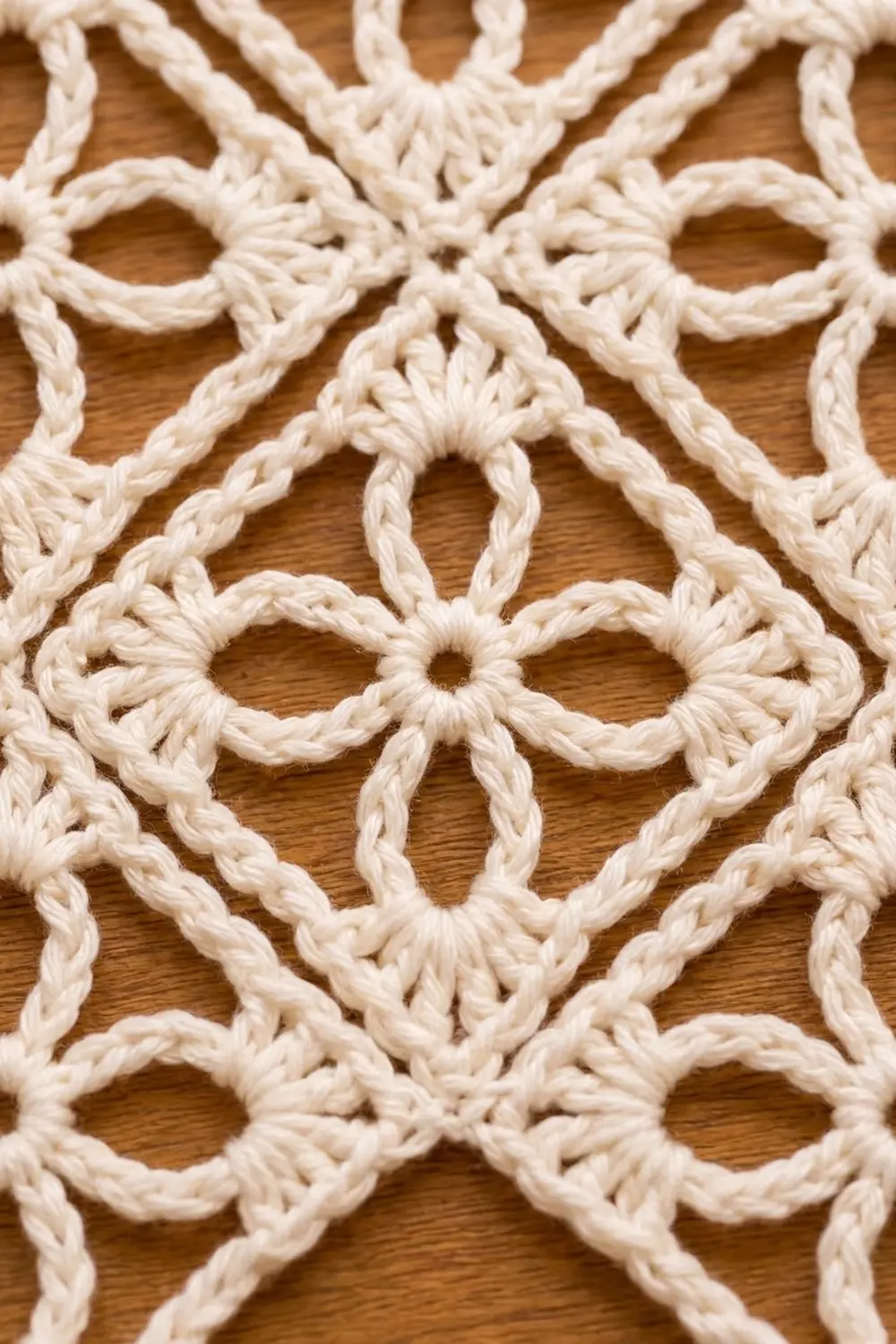
Motif Pattern
Ch 6, sl st in first ch to form a ring.
Rnd 1: Ch 1, 12 sc in ring, sl st in first sc to join. (12 sc)
Rnd 2 (petals): Ch 1, *sc in next sc, ch 10, sc in same sc, sc in each of next 2 sc; rep from * 3 more times, sl st in first sc to join. (16 sc and 4 ch-10 loops)
Each repeat uses 3 sts of Rnd 1 and makes 4 sc plus one loop, so the 4 repeats use all 12 sts. The 4 loops become the oval petals. Keep the chains even and don’t twist the loops.
Rnd 3 (corner fans): Sl st into the next ch-10 loop. Ch 3 (counts as dc), (2 dc, ch 2, 3 dc) in same loop, ch 7, *(3 dc, ch 2, 3 dc) in next ch-10 loop, ch 7; rep from * 2 more times, sl st in top of beginning ch-3 to join. (24 dc, 4 corner ch-2 sps, 4 ch-7 sps)
The fans gather the tip of each petal. This pulls each petal into a long oval that points straight into its corner. The ch-7 spaces become the open straight sides.
Rnd 4 (outline): Sl st in each of next 2 dc and into the corner ch-2 sp. Ch 1, (sc, ch 2, sc) in same corner sp, sc in each of next 3 dc, 8 sc in ch-7 sp, sc in each of next 3 dc, (sc, ch 2, sc) in next corner ch-2 sp; rep from * 3 more times, ending the last rep at *. Sl st in first sc to join and fasten off. (64 sc, 4 corner ch-2 sps)
Per side count: 1 corner sc + 3 + 8 + 3 + 1 corner sc = 16 sc. This count includes both corner sc of that side. 16 sc x 4 sides = 64 sc, which matches the round total.
At 18 sc per 4 in (10.2 cm), 16 sc measure about 3.5 in (8.9 cm). Set on point, the motif measures about 5 in (12.7 cm) from tip to tip.
Make All Pieces
Make 1 full motif; your swatch counts as motif A1. For the other 26 motifs, work Rnds 1–3 as written, then work Rnd 4 with corner joins as described under Joining.
- Ivory: 27 motifs total
- Tassels: 6, made after joining
Layout grid (each label is one diamond; rows run down the length of the runner):
Row 1:  A1  A2  A3
Row 2:  B1  B2  B3
Row 3:  C1  C2  C3
Row 4:  D1  D2  D3
Row 5:  E1  E2  E3
Row 6:  F1  F2  F3
Row 7:  G1  G2  G3
Row 8:  H1  H2  H3
Row 9:  I1  I2  I3
Every motif is turned on point, with its corners at the top, right, bottom, and left.
Joining
Method: Join-as-you-go on Rnd 4, at the corner points only. No sides are sewn together, which is what creates the open diamond windows between motifs.
Stitch logic:
- Horizontal join: the left point of the new motif joins to the right point of the motif beside it.
- Vertical join: the top point of the new motif joins to the bottom point of the motif above it.
Work Rnd 4 as normal until you reach a corner that needs joining. Work the first sc into the corner sp, then the corner join (ch 1, sl st into the neighbor’s ch-2 sp, ch 1), then the second sc in the same corner sp. Continue the round. The new motif still has 16 sc per side and 64 sc in total.
Order:
- A2 joins to A1 at 1 point. A3 joins to A2 at 1 point.
- B1 joins to A1 at 1 point (top to bottom).
- B2 joins to A2 (top) and to B1 (left), for 2 points. B3 joins to A3 and B2, for 2 points.
- Repeat the Row 2 order for Rows 3–9.
Total joins: 2 horizontal joins x 9 rows = 18, plus 3 vertical joins x 8 row gaps = 24, for 42 joins.
Tension: Make the ch 1 on each side of the join sl st the same size as your other chains. A tight join pulls the points inward and the windows pucker. A loose join lets the motifs sag apart.
Size checkpoint: Measure after Row 3. The width should be about 15 in (38.1 cm) point to point, and Rows 1–3 should be about 15 in (38.1 cm) long. If the width is already over 15.5 in (39.4 cm), compare your newer motifs against your swatch.
Border
Border gauge: One sl st into each sc of Rnd 4. The sl st round sits on the edge and adds no width.
The border runs only around the outer zigzag edge. It doesn’t go into the inner windows.
Counting the perimeter: The outer edge is made of exposed motif sides, and each side has 16 sc.
- Top end: 3 motifs x 2 sides (upper-left and upper-right) = 6 sides = 96 sl st
- Bottom end: 3 motifs x 2 sides = 6 sides = 96 sl st
- Each long edge: Rows 1 and 9 add 1 side each and Rows 2–8 add 2 sides each, so 2 + 14 = 16 sides = 256 sl st
Total: 96 + 96 + 256 + 256 = 704 sl st.
Border Rnd: Join yarn with a sl st in the first sc after the top point of A1. *Sl st in each sc to the end of that side. At an outer point (a free ch-2 corner), ch 2 and continue onto the next side. At an inner point (a joined corner), skip the join and sl st straight into the first sc of the next motif’s side. Rep from * all the way around. Sl st in first sl st to join and fasten off.
Points: There are 24 outer points (3 at the top, 3 at the bottom, and 9 on each long edge) and 20 inner valleys (2 at the top, 2 at the bottom, and 8 on each long edge). 24 + 20 = 44 corners for 44 sides, so the count closes correctly.
Why the math works: Each side keeps its own 16 sc, corners included, and no stitches are added at the seams. 44 sides x 16 = 704 sl st, plus 24 ch-2 points. Because the border adds no stitches, the size is the same before and after the border: about 15 in (38.1 cm) x 45 in (114.3 cm).
Tassels
Make 6.
- Wrap yarn 30 times around the 4.5 in (11.4 cm) card.
- Slide a 10 in (25.4 cm) tie under the wraps at the top of the card and knot it tightly.
- Cut the loops at the bottom.
- Wrap a second strand 6 times around the bundle, 0.75 in (1.9 cm) below the top, and knot it. Hide the ends inside the tassel.
- Trim the tassel to 4 in (10.2 cm).
Use the tie ends to attach one tassel to the outer ch-2 point at the top of A1, A2, and A3, and at the bottom of I1, I2, and I3. Knot the ties on the wrong side and weave them in.
Final Blocking
- Weave in all ends along the sc outlines, not across the open windows.
- Soak the runner in cool water for 10 minutes, then press the water out in a towel. Don’t wring it.
- Lay it right side up on blocking mats.
- Pin the outer points first, 5 in (12.7 cm) apart across the width and down the length.
- Pin the inner joins so each window forms a clear diamond.
- Shape each petal with your fingers so it points into its corner.
- Check the overall size: 15 in (38.1 cm) x 45 in (114.3 cm).
- Let it dry fully, about 24 hours. Comb the tassels and re-trim them to 4 in (10.2 cm).
Final Quality-Control Checklist
- 27 motifs, each with 64 sc and 16 sc per side
- 4 even petals per motif, each pointing to a corner
- 42 joins, none twisted or skipped
- All windows open and diamond-shaped
- Border of 704 sl st plus 24 ch-2 points, with a flat edge that doesn’t ripple
- Width about 15 in (38.1 cm) and length about 45 in (114.3 cm)
- 6 tassels, each 4 in (10.2 cm) and firmly attached
- All ends hidden and trimmed
Troubleshooting
Petals twist or flop: Your ch-10 loops are uneven. Count the chains carefully and block each petal straight.
Motif cups: Rnd 4 is too tight in the ch-7 spaces. Make sure you work 8 sc in each space, or go up a hook size for Rnd 4 only.
Motif ruffles: There are too many sc in the ch-7 spaces, or the hook is too large. Recount to 8 sc per space.
Runner leans to one side: A join is on the wrong corner. Check the grid; each motif joins only top to bottom and left to right.
Border ripples: Your sl sts are too loose, or you added stitches at the valleys. Work exactly 1 sl st per sc and skip the joins.
Tassels uneven: After blocking, lay all the tassels together and re-trim them.
Care
Hand wash in cool water with mild soap, then dry flat and reshape the points. If the windows lose their shape, you can lightly steam the cotton.
Final Notes
The measurement chain is short. A 16 sc side gives a 3.5 in (8.9 cm) motif that measures about 5 in (12.7 cm) on point. Three motifs across give about 15 in (38.1 cm), and nine down give about 45 in (114.3 cm). The slip stitch border keeps those numbers the same, and the 4 in (10.2 cm) tassels bring the full length to about 53 in (134.6 cm). Get your first motif right and the rest will follow.
Happy crocheting!