

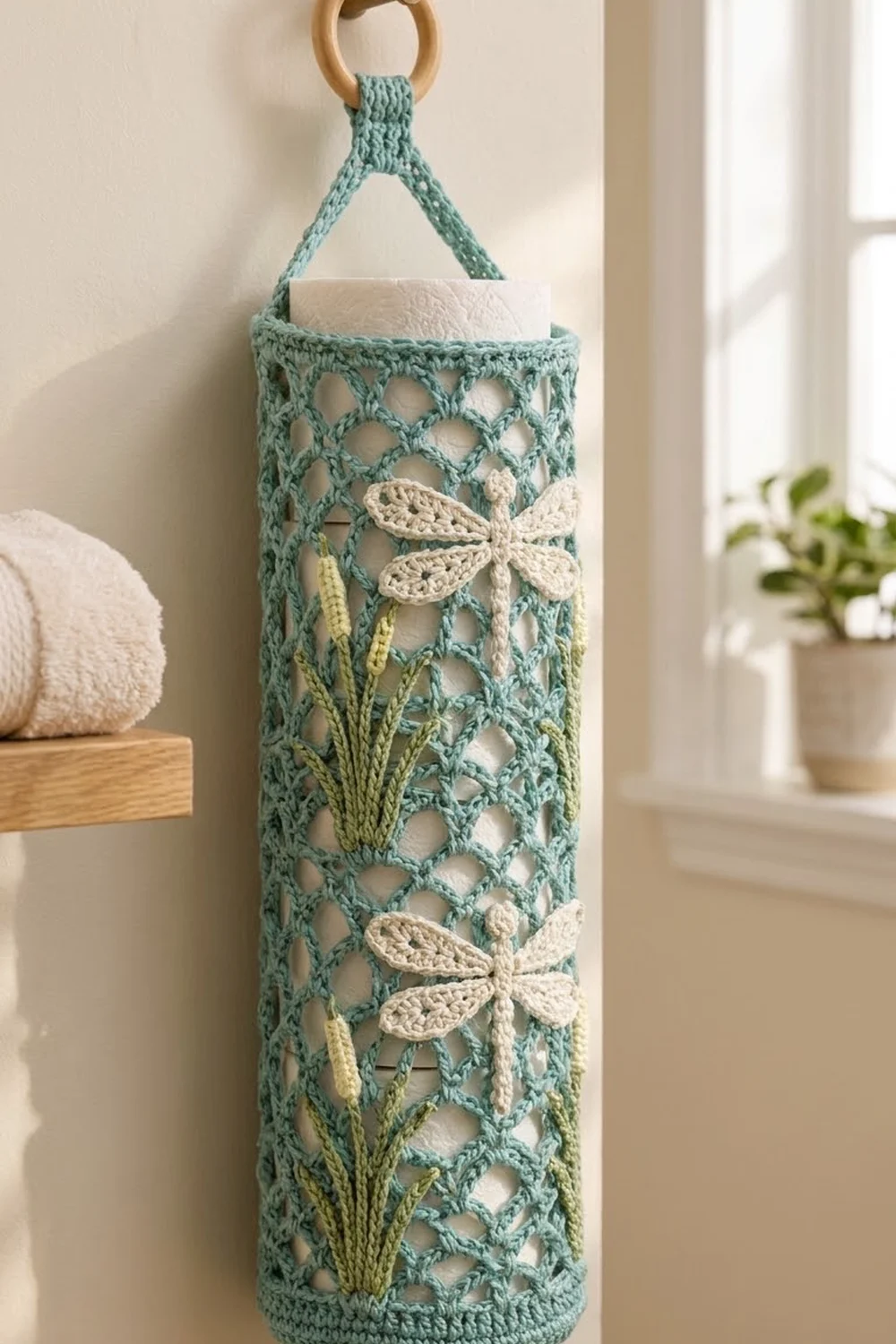
This hanging holder turns spare toilet rolls into bathroom decor. It is a tall teal tube with an open fishnet body. Two cream dragonflies float up the front, and sage green cattails grow from below each one. The roll inside shows through the mesh, so the holder looks light even when it is full.
The palette is soft and natural: teal for the body, cream for the dragonflies and cattail heads, and sage for the leaves and stems. A wooden ring at the top completes the cottage-bathroom style.
This pattern uses US crochet terms. The finished tube is 5.25 in (13.3 cm) across and 15 in (38.1 cm) tall. It holds three standard rolls, each about 4.5 in (11.4 cm) wide and 4.25 in (10.8 cm) tall.
You work the body in one piece from the bottom up. First comes a flat circle base, then a solid band, then 20 rounds of mesh, then a solid top band with a crab-stitch edge. You make the strap separately and sew it inside the rim. Finally, you crochet the appliqués and sew them onto the front.
Finished Size and Construction
- Finished size: 5.25 in (13.3 cm) diameter × 15 in (38.1 cm) tall, plus about 8 in (20.3 cm) of strap and ring
- Skill level: Intermediate
- Terminology: US
- Yarn weight: Worsted (#4) cotton
- Hook: 4.0 mm (G-6)
- Number of pieces: 1 body, 1 strap, and appliqués (2 dragonfly bodies, 8 wings, 12 leaves, 4 stems, 4 cattail heads)
- Layout: one tube; the two dragonflies are centered on the front, one above the other
- Body circumference: 16.5 in (41.9 cm), 66 stitches
- Height before the top border: about 14.75 in (37.5 cm)
- Border depth: one crab-stitch round, about 0.25 in (0.6 cm)
Materials
Use 100% cotton or a cotton blend in worsted weight. Cotton holds its shape in a damp bathroom and keeps the mesh crisp. Avoid fuzzy acrylic, because it blurs the arcs.
- Teal (main color): 150 g, about 230 m
- Cream: 25 g, about 38 m
- Sage green: 20 g, about 31 m
All quantities include a safety margin of about 15%.
Tools:
– 4.0 mm (G-6) crochet hook
– Wooden ring, 2.75 in (7.0 cm) diameter
– Tapestry needle
– Stitch markers
– Rust-proof pins
– Measuring tape
– Spray bottle
Abbreviations (US Terms)
- ch – chain
- sl st – slip stitch
- sc – single crochet
- hdc – half double crochet
- dc – double crochet
- inc – 2 sc in the same stitch
- sk – skip
- BLO – back loop only
- sp – space
- st(s) – stitch(es)
- rnd – round
Special stitch – Crab stitch (reverse sc): Work single crochet from left to right (right to left if you crochet left-handed). Insert the hook into the next stitch to the right, yarn over, pull up a loop, yarn over, and pull through both loops. This makes a twisted, rope-like edge.
Gauge and Checkpoints
- Sc gauge: 16 sts and 17 rnds = 4 in (10.2 cm)
- Mesh gauge: 4 ch-5 arcs = 3 in (7.6 cm) across; 8 mesh rnds = 5 in (12.7 cm) tall
Test the base first. It is your gauge swatch. After Rnd 11 it should lie flat and measure 5.25 in (13.3 cm) across.
Checkpoints:
1. After Rnd 11 (base): 5.25 in (13.3 cm) across, 66 sts
2. After Rnd 15 (bottom band): the wall is 1.25 in (3.2 cm) tall
3. After Rnd 23 (8 mesh rnds): the mesh section is 5 in (12.7 cm) tall
4. After Rnd 35 (all 20 mesh rnds): the mesh section is 12.5 in (31.8 cm) tall
5. After Rnd 40: the tube is 15 in (38.1 cm) tall
If the base is too big, use a hook 0.5 mm smaller. If it is too small, use a hook 0.5 mm larger. If the base is right but the mesh is too tall, add or remove mesh rounds in pairs. Each round is about 0.625 in (1.6 cm).
Base (Teal)
- Rnd 1: Make a magic ring. Work 6 sc in the ring, then sl st to the first sc. (6)
- Rnd 2: Ch 1, inc in each st around, then sl st to the first sc. (12)
- Rnd 3: Ch 1, (sc 1, inc) 6 times, then sl st to join. (18)
- Rnd 4: Ch 1, (sc 2, inc) 6 times, then join. (24)
- Rnd 5: Ch 1, (sc 3, inc) 6 times, then join. (30)
- Rnd 6: Ch 1, (sc 4, inc) 6 times, then join. (36)
- Rnd 7: Ch 1, (sc 5, inc) 6 times, then join. (42)
- Rnd 8: Ch 1, (sc 6, inc) 6 times, then join. (48)
- Rnd 9: Ch 1, (sc 7, inc) 6 times, then join. (54)
- Rnd 10: Ch 1, (sc 8, inc) 6 times, then join. (60)
- Rnd 11: Ch 1, (sc 9, inc) 6 times, then join. (66)
Checkpoint: the base is flat and 5.25 in (13.3 cm) across.
Bottom Band
- Rnd 12: Ch 1, sc in the BLO of each st around, then join. (66) This turns the wall upward. The unused front loops form a ridge around the bottom edge.
- Rnds 13–14: Ch 1, sc in each st around, then join. (66)
- Rnd 15: Ch 3 (counts as the first dc), dc in each remaining st around, then sl st to the top of the ch-3. (66)
Checkpoint: the wall is 1.25 in (3.2 cm) tall.
Mesh Body
- Rnd 16 (set-up): Ch 1, sc in the first st. Then work (ch 5, sk 2, sc in next st) 21 times. To close the round, ch 2, sk the last 2 sts, and dc in the first sc. The ch-2 plus dc forms the 22nd arc and leaves your hook in the middle of that arc. (22 sc, 22 arcs) The math: 1 sc + 21 repeats of 3 sts uses 64 sts, and the last 2 sts are skipped, for 66 in total.
- Rnds 17–34: Ch 1, sc around the joining dc. Then work (ch 5, sc in the next ch-5 arc) 21 times. Close with ch 2 and dc in the first sc. (22 arcs each round)
- Rnd 35: Ch 1, sc around the joining dc. Work (ch 5, sc in the next arc) 21 times. Then ch 5 and sl st to the first sc. (22 full ch-5 arcs)
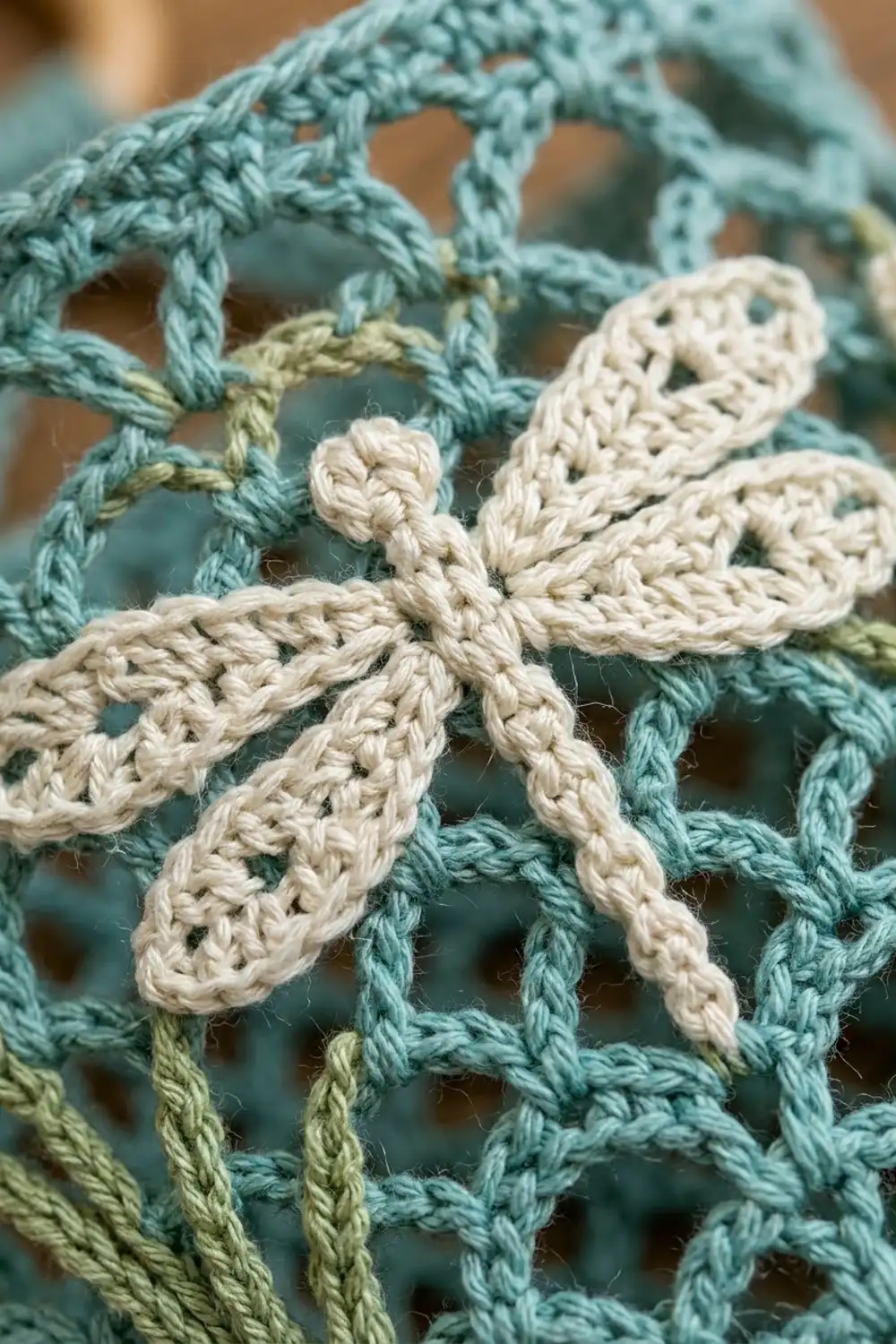
Because each sc sits in the middle of the arc below, the arcs stack into the scallop pattern you see in the photo. Checkpoint after Rnd 23: the mesh is 5 in (12.7 cm) tall. After Rnd 35: the mesh is 12.5 in (31.8 cm) tall.
Top Band
- Rnd 36 (conversion): Sl st into the first arc. Ch 1, work 3 sc in each ch-5 arc around, skipping the sc between arcs, then join. (22 arcs × 3 sc = 66 sc, plus 0 extra = 66)
- Rnds 37–39: Ch 1, sc in each st around, then join. (66)
Checkpoint: the tube is about 14.75 in (37.5 cm) tall and 16.5 in (41.9 cm) around, the same as the base.
Top Border
The border is one crab-stitch round at the sc gauge, 16 sts = 4 in (10.2 cm). Mark st 1 and st 34. These are the side points where the strap attaches. They divide the round into two halves of 33 sts: sts 1–33 at the back and sts 34–66 at the front.
- Rnd 40: Ch 1. Work crab stitch in each st around: 33 sts across the back half and 33 sts across the front half (66 in total). Sl st to join and fasten off.
Why the math works: The base, the bottom band, and the top band all have 66 sts. The mesh has 22 arcs, and 22 × 3 = 66. Every solid round therefore has the same circumference, so the tube’s walls stay straight. Working one crab stitch into each stitch keeps the rim from rippling or pulling in.
Strap (Teal)
Tab:
– Row 1: Ch 7. Sc in the 2nd ch from the hook and in each ch across, then turn. (6)
– Rows 2–14: Ch 1, sc across, then turn. (6)
The tab is 1.5 in (3.8 cm) wide and about 3.25 in (8.3 cm) long.
Leg 1:
– Row 15: Ch 1, sc 3, then turn. (3)
– Rows 16–44: Ch 1, sc 3, then turn. (3)
Fasten off. The leg is 30 rows, about 7 in (17.8 cm) long and 0.75 in (1.9 cm) wide.
Leg 2:
– Join yarn in the remaining 3 sts of Row 14. Work 30 rows of 3 sc to match Leg 1, then fasten off.
Attach:
1. Fold Rows 1–6 of the tab over the wooden ring. Whipstitch Row 1 to Row 12.
2. Sew the end of Leg 1 to the inside of Rnds 37–39, centered on st 1 (sts 66, 1, and 2).
3. Sew Leg 2 the same way, centered on st 34 (sts 33, 34, and 35).
The legs meet about 6.5 in (16.5 cm) above the rim.
Dragonflies (Cream, make 2)
Body:
1. Ch 13.
2. Sc in the 2nd ch from the hook and in the next 8 ch (9 sc for the tail).
3. Hdc in the next 2 ch (thorax).
4. Work 5 dc in the last ch (head).
5. Working along the other side of the chain, hdc in the next 2 ch, then sc in the next 9 ch.
6. Sl st in the skipped ch and fasten off.
Count: 27 sts. The body is about 3.25 in (8.3 cm) long. The stitches on both sides of the chain give the tail its beaded, segmented look.
Upper wing (make 2 per dragonfly):
1. Ch 9.
2. Sc in the 2nd ch from the hook, hdc in the next ch, and dc in the next ch.
3. Ch 1, sk 1 ch, dc in the next ch. Repeat once more.
4. Work 5 sc in the last ch (wing tip).
5. Along the other side of the chain: dc in the next ch, ch 1, sk 1, dc in the next ch, ch 1, sk 1, dc in the next ch, hdc in the next ch, and sc in the next ch.
6. Sl st in the skipped ch.
Count: 15 sts and 4 ch-1 sps. The wing is 2 in (5.1 cm) long.
Lower wing (make 2 per dragonfly):
1. Ch 8.
2. Sc in the 2nd ch from the hook, hdc in the next ch, and dc in the next ch.
3. Ch 1, sk 1 ch, dc in the next ch, then hdc in the next ch.
4. Work 5 sc in the last ch (wing tip).
5. Along the other side of the chain: hdc in the next ch, dc in the next ch, ch 1, sk 1, dc in the next ch, hdc in the next ch, and sc in the next ch.
6. Sl st in the skipped ch.
Count: 15 sts and 2 ch-1 sps. The wing is 1.75 in (4.4 cm) long.
Assemble: Sew the narrow base of each wing to the hdc section of the body. Put the upper wings just below the head and the lower wings right under them. The total wingspan is about 4.5 in (11.4 cm).
Cattail Clusters (make 4)
Long leaf (Sage, make 2 per cluster):
– Ch 13. Sl st in the 2nd ch from the hook, sc in the next 3 ch, hdc in the next 4 ch, sc in the next 3 ch, and sl st in the last ch. (12) The leaf is 3 in (7.6 cm) long.
Short leaf (Sage, make 1 per cluster):
– Ch 10. Sl st in the 2nd ch from the hook, sc in the next 2 ch, hdc in the next 3 ch, sc in the next 2 ch, and sl st in the last ch. (9) The leaf is 2.25 in (5.7 cm) long.
Stem (Sage, make 1 per cluster):
– Ch 15. Sl st in the back bump of the 2nd ch from the hook and in each ch across. (14) The stem is 3.5 in (8.9 cm) long.
Cattail head (Cream, make 1 per cluster):
1. Ch 6.
2. Sc in the 2nd ch from the hook, hdc in the next 3 ch, and work 3 sc in the last ch.
3. Along the other side of the chain, hdc in the next 3 ch and sc in the last ch.
4. Sl st to the first sc.
Count: 11 sts. The head is 1.25 in (3.2 cm) long.
Assemble each cluster: Sew the head to the top of the stem. Gather the base of the stem and the three leaves, and fan the leaves outward with the short leaf in the middle.
Placing the Appliqués
Measure from the bottom edge of the tube and pin everything before you sew. Keep the strap legs at the sides and the appliqués centered on the front, at sts 50–51.
- Lower clusters: Pin the bases on the top of Rnd 15, at 1.25 in (3.2 cm). Place one cluster on each side of the front center, about 2.5 in (6.4 cm) apart.
- Lower dragonfly: Pin the head at 7.5 in (19.1 cm) and the tail tip at 4.25 in (10.8 cm).
- Upper clusters: Pin the bases at 7.75 in (19.7 cm), using the same spacing as the lower clusters.
- Upper dragonfly: Pin the head at 13.5 in (34.3 cm) and the tail tip at 10.25 in (26.0 cm).
Sew each piece along its edges, catching the mesh sc and arcs. Slip a cardboard tube or rolled towel inside while you sew so you don’t stitch through to the back of the tube.
Final Blocking
- Put three rolls inside, or a wrapped cylinder 5.25 in (13.3 cm) wide.
- Spritz the whole holder until it is damp, but not soaked.
- Pull the mesh gently so each arc opens into an even scallop.
- Use your fingertips to press the dragonfly wings flat and the leaves into gentle curves.
- Check the measurements: 15 in (38.1 cm) tall and 16.5 in (41.9 cm) around.
- Let it dry fully in place, then hang it from the ring.
Final Quality-Control Checklist
- [ ] Base, bottom band, and top band each have 66 sts
- [ ] Every mesh round has 22 arcs
- [ ] The mesh section is 12.5 in (31.8 cm) tall
- [ ] The crab-stitch rim is even: 33 sts in each half
- [ ] The strap legs are exactly opposite each other, at sts 1 and 34
- [ ] The ring tab is sewn securely through both layers
- [ ] The dragonflies are centered and parallel to each other
- [ ] All yarn ends are woven into solid stitches, not the mesh
Troubleshooting
- The base cups or ruffles: Your tension changes between rounds. Count the increases (6 per round) and adjust your hook size.
- The mesh spirals to one side: Always begin each round around the joining dc, not the next arc.
- The top band flares: Work exactly 3 sc per arc in Rnd 36, never 4.
- The holder tilts on the wall: The legs differ in length. Make sure both have 30 rows.
- The wings curl: Block them pinned flat, or go down a hook size for the wings only.
- Appliqués show stitches on the back: Sew with a cardboard tube inside to block the needle.
Care
Hand wash in cool water with mild soap, then reshape and dry flat over a roll. Do not tumble dry, because heat can distort the mesh and the appliqués.
Final Notes
The holder works because every stage depends on the same number. The base is 66 sts and 5.25 in (13.3 cm) across. The bottom band adds 1.25 in (3.2 cm) at 66 sts. The mesh has 22 arcs, each 3 sts wide, and adds 12.5 in (31.8 cm). The top band goes back to exactly 66 sts and brings the tube to 15 in (38.1 cm). If your base matches gauge, the rest of the holder will match too. Then the dragonflies and cattails turn a practical tube into a small marsh scene for the bathroom wall.
Happy crocheting!