

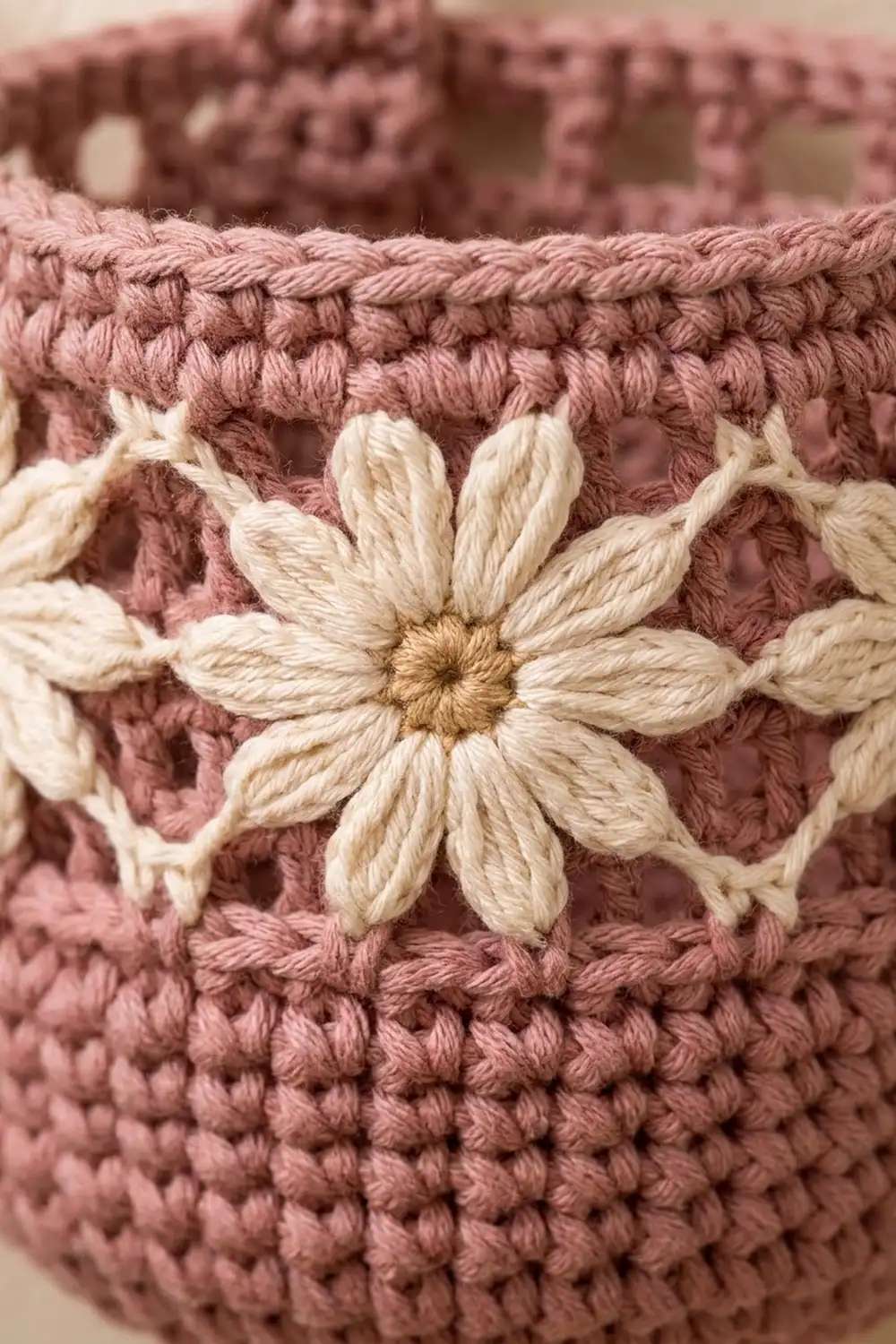
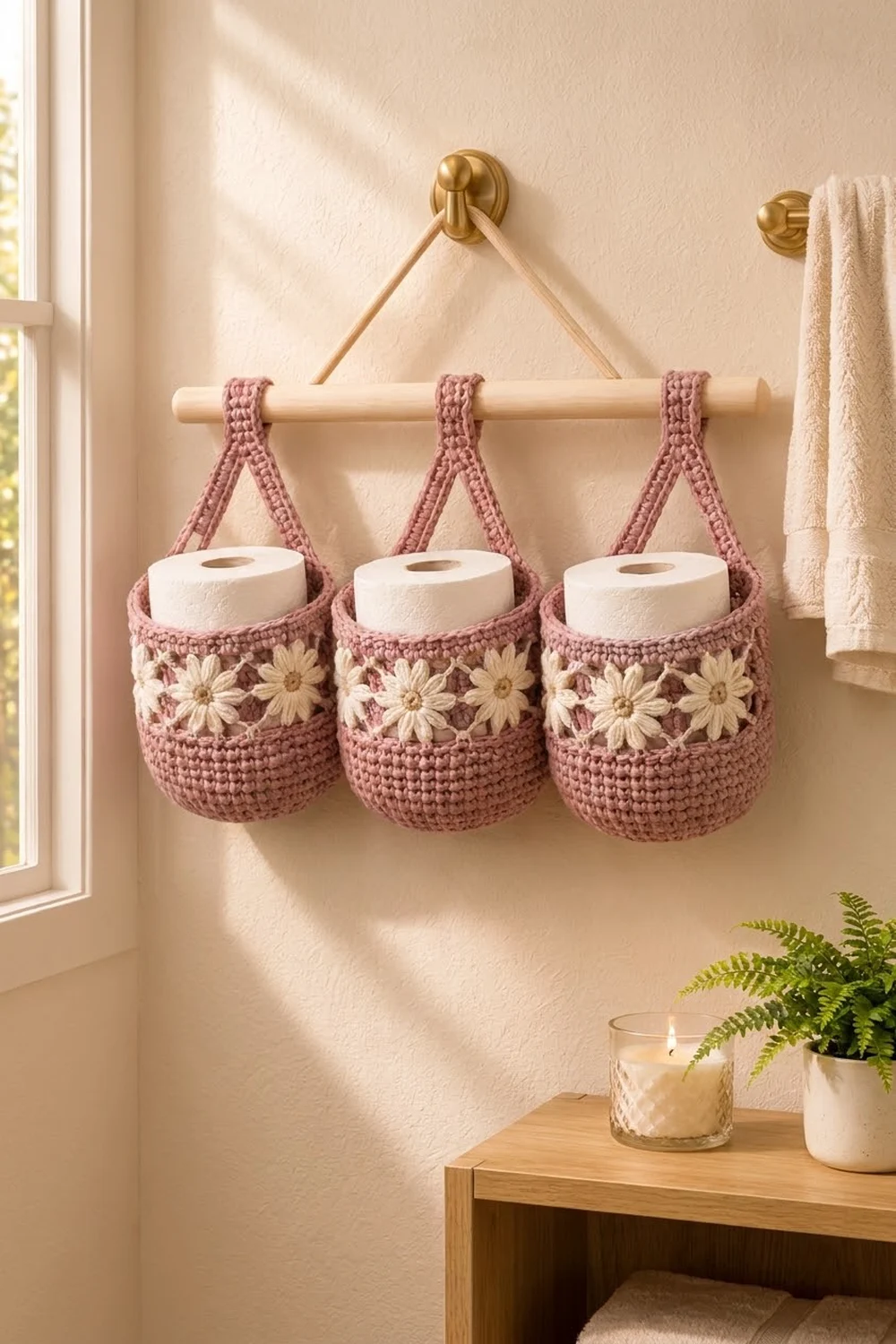
This hanging toilet paper holder has three rounded pockets in a row, one spare roll in each. They hang from a simple wooden dowel. The dense dusty-rose fabric keeps its shape, and the open mesh band gives the piece a light, airy look. Cream daisies with warm tan centers sit on top of the mesh.
The style is soft cottage-bathroom. Use a matte cotton or cotton-blend yarn in three colors: dusty rose for the pockets and straps, cream for the petals and lattice, and tan for the flower centers.
The pattern uses US crochet terms. The finished holder measures about 15.3 in (38.9 cm) wide. Each pocket is 5.1 in (13.0 cm) across and 4 in (10.2 cm) tall from the base edge to the rim.
Here is how it’s built. Each pocket starts as a flat single crochet circle, and the sides rise from it without a turning ridge, which keeps the bottom rounded. Two mesh rounds make the band. You sew the three pockets together along their sides, add a reverse single crochet rim, then attach a V-shaped hanger and the daisy appliqués to each pocket.
Finished Size and Construction
- Finished size: 15.3 in (38.9 cm) wide × about 4 in (10.2 cm) tall at the pocket sides
- Skill level: Intermediate
- Terminology: US
- Yarn weight: Bulky (#5) for the pockets; worsted (#4) for the appliqués
- Hooks: 6.0 mm (J-10) and 4.0 mm (G-6)
- Number of pieces: 3 pockets, 3 V-hangers, 9 daisies, 6 lattice chains
- Layout: 3 pockets in a single row (3 × 1)
- Piece size: each pocket is 5.1 in (13.0 cm) across, with a circumference of 16 in (40.6 cm)
- Size before border: 3.6 in (9.1 cm) side height
- Border depth: 0.4 in (1.0 cm)
Materials
Choose a firm bulky cotton or cotton blend. Soft acrylic will sag once a roll is inside.
- Dusty rose, bulky (#5): 250 g, about 350 m
- Cream, worsted (#4) cotton: 50 g, about 95 m
- Tan, worsted (#4) cotton: 5 g, about 10 m
These quantities include a margin of about 15–20% for your gauge swatch and seams.
Tools:
– 6.0 mm (J-10) and 4.0 mm (G-6) hooks
– Wooden dowel, 0.75 in (1.9 cm) thick and 18 in (45.7 cm) long
– Cord, 24 in (61.0 cm) long, for hanging
– Locking stitch markers
– Tapestry needle
– Scissors
– Pins
– Tape measure
Abbreviations (US Terms)
- ch: chain
- sl st: slip stitch
- sc: single crochet
- hdc: half double crochet
- dc: double crochet
- inc: 2 sc in the same stitch
- sc2tog: single crochet 2 together
- sp: space
- st(s): stitch(es)
- rnd: round
Special stitch: reverse sc (crab stitch). Work this from left to right. Insert the hook into the next stitch to the right, yarn over, pull up a loop, then yarn over and draw through both loops.
Gauge and Checkpoints
Gauge: 12 sc and 13 rnds = 4 in (10.2 cm) with the 6.0 mm hook.
Make one full pocket before you start the others, and check it at each stage:
- After Rnd 8: the base measures 5.1 in (13.0 cm) across while lying flat.
- After Rnd 13: the sides measure 1.5 in (3.8 cm) from the base edge.
- After Rnd 15: the mesh band measures 1.2 in (3.0 cm).
- After Rnd 18: the side height is 3.6 in (9.1 cm).
If the base is wider than 5.3 in (13.5 cm), go down half a hook size. If it is narrower than 4.9 in (12.4 cm), go up half a size. A standard roll, about 4.5 in (11.4 cm) across, should slide in with light ease.
Pocket (make 3)
Use dusty rose and the 6.0 mm hook. Work in continuous joined rounds, and don’t turn.
Rnd 1: Magic ring, ch 1, 6 sc in the ring, sl st to the first sc. (6)
Rnd 2: Ch 1, inc in each st around, join. (12)
Rnd 3: Ch 1, sc 1, inc; repeat around, join. (18)
Rnd 4: Ch 1, sc 2, inc; repeat around, join. (24)
Rnd 5: Ch 1, sc 3, inc; repeat around, join. (30)
Rnd 6: Ch 1, sc 4, inc; repeat around, join. (36)
Rnd 7: Ch 1, sc 5, inc; repeat around, join. (42)
Rnd 8: Ch 1, sc 6, inc; repeat around, join. (48)
The base is now complete. Check it against the first checkpoint.
Rnds 9–13: Ch 1, sc in each st around, join. (48)
Work these rounds through both loops. With no increases, the fabric curves upward naturally and forms the rounded bottom.
Rnd 14 (mesh): Ch 4 (counts as dc + ch 1), skip the next st. Dc in the next st, ch 1, skip the next st; repeat 22 more times. Sl st to the 3rd ch of the beginning ch-4. (24 dc + 24 ch-1 sps = 48)
Rnd 15 (mesh): Sl st into the first ch-1 sp, ch 4 (counts as dc + ch 1). Dc in the next dc, ch 1; repeat 22 more times, join. (24 dc + 24 ch-1 sps = 48)
The dc stack directly above the dc of Rnd 14, so the openings form square windows.
Rnd 16 (conversion): Ch 1, sc in each dc and in each ch-1 sp around, join. (24 sc into dc + 24 sc into sps = 48)
Rnds 17–18: Ch 1, sc in each st around, join. (48)
Fasten off and weave in the ends.
Mark the rim. Number the Rnd 18 stitches from 1 to 48, with stitches 1–24 as the front half and 25–48 as the back half. Place a marker at stitch 1 and another at stitch 25. These two points sit on the sides, where neighboring pockets meet.
Make All Pieces
Work all pieces before you assemble:
- Dusty rose: 3 pockets and 3 V-hangers
- Cream: 9 daisy petal rounds and 6 lattice chains
- Tan: 9 daisy centers
Layout, seen from the front:
[ Pocket L ] [ Pocket C ] [ Pocket R ]
     ^            ^            ^
  hanger       hanger       hanger
Joining
Place the pockets side by side with their front halves facing you.
- Line up stitch 25 of Pocket L with stitch 1 of Pocket C.
- With dusty rose and the tapestry needle, whipstitch that single column together from Rnd 9 up to Rnd 18. Sew one stitch to one stitch, row for row. In mesh Rnds 14–15, sew around the dc posts.
- Repeat to join stitch 25 of Pocket C to stitch 1 of Pocket R.
The seam doesn’t use or add any stitches, so every rim still has 48 stitches. Keep the tension snug enough that the seam doesn’t gap but loose enough that the pockets stay round.
Checkpoint: The joined set measures 15.3 in (38.9 cm) across the fronts, and each seam is 3.6 in (9.1 cm) long.
Border
The border gauge matches the body: 12 reverse sc = 4 in (10.2 cm). Work the border on each rim separately.
Rnd B1: Join dusty rose at stitch 1. Ch 1, sc in each st around, join. That is 24 sts on the front half and 24 on the back half. (48)
Rnd B2: Ch 1, reverse sc in each st around, join. (48)
Fasten off.
Totals across the joined set:
– Front edge: 3 pockets × 24 = 72 sts
– Back edge: 3 pockets × 24 = 72 sts
Why the math works: Reverse sc is worked one-for-one, so the 48-stitch rim keeps its 16 in (40.6 cm) circumference without ruffling or pulling in. No stitches are added at the seams, and the rolled edge adds 0.4 in (1.0 cm), bringing each side to 4 in (10.2 cm).
V-Hanger (make 3)
Use dusty rose and the 6.0 mm hook.
Leg A: Ch 5. Sc in the 2nd ch from the hook and in each ch across. (4)
Rows 2–14: Ch 1, turn, sc 4. (4)
Fasten off. The leg measures 4.3 in (10.9 cm).
Leg B: Work as for Leg A, but don’t fasten off.
Row 15: Ch 1, turn, sc 4 across Leg B, then sc 4 across the last row of Leg A. (8)
Row 16 (conversion): Ch 1, turn, sc2tog 4 times. (4)
Rows 17–28: Ch 1, turn, sc 4. (4)
Fasten off, leaving a 12 in (30.5 cm) tail. Rows 17–28 measure 3.7 in (9.4 cm), and the strap is 1.3 in (3.3 cm) wide.
Attach:
1. Fold Rows 17–28 back and sew Row 28 to the back of Row 16 to make the loop. The loop fits a 0.75 in (1.9 cm) dowel easily.
2. Sew the bottom of Leg A inside the back rim over stitches 27–30. Sew Leg B over stitches 43–46. Overlap each leg by 0.6 in (1.5 cm).
Along the back half, that leaves 2 + 4 + 12 + 4 + 2 = 24 stitches, with a 4 in (10.2 cm) gap between the legs.
Daisy (make 9)
Use the 4.0 mm hook.
Center: With tan, make a magic ring, ch 1, 10 sc in the ring, sl st to the first sc. (10) Fasten off.
Petals: Join cream in any sc. Ch 4, sc in the 2nd ch from the hook, hdc in the next ch, dc in the next ch, sl st in the same center sc, sl st in the next center sc; repeat 9 more times. (10 petals)
The finished daisy is 2 in (5.1 cm) across.
Lattice Chain (make 6)
With cream and the 4.0 mm hook, chain until the chain measures 9 in (22.9 cm), about 36 ch. Fasten off.
Placing the Appliqués
Number the front mesh windows 1–12, counting from stitch 1. Rnd 14 is the lower row of windows and Rnd 15 is the upper row.
- Chain A: Pin it across the upper row at window 2, the lower row at window 4, then upper 6, lower 8, upper 10, lower 12.
- Chain B: Pin it as the mirror image: lower 2, upper 4, lower 6, upper 8, lower 10, upper 12.
- Tack each turning point with cream yarn. The two chains cross to form diamonds.
- Center the daisies over windows 2, 6, and 10, which puts them at stitch positions 4, 12, and 20.
- Sew each daisy around its tan center, then tack each petal tip.
Final Blocking
- Mist the pockets lightly.
- Stuff each pocket with a toilet roll or a folded towel.
- Shape the rims round, and push the bottoms into a smooth curve.
- Pat the daisy petals flat, and pin the tips if they curl.
- Let everything dry completely.
- Slide the dowel through the three loops, and tie the cord to both ends of the dowel for hanging.
Final Quality-Control Checklist
- Each rim has 48 stitches: 24 front and 24 back.
- Each pocket is 5.1 in (13.0 cm) across and 4 in (10.2 cm) tall.
- Each seam runs from Rnd 9 to Rnd 18.
- The mesh windows are square and line up vertically.
- The hanger legs sit evenly spaced, 12 stitches apart.
- All 9 daisies are centered over windows 2, 6, and 10.
- All ends are woven in securely.
Troubleshooting
- The base cups early: Your tension is too tight. Go up half a hook size.
- The base ruffles: You have extra stitches. Recount Rnds 2–8.
- The mesh windows slant: You are moving the join point each round. Start every round in the same place.
- The pockets pull apart: The seam is too loose. Add a second pass of whipstitch.
- The rim flares: Your reverse sc is loose. Use the 5.5 mm (I-9) hook for Rnd B2.
- The hangers twist: Check that each leg was sewn on with its right side facing out.
Care
Hand wash in cool water and reshape while damp. Lay flat to dry, then re-block over rolls.
Final Notes
The measurement chain is short:
– A 48-stitch base gives a 5.1 in (13.0 cm) pocket.
– Rnds 9–18 build 3.6 in (9.1 cm) of side.
– The border brings each pocket to 4 in (10.2 cm).
– Three joined pockets span 15.3 in (38.9 cm).
Check each stage, and the three pockets will hang evenly. Happy crocheting!