
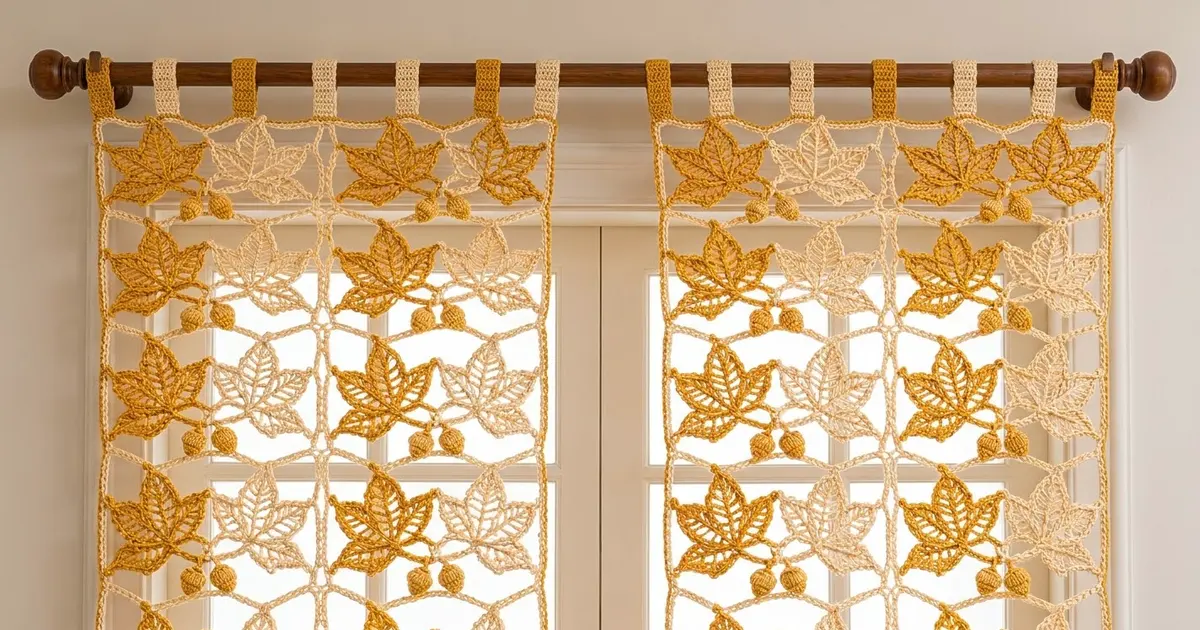
This curtain is built from lacy maple-leaf blocks. Every block holds one mustard-gold leaf and one cream leaf side by side, with two small textured acorns hanging between them. A thin cream chain-and-single-crochet frame holds each pair in an open rectangle. Once the blocks are joined, the panel reads as a light, airy mesh with alternating gold and cream leaf columns.
The palette is warm and soft: mustard gold and natural cream. It suits autumn decor, and because the mesh is open it lets the light through. The pattern uses US crochet terms.
One finished panel measures 40.8 x 72.8 inches (103.6 x 184.9 cm) before the hanging tabs. The tabs add about 3 inches (7.6 cm) of hanging loop. The photo shows two matching panels, so plan to make two.
Construction is modular. You crochet two leaves and two acorns, tack them together, and work a two-round frame around them to make a block measuring 8 x 6 inches (20.3 x 15.2 cm). Then you join 60 blocks into a grid that is 5 blocks wide and 12 tall, add a two-round border and crochet tab tops.
Finished Size and Construction
- Finished panel: 40.8 x 72.8 in (103.6 x 184.9 cm), plus tabs
- Skill level: Intermediate
- Terminology: US
- Yarn weight: DK (light worsted, #3)
- Hook: 4.0 mm (US G-6)
- Pieces per panel: 60 blocks (each made of 2 leaves + 2 acorns + frame)
- Layout: 5 blocks across x 12 blocks down
- Block size: 8 x 6 in (20.3 x 15.2 cm)
- Size before border: 40 x 72 in (101.6 x 182.9 cm)
- Border depth: 0.4 in (1.0 cm), 2 rounds of sc
Materials
Pick a smooth cotton or cotton-blend DK yarn. It shows the leaf points clearly, blocks well and doesn’t stretch much when it hangs. Avoid fuzzy yarns, because they hide the lace.
Quantities below are for two panels (120 blocks), assuming about 230 m per 100 g:
- Mustard gold: 1,200 g / 2,760 m (leaves and acorns)
- Cream: 1,800 g / 4,140 m (leaves, frames, border, tabs)
These quantities include a margin of about 10%. Buy all balls from one dye lot.
Tools:
– 4.0 mm (US G-6) hook
– Tapestry needle
– Stitch markers
– A small amount of fiberfill or yarn scraps for the acorns
– Blocking mats, rust-proof pins and a spray bottle or steamer
– Tape measure
Abbreviations (US Terms)
- ch – chain
- sl st – slip stitch
- sc – single crochet
- hdc – half double crochet
- dc – double crochet
- tr – treble crochet
- sc2tog – single crochet 2 together
- BLO / FLO – back loop only / front loop only
- MR – magic ring
- sp – space
- st(s) – stitch(es)
Tip picot: Ch 4, sl st in the 4th ch from the hook. This gives a small closed loop at the point of each lobe.
Gauge and Checkpoints
Frame gauge: 18 sc and 20 sc rows = 4 in (10.2 cm).
Make and block one complete block before you start the rest. Check it at each stage:
- Leaf Rnd 1: about 1.2 in (3.0 cm) across.
- Leaf Rnd 2: about 2.3 in (5.8 cm) across.
- Finished leaf: about 3.5 in (8.9 cm) from tip to tip.
- Acorn: about 0.9 in (2.3 cm) tall and 0.75 in (1.9 cm) wide.
- Blocked block: 8 x 6 in (20.3 x 15.2 cm).
If the block comes out bigger, go down a hook size (3.75 mm). If it’s smaller, go up (4.5 mm). The block size matters most, because every later measurement depends on it.
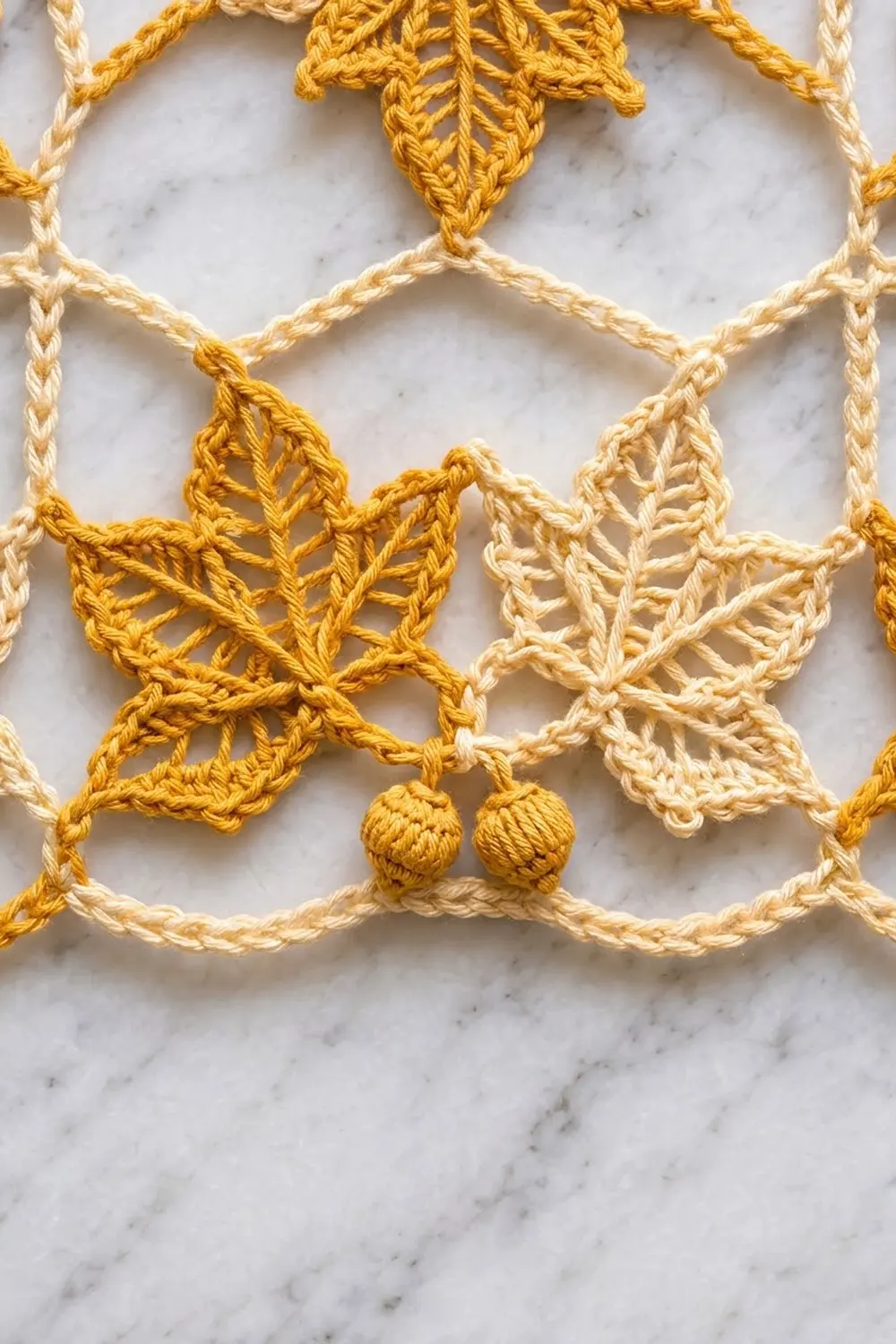
Mustard Leaf (make 1 per block)
With mustard:
Rnd 1: MR, ch 3 (counts as dc), 9 dc in ring, join with sl st to top of ch-3. (10 dc)
Rnd 2: Ch 5 (counts as dc + ch 2), *dc in next dc, ch 2; repeat from * 8 more times, join with sl st to 3rd ch of ch-5. (10 dc, 10 ch-2 sps)
The ten spokes form the open veins of the leaf.
Rnd 3 (lobes): *In next ch-2 sp work (sc, hdc, dc, tr); in next dc work (tr, tip picot, tr); in next ch-2 sp work (tr, dc, hdc, sc); sl st in next dc (notch). Repeat from * 4 more times. The last sl st lands in the joining dc. (5 lobes: 50 sts, 5 tip picots, 5 notch sl sts)
Rnd 4 (outline): Ch 1, *sc in each of next 5 sts, (sc, ch 2, sc) in tip picot, sc in each of next 5 sts, sl st in notch sl st. Repeat from * 4 more times. (60 sc, 5 ch-2 tips, 5 sl sts)
This round makes the raised outline and the sharp points.
Stem: At the final notch, ch 8. Sl st in the 2nd ch from the hook and in each ch back to the leaf (7 sl sts), then sl st into the notch. Fasten off.
Hold the leaf right side up with the stem pointing down. Name the tips going clockwise from the stem: lower-left, upper-left, top, upper-right, lower-right.
Cream Leaf (make 1 per block)
Work exactly like the Mustard Leaf, using cream. Use the same tip names.
Acorns (make 2 per block)
With mustard. Work in continuous spirals and mark the first st of each round.
Rnd 1: MR, 5 sc in ring. (5)
Rnd 2: 2 sc in each st. (10)
Rnd 3: Sc in each st. (10)
Rnd 4: Sc in each st. (10)
Rnd 5 (cap): Working in BLO, sc in each st. (10)
Rnd 6: Working in BLO, sc2tog 5 times. (5)
Stuff the acorn lightly, then close it with the tail.
Cap brim: Join mustard in any free front loop of Rnd 4. Ch 1, 2 sc in each front loop around, join. (20 sc) Fasten off.
The free loops and the brim make the ridged cap shown in the photo.
Hanging cord: Join at the top of the cap, ch 6, fasten off and leave a 6 in (15.2 cm) tail.
Assembling the Leaf Pair
- Lay the mustard leaf on the left and the cream leaf on the right, right sides up.
- Overlap the lower-right tip of the mustard leaf onto the lower-left tip of the cream leaf. Tack them together with 2–3 stitches.
- Cross the two stems so their ends meet below the tacked tips. Sew the ends together.
- Sew both acorn cords to the stem junction so the acorns hang side by side about 1 in (2.5 cm) below it.
The leaf pair is now about 7 in (17.8 cm) wide.
Block Frame (make 1 per block)
With cream. Pin the leaf pair flat on your blocking mat inside an 8 x 6 in (20.3 x 15.2 cm) rectangle. This keeps the chain lengths even.
Rnd 1: Join cream with sc in the mustard top tip ch-2 sp.
– Ch 10, sc in the cream top tip.
– Ch 17, placing a marker in the 12th ch (top-right corner ch).
– Sc in the cream upper-right tip, ch 4, sc in the cream lower-right tip.
– Ch 30, placing a marker in the 15th ch (bottom-right corner ch).
– Sc in the MR center at the bottom of the right acorn, ch 2, sc in the bottom of the left acorn.
– Ch 30, placing a marker in the 16th ch (bottom-left corner ch).
– Sc in the mustard lower-left tip, ch 4, sc in the mustard upper-left tip.
– Ch 17, placing a marker in the 6th ch (top-left corner ch).
– Join with sl st to the first sc.
Stitches between corner chs:
– Top: 11 + 1 + 10 + 1 + 11 = 34
– Right: 5 + 1 + 4 + 1 + 14 = 25
– Bottom: 15 + 1 + 2 + 1 + 15 = 34
– Left: 14 + 1 + 4 + 1 + 5 = 25
Total: 34 + 25 + 34 + 25 + 4 corner chs = 122 sts.
Rnd 2 (conversion): Ch 1. Sc in each st and ch around, and work (sc, ch 2, sc) in each marked corner ch. Join.
Count: 122 sts worked 1 per st, plus 4 extra sc at the corners = 126 sc, plus 4 corner ch-2 sps.
Per side, including the sc on each side of the corner sps:
– Top and bottom: 34 + 2 = 36 sc
– Left and right: 25 + 2 = 27 sc
Check: 36 + 27 + 36 + 27 = 126. At gauge, 36 sc = 8 in (20.3 cm) and 27 sc = 6 in (15.2 cm).
Fasten off. Block each finished block to 8 x 6 in (20.3 x 15.2 cm) before joining.
Make All Pieces
For one panel, make 60 blocks:
– Mustard: 60 leaves, 120 acorns
– Cream: 60 leaves, 60 frames
For two panels, double everything: 120 blocks.
Every block is identical and faces the same way, so the leaf colors line up in alternating columns. M = mustard leaf, C = cream leaf:
Row 1:  [M C] [M C] [M C] [M C] [M C]
Row 2:  [M C] [M C] [M C] [M C] [M C]
Row 3:  [M C] [M C] [M C] [M C] [M C]
 ...    (repeat for 12 rows total)
Row 12: [M C] [M C] [M C] [M C] [M C]
Joining
Method: Hold two blocks with wrong sides together and sl st through the back loops of both pieces. Use cream.
Stitch-to-stitch logic:
– Vertical seams: Match 27 sts to 27 sts. Start in the two corner ch-2 sps held together, sl st through each matching pair of sc, and end in the opposite pair of corner sps.
– Horizontal seams: Match 36 sts to 36 sts per block, so 180 to 180 across a row.
Join the blocks into 12 rows of 5 first. Then join the rows together. Where four corners meet, sl st through all of the corner sps together so the intersection stays flat.
Tension: Keep each sl st as loose as one sc. Tight seams pull the panel in and cause puckers. Go up to a 4.5 mm hook for the seams if you need to.
Checkpoint: The joined panel should measure 40 x 72 in (101.6 x 182.9 cm). Each row of 5 blocks should measure 40 in (101.6 cm).
Border
Work the border with cream at frame gauge (18 sc = 4 in / 10.2 cm).
Starting counts:
– Top and bottom: 5 blocks x 36 sts = 180 sts
– Sides: 12 blocks x 27 sts = 324 sts
The seam corner sps are already joined. Don’t work into them, and don’t add any stitches at seams. Go straight from the last sc of one block to the first sc of the next.
Rnd 1: Join in the top-right corner ch-2 sp. Ch 1 and work (sc, ch 2, sc) in the same sp. Sc in each st across each side, and work (sc, ch 2, sc) in each of the 3 remaining outer corner sps. Join.
– Top and bottom: 180 + 2 = 182 sc
– Sides: 324 + 2 = 326 sc
– Total: 1,016 sc and 4 ch-2 sps
Rnd 2: Repeat Rnd 1, working into the Rnd 1 corner sps.
– Top and bottom: 182 + 2 = 184 sc
– Sides: 326 + 2 = 328 sc
– Total: 1,024 sc and 4 ch-2 sps
Fasten off.
Why the math works: Each round adds exactly 1 sc at each end of every side, inside the corner ch-2 sps. That’s +2 per side per round, so the corners stay square and the edges stay flat without ruffling.
Tab tops: Work across the top edge of Rnd 2 (184 sts). Set up 12 tabs of 8 sts each with 11 gaps of 8 sts: (12 x 8) + (11 x 8) = 96 + 88 = 184.
- Row 1: Join in the first top-edge sc, ch 1, sc in the same st and in each of the next 7 sts. (8 sc)
- Rows 2–30: Ch 1, turn, sc in each st across. (8 sc)
Fasten off and leave a long tail. Fold the tab to the wrong side and sew the last row to the base of the tab. Skip 8 sts and make the next tab.
Each tab is 1.8 in (4.6 cm) wide and 6 in (15.2 cm) long before folding, which gives a 3 in (7.6 cm) loop. This fits rods up to 1.5 in (3.8 cm) in diameter.
Final Blocking
- Weave in all ends securely through the solid outline stitches, not the open chains.
- Soak the panel in cool water for 15 minutes, then press the water out in a towel. Don’t wring it.
- Lay the panel flat on a clean sheet or on joined blocking mats.
- Pin the outer border to 40.8 x 72.8 in (103.6 x 184.9 cm).
- Pin each leaf tip and smooth the acorns into place.
- Let it dry completely, then hang it. The weight of the panel will even out any small waves.
Final Quality-Control Checklist
- Each block is 8 x 6 in (20.3 x 15.2 cm), with 36 / 27 sc per side.
- Every leaf has 5 sharp tips and a 7-st stem.
- The acorns hang evenly and are anchored by the frame.
- All seams are flat, with no puckers.
- Border counts are 184 / 328 sc per side.
- There are 12 tabs, evenly spaced.
- The finished panel measures 40.8 x 72.8 in (103.6 x 184.9 cm).
Troubleshooting
- Leaf cups: Rnd 2 chains are too short or tight. Loosen them, or work ch 3 instead.
- Leaf ruffles: Your tension is loose. Go down one hook size for the leaves.
- Frame bows inward: The Rnd 1 chains were pulled tight. Re-block the frame on pins.
- Wrong side counts: Recount the Rnd 1 chain segments against the totals above.
- Panel too long: Sc rows are relaxing as the panel hangs. Block it heavier, or remove one row of blocks.
- Tabs twist: Sew the folds straight and line them up with the border stitches.
Care
Hand wash in cool water with a mild detergent and dry flat. Don’t put it in the dryer, because the acorn stuffing and the lace keep their shape better when air-dried.
Final Notes
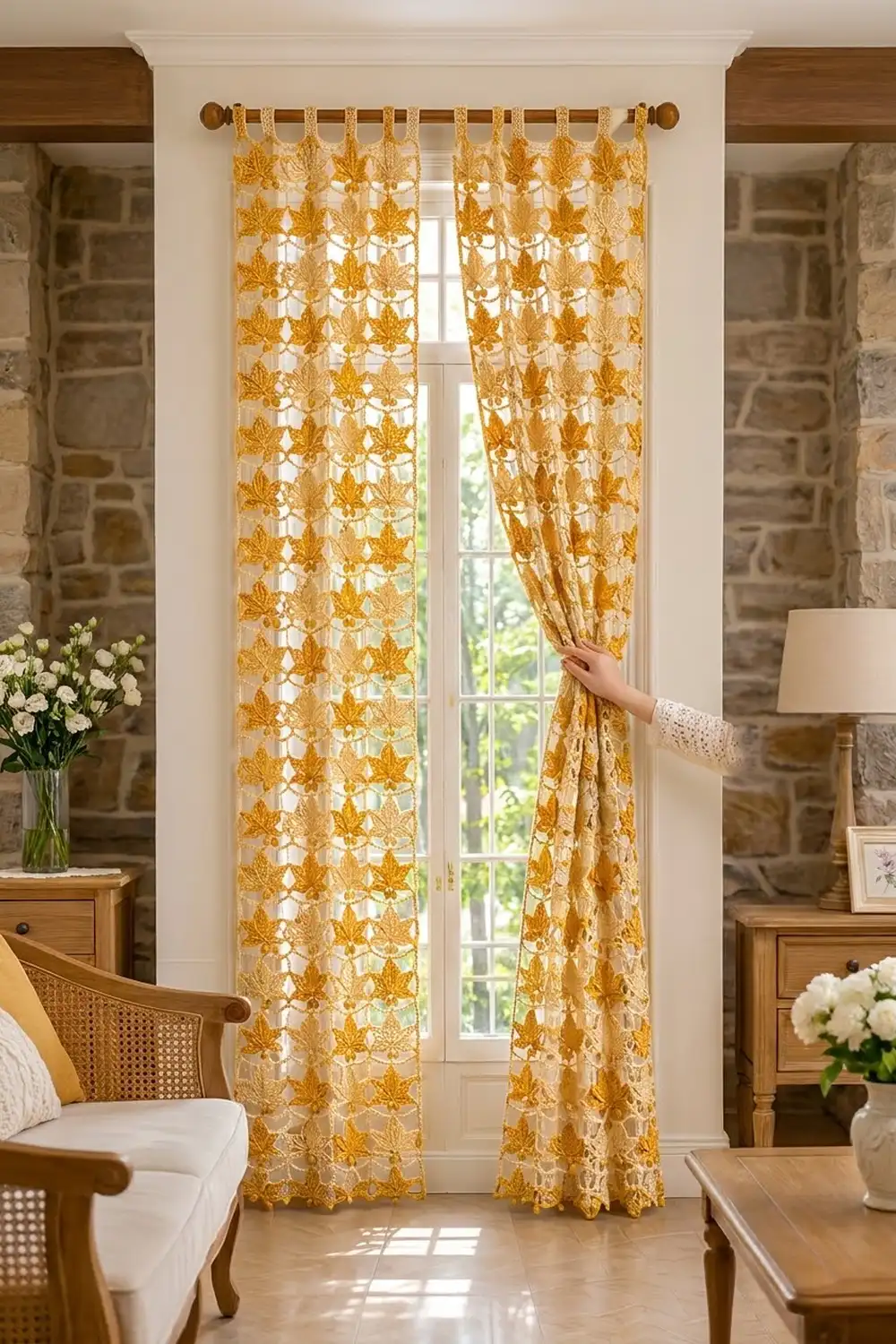
The measurement chain for this curtain is simple. A 3.5 in (8.9 cm) leaf sits inside an 8 x 6 in (20.3 x 15.2 cm) block with 36 / 27 sc per side. Sixty blocks make 40 x 72 in (101.6 x 182.9 cm), and two border rounds bring the panel to 40.8 x 72.8 in (103.6 x 184.9 cm). If you check your gauge at each step, the panel will hang straight and square.
Happy crocheting!