
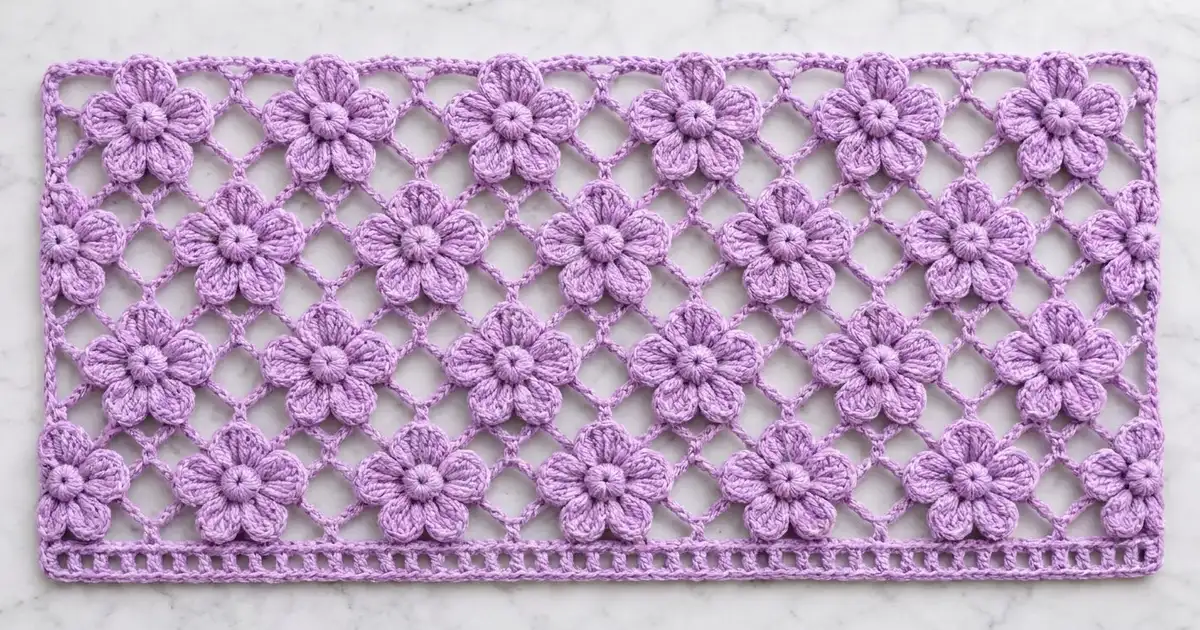
This curtain panel is made for soft light and quiet texture. A diamond chain-mesh lattice lets daylight through, and staggered rows of five-petal flowers sit on top of it, so the panel looks like a garden trellis covered in blossoms. The bottom and top edges have a firm band of double crochet and filet mesh, and a neat single crochet edge frames the whole panel.
The sample uses one color, a pale lavender cotton. With only one shade the look stays calm and the texture stands out: domed flower centers, rounded petals and open diamonds that cast pretty shadows when the sun is behind them.
The pattern uses US crochet terms. One finished panel measures 41¼ in wide x 83.9 in long (104.8 cm x 213.1 cm). For a standard window pair, make two panels.
The construction is simple and repetitive. First you crochet the base panel in one piece from the bottom up: a dc/mesh band, 161 rows of chain lattice and a matching top band. Then you make 400 small flowers, sew them onto the lattice in a staggered grid, add a two-round border and block.
Finished Size and Construction
- Finished size (one panel): 41¼ in x 83.9 in (104.8 cm x 213.1 cm)
- Skill level: Intermediate (easy stitches, large scale)
- Terminology: US
- Yarn weight: DK (light #3) cotton
- Hook: 5 mm (H-8)
- Number of pieces: 1 base panel + 400 flower appliqués
- Layout: 32 flower rows that alternate between 13 and 12 flowers
- Flower size: 2 in (5.1 cm) across
- Size before border: 40¼ in x 82.9 in (102.2 cm x 210.6 cm)
- Border depth: 0.5 in (1.3 cm) on every side
Materials
Choose a smooth, mercerized or combed DK cotton. Cotton holds the lattice open, keeps the petals crisp and washes well. Avoid fuzzy or brushed yarns, because they blur the diamonds.
- Lavender DK cotton: 1,000 g, about 2,400 m (2,625 yd) per panel. Double this for a pair.
- The flowers use about 1,300 m, and the base panel and border use about 900 m.
Tools:
- 5 mm (H-8) crochet hook
- Tapestry needle
- 20–30 locking stitch markers
- Scissors and a measuring tape
- Blocking mats, or a clean carpet covered with a sheet, plus rust-proof pins
- Spray bottle
- 14 curtain clip rings for hanging (not crocheted)
The quantities include a margin of about 10% for gauge differences, swatching and weaving in ends.
Abbreviations (US Terms)
- ch – chain
- sl st – slip stitch
- sc – single crochet
- hdc – half double crochet
- dc – double crochet
- sp(s) – space(s)
- st(s) – stitch(es)
- BLO – back loop only
- RS – right side
- arc – ch-5 loop in the lattice
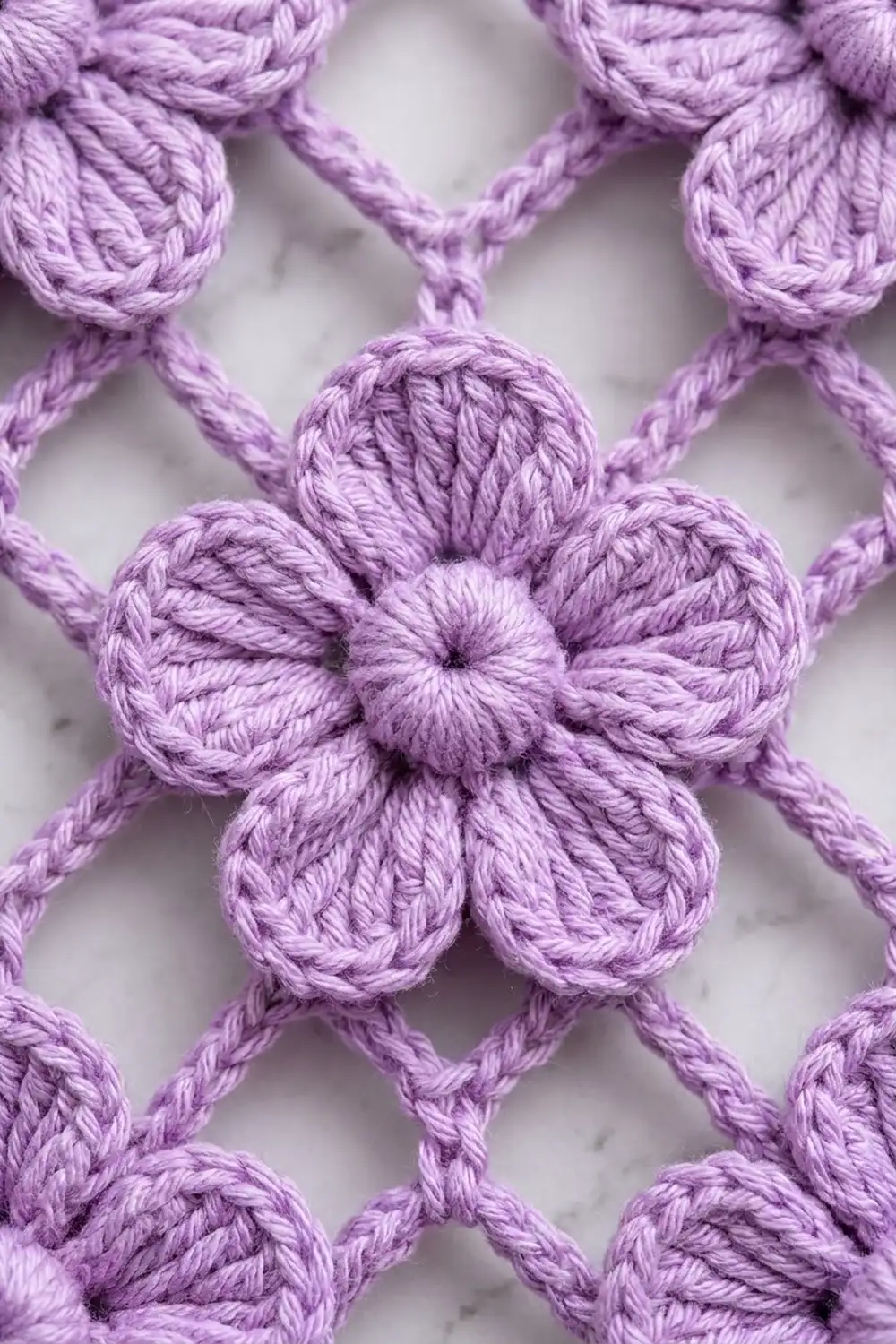
Special stitch – Petal: In one ch-3 sp, work (sc, hdc, 5 dc, hdc, sc). Each petal has 9 sts.
Gauge and Checkpoints
Gauge matters here because small errors add up over 161 rows.
- Double crochet: 16 dc = 4 in (10.2 cm), and 10 dc rows = 4 in (10.2 cm). Each dc row is 0.4 in (1.0 cm).
- Lattice: each arc spans 4 sts, which is 1 in (2.5 cm). 8 lattice rows = 4 in (10.2 cm), so each lattice row is 0.5 in (1.3 cm) after blocking.
- Flower: 2 in (5.1 cm) across, from one petal tip to the opposite petal edge.
Test piece first: Ch 39. Work Rows 1–3 of the panel on 37 sts, then Row 4 and 7 more lattice rows (9 arcs wide). Make one flower as well. Block both pieces before you measure.
- Swatch width: 9¼ in (23.5 cm).
- Bottom band (3 rows): 1.2 in (3.0 cm).
- 8 lattice rows: 4 in (10.2 cm).
If your swatch is too big, go down 0.5 mm. If it’s too small, go up 0.5 mm. If only the lattice is off, change your chain tension rather than your hook, because loose chains make tall diamonds.
Checkpoints on the real panel:
- After Row 3: 40¼ in (102.2 cm) wide, 1.2 in (3.0 cm) tall.
- After Row 23 (20 lattice rows): lattice section is 10 in (25.4 cm) tall.
- After Row 164: 81.7 in (207.5 cm) total height.
- After Row 167: 82.9 in (210.6 cm) total height.
Base Panel
Work back and forth in rows. Turning chains count as a stitch unless stated otherwise.
Bottom Band
Foundation: Ch 163.
Row 1: Dc in 4th ch from hook (the skipped ch count as the first dc) and in each ch across, turn. (161 dc)
Row 2 (mesh): Ch 4 (counts as dc + ch 1), skip next st, dc in next st, ch 1, skip next st, dc in next st 79 times, ending in top of turning ch, turn. (81 dc, 80 ch-1 sps)
Row 3 (conversion): Ch 3, dc in next ch-1 sp, dc in next dc across, ending in 3rd ch of turning ch-4, turn. (81 dc worked 1-per-dc + 80 dc worked in sps = 161 dc)
Lattice
Row 4 (setup): Ch 1 (does not count), sc in first st, ch 5, skip 3 sts, sc in next st 40 times, working the last sc in top of turning ch, turn. (41 sc, 40 arcs)
Row 5: Ch 5 (counts as dc + ch 2), sc in first arc, ch 5, sc in next arc 39 times, ch 2, dc in last sc, turn. (40 sc, 39 full arcs, 2 half arcs)
Row 6: Ch 1, sc in first dc, ch 5, sc in next full arc 39 times, ch 5, sc in 3rd ch of turning ch-5, turn. (41 sc, 40 arcs)
The half arcs in Row 5 keep the side edges straight. The Row 6 sc sit directly above the Row 4 sc, so the lattice forms even diamonds.
Rows 7–164: Repeat Rows 5–6 another 79 times. This gives 161 lattice rows in total (Rows 4–164) and ends on a Row 6 type row. (41 sc, 40 arcs)
Top Band
Row 165 (conversion): Ch 3 (counts as dc), 3 dc in next arc, dc in next sc, 3 dc in next arc 39 times, dc in last sc, turn. (41 dc worked 1-per-sc + 120 dc worked in arcs = 161 dc)
Row 166: Work as Row 2. (81 dc, 80 ch-1 sps)
Row 167: Work as Row 3. (161 dc) Fasten off.
Height check: 3 band rows (1.2 in) + 161 lattice rows (80.5 in / 204.5 cm) + 3 band rows (1.2 in) = 82.9 in (210.6 cm).
Flower Appliqué
Rnd 1: Make a magic ring, ch 1, 10 sc in ring, sl st to first sc. Pull the ring closed, leaving a tiny hole in the center. (10 sc)
Rnd 2: Working in BLO, ch 1, sc in next st, ch 3, skip next st 5 times, sl st to first sc. (5 sc, 5 ch-3 sps) The unused front loops of Rnd 1 stand up as a raised ring, which gives the flower its domed center.
Rnd 3: Work Petal in next ch-3 sp, sl st in next sc 5 times. (5 petals = 45 sts, plus 5 sl sts) Fasten off, leaving a 12 in (30.5 cm) tail for sewing.
The flower should measure 2 in (5.1 cm) across. Weave in only the starting tail; you’ll use the other tail to sew.
Make All Flowers
You need 400 flowers per panel, all in lavender (800 for a pair). Make them in batches of 25 and compare each batch with your first flower, so the size stays the same.
Each flower is centered over one lattice sc. There are 32 flower rows, and the layout is symmetric, so you can count sc from either edge.
- Even flower rows (lattice Rows 6, 16, 26 … 156): 16 rows x 13 flowers = 208. Center them on sc #3, 6, 9 … 39 (of 41).
- Odd flower rows (lattice Rows 11, 21, 31 … 161): 16 rows x 12 flowers = 192. Center them on sc #4, 7, 10 … 37 (of 40, not counting the end dc).
Within a row, the flowers are 3 in (7.6 cm) apart. Neighboring flower rows are 5 lattice rows, or 2.5 in (6.4 cm), apart and offset by half a repeat.
Layout grid for the bottom of the panel (F = flower, · = open lattice):
Row 21:  · · · F · · F · · F · · F ...  (12)
Row 16:  · · F · · F · · F · · F · ...  (13)
Row 11:  · · · F · · F · · F · · F ...  (12)
Row 6:   · · F · · F · · F · · F · ...  (13)
Attaching the Flowers
First block the base panel lightly (see Final Blocking) so the diamonds are even, then lay it flat.
- Put a marker on every target sc in one flower row.
- Center a flower over a marked sc, RS up.
- Using the tail, stitch through the center ring and around the lattice sc 2–3 times.
- Tack each petal tip to the nearest lattice chain with one small stitch.
- Run the tail under the stitches on the back and fasten off.
Each flower is attached at 6 points: the center and the 5 petal tips. Keep your tension relaxed. The tacking should hold the flower flat without pulling the diamonds together; if the lattice puckers, your stitches are too tight.
Size checkpoint: After every 4 flower rows, measure the width across those rows. It should still be 40¼ in (102.2 cm).
Border
Border gauge: 4 sc = 1 in (2.5 cm) along every edge. This matches the dc gauge (4 sts per inch) and the lattice rows (2 sc per 0.5 in row).
Each corner st gets 2 sc, and each of those sc counts toward the side it sits on.
Rnd 1: With RS facing, join the yarn in the top right corner st. Ch 1, (sc, ch 2, sc) in the corner st, sc in each st across the top to the next corner, then (sc, ch 2, sc) in that corner st. Down the side, work 2 sc in the end of each of Rows 166 and 165, 2 sc in the end of each lattice row (Rows 164–4), and 2 sc in the end of each of Rows 3 and 2. Work the bottom corner, the bottom edge and the second side the same way. Sl st to first sc.
- Top and bottom: 161 sc each (159 sts between the corners + 1 corner sc at each end)
- Each side: 332 sc (1 corner sc + 4 + 322 + 4 + 1 corner sc)
- Total: 2 x 161 + 2 x 332 = 986 sc, plus 4 ch-2 corner sps
Rnd 2: Ch 1, sc in each sc, and work (sc, ch 2, sc) in each corner sp. Sl st to first sc. Fasten off.
- Top and bottom: 163 sc each
- Each side: 334 sc
- Total: 2 x 163 + 2 x 334 = 994 sc (986 + 8)
Why the math works: 161 sc at 4 per inch is 40¼ in, which is exactly the panel width. Along the sides, 332 sc at 4 per inch is 83 in. That’s within a tenth of an inch of the 82.9 in panel, a difference blocking easily absorbs. The two sc rounds add 0.5 in (1.3 cm) on each side, so the panel finishes at 41¼ in x 83.9 in (104.8 cm x 213.1 cm).
Final Blocking
- Soak the finished panel in cool water, then press the water out gently. Don’t wring it.
- Roll it in towels to remove excess moisture.
- Lay it flat on mats or on a sheet-covered floor.
- Pin the four corners so the panel measures 41¼ in x 83.9 in (104.8 cm x 213.1 cm).
- Pin the sides every 4–6 in (10.2–15.2 cm), keeping the edges straight.
- Nudge the diamonds square with your fingers and pin the lattice rows level.
- Shape each flower: press the petals flat and lift the center.
- Let it dry completely, for at least 24 hours, before you remove the pins.
Final Quality-Control Checklist
- The width is 41¼ in (104.8 cm) at the bottom, middle and top.
- The length is 83.9 in (213.1 cm) on both sides.
- All 400 flowers are attached: 16 rows of 13 and 16 rows of 12.
- Every flower is tacked at its center and at all 5 petal tips.
- There are no puckers around the flowers.
- The corners are square and lie flat.
- All ends are woven in securely on the back.
Troubleshooting
- Diamonds too tall: your ch-5 arcs are loose. Chain more firmly and check the swatch again.
- Panel narrows as you go: you missed the half arcs on Row 5 type rows. Every odd lattice row should have 40 sc.
- Edges wavy: you skipped or doubled stitches at the turning chains. Every Row 6 type row should have 41 sc.
- Flowers cup: Rnd 3 is too tight. Go up 0.5 mm for the flowers only.
- Flower centers flat: make sure you worked Rnd 2 in BLO.
- Border ruffles: your sc gauge is looser than 4 per inch. Go down 0.5 mm for the border only.
- Border pulls in: go up 0.5 mm for the border, or relax your tension.
Care
Hand wash, or machine wash cold on a gentle cycle inside a mesh laundry bag. Lay flat to dry and re-pin if needed, and don’t hang the panel while it’s wet, because the weight will stretch the lattice.

Final Notes
Every measurement in this pattern depends on the one before it. Your swatch confirms 4 sts and 2 lattice rows per inch. That gives a band 40¼ in (102.2 cm) wide, 80.5 in (204.5 cm) of lattice and a height of 82.9 in (210.6 cm) before the border. The 2 in (5.1 cm) flowers sit 3 in (7.6 cm) apart, and the two-round border brings the panel to 41¼ in x 83.9 in (104.8 cm x 213.1 cm). If you check each step as you go, the panel will hang straight and even.
Happy crocheting!