
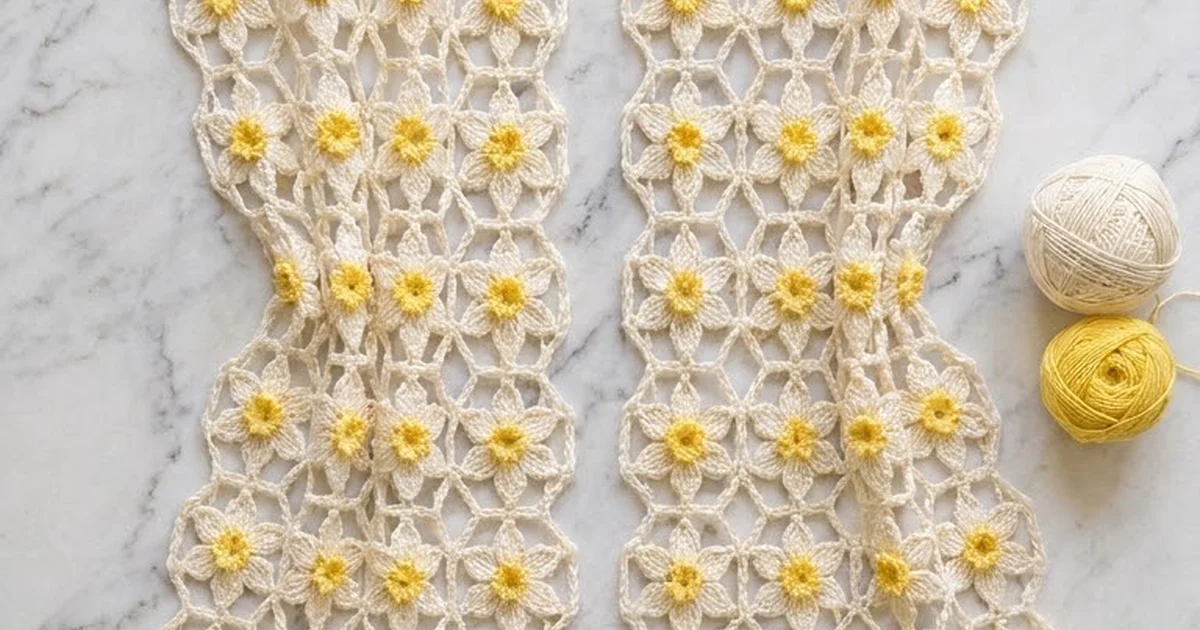
The Daffodil Window Curtain turns a sunny window into a spring garden. Each motif is a cream six-petal flower with a ruffled butter-yellow trumpet. An open octagonal frame surrounds the flower, and the gaps between petals and between motifs let the light through.
The palette has two colors: soft cream for the petals, frames, seams, border, and tabs, and warm butter yellow for the daffodil centers. The style is light and airy, a little vintage, and suits a cottage kitchen, a sunroom, or a bedroom window.
This pattern uses US crochet terms. Each blocked panel measures 40 x 79 in (101.6 x 200.7 cm) before the tabs. The folded tabs add about 2 in (5.1 cm) above the top edge. The pattern makes a matching pair of panels.
Construction is simple and repetitive. You work 72 octagon motifs per panel in the round, block them, and join them in a 6 x 12 grid with flat slip-stitch seams. Two rounds of single crochet border each panel, and six hanging tabs finish the top edge.
Finished Size and Construction
- Finished panel size: 40 x 79 in (101.6 x 200.7 cm), plus tabs
- Skill level: Intermediate
- Terminology: US
- Yarn weight: DK (light #3)
- Hook: 4.0 mm (US G-6)
- Number of pieces: 144 motifs total (72 per panel), 2 panels
- Layout per panel: 6 motifs wide x 12 motifs tall
- Motif size: 6.5 in (16.5 cm) flat side to flat side, blocked
- Panel size before border: 39 x 78 in (99.1 x 198.1 cm)
- Border depth: 0.5 in (1.3 cm), 2 rounds
Materials
Choose a smooth DK cotton or cotton blend with about 230 m per 100 g. Cotton holds the petal shapes, blocks crisply, and washes well, which matters for a curtain in the sun. Avoid fuzzy yarn, because it hides the open frame.
- Color A (cream): 1,900 g, about 4,370 m
- Color B (butter yellow): 200 g, about 460 m
Quantities cover both panels and include a margin of about 10%.
Tools:
- 4.0 mm (US G-6) crochet hook
- Tapestry needle
- Scissors
- Stitch markers
- Rust-proof pins and a large blocking surface
- Spray bottle
- Measuring tape
Abbreviations (US Terms)
- ch chain
- sl st slip stitch
- sc single crochet
- hdc half double crochet
- dc double crochet
- tr treble crochet
- sc2tog single crochet 2 together
- sc3tog single crochet 3 together
- FLO / BLO front loop only / back loop only
- sp space
- st(s) stitch(es)
- RS / WS right side / wrong side
Special stitch – Petal: Ch 11. Side A: sc in 2nd ch from hook, hdc in next ch, dc in next 2 ch, tr in next 2 ch, dc in next 2 ch, hdc in next ch, sc in last ch (10 sts). Sl st in next sc of Round 3. Side B: working into the free loops on the other side of the same chain, sc in first ch, hdc in next ch, dc in next 2 ch, tr in next 2 ch, dc in next 2 ch, hdc in next ch, sc in next ch (10 sts). Tip: (sc, ch 2, sc) in the skipped tip ch. Vein: sl st down the center of the petal, inserting the hook between the paired Side A and Side B sts, 10 times, ending at the base.
The stitches on both sides lean away from the center line, which gives each petal its herringbone texture and a raised center vein.
Gauge and Checkpoints
Gauge: 18 sc = 4 in (10.2 cm).
Make one full motif and block it before you start production. The motif is your real gauge swatch.
- After Round 2: yellow trumpet about 1.5 in (3.8 cm) across
- After Round 3: cream ring about 1.75 in (4.4 cm) across
- After Round 4: petals about 2.3 in (5.8 cm) long and 1.4 in (3.6 cm) wide, about 5.5 in (14.0 cm) tip to tip
- After Round 6 (blocked): 6.5 in (16.5 cm) flat side to flat side, each side about 2.7 in (6.9 cm)
Anything from 6.25 to 6.75 in (15.9 to 17.1 cm) works. Make every motif with the same hook and tension.
Motif too big: change to a 3.75 mm hook, or shorten the Round 5 chains by working them more firmly.
Motif too small: change to a 4.5 mm hook. If only the frame is tight, loosen your Round 5 chains.
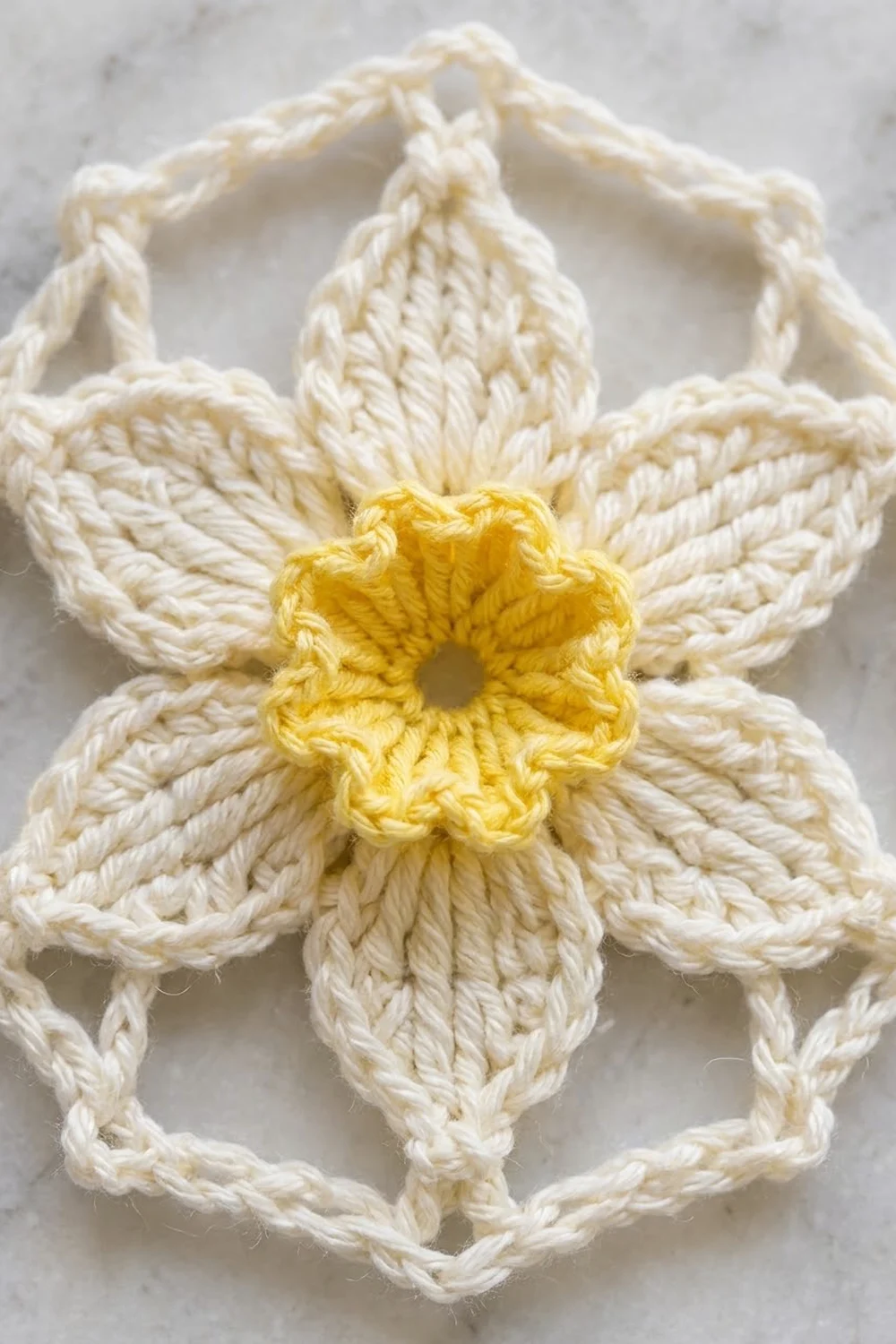
Daffodil Motif (Make 144)
Round 1 (Color B)
Make a magic ring. Ch 1, 12 sc in ring. Pull the ring closed, but leave a hole about 1/4 in (0.6 cm) wide at the center. Sl st to first sc. (12 sts)
Round 2 – Trumpet Ruffle (Color B)
Working in FLO: ch 2 (does not count), (hdc, dc, hdc) in same st, (hdc, dc, hdc) in FLO of each remaining st around. Sl st to first hdc. (36 sts: 12 shells)
Fasten off. Working in front loops makes the shells stand up from the base to form the trumpet. The free back loops of Round 1 stay available.
Round 3 (Color A)
Join Color A in the BLO of any Round 1 st, behind the trumpet. Ch 1, 2 sc in BLO of each st around. Sl st to first sc. (24 sts)
Round 4 – Petals (Color A)
Sl st in next sc, work Petal, sl st in next 2 sc; repeat from * 5 more times. (6 petals)*
Each petal uses 4 sts of Round 3. Your last sl st lands in the first sc of Round 3. Each petal has 20 side sts, plus a tip of (sc, ch 2, sc). Fasten off.
Round 5 – Frame Chains (Color A)
Join Color A in the tip ch-2 sp of any petal. Sc in tip ch-2 sp, ch 15; repeat from * 5 more times. Sl st to first sc. (96 sts: 6 sc + 90 ch)*
Keep the chains relaxed. Each ch-15 should sag slightly between tips.
Round 6 – Octagon Frame (Color A)
Ch 1. Sc in the first sc and in each of the next 5 ch (6 sc). Ch 2. Sc in each of the next 12 sts, ch 2; repeat from * 6 more times. Sc in the last 6 sts. Sl st to first sc. (96 sc + 8 corner ch-2 sps)*
Work every sc into a chain or sc, not around the loop, so the outline stays even. Each side has 12 sc. The ch-2 corners are spaces, not stitches. With this start, a petal tip sits at the center of the top side, and the opposite petal tip sits at the center of the bottom side. The left and right sides sit between petals.
Fasten off and weave in the ends. Block each motif to a 6.5 in (16.5 cm) octagon with its petal tips pointing straight up and down. Let it dry.
Make All Pieces
- Color B: Rounds 1–2 on all 144 motifs
- Color A: Rounds 3–6 on all 144 motifs, plus all seams, borders, and tabs
Lay out 72 motifs per panel, with petal tips vertical:
Row  1:  M  M  M  M  M  M
Row  2:  M  M  M  M  M  M
  ...    (rows 3–11 identical)
Row 12:  M  M  M  M  M  M
Every motif sits square to its neighbors. The top and bottom sides join to the motifs above and below, and the left and right sides join to the motifs beside it. The four diagonal sides of each motif stay free, so a small open diamond forms wherever four motifs meet.
Joining
Method: flat slip-stitch seam in Color A.
Hold two neighboring motifs with WS together and the shared sides aligned. Sl st through both corner ch-2 sps at the start of the side. Then sl st through the inner loops of each matching pair of sc, 12 times. End with a sl st through both corner ch-2 sps at the end. That makes 14 sl sts per seam.
The join is stitch to stitch: sc 1 meets sc 1, and sc 12 meets sc 12. Never skip or double a stitch.
Join each horizontal row of 6 motifs first, with 5 seams per row. Then join the rows together with 6 separate seams between each pair of rows. Because the diamonds separate the seams, fasten off after each one and leave 6 in (15.2 cm) tails to weave in. Each panel has 126 seams.
Tension: match your sl st height to your sc. If seams pucker, go up to a 4.5 mm hook for joining only.
Checkpoint: a joined panel measures 39 x 78 in (99.1 x 198.1 cm), flat side to flat side, with 6.5 in (16.5 cm) per motif.
Border
Border gauge: same as the motifs, 18 sc = 4 in (10.2 cm).
The panel outline zigzags. It has flat outer sides, V-shaped notches between edge motifs, and a cut corner on each corner motif. Two terms are used below:
- Convex corner: any exposed motif ch-2 corner sp
- Valley: the bottom of a notch, where two joined corner sps meet
Round 1
Join Color A in any exposed side. Ch 1. Sc in each sc of every exposed side, (sc, ch 2, sc) in each convex corner, and sc2tog in each valley, inserting the hook once into each of the two joined corner sps. Sl st to first sc.
Per edge:
- Bottom edge: 6 flat sides + 10 notch diagonals + 2 cut corners = 18 sides x 12 = 216 sc. Add 12 convex corners (24 sc) and 5 valleys (5 sts) for 245 sts.
- Top edge: the same, 245 sts.
- Left edge: 12 flat sides + 22 notch diagonals = 34 sides x 12 = 408 sc. Add 24 convex corners (48 sc) and 11 valleys (11 sts) for 467 sts.
- Right edge: the same, 467 sts.
Round 1 total: 1,424 sts + 72 ch-2 sps.
Round 2
Ch 1. Sc in each st, (sc, ch 2, sc) in each ch-2 sp, and sc3tog over each valley (st before, valley st, st after). Sl st to first sc.
- Bottom and top edges: 245 + 24 − 10 = 259 sts each
- Left and right edges: 467 + 48 − 22 = 493 sts each
Round 2 total: 1,504 sts + 72 ch-2 sps.
Why the math works: every Round 1 sc sits on exactly one motif sc, and no stitches are added at the seams. The 104 exposed sides x 12 = 1,248 sc. Adding 2 sc at each convex corner lets those corners spread, and the decreases at the valleys stop the notches from flaring. The zigzag stays crisp, and the panel stays flat.
Hanging Tabs (Make 6 per panel)
On Round 2, find the 12 sc above the top flat side of each top-row motif. Skip the first 2 and join Color A in the 3rd.
- Row 1: ch 1, sc in the next 8 sts, turn. (8 sts)
- Rows 2–20: ch 1, sc in each st, turn. (8 sts)
Each tab is about 1.8 in (4.6 cm) wide and 4.5 in (11.4 cm) long. Fold it to the WS and sew the last row to the back of Round 1. The folded loop rises about 2 in (5.1 cm) above the panel.
Make the second panel the same way.
Final Blocking
- Weave in all ends along seams or frames, never across the open diamonds.
- Soak the panel in cool water for 15 minutes, then press out the water in a towel. Don’t wring it.
- Lay it flat on blocking mats or a clean sheet.
- Pin the four outer corners to 40 x 79 in (101.6 x 200.7 cm).
- Pin every convex corner and valley along the edges so the zigzag points stay sharp.
- Ease each motif square and each diamond open, then pin the petal tips if they curl.
- Mist the petals and trumpets and shape the ruffles with your fingers.
- Let the panel dry completely before you unpin it.
Final Quality-Control Checklist
- Every motif has 6 petals, 96 sc, and 8 corner ch-2 sps.
- Petal tips are vertical in every motif.
- Every seam has 14 sl sts, with matching stitches.
- Every diamond is open and even.
- Round 1 counts are 245 / 467 / 245 / 467.
- Round 2 counts are 259 / 493 / 259 / 493.
- The panel measures 40 x 79 in (101.6 x 200.7 cm).
- There are 6 tabs, evenly spaced and securely sewn.
- Both panels match in size.
Troubleshooting
Trumpet lies flat: Round 2 must be worked in FLO, and Round 3 in BLO. Steam the ruffle upward.
Petals twist: work Side B into the free loops on the other side of the chain, not into the Side A stitches.
Frame pulls the petals outward: your ch-15 loops are too tight. Rework Round 5 more loosely.
Frame is rounded, not octagonal: recount the 12 sc per side and block the corners firmly.
Seams ripple: loosen your slip stitches or use a larger hook for joining.
Edges flare at the notches: check that every valley has its sc2tog or sc3tog.
Care
Hand wash or machine wash cold on a gentle cycle in a mesh bag. Reshape the panels and dry them flat, out of direct sun.
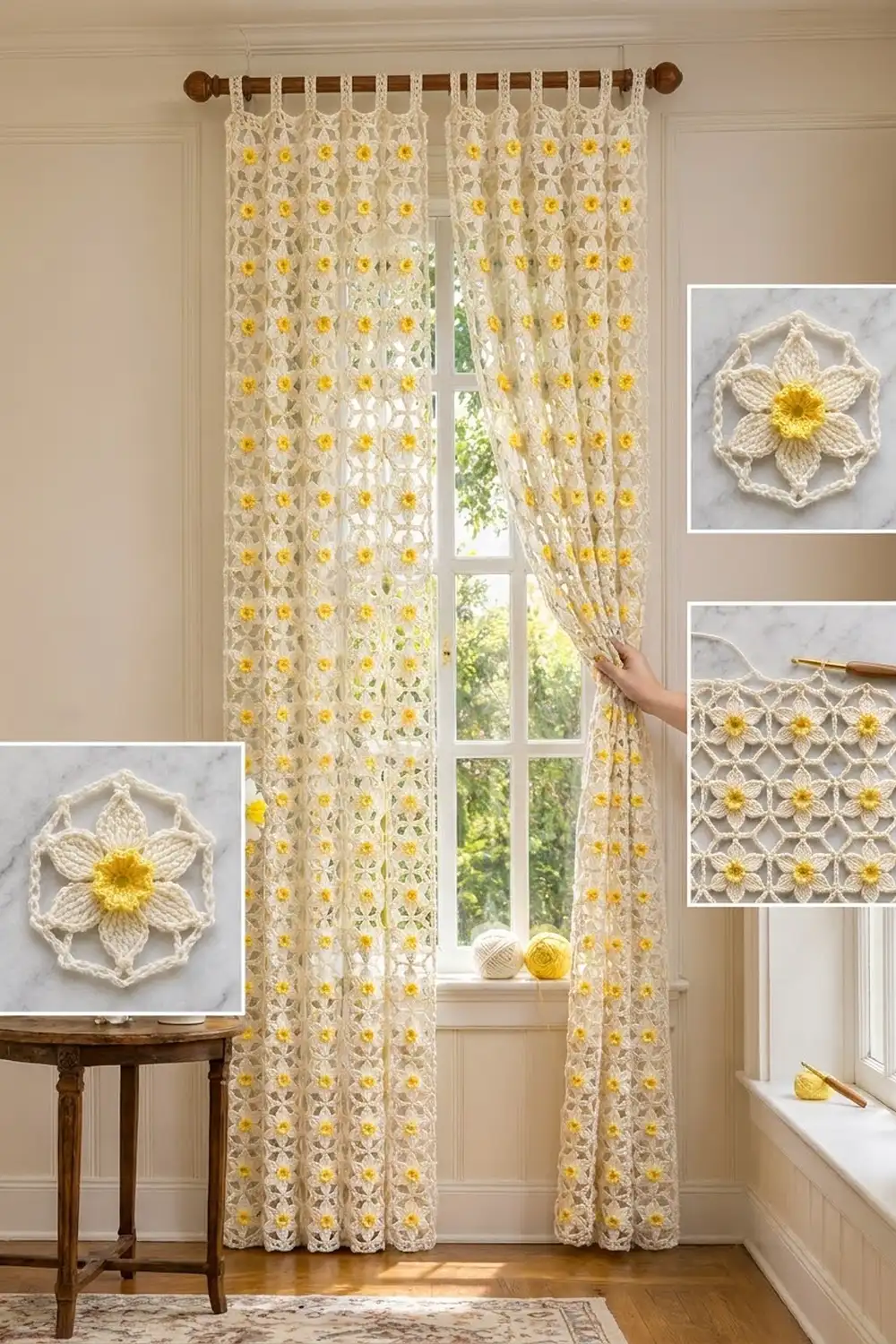
Final Notes
The measurement chain is short and reliable. You need 18 sc to 4 in (10.2 cm), which gives motifs of 6.5 in (16.5 cm) with 12 sc per side. Six motifs across and twelve down make a panel of 39 x 78 in (99.1 x 198.1 cm), and two border rounds bring it to 40 x 79 in (101.6 x 200.7 cm). Check each link in the chain and your two panels will hang straight and match.
Happy crocheting!