
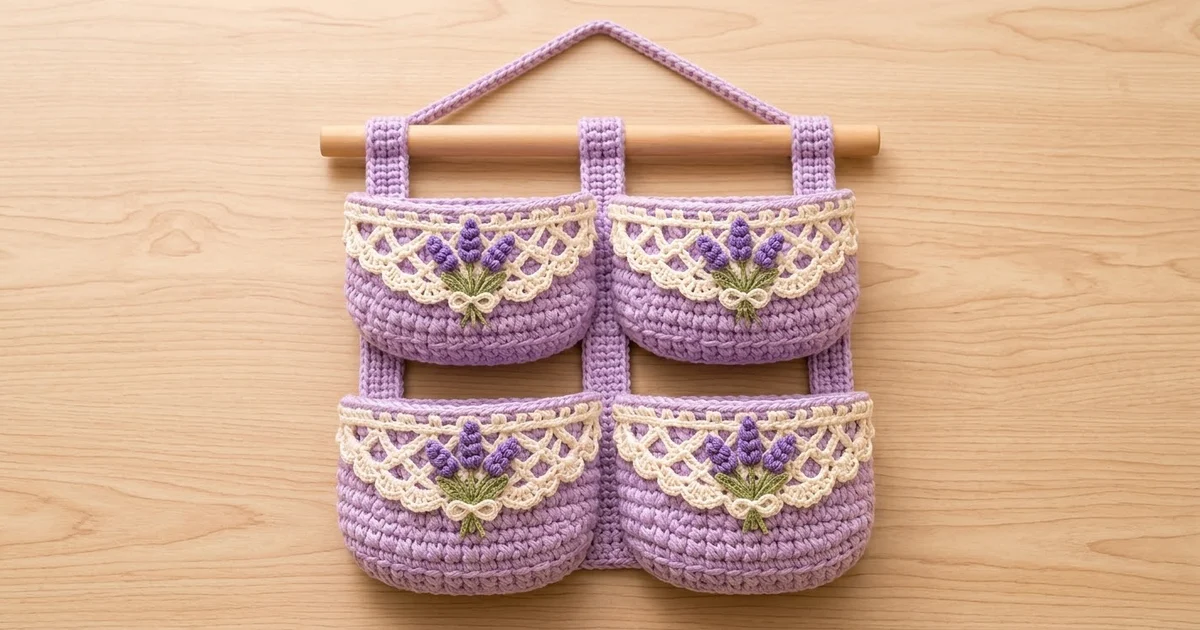
This hanging organizer has four soft lilac pockets in two columns and two rows. Each pocket front has an ivory lace apron with a scalloped edge and a small lavender sprig appliqué. Three lilac straps hold the pockets and loop over a wooden dowel, and a crocheted cord hangs the whole piece from one hook.
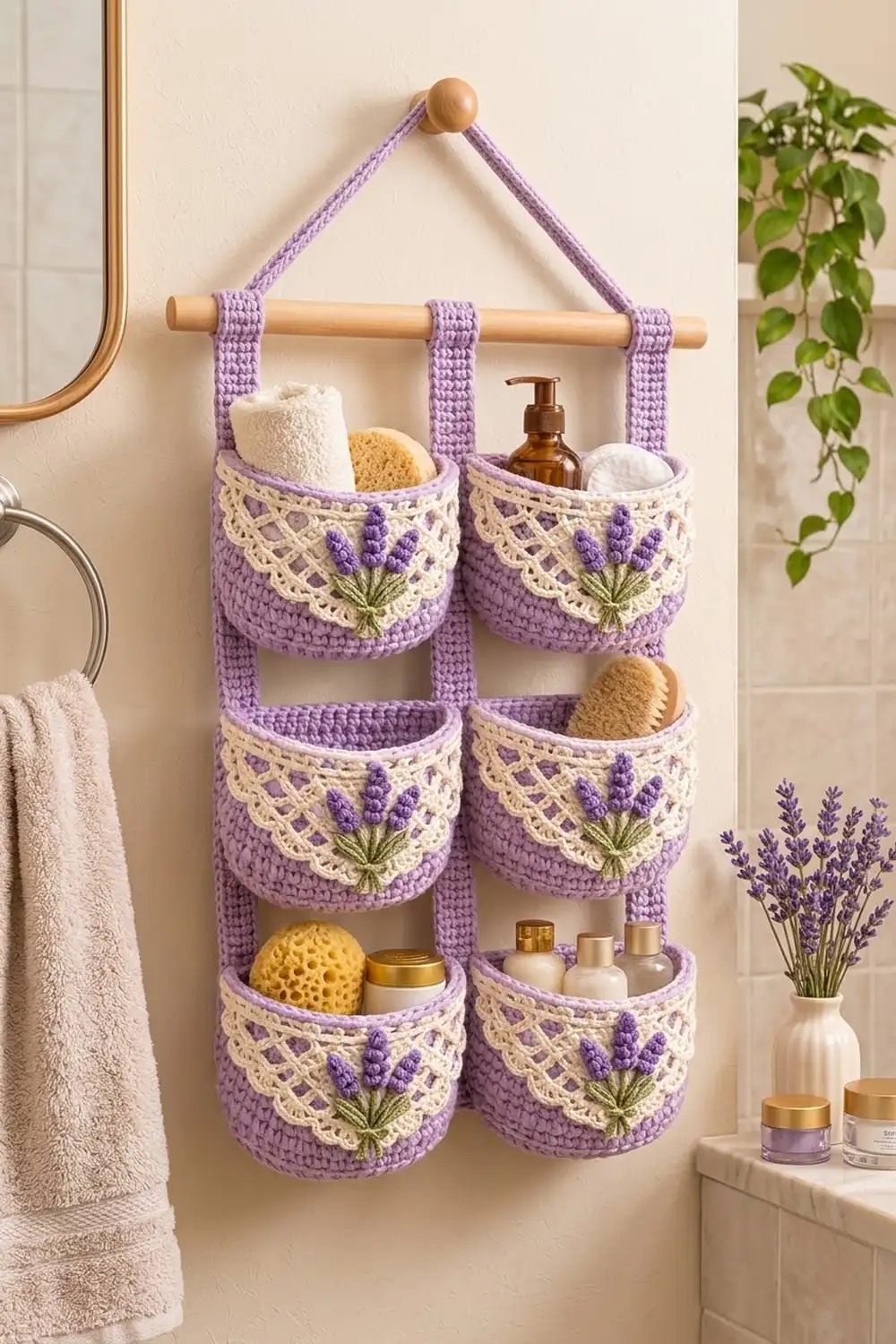
The colors are lilac, ivory, purple, and soft green. It has a gentle cottage style, but the pockets are worked in dense single crochet so they keep their shape when you fill them with rolled towels, jars, or bottles.
This pattern uses US terms. The finished organizer is 15.25 in (38.7 cm) wide across the pockets and 13 in (33.0 cm) tall below the dowel. With the cord, the total height is about 21 in (53.3 cm).
You’ll make each pocket from an oval base with straight walls, then work the lace into free front loops near the rim. Next you’ll make three edged straps, sew the pockets onto them, fold the straps over the dowel, and tie on the cord.
Finished Size and Construction
- Finished size: 15.25 x 13 in (38.7 x 33.0 cm) below the dowel; 21 in (53.3 cm) tall including the cord
- Skill level: Intermediate
- Terminology: US
- Yarn weight: Worsted (#4) cotton
- Hook: 4.0 mm (G-6)
- Number of pieces: 4 pockets, 3 straps, 1 cord, 4 appliqués
- Layout: 2 columns x 2 rows
- Pocket size: base 7.25 x 3.25 in (18.4 x 8.3 cm); walls 4 in (10.2 cm) tall
- Strap size before border: 1.25 x 18 in (3.2 x 45.7 cm)
- Border depth: 0.25 in (0.6 cm) per side, so each finished strap is 1.75 x 18.5 in (4.4 x 47.0 cm)
Materials
Use a smooth, firm cotton or cotton blend. Mercerized cotton shows the lace mesh clearly and holds up well in a damp bathroom. Avoid fuzzy acrylic, because it blurs the mesh and stretches when the pockets are loaded.
- Lilac (main): 320 g / 545 m
- Ivory (lace): 60 g / 102 m
- Purple (buds): 15 g / 26 m
- Green (stems and leaves): 10 g / 17 m
Tools: 4.0 mm (G-6) hook; wooden dowel, 18 in (45.7 cm) long and 0.75 in (1.9 cm) thick; tapestry needle; 8 stitch markers; rust-proof pins; measuring tape; wall hook or knob.
The quantities include a margin of about 15 percent for swatching and seams.
Abbreviations (US Terms)
- ch: chain
- sl st: slip stitch
- sc: single crochet
- hdc: half double crochet
- dc: double crochet
- sk: skip
- sp(s): space(s)
- st(s): stitch(es)
- BLO: back loop only
- rep: repeat
- RS: right side
Bobble: (Yo, insert hook in the st, yo and pull up a loop, yo and draw through 2 loops) 3 times in the same st. Yo and draw through all 4 loops on the hook.
Picot: Ch 3, sl st in 3rd ch from hook.
Gauge and Checkpoints
Gauge: 16 sc and 18 rows = 4 in (10.2 cm) in sc with the 4.0 mm hook.
Make one complete pocket before you start the others. It is your real gauge test, because it shows whether the walls stand up and whether the lace lies flat.
- After Rnd 7: the base is 7.25 x 3.25 in (18.4 x 8.3 cm) and lies flat.
- After Rnd 25: the walls are 4 in (10.2 cm) tall and the rim is about 19 in (48.3 cm) around.
- Lace apron: about 9.25 in (23.5 cm) along its top edge and 2.5 in (6.4 cm) deep.
- Strap before border: 1.25 x 18 in (3.2 x 45.7 cm).
Too big? Go down 0.5 mm in hook size. Too small? Go up 0.5 mm. If the base cups, your increases are too tight. If it ruffles, your gauge is too loose.
Pocket (Make 4)
Base
With lilac, ch 20.
Rnd 1: Sc in 2nd ch from hook and in next 17 ch. Work 3 sc in last ch. Working along the underside of the ch, sc in next 17 ch, then 2 sc in the same ch as the first sc. Join with sl st. (40 sts: 17 per straight side + 3 per curved end.)
For the rest of the base, keep 17 sts on each straight side and increase only at the ends.
Rnd 2: Ch 1. Sc in each straight st, and work 2 sc in each of the 3 sts at each end. Join. (46 sts; 6 per end.)
Rnd 3: Ch 1. Sc in each straight st. At each end, work (sc in next st, 2 sc in next st) 3 times. Join. (52 sts; 9 per end.)
Rnd 4: Work as for Rnd 3, but at each end work (sc in next 2 sts, 2 sc in next st) 3 times. (58 sts; 12 per end.)
Rnd 5: Work as for Rnd 3, but at each end work (sc in next 3 sts, 2 sc in next st) 3 times. (64 sts; 15 per end.)
Rnd 6: Work as for Rnd 3, but at each end work (sc in next 4 sts, 2 sc in next st) 3 times. (70 sts; 18 per end.)
Rnd 7: Work as for Rnd 3, but at each end work (sc in next 5 sts, 2 sc in next st) 3 times. (76 sts: 17 + 21 + 17 + 21.)
Adding 6 sts per round (3 per end) keeps a single-crochet oval flat.
Walls
Rnd 8: Ch 1, sc BLO in each st, join. (76 sts.) This makes a crisp fold between the base and the walls.
Rnds 9–22: Ch 1, sc in each st, join. (76 sts.)
Choose one straight side as the front. Count 10 sts into each curved end and place a marker in each of those 2 sts. The front span between the markers is 37 sts (10 + 17 + 10), and the back is 39 sts (11 + 17 + 11).
Rnd 23: Ch 1. Sc BLO in each of the 37 front sts, then sc in both loops of the 39 back sts. Join. (76 sts.) This leaves 37 free front loops on Rnd 22 for the lace.
Rnd 24: Ch 1, sc in each st, join. (76 sts.)
Rnd 25 (rim): Ch 1, sl st loosely in each st, join. (76 sl sts: 37 front + 39 back.) Fasten off.
The walls are Rnds 8–25, which is 18 rounds. At gauge, that gives a 4 in (10.2 cm) wall.
Ivory Lace Apron
Turn the pocket upside down so the free front loops face you. You’ll work rows down toward the base.
Row 1 (RS): Join ivory in the free loop at the right marker. Ch 1, then sc in each of the 37 free loops. Turn. (37 sc.)
Row 2: Ch 1, sc in first st. Ch 5, sk 3 sts, sc in next st. Rep from * 8 more times. Turn. (9 ch-5 sps; 1 + 9 x 4 = 37 sts used.)*
Row 3: Ch 5 (counts as dc + ch 2). Sc in first ch-5 sp. Ch 5, sc in next ch-5 sp. Rep from * across. Ch 2, dc in last sc. Turn. (8 ch-5 sps + 2 half sps; 9 sc.)*
Row 4: Ch 1, sc in first dc. Ch 5, sc in next ch-5 sp. Rep from * 7 more times. Ch 5, sc in 3rd ch of turning ch. Turn. (9 ch-5 sps.)*
Row 5 (scallops): Ch 1. In next ch-5 sp, work (2 sc, hdc, 2 dc, picot, 2 dc, hdc, 2 sc). Rep from * 8 more times. Sl st in last sc. (9 scallops.)* Fasten off.
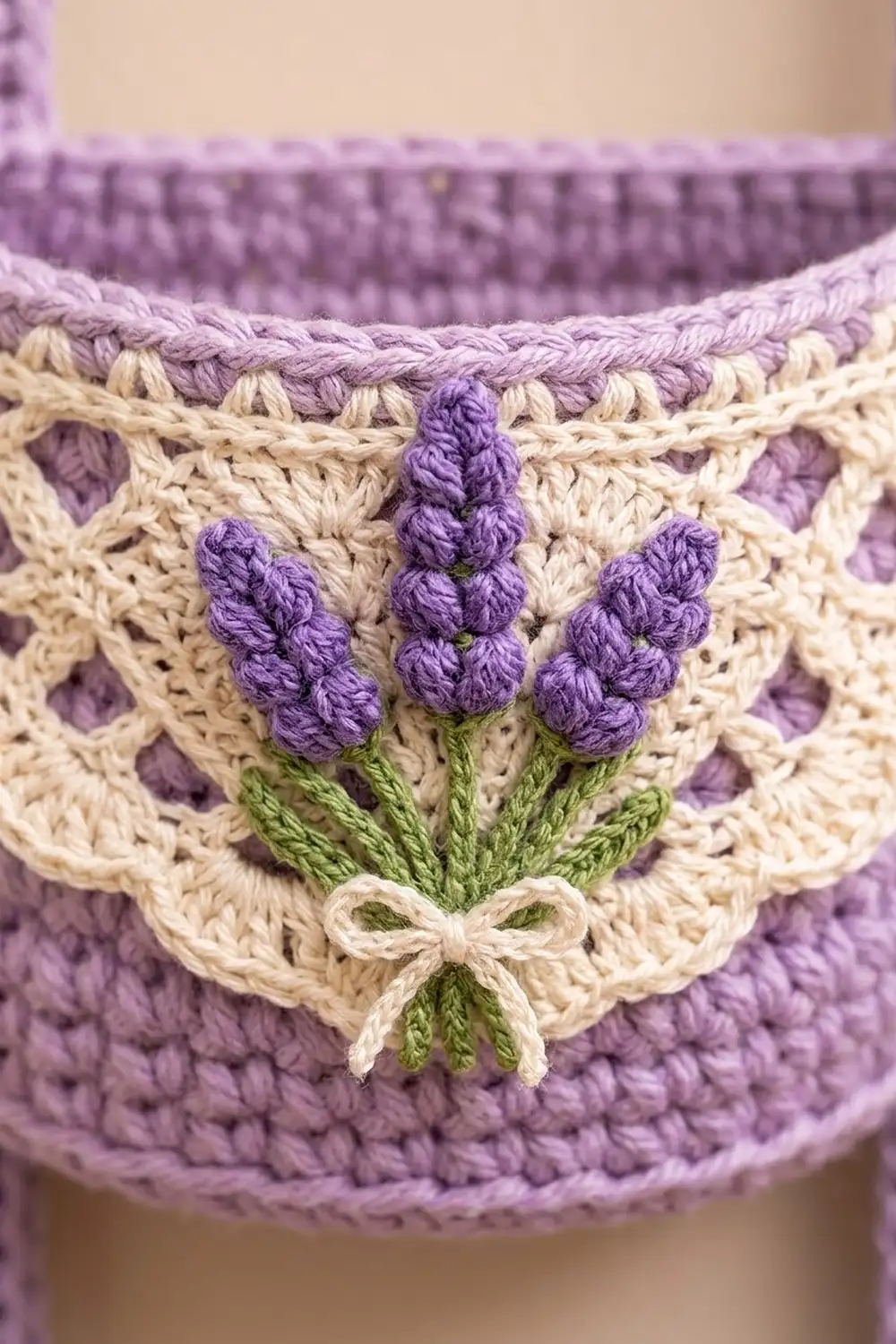
The apron hangs over the upper front wall, about 2.5 in (6.4 cm) deep. Tack both side edges down with ivory.
Lavender Sprig Appliqué
Spike (make 5 per pocket): With purple, ch 8. Work a bobble in the 3rd ch from hook, then (sl st in next ch, bobble in next ch) twice. Sl st in last ch. (3 bobbles.) Fasten off, leaving a 6 in (15.2 cm) tail. Each spike is about 1.5 in (3.8 cm) long.
Leaf (make 2 per pocket): With green, ch 8. Sl st in 2nd ch from hook, sc in next ch, hdc in next 2 ch, sc in next ch, sl st in last 2 ch. (7 sts.) Fasten off, leaving a long tail.
Assembly: Center the sprig on the lace, just above the scallops.
- With green, backstitch five 1 in (2.5 cm) stems that fan out from a single base point.
- Sew a spike to the top of each stem. Keep the middle spike upright and angle the others outward.
- Sew one leaf on each side of the base point.
- Work three ivory satin stitches across the base point, and tie a small bow from a 6 in (15.2 cm) ivory strand.
The finished sprig is about 2.5 x 2 in (6.4 x 5.1 cm).
Straps (Make 3)
With lilac, ch 6.
Row 1: Sc in 2nd ch from hook and in each ch across. Turn. (5 sc.)
Rows 2–81: Ch 1, sc in each st. Turn. (5 sc.)
Do not fasten off. At 18 rows per 4 in, 81 rows gives 1.25 x 18 in (3.2 x 45.7 cm).
Cord (Make 1)
With lilac, ch 101.
Row 1: Sc in 2nd ch from hook and in each ch across. (100 sc.)
Row 2: Turn, sl st in each st. (100 sl sts.) Fasten off.
At 4 sts per inch, 100 sts gives a 25 in (63.5 cm) cord.
Make All Pieces
- Lilac: 4 pockets, 3 straps, 1 cord
- Ivory: 4 lace aprons
- Purple: 20 spikes
- Green: 8 leaves, plus the embroidered stems
     ====== dowel ======
     S1       S2       S3
   [ P1 ]   [ P2 ]        <- upper row
   [ P3 ]   [ P4 ]        <- lower row
Straps S1 and S3 run behind the outer ends of the pockets, and S2 runs behind the gap between the two columns.
Joining
Placement: Work the strap border (next section) before joining.
The 13 in (33.0 cm) below the dowel breaks down like this:
- 3.5 in (8.9 cm) of bare strap
- 4 in (10.2 cm) upper pocket
- 1.5 in (3.8 cm) gap
- 4 in (10.2 cm) lower pocket
Set the two pockets in each row 0.75 in (1.9 cm) apart. S2 is 1.75 in (4.4 cm) wide, so it overlaps each pocket back by 0.5 in (1.3 cm). Set the outer edges of S1 and S3 0.25 in (0.6 cm) inside the pocket ends. Pin everything flat.
Method: Whipstitch with lilac through the pocket’s back wall and the strap’s border sc. Sew along both long edges of each strap where it lies under a pocket.
Stitch-to-stitch logic: Each pocket wall has 18 rounds, and each 4 in (10.2 cm) section of strap has 18 border sc along each edge. Join 1 wall round to 1 border sc, which gives 18 stitches per seam line. Then sew across the strap at the base fold (Rnd 8) to support the bottom of the pocket.
Tension: Make the stitches snug but not tight. Tight seams pucker the back wall and tip the pocket forward.
Size checkpoint: The joined piece should measure 15.25 in (38.7 cm) across the pockets.
Border
Each strap gets one round of sc, which gives the seams a firm edge to sew into.
Border gauge: 4 sc per inch along sts, and 1 sc per row end. At this gauge, sc fabric is nearly square, so 1 sc per row end lies flat.
Border Rnd: Ch 1, then work around the strap:
- Top end (across Row 81): 3 sc in first st, sc in next 3 sts, 3 sc in last st. (9 sts.)
- Long side: Sc in each row end from Row 80 down to Row 2. (79 sts.)
- Bottom end (into the foundation ch): 3 sc in first ch, sc in next 3 ch, 3 sc in last ch. (9 sts.)
- Second long side: Sc in each row end from Row 2 up to Row 80. (79 sts.)
- Join with sl st and fasten off.
Total: 9 + 79 + 9 + 79 = 176 sts.
Why the math works: Each end has 5 sts. The 2 corner sts get 3 sc each and the 3 middle sts get 1 sc each, which gives 9. Rows 1 and 81 are already covered by the corner groups, so each long side uses the remaining 79 row ends and no corner is counted twice. The border adds 0.25 in (0.6 cm) on every side, which gives 1.75 x 18.5 in (4.4 x 47.0 cm).
Hanging: Fold the top of each strap over the dowel. About 2.5 in (6.4 cm) wraps around the dowel, and a 3 in (7.6 cm) tail is sewn to the back of the strap (13 + 2.5 + 3 = 18.5 in). Space the straps 6.5 in (16.5 cm) apart, center to center. Tie each end of the cord around the dowel 0.75 in (1.9 cm) from the dowel end. The peak of the cord sits about 8 in (20.3 cm) above the dowel.
Final Blocking
- Lightly mist the pockets and lace with cool water.
- Stuff each pocket with a folded towel to set a rounded oval shape.
- Pin the aprons flat and open each scallop and picot.
- Pin the straps to 1.75 x 18.5 in (4.4 x 47.0 cm).
- Let everything dry completely, for at least 24 hours.
- Remove the pins and towels, then hang the organizer.
Final Quality-Control Checklist
- Each wall round has 76 sts, and each rim has 37 front + 39 back sts.
- Each apron has 9 even scallops and is tacked down at both sides.
- Each sprig has 5 spikes, 2 leaves, and a bow.
- Each strap border has 176 sts.
- The pockets are level and spaced 0.75 in (1.9 cm) apart.
- The organizer measures 15.25 x 13 in (38.7 x 33.0 cm) below the dowel.
- All tails are woven in on the wrong side.
Troubleshooting
- The base cups: Make sure you increase exactly 3 sts per end on every round.
- The base ruffles: Recount your sts, or go down a hook size.
- The walls lean outward: Go down a hook size for Rnds 9–25.
- The lace curls: Wet-block it, and check that Row 1 has exactly 37 sc.
- The apron is off-center: Recount the 10 end sts before you work Rnd 23.
- A pocket tips forward: Add a second seam across the base fold.
- The strap edges wave: Skip 1 row end in every 9, the same way on both sides.
Care
Remove the dowel first. Hand wash in cool water with mild soap, press out the water in a towel, reshape, and dry flat.
Final Notes
The measurement chain is:
- Gauge of 16 sc and 18 rows = 4 in (10.2 cm)
- Base: 7.25 x 3.25 in (18.4 x 8.3 cm)
- Walls: 18 rounds = 4 in (10.2 cm)
- Lace: 37 front sts carry 9 scallops
- Straps: 81 rows plus a 176-st border = 1.75 x 18.5 in (4.4 x 47.0 cm)
- Assembled organizer: 15.25 x 13 in (38.7 x 33.0 cm)
Check each stage against these numbers and the organizer will hang straight.
Happy crocheting!