
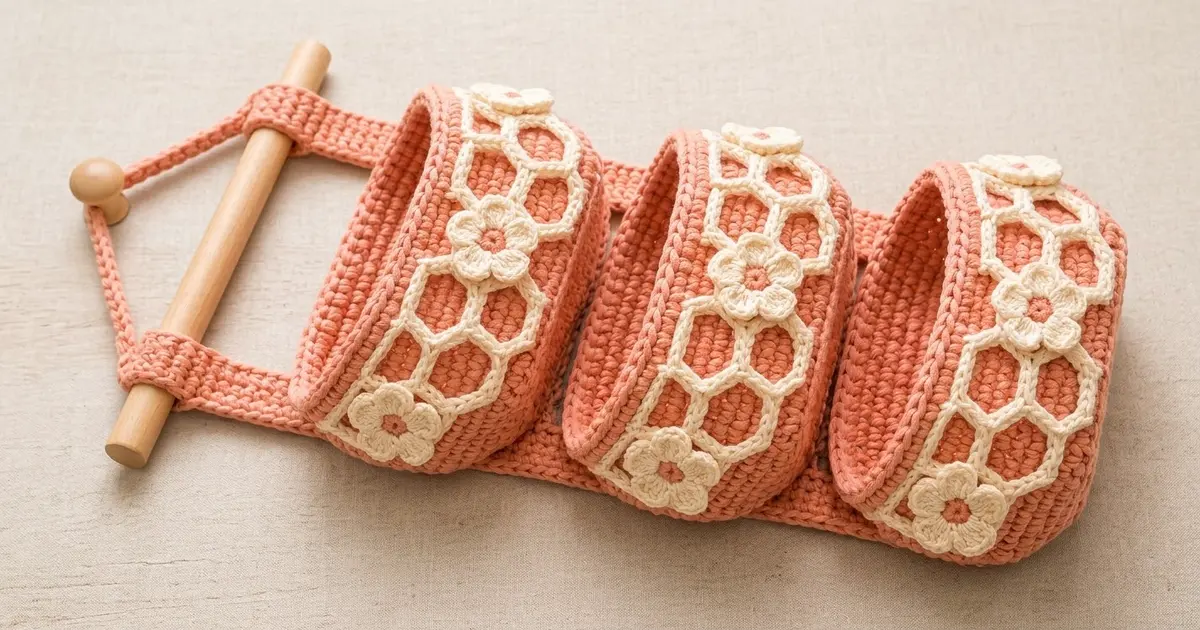
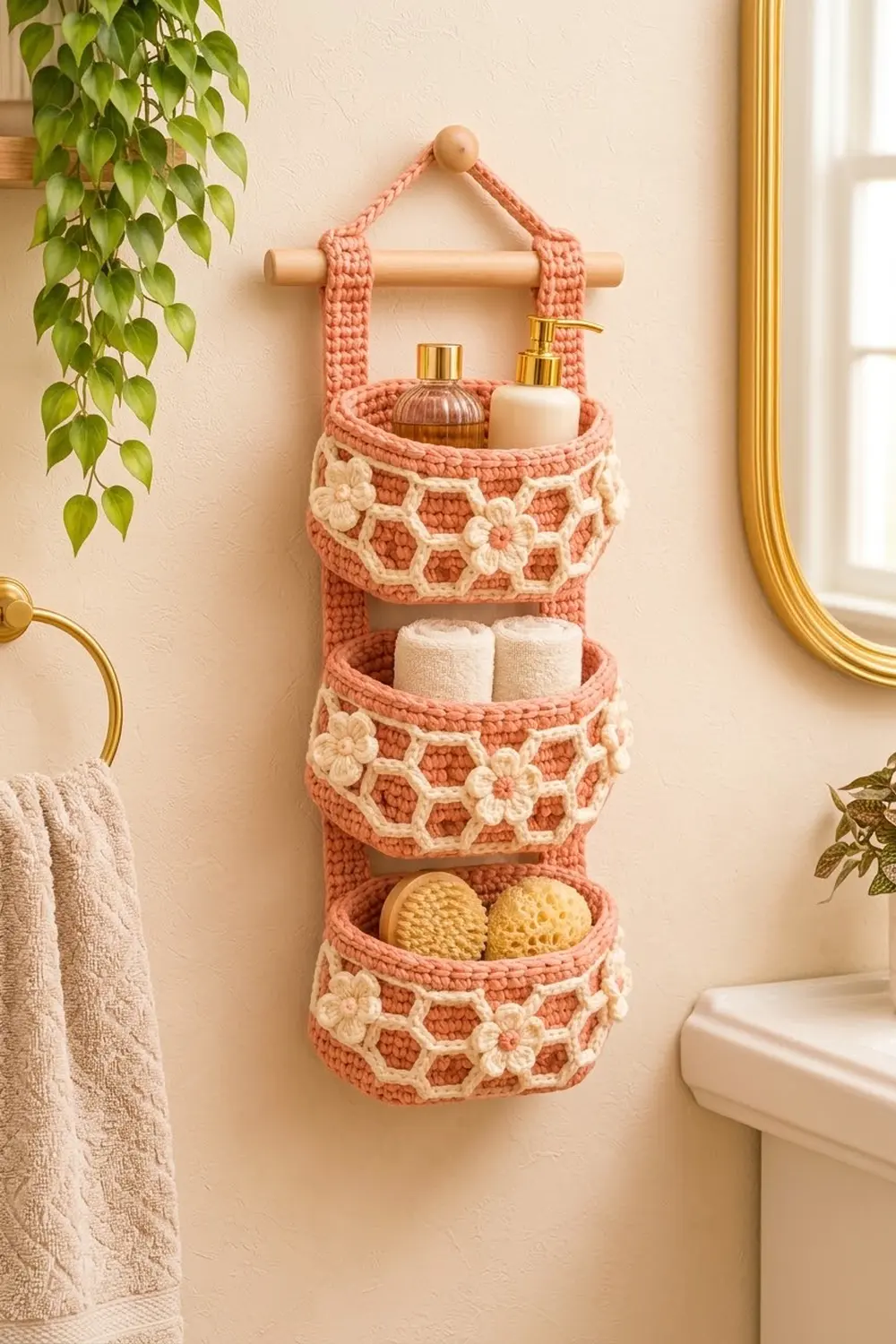
This hanging organizer has three wide hexagon pockets stacked on one back panel. A wooden dowel at the top carries the weight, and a crocheted strap hangs it from a wall knob. Each pocket is made of solid apricot single crochet, with a raised ivory honeycomb mesh wrapped around the outside. Small five-petal ivory flowers with apricot centers sit on the front and on both ends.
It looks soft next to cream towels and pink blooms, but the fabric is firm enough to hold washcloths, soap, sponges and small bottles. It uses two colors: apricot for the structure and ivory for the mesh and petals.
The pattern uses US crochet terms. The finished organizer is 11.5 in (29.2 cm) wide at the pockets and 16.5 in (41.9 cm) tall at the panel. Each pocket is about 4.6 in (11.7 cm) tall and 3.75 in (9.5 cm) deep.
Each pocket starts as a flat, stretched hexagon base worked in rounds. The walls rise from a back-loop turning round. Next, a separate ivory mesh tube slides over the wall and is crocheted into the rim. Finally, the pockets are sewn to a rectangular panel, two tabs wrap around the dowel, and a strap hangs the whole piece.
Finished Size and Construction
- Finished size: 11.5 in (29.2 cm) wide x 16.5 in (41.9 cm) tall, plus tabs and hanger
- Skill level: Intermediate
- Terminology: US
- Yarn weight: Bulky (#5) cotton or cotton blend
- Hook: 5.5 mm (I-9)
- Number of pieces: 3 pockets, 3 mesh bands, 9 flowers, 1 back panel, 2 tabs, 1 hanger strap
- Layout: 3 pockets stacked vertically on one panel
- Pocket size: 11.5 in (29.2 cm) long x 3.75 in (9.5 cm) deep x 4.25 in (10.8 cm) wall height
- Panel size before border: 7.3 in (18.5 cm) x 16 in (40.6 cm)
- Border depth: pocket rim 0.6 in (1.5 cm); panel edging 0.3 in (0.8 cm)
Materials
Use a smooth, firm bulky cotton. Soft or loosely plied yarn will sag once the pockets are full. The amounts below assume about 130 m per 100 g.
- Apricot (main): 500 g, about 650 m (711 yd)
- Ivory (mesh and petals): 160 g, about 200 m (219 yd)
Both amounts include a margin of about 10 percent for swatching and seaming.
Tools:
- 5.5 mm (I-9) crochet hook
- Tapestry needle
- 8 locking stitch markers
- Wooden dowel, 12 in (30.5 cm) long, 5/8 in (1.6 cm) diameter
- Wall knob or hook
- Rust-proof pins, measuring tape, spray bottle
Abbreviations (US Terms)
- ch – chain
- sc – single crochet
- dc – double crochet
- sl st – slip stitch
- sk – skip
- st(s) – stitch(es)
- sp(s) – space(s)
- BLO – back loop only
- rnd – round
- rev sc – reverse single crochet
Reverse single crochet (rev sc): Work from left to right. Insert the hook into the next stitch to the right, yarn over and pull up a loop, then yarn over and pull through both loops. This makes the rope-like rim.
Bar: 2 sc worked side by side in the mesh.
Gauge and Checkpoints
Gauge: 12 sc and 13 rows = 4 in (10.2 cm) in sc.
Make one full pocket and check it before you make the others.
- After Rnd 1: the base is about 8.5 in (21.6 cm) long.
- After Rnd 6: the base is 11.5 in (29.2 cm) x 3.75 in (9.5 cm) and lies flat.
- After Rnd 18: the wall is about 3.75 in (9.5 cm) tall.
- Mesh band: about 3.5 in (8.9 cm) tall, with 90 sts around, the same as the wall.
- After the rim: the wall is 4.25 in (10.8 cm) tall.
If your piece is too big, use a 5 mm (H-8) hook. If it is too small or feels stiff, use a 6 mm (J-10). Change the hook size, not the stitch counts, because every seam depends on matching counts.
Pockets (Make 3)
Use apricot.
Base
Ch 25.
Rnd 1: 3 sc in 2nd ch from hook, sc in next 22 ch, 3 sc in last ch. Rotate the work and sc in the bottom of the next 22 ch. Join with sl st to first sc. (50 sts)
Each round has two end groups (one at each tip) and two long sides of 22 sts. The long sides never change. All increases happen in the end groups.
Rnd 2: Ch 1. 2 sc in next st, 3 sc in next st, 2 sc in next st, sc in next 22 sts; repeat from * once. Join. (58 sts)
Rnd 3: Ch 1. 2 sc in next st, sc in next 2 sts, 3 sc in next st, sc in next 2 sts, 2 sc in next st, sc in next 22 sts; repeat from * once. Join. (66 sts)
Rnd 4: Work as Rnd 3, but sc in next 4 sts on each side of the tip. (74 sts)
Rnd 5: Work as Rnd 3, but sc in next 6 sts on each side of the tip. (82 sts)
Rnd 6: Work as Rnd 3, but sc in next 8 sts on each side of the tip. (90 sts)
Each end group now has 23 sts, so the round is 23 + 22 + 23 + 22 = 90. The 2-sc increases make the four shoulder corners. The 3-sc increase makes each pointed tip.
Put markers in sts 1, 24, 46 and 69 to mark the start of each section. Sts 24–45 are the back long side. Sts 69–90 are the front.
Walls
Rnd 7 (turning round): Ch 1, sc in BLO of each st around. Join. (90 sts)
Rnds 8–18: Ch 1, sc in each st around. Join. (90 sts)
Don’t fasten off. Leave a long live loop on a marker.
Honeycomb Mesh Band (Make 3)
Use ivory.
Foundation: Ch 90 and join with sl st to form a ring. Make sure the chain isn’t twisted.
Rnd 1: Ch 1, sc in each ch around. Join. (90 sts)
Rnd 2: Ch 1. Sc in next 2 sts, ch 5, sk 4 sts; repeat from * 14 more times. Join. (15 bars = 30 sc; 15 ch-5 sps)
Rnd 3: Sl st in next sc and in next ch-5 sp. Ch 1. 2 sc in ch-5 sp, ch 5; repeat from * in each ch-5 sp around. Join. (30 sc; 15 ch-5 sps)
Rnds 4–7: Repeat Rnd 3. (30 sc; 15 ch-5 sps)
Each bar pulls the chain below it up into a point, which closes each opening into a hexagon cell.
Rnd 8 (closing round): Ch 1. Sc in next 2 sc, 4 sc in next ch-5 sp; repeat from * around. Join. (15 x 6 = 90 sts)
Fasten off and leave a 40 in (101.6 cm) tail.
Flowers (Make 9)
Rnd 1 (apricot): Make a magic ring. Ch 1, work 10 sc in the ring, pull it closed and join. (10 sts) Fasten off.
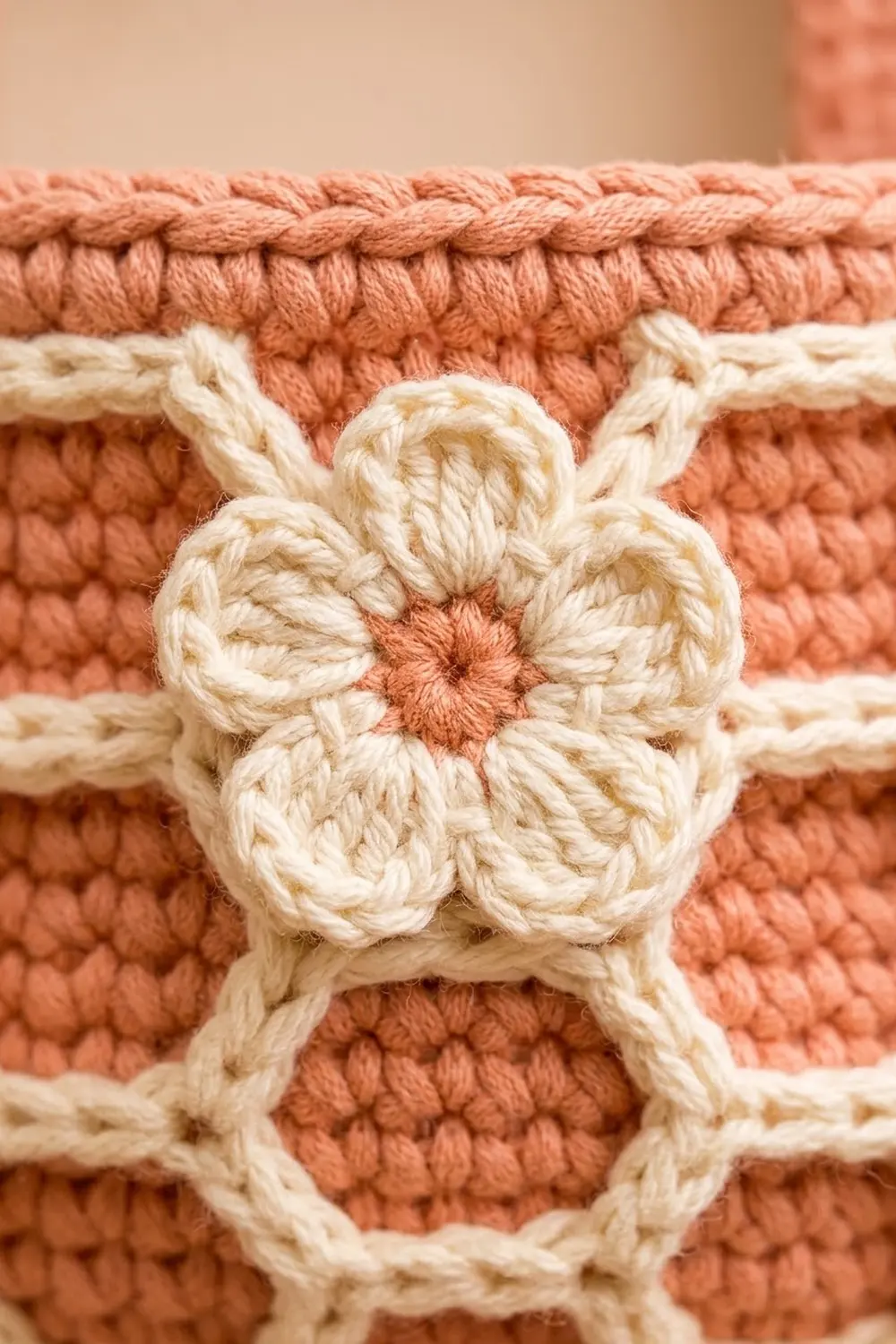
Rnd 2 (ivory): Join ivory in any st. Sl st in next st, (ch 2, 3 dc, ch 2, sl st) in next st; repeat from * 4 more times. (5 petals)
Each petal uses 2 sts, so the 10 sts make exactly 5 petals. The flower is about 2 in (5.1 cm) across.
Back Panel, Tabs and Hanger
Use apricot.
Panel: Ch 23.
Row 1: Sc in 2nd ch from hook and in each ch across. (22 sts)
Rows 2–52: Ch 1, turn, sc in each st across. (22 sts)
The panel should measure 7.3 in (18.5 cm) x 16 in (40.6 cm).
Tabs (make 2): Ch 6. Row 1: Sc in 2nd ch from hook and in each ch across. (5 sts) Rows 2–13: Ch 1, turn, sc in each st. (5 sts) Each tab is about 1.75 in (4.4 cm) x 4 in (10.2 cm).
Hanger strap: Ch 5. Row 1: Sc in 2nd ch from hook and in each ch across. (4 sts) Rows 2–65: Ch 1, turn, sc in each st. (4 sts) The strap is about 1.3 in (3.3 cm) x 20 in (50.8 cm).
Make All Pieces
- Apricot: 3 pockets, 1 panel, 2 tabs, 1 hanger strap, 9 flower centers
- Ivory: 3 mesh bands, 9 petal rounds
Layout (panel rows, counted from the bottom):
          ^    hanger strap to knob
   ======[tab]=========[tab]======  dowel
   +------------------------------+
   | rows 50-52   top margin      |
   | POCKET 3     rows 35-49      |
   | rows 33-34   gap             |
   | POCKET 2     rows 18-32      |
   | rows 16-17   gap             |
   | POCKET 1     rows 1-15       |
   +------------------------------+
Joining
Joining happens in two stages. The mesh goes on before the rims are worked. The pockets go on the panel after the Border section is done.
Stage 1: mesh to wall. Slide a mesh band over a pocket with band Rnd 1 at the bottom. Line up band sts 1, 24, 46 and 69 with the wall markers and pin them. With the ivory tail, whipstitch each st of band Rnd 1 to one st of wall Rnd 8. That’s 90 sts to 90 sts, so no easing is needed. The top of the band is joined in border Rnd 19.
Stage 2: pockets to panel. Center pocket 1 on the panel. Whipstitch the 22 back long-side sts of base Rnd 6 to the 22 sts of panel Row 1, one to one. Then whipstitch the 22 back long-side sts of rim Rnd 20 to the 22 sts of Row 15. Tack the two back corners down the panel edges over Rows 1–15. Repeat for pocket 2 (Rows 18 and 32) and pocket 3 (Rows 35 and 49).
Tabs and hanger. Sew Row 1 of one tab to panel sts 1–5 along the top edge. Sew the other tab to sts 18–22. Fold each tab over the dowel and sew its last row to the back of the panel, behind Row 1. Wrap 1 in (2.5 cm) of each end of the strap around the dowel just outside the tabs and sew it down.
Tension: Keep the whipstitches snug but not tight. Tight seams make the panel cup.
Size checkpoint: The pockets measure 11.5 in (29.2 cm) across and stick out about 1.75 in (4.4 cm) past each side of the panel. The panel measures 8 in (20.3 cm) x 16.5 in (41.9 cm).
Border
The border gauge is the same as the body: 12 sc = 4 in (10.2 cm).
Pocket rim (apricot, from the live loop)
Rnd 19: Hold band Rnd 8 against the outside of wall Rnd 18. Ch 1. Insert the hook through one band st and the matching wall st, then sc them together. Work this way all around and join.
(90 sts: end 23, long 22, end 23, long 22)
Rnd 20: Ch 1, rev sc in each st around. Join and fasten off.
(90 sts: end 23, long 22, end 23, long 22)
The band and the wall both have 90 sts. Every stitch has exactly one partner, so the rim stays the same size as the base.
Panel edging (apricot)
Rnd 1: Join yarn in the last st of Row 52. Work 3 sc in that corner st, sc in next 20 sts, then 3 sc in the last st for the next corner. Down the side, sc in the row-ends of Rows 51 to 2, skipping Rows 44, 33, 22 and 11 (46 sc). Work 3 sc in the first st of Row 1 (corner), sc in next 20 sts, 3 sc in the last st (corner). Up the other side, sc in the row-ends of Rows 2 to 51, skipping Rows 11, 22, 33 and 44 (46 sc). Join.
Between the corner groups, the counts are top 20, side 46, bottom 20 and side 46. Adding the four 3-sc corners gives 20 + 46 + 20 + 46 + 12 = 144 sts.
Here’s why the math works. The panel is 16 in (40.6 cm) tall, and at 3 sc per inch that needs 48 sts per side. Each side has 46 sc plus the center sc of its two corner groups, so 46 + 2 = 48. Working into all 52 row-ends would make the edges ruffle.
Final Blocking
- Mist all pieces until damp.
- Pin the panel flat to 8 in (20.3 cm) x 16.5 in (41.9 cm).
- Stuff each pocket firmly with a rolled towel so the base sits flat.
- Gently stretch the mesh so every hexagon opens evenly.
- Smooth the petals flat with your fingers.
- Let everything dry for about 24 hours.
- Sew on the flowers: one in the center front of each pocket, halfway up the mesh, and one centered on each end tip.
Final Quality-Control Checklist
- Every pocket has 90 sts from Rnd 6 through Rnd 20.
- The bases measure 11.5 in (29.2 cm) x 3.75 in (9.5 cm) and have clear points at the tips.
- Each mesh band has 15 hexagon cells per round.
- No ivory loops show above the rim.
- The panel edging has 144 sts.
- The pockets hang level, with 0.6 in (1.5 cm) gaps between them.
- The tabs and hanger are sewn on securely.
Troubleshooting
- The base ruffles: Go down a hook size. Keep all the increases.
- The base cups: Go up a hook size or loosen your tension in Rnds 4–6.
- The mesh is tight on the wall: Make sure Rnd 2 skips exactly 4 sts and work looser chains.
- The cells look like diamonds: Work each bar into the center of the chain space.
- The pockets droop forward: Add a tack line across the middle of each pocket’s back.
- The panel twists: Check that both tabs are the same length, then block again.
Care
Hand wash in cool water with mild soap. Press out the water in a towel and dry the pockets flat with a towel inside them.
Final Notes
Here’s how the measurements connect, step by step:
- The 50-st base grows 8 sts per round to 90 sts at 11.5 in (29.2 cm).
- The 90-st walls rise to 4.25 in (10.8 cm).
- The 90-st mesh joins the wall stitch for stitch.
- Each 22-st back side sews to a 22-st panel row.
- The 144-st edging squares the panel to 8 in (20.3 cm) x 16.5 in (41.9 cm).
Keep those counts and the pockets will hang level.
Happy crocheting!