
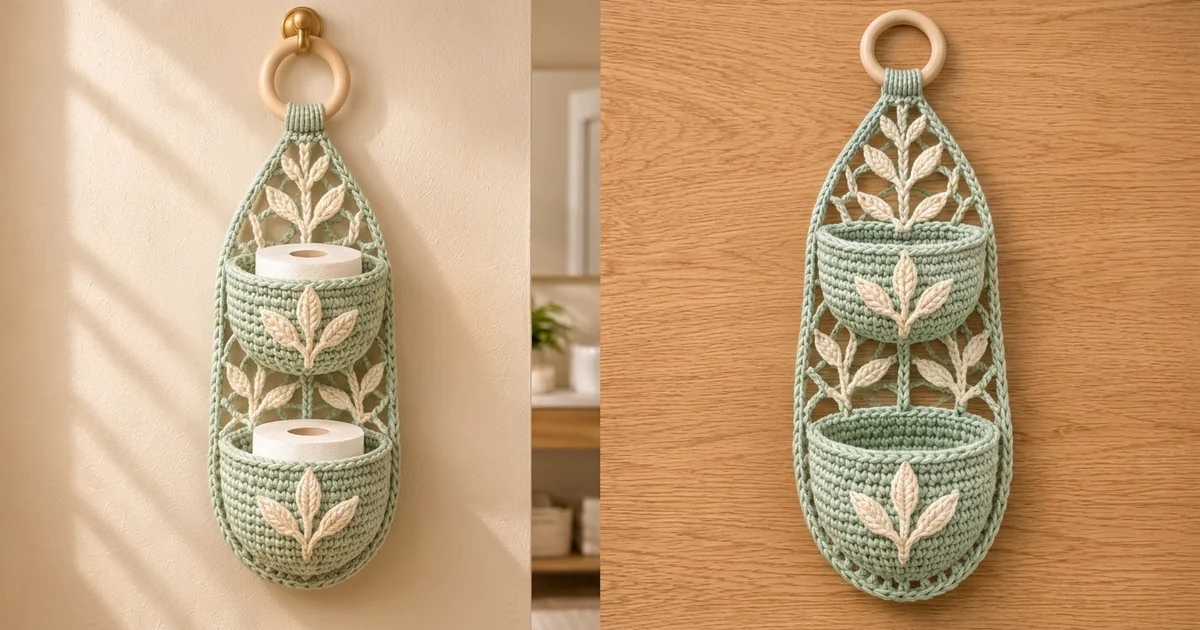
This hanging holder pairs a tall openwork backing panel with two deep crochet baskets, and each basket holds one standard toilet roll. The sage green body has a corded edge that looks like rope. Cream leaf sprigs climb across the baskets and the open mesh between them. The holder hangs from a natural wooden ring and suits a calm, Scandinavian-inspired bathroom.
The pattern uses US crochet terms throughout. The finished panel measures 7.75 in (19.7 cm) wide by 19.5 in (49.5 cm) tall. With the tab and ring, the holder hangs about 23 in (58.4 cm) long. Each basket is 5.25 in (13.3 cm) across and about 4.25 in (10.8 cm) tall including the rim.
The holder is built in parts. You work the panel in filet-style mesh rows from the bottom up, taper the top, and finish with a three-round border. The baskets are worked in the round from a flat base. Leaves and stems are made separately in cream and sewn on. Then the baskets are stitched to the panel and a short tab is wrapped around the ring.
Finished Size and Construction
- Finished size: 7.75 in x 19.5 in (19.7 cm x 49.5 cm) panel; about 23 in (58.4 cm) hanging length with tab and ring
- Skill level: Intermediate
- Terminology: US crochet terms
- Yarn weight: Worsted (weight 4)
- Hook: 5.0 mm (H-8)
- Number of pieces: 1 backing panel, 2 baskets, 1 hanging tab, 22 leaves, 6 stems
- Layout: Lower and upper baskets stacked on the panel, with open mesh and leaf sprigs above each basket
- Basket size: 5.25 in (13.3 cm) base diameter, 4.25 in (10.8 cm) tall
- Panel size before border: 6.25 in x 18 in (15.9 cm x 45.7 cm)
- Border depth: 0.75 in (1.9 cm) on every edge
Materials
Choose a smooth cotton or cotton-blend worsted yarn. Cotton holds the basket shape well and copes with a humid bathroom. Avoid fuzzy yarns, which hide the leaf shaping and the mesh.
- Sage green (main color): 120 g, approx. 216 m (236 yd)
- Cream (leaves and stems): 30 g, approx. 54 m (59 yd)
Tools:
- 5.0 mm (H-8) crochet hook
- Wooden ring, 2.5 in (6.4 cm) outer diameter
- Tapestry needle
- Locking stitch markers
- Rust-proof pins and a blocking mat
- Measuring tape and scissors
The yarn quantities include a margin of about 20% for gauge differences and swatching.
Abbreviations (US Terms)
- ch – chain
- sl st – slip stitch
- sc – single crochet
- hdc – half double crochet
- dc – double crochet
- BLO – back loop only
- sp – space
- st(s) – stitch(es)
- MR – magic ring
- rev sc – reverse single crochet
Reverse single crochet (rev sc): Work from left to right (if you are right-handed). Insert the hook into the next stitch to the right, yarn over and pull up a loop, then yarn over and pull through both loops. This makes the corded, rope-like edge on the panel and the basket rims.
Mesh space: One dc plus one ch-2 space, 3 sts wide.
Gauge and Checkpoints
- Single crochet: 16 sc x 18 rows = 4 in (10.2 cm)
- Mesh: 1 mesh space = 0.75 in (1.9 cm) wide; 1 dc row = 0.5 in (1.3 cm) tall
Make one basket first. It is the best gauge test, because the base has to be wide enough for a roll.
Checkpoints:
- Basket base after Round 11: 5.25 in (13.3 cm) across.
- Basket walls after Round 29: 4 in (10.2 cm) from the fold line to the top.
- Panel after Row 1: 6.25 in (15.9 cm) wide.
- Panel after Row 30: 15 in (38.1 cm) tall.
- Panel after Row 36: 18 in (45.7 cm) tall.
- Bordered panel: 7.75 in x 19.5 in (19.7 cm x 49.5 cm).
If your basket base is too big, go down half a hook size. If it is too small, go up half a size. A standard roll is about 4.5 in (11.4 cm) wide, so a base under 5 in (12.7 cm) will be too tight. Keep the same hook for the panel unless your mesh width is off at Row 1.
Baskets (Make 2)
Use sage green. Work in joined rounds. The ch 1 at the start of each round does not count as a stitch.
Round 1: Make a MR, ch 1, 6 sc in ring, sl st to first sc. (6 sts)
Round 2: Ch 1, 2 sc in each st around, sl st to join. (12 sts)
Round 3: Ch 1, sc in next st, 2 sc in next st 6 times, join. (18 sts)
Round 4: Ch 1, sc in next 2 sts, 2 sc in next st 6 times, join. (24 sts)
Rounds 5–10: Keep increasing 6 sts per round, working one more sc between increases each round. Round 5 has 30 sts, Round 6 has 36, Round 7 has 42, Round 8 has 48, Round 9 has 54, and Round 10 has 60.
Round 11: Ch 1, sc in next 9 sts, 2 sc in next st 6 times, join. (66 sts)
Checkpoint: the base lies flat and measures 5.25 in (13.3 cm). At 4 sc per inch, 66 sts make a 16.5 in (41.9 cm) circumference.
Round 12: Ch 1, sc in BLO of each st around, join. (66 sts) This round turns the edge of the base upward and starts the wall.
Rounds 13–29: Ch 1, sc in each st around, join. (66 sts)
Checkpoint: Rounds 12–29 make 18 rounds, or 4 in (10.2 cm) of wall.
Round 30: Ch 1, rev sc in each st around, join. (66 sts) Fasten off, leaving a 24 in (61.0 cm) tail for sewing.
Backing Panel
Use sage green. Work in rows, turning at the end of each row.
Row 1: Ch 29. Dc in 8th ch from hook. The 7 skipped chains count as the first dc, a ch-2 space and the base of the first mesh space. Ch 2, sk 2 ch, dc in next ch 7 times. (8 mesh spaces, 25 sts)
Checkpoint: 6.25 in (15.9 cm) wide.
Rows 2–30: Ch 5 (counts as dc and ch 2), turn. Sk first ch-2 sp, dc in next dc. Ch 2, dc in next dc across, working the last dc in the 3rd ch of the turning chain. (8 mesh spaces, 25 sts)
Checkpoint: 15 in (38.1 cm) tall after Row 30.
Tapered top. Each decrease row removes one mesh space at each edge, which is 0.75 in (1.9 cm) per side.
Row 31 (decrease): Turn. Sl st in next 2 ch and next dc (3 sl sts). Ch 5, dc in next dc. Ch 2, dc in next dc until one mesh space remains, and leave that space unworked. (6 mesh spaces, 19 sts)
Row 32: Work as Rows 2–30. (6 mesh spaces, 19 sts)
Row 33 (decrease): Work as Row 31. (4 mesh spaces, 13 sts)
Row 34: Work as Rows 2–30. (4 mesh spaces, 13 sts)
Row 35 (decrease): Work as Row 31. (2 mesh spaces, 7 sts)
Row 36: Work as Rows 2–30. (2 mesh spaces, 7 sts) Do not fasten off.
Checkpoint: 18 in (45.7 cm) tall. The taper rises 3 in (7.6 cm) and steps in 2.25 in (5.7 cm) on each side.
Leaves and Stems
Use cream. Leave an 8 in (20.3 cm) tail on every piece for sewing.
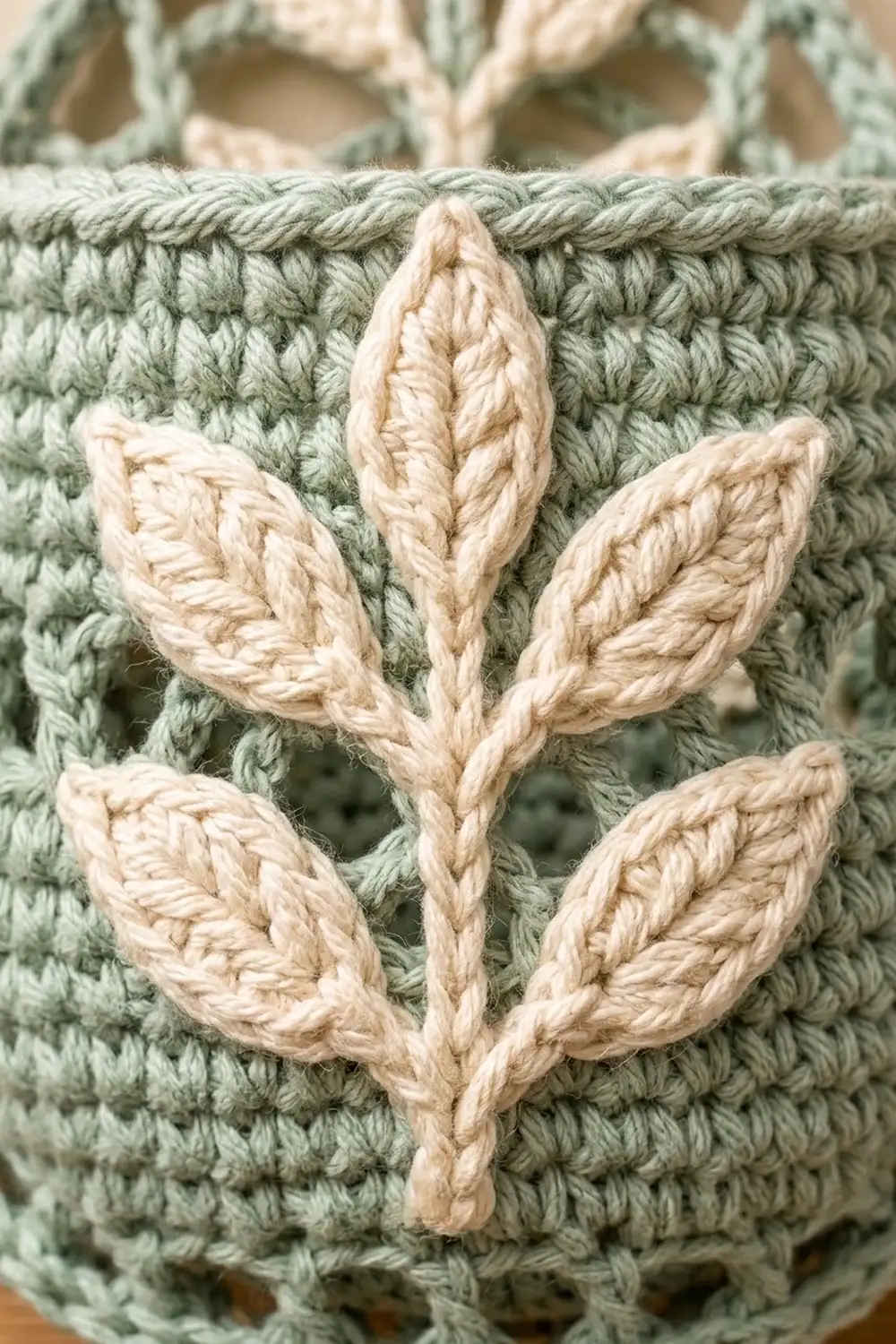
Large leaf (make 3): Ch 7. Starting in the 2nd ch from hook and working toward the base: sc, hdc, dc in next 2 ch, hdc, sc in last ch. (6 sts) Ch 1 to turn the base corner. Working along the opposite side of the foundation ch: sc, hdc, dc in next 2 ch, hdc, sc. (6 sts) Ch 2, sl st to first sc to form the pointed tip. (12 sts plus ch-2 tip) Size: about 1.75 in (4.4 cm) long.
Small leaf (make 19): Ch 5. Starting in the 2nd ch from hook: sc, hdc, dc, sc. (4 sts) Ch 1. Along the opposite side: sc, dc, hdc, sc. (4 sts) Ch 2, sl st to first sc. (8 sts plus ch-2 tip) Size: about 1.25 in (3.2 cm) long and 0.6 in (1.5 cm) wide.
The two halves of each leaf meet along the foundation chain, which forms the raised center vein.
Stems: Ch the number given, then sl st in 2nd ch from hook and in each ch across.
- Short stem (make 4): ch 9 (8 sl sts), 2 in (5.1 cm)
- Middle stem (make 1): ch 13 (12 sl sts), 3 in (7.6 cm)
- Top stem (make 1): ch 17 (16 sl sts), 4 in (10.2 cm)
Sprig sets:
- Each basket: 1 short stem, 1 large leaf at the top, 2 pairs of small leaves angled upward.
- Top panel sprig: top stem, 1 large leaf, 2 pairs of small leaves.
- Middle panel sprigs: the middle stem with 1 small leaf at the top and 1 pair of small leaves, plus 2 short stems with 2 small leaves each, angled outward.
In total this uses 3 large leaves and 19 small leaves.
Border
Continue with the yarn from Row 36. The border gauge matches the sc gauge of 4 sc per inch.
Round 1: Ch 1 and work sc around the whole panel as follows. Join with sl st to first sc.
- Top edge: 7 sc, one in each st of Row 36.
- Each tapered edge: 15 sc spread evenly, about 2 per row end plus 1 over each step.
- Each straight side: 60 sc, 2 sc in each dc row end.
- Bottom edge: 1 sc in each of the 25 foundation ch, working 3 sc in the first and last ch. (29 sc)
Total: 7 + 15 + 60 + 29 + 60 + 15 = 186 sts.
Round 2: Ch 1, sc in each st around, working 2 sc in each of the 3 sts of each bottom corner group. Join. (186 + 6 = 192 sts) This rounds the bottom corners.
Round 3: Ch 1, rev sc in each st around. Join. (192 sts) Fasten off.
Why the math works:
- Straight sides: each is 15 in (38.1 cm) long, so 60 sc at 4 per inch fit exactly.
- Tapered edges: each slope is 3 in (7.6 cm) tall and 2.25 in (5.7 cm) across, which makes it 3.75 in (9.5 cm) long, or 15 sc.
- Bottom edge: 25 sts span 6.25 in (15.9 cm).
- Corners: the outer edge of a border is longer than the inner edge. The extra corner stitches in Rounds 1 and 2 add that length, so the border stays flat as it curves around the bottom.
- Depth: three rounds of sc at 0.25 in (0.6 cm) each make the 0.75 in (1.9 cm) border.
Hanging Tab
Use sage green. Ch 6.
Row 1: Sc in 2nd ch from hook and in each ch across. (5 sts)
Rows 2–22: Ch 1, turn, sc in each st across. (5 sts)
The tab measures about 5 in (12.7 cm).
- Fold the tab over the wooden ring.
- Place the top tip of the panel between the two ends of the tab, overlapping 1 in (2.5 cm).
- Sew through all layers.
- Wrap sage yarn tightly around the doubled tab, just below the ring, for 0.5 in (1.3 cm). Tuck the end inside the wrap to secure it.
Assembly
- Leaves on baskets. Center one basket sprig on the front of each basket, with the base of the stem 0.5 in (1.3 cm) above the fold line. Sew the stem and leaves flat with cream yarn.
- Panel sprigs. Sew the top sprig vertically centered over Rows 27–36. Sew the middle sprigs over Rows 11–17, with the middle stem centered and a short sprig angled outward on each side. Stitch through the dc posts and chains of the mesh so the leaves stay flat.
- Lower basket. Mark 22 rim sts at the back of the basket, opposite the leaf sprig. Line them up along Row 10, centered on the panel. Whip-stitch those 22 rim sts to the panel; they cover 5.5 in (14.0 cm). Tack the back of the base to Rows 1–2 at three points.
- Upper basket. Repeat along Row 26, tacking the base to Rows 17–18.
This leaves 3.5 in (8.9 cm) of open mesh between the baskets and 5 in (12.7 cm) above the upper basket.
Final Blocking
Block the panel and leaves before you attach the baskets.
- Wet the panel and leaves and roll them in a towel to remove excess water.
- Pin the panel to 7.75 in x 19.5 in (19.7 cm x 49.5 cm), pinning each dc post of the mesh straight.
- Shape the bottom corners into smooth curves and the tapered top into a clean point.
- Pin each leaf flat with a sharp tip.
- Shape each basket around a towel-wrapped roll.
- Let everything dry completely before assembly.
Final Quality-Control Checklist
- Each basket base measures 5.25 in (13.3 cm), and the walls are 4 in (10.2 cm) tall.
- Each basket has 66 sts in Round 30.
- The panel has 8 mesh spaces through Row 30, then 6, 4 and 2.
- Border Round 1 has 186 sts, and Rounds 2 and 3 have 192.
- The bordered panel measures 7.75 in x 19.5 in (19.7 cm x 49.5 cm).
- There are 3 large leaves and 19 small leaves.
- Both basket rims are level and centered on the panel.
- The tab is secure, and all yarn tails are woven in.
Troubleshooting
Basket is too narrow for the roll: Go up half a hook size. Or add one more increase round after Round 11 (72 sts) and work the walls on 72 sts.
Basket walls flare outward: Your walls are looser than your base. Go down half a hook size for Rounds 13–29.
Panel edges wave: There are too many sc along the sides. Recount Round 1 against the totals above.
Bottom corners cup: Add one more 2-sc increase at each corner in Round 2.
Mesh leans: Make sure you skip the first ch-2 sp after each turning chain.
Baskets sag forward: Add more tacking points between the base and the panel.
Care
Hand wash in cool water and lay flat to dry. Take out the rolls and reshape the baskets while they are damp.

Final Notes
Here is how the measurements build on each other:
- Each basket base reaches 5.25 in (13.3 cm) at 66 sts, and the walls rise 4 in (10.2 cm).
- The panel mesh measures 6.25 in x 18 in (15.9 cm x 45.7 cm) before the border.
- The three border rounds add 0.75 in (1.9 cm) on every edge, for a finished panel of 7.75 in x 19.5 in (19.7 cm x 49.5 cm).
If each checkpoint matches, the baskets, leaves and tab will line up as planned.
Happy crocheting!