

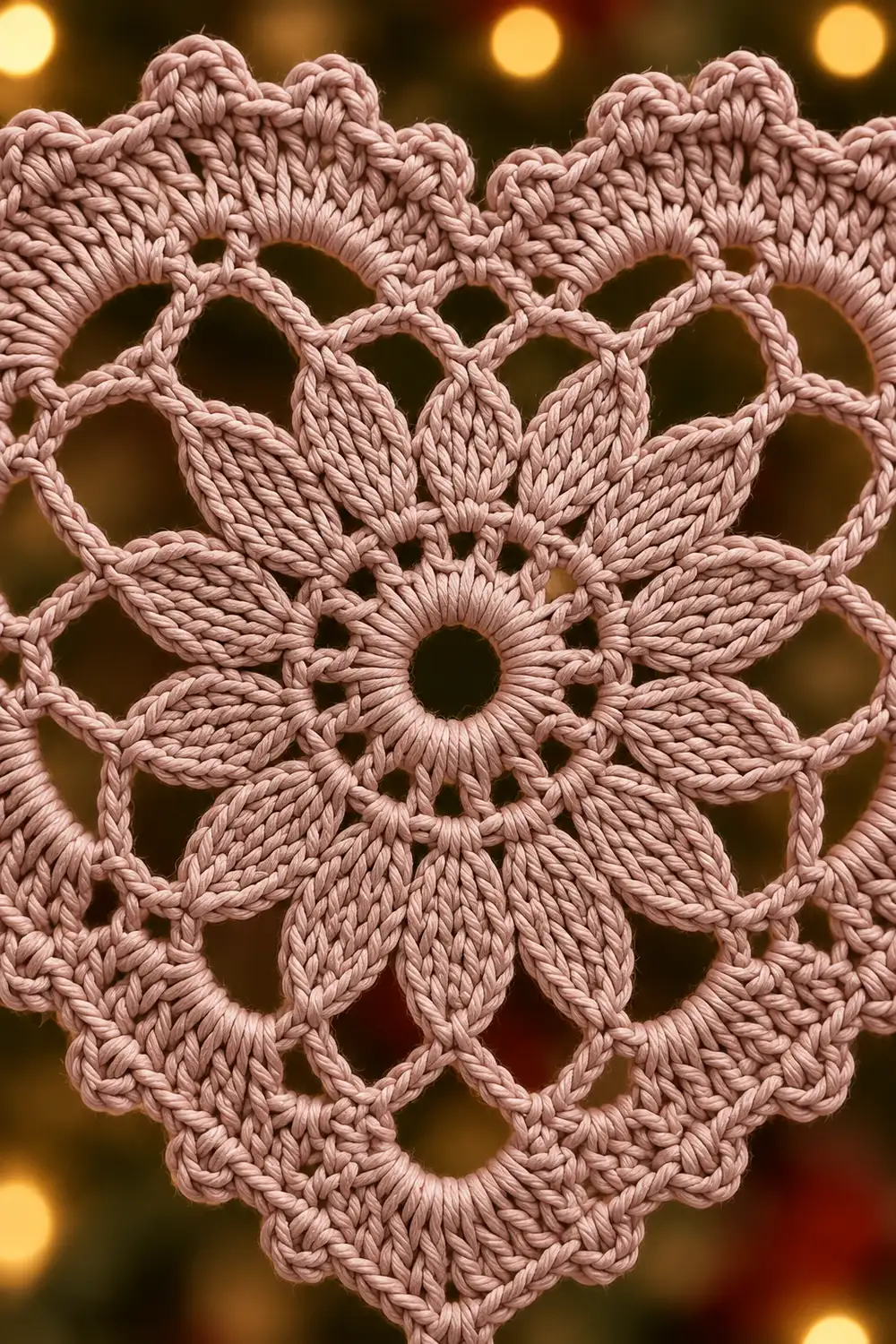
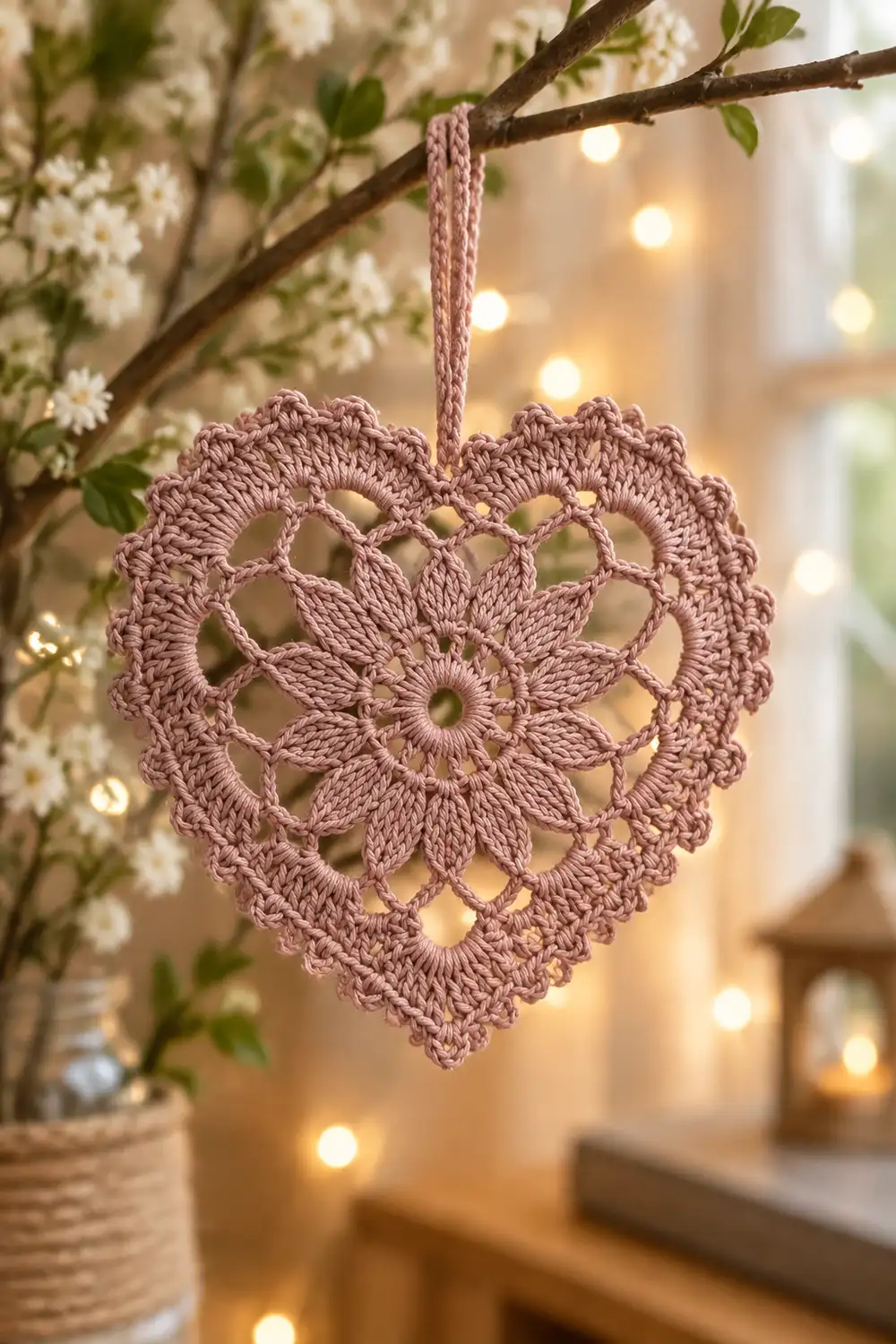
This little heart is all openwork and texture. A small round opening sits at the center, surrounded by twelve slim petals. A ring of airy arches comes next, and a bumpy picot-shell edge traces the classic heart outline. Worked in one dusty rose or mauve color, it looks soft and vintage, especially against warm string lights.
The pattern uses US crochet terms throughout. The finished heart measures 3.75 in (9.5 cm) wide and 3.5 in (8.9 cm) tall after blocking.
Construction is simple to follow. You work one single motif in the round, starting from a center ring. You build the petals and arches as a circle, then shape that circle into a heart in Round 5 by changing stitch heights. Round 6 adds the picot-shell border. There is no seaming and no joining. Blocking sets the final shape.
Finished Size and Construction
- Finished size: 3.75 in (9.5 cm) wide x 3.5 in (8.9 cm) tall
- Skill level: Intermediate (clusters, treble and double treble stitches, picots)
- Terminology: US crochet terms
- Yarn weight: #1 super fine (fingering-weight cotton) or size 3 crochet thread
- Hook: 2.25 mm (US B-1)
- Number of pieces: 1
- Layout: single motif, worked in joined rounds without turning
- Piece size: 3.75 in (9.5 cm) wide x 3.5 in (8.9 cm) tall
- Size before border: 3.25 in (8.3 cm) wide x 3 in (7.6 cm) tall
- Border depth: about 0.25 in (0.6 cm) on every edge
Materials
Yarn advice: Choose a mercerized cotton in fingering weight or size 3 thread. Mercerized cotton shows stitch definition crisply, holds a picot well, and blocks into a sharp heart shape. Avoid fuzzy or very stretchy fibers. They blur the openwork and make the point hard to set.
Color:
– Dusty rose / mauve: 8 g, about 28 m (31 yd)
The heart itself uses about 5 to 6 g. The quantity above includes a margin for your gauge swatch, a possible restart, and weaving in ends.
Tools:
– 2.25 mm (US B-1) crochet hook
– Tapestry needle with an eye small enough for your yarn
– Small scissors
– Ruler or tape measure
– Blocking mat or folded towel
– Rustproof pins
– Spray bottle
Abbreviations (US Terms)
- ch – chain
- sl st – slip stitch
- sc – single crochet
- hdc – half double crochet
- dc – double crochet
- tr – treble crochet (yo twice)
- dtr – double treble crochet (yo 3 times)
- sp – space
- st(s) – stitch(es)
- yo – yarn over
Special stitches:
- 4-tr cluster (4-tr cl): Yo twice, insert hook in the space, pull up a loop, [yo, pull through 2 loops] twice. Repeat from * to * 3 more times in the same space (5 loops on hook). Yo and pull through all 5 loops.
- Beginning cluster (beg cl): Ch 4 (counts as the first leg). Work the 4-tr cl steps only 3 times in the same space (4 loops on hook). Yo and pull through all 4 loops.
- Picot: Ch 3, sl st in the 3rd ch from hook.
- Picot shell (PS): (2 dc, picot, 2 dc) all in the same st or space.
Gauge and Checkpoints
Test the motif first. Work Rounds 1 to 3 and measure them before going further. These three rounds hold most of the tension variation in the pattern.
Gauge: Rounds 1–3 = 2.25 in (5.7 cm) across, measured lightly flattened and unblocked.
Measurement checkpoints (unblocked, across the widest point):
- After Round 1: 0.75 in (1.9 cm)
- After Round 2: 1.25 in (3.2 cm)
- After Round 3: 2.25 in (5.7 cm)
- After Round 4: 2.75 in (7.0 cm)
- After Round 5: 3.25 in (8.3 cm) wide x 3 in (7.6 cm) tall
- After Round 6 and blocking: 3.75 in (9.5 cm) wide x 3.5 in (8.9 cm) tall
If your motif is too big: go down to a 2.0 mm hook, or tighten your chain spaces.
If your motif is too small: go up to a 2.5 mm hook. Also check that your tr legs are pulled up to full height.
A difference of 0.25 in (0.6 cm) at Round 3 grows to roughly 0.5 in (1.3 cm) by the finished edge. Fix it early.
Pattern
Round 1 – Center Ring
Ch 8 and sl st to the first ch to form a ring.
Ch 1 (does not count as a st). Work 24 sc into the ring. Sl st to the first sc.
(24 sc)
Leave a 6 in (15.2 cm) starting tail. Pack the sc evenly around the ring so the center stays a clean, round opening.
Round 2 – Spoke Round
Ch 1, sc in the same st as the join, ch 3, skip next sc. Sc in next sc, ch 3, skip next sc. Repeat from * 10 more times. Sl st to the first sc.
(12 sc, 12 ch-3 sps)
Every other Round 1 sc is skipped: 24 ÷ 2 = 12 spokes.
Round 3 – Petals
Sl st into the first ch-3 sp. Work a beg cl in that same sp, then ch 5. Work a 4-tr cl in the next ch-3 sp, ch 5. Repeat from * 10 more times. Sl st to the top of the beg cl.
(12 clusters, 12 ch-5 sps)
Each cluster forms one slim, ridged petal pointing outward. The ch-5 spaces leave open wedges between the petals.
Checkpoint: 2.25 in (5.7 cm) across.
Round 4 – Arches
Ch 1, sc in the top of the same cluster. Ch 7. Sc in the top of the next cluster, ch 7. Repeat from * 10 more times. Sl st to the first sc.
(12 sc, 12 ch-7 loops)
Each ch-7 arch spans over one ch-5 space below, which creates the large rounded openings.
Label your positions now. The first sc of this round is the top center of the heart (the dip). The ch-7 loops are Loops 1 to 12, counted in your working direction from the top center. The 7th sc sits between Loops 6 and 7, directly opposite the top center. This sc becomes the bottom point.
Place a stitch marker in the top-center sc and another in the 7th sc.
Checkpoint: 2.75 in (7.0 cm) across.
Round 5 – Heart Shaping
In this round you work only into the ch-7 loops, skipping the sc between them. The one exception is the bottom-point sc. Stitch height does the shaping:
- Short stitches next to the top center form the dip.
- Tall stitches build the two lobes.
- Hdc pulls the sides inward.
- A dtr pair with a ch-3 pushes out the point.
Do not ch up. Work directly into Loop 1.
- Loop 1: sc, hdc, 4 dc (6 sts)
- Loop 2: 7 tr (7 sts)
- Loop 3: 7 tr (7 sts)
- Loop 4: 7 dc (7 sts)
- Loop 5: 7 hdc (7 sts)
- Loop 6: 2 dc, 4 tr (6 sts)
- Bottom-point sc: (dtr, ch 3, dtr) (2 sts + ch-3 point sp)
- Loop 7: 4 tr, 2 dc (6 sts)
- Loop 8: 7 hdc (7 sts)
- Loop 9: 7 dc (7 sts)
- Loop 10: 7 tr (7 sts)
- Loop 11: 7 tr (7 sts)
- Loop 12: 4 dc, hdc, sc (6 sts)
Sl st to the first sc of Loop 1. The top-center sc from Round 4 stays unworked below the dip.
Count check:
– Right half (Loops 1–6): 6 + 7 + 7 + 7 + 7 + 6 = 40 sts
– Left half (Loops 7–12): 6 + 7 + 7 + 7 + 7 + 6 = 40 sts
– Point: 2 dtr
(82 sts + 1 ch-3 sp)
The two halves mirror each other stitch for stitch, so the heart comes out symmetrical. Lay the piece flat. It should already read clearly as a heart, even if the lobes look a little soft.
Checkpoint: 3.25 in (8.3 cm) wide x 3 in (7.6 cm) tall.
Border
Border Gauge
The border is worked at the same tension as the motif. There is no change in hook or density.
Along the Round 5 edge, the stitches run at about 8 sts per inch. That puts each half-edge, from dip to point, at about 5 in (12.7 cm). One 4-st border repeat covers about 0.5 in (1.3 cm).
Round 6 – Picot-Shell Edge
Ch 1 (does not count). Sc in the same st as the join, which is the first sc of Loop 1.
Right half:
– Skip next st, PS in next st, skip next st.
– Sc in next st, skip next st, PS in next st, skip next st. Repeat from * 8 more times.
You have now worked 10 repeats over the 40 right-half sts, giving 10 sc and 10 PS.
Point:
– Sc in the first dtr.
– PS in the ch-3 point sp.
– Sc in the second dtr.
Left half:
– Skip next st, PS in next st, skip next st, sc in next st. Repeat from * 9 more times.
That is 10 repeats over the 40 left-half sts. The final sc lands in the last sc of Loop 12. Sl st to the first sc and fasten off, leaving a 6 in (15.2 cm) tail.
Border count:
– Right half: 10 sc + 10 PS (worked 1 element per existing st group, 40 sts used)
– Point: 2 sc (one in each dtr) + 1 PS in the ch-3 sp
– Left half: 10 sc + 10 PS (40 sts used)
(22 sc, 21 picot shells)
Why the Math Works
Each half of Round 5 has exactly 40 sts. The border repeat uses 4 sts, and 40 ÷ 4 = 10, so the repeat fits with nothing left over.
The right half starts with a sc and the left half ends with a sc. This places two sc side by side at the dip, which forms a clean V.
The two dtr each take a sc, and the point gets its own shell. The point stays centered and sharp. Because both halves are identical, the shells line up in mirror image along both sides.
Final Blocking
- Weave in both tails along the back of solid stitches. Do not trim yet.
- Soak the heart in cool water for 5 minutes. Press out the water gently in a towel. Do not wring.
- Lay it right side up on the blocking mat.
- Pin the top dip and the bottom point first, 3.5 in (8.9 cm) apart.
- Pin the widest point of each lobe so the heart measures 3.75 in (9.5 cm) across.
- Pin each picot outward so the shells fan evenly.
- Open the center ring and the arch spaces with your fingertips. Add pins inside the larger openings if needed.
- Mist lightly and let dry completely, usually 12 to 24 hours.
- Unpin and trim the woven tails close.
Final Quality-Control Checklist
- Center opening is round and even, with 24 sc around it.
- 12 petals are evenly spaced, and all clusters are closed fully.
- 12 arches are present and the same length.
- Round 5 has 40 sts on each half, plus 2 dtr at the point.
- Border has 21 picot shells and 22 sc.
- Two sc sit side by side at the top dip.
- Point shell sits centered at the bottom.
- Blocked size is 3.75 in (9.5 cm) wide x 3.5 in (8.9 cm) tall.
- Ends are secure and invisible from the front.
Troubleshooting
Center ring cups or puckers: The ring chain is too short for your yarn, or the sc are bunched. Redo it with a ch 9 ring, still working 24 sc.
Petals curl forward: Your ch-5 spaces are too tight. Loosen your chains, or work ch 6.
Motif ruffles after Round 4: The ch-7 loops are too long for your tension. Try ch 6, keeping the same Round 5 counts.
Heart shape looks round: Check your stitch heights in Round 5. The lobes must be tr and the sides hdc. Pin firmly when blocking.
Point is blunt: Make sure both dtr go into the bottom-point sc, and pin the ch-3 point sharply.
Uneven border shells: Recount each half. Each one should have exactly 40 Round 5 sts. A missing stitch shifts every shell after it.
Picots look flat: Sl st into the 3rd ch from the hook, not into the dc.
Care
Hand wash in cool water with mild soap and lay flat to dry. Re-block with pins if the heart loses its shape.
Final Notes
Everything in this pattern follows a short measurement chain:
- Round 3 sets your gauge at 2.25 in (5.7 cm).
- Round 4 grows the circle to 2.75 in (7.0 cm).
- Round 5 shapes it into a 3.25 in (8.3 cm) x 3 in (7.6 cm) heart, with 40 sts per half.
- Round 6 adds 0.25 in (0.6 cm) of picot shells all around.
- Blocking sets the final 3.75 in (9.5 cm) x 3.5 in (8.9 cm) heart.
Measure at each checkpoint, keep your halves matched, and the shape will take care of itself.
Happy crocheting!