

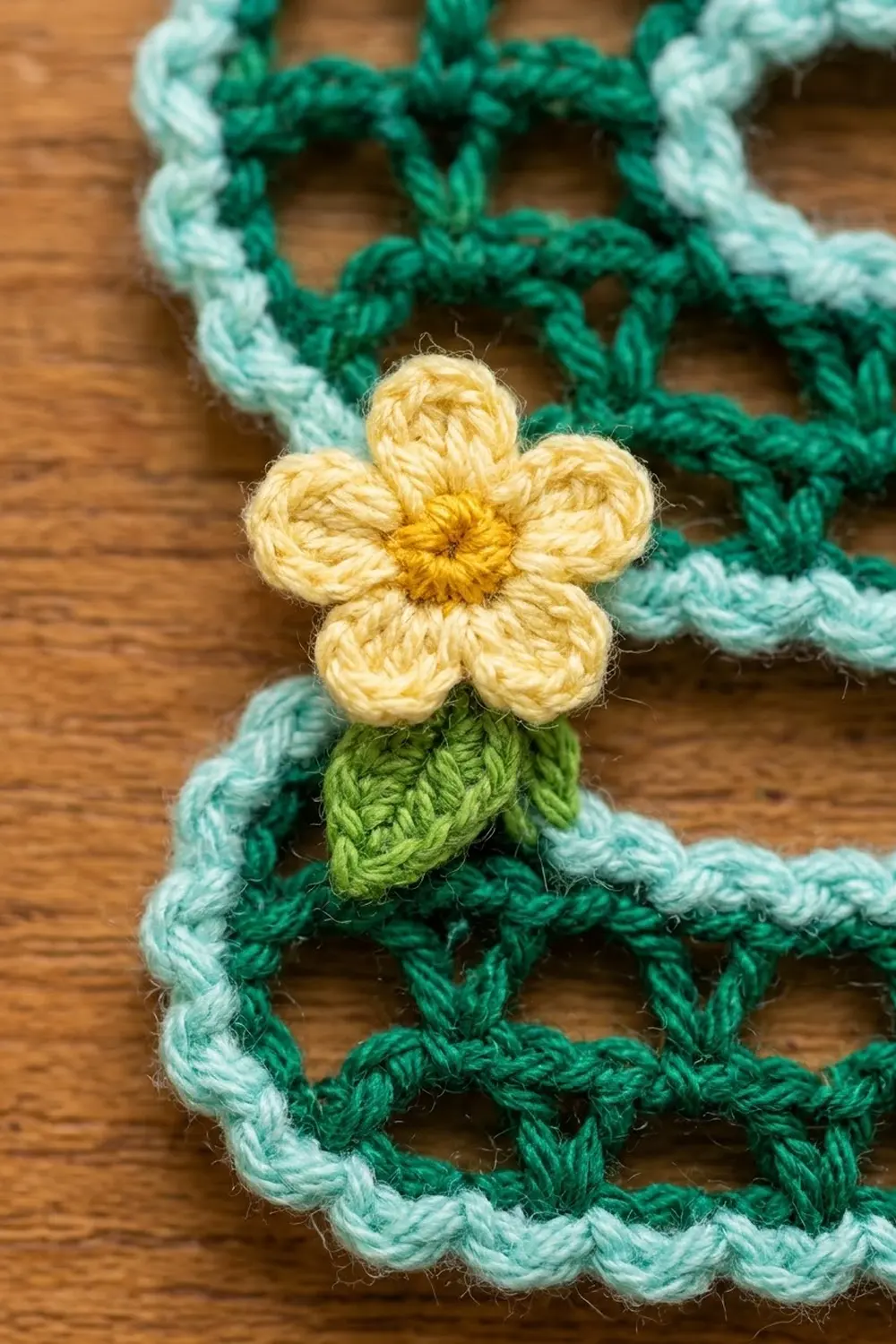
The Garden Script Letter S Keychain is a small, lacy monogram charm for keys, bags and zipper pulls. A dark green V-stitch mesh forms the letter. A light aqua crab-stitch edge outlines every curve, and three tiny pale yellow flowers with spring green leaves sit on the band.
The color palette is fresh and botanical: deep green, soft aqua, butter yellow, golden yellow and leaf green. The open mesh keeps the charm light, and the corded border gives it a crisp outline that holds its shape on a bag.
This pattern uses US crochet terms. The finished S measures 3.5 in (8.9 cm) tall and 2.75 in (7.0 cm) wide, not counting the hardware.
The letter is worked as one straight strip of V-stitch mesh. The aqua border bends it into an S because it puts more stitches along the outer edge of each curve and fewer along the inner edge. Blocking then sets the curves. The flowers and leaves are made separately and sewn on.
Finished Size and Construction
- Finished size: 3.5 in (8.9 cm) tall × 2.75 in (7.0 cm) wide, without hardware
- Skill level: Easy-intermediate
- Terminology: US crochet terms
- Yarn weight: Fingering (Super Fine, #1) cotton, or size 3 crochet thread
- Hook: 2.5 mm (US B/1 or C/2, depending on brand)
- Number of pieces: 1 main S, plus 3 flowers and 5 leaves sewn on as appliqués
- Layout: Single piece, no joining
- Strip size before border: 6.75 in (17.1 cm) long × 0.75 in (1.9 cm) wide
- Border depth: 0.15 in (0.4 cm) on every edge
- Strip size after border, before shaping: 7.05 in (17.9 cm) × 1.05 in (2.7 cm)
Materials
Use a smooth mercerized cotton so the mesh shows clearly and the crab stitch looks like a neat cord. Avoid fuzzy or very stretchy yarns, because they blur the open spaces and let the curves relax.
- Color A, dark green (mesh): 4 g, about 17 m
- Color B, light aqua (border and hanging loop): 3 g, about 13 m
- Color C, pale yellow (petals): 2 g, about 8 m
- Color D, golden yellow (flower centers): 1 g, about 4 m
- Color E, spring green (leaves): 1 g, about 4 m
Tools:
- 2.5 mm crochet hook
- Tapestry needle with a sharp tip
- 1 gold split key ring, 25 mm (1 in)
- 2 gold jump rings, 6 mm
- 2 pairs of flat-nose pliers, for opening the jump rings
- Rust-proof pins and a foam blocking board
- Spray starch or a fabric stiffener (optional)
- Scissors
These quantities include a margin of about 30% for swatching and weaving in ends.
Abbreviations (US Terms)
- ch – chain
- sl st – slip stitch
- sc – single crochet
- hdc – half double crochet
- dc – double crochet
- rev sc – reverse single crochet (crab stitch)
- sp – space
- st(s) – stitch(es)
- MR – magic ring
- RS – right side
V-st (V-stitch): (dc, ch 1, dc) in the stitch or space indicated. Each V-st has 2 dc and 1 ch-1 sp.
Rev sc: Work from left to right (right-handed). Insert the hook into the next stitch to the right, yarn over, pull up a loop, then yarn over and pull through both loops.
Gap: The opening between two neighboring V-sts, or between an end V-st and the edge dc.
Gauge and Checkpoints
Gauge: 10 V-sts = 3 in (7.6 cm) and 4 rows = 1 in (2.5 cm) in V-st mesh. On a straight test edge, 9 sc in Color B = 1 in (2.5 cm).
Gauge matters here because the border math depends on the strip length. Work the full strip first and check it before you add the border.
Checkpoints:
- After Row 1: the strip measures 6.75 in (17.1 cm) long.
- After Row 3: the strip measures 6.75 in (17.1 cm) × 0.75 in (1.9 cm).
- After Border Rnd 2, before shaping: 7.05 in (17.9 cm) × 1.05 in (2.7 cm).
- After blocking: the S measures 3.5 in (8.9 cm) × 2.75 in (7.0 cm).
If the strip is too long: for example, 7.25 in (18.4 cm) or more, change to a 2.25 mm hook. If it is too short: for example, 6.25 in (15.9 cm) or less, change to a 2.75 mm hook. Don’t change the stitch counts. The border depends on exactly 22 V-sts.
Main Pattern: The S Strip
With Color A, ch 70.
Row 1 (RS): V-st in 5th ch from hook. The 4 skipped ch count as the edge dc plus 1 skipped ch. Skip 2 ch, V-st in next ch; repeat from * to * 20 more times. Skip 1 ch, dc in last ch. Turn.
Count: 22 V-sts plus 2 edge dc (46 dc and 22 ch-1 sps).
The chain count works like this: 4 ch for the start, 1 ch for the first V-st, 21 repeats of 3 ch (63 ch), 1 skipped ch and 1 ch for the last dc. That totals 70.
Row 2: Ch 3 (counts as edge dc). V-st in each ch-1 sp across (22 V-sts). Dc in the top of the turning ch. Turn.
Count: 22 V-sts plus 2 edge dc.
Row 3: Repeat Row 2. Fasten off, leaving a 6 in (15.2 cm) tail.
Count: 22 V-sts plus 2 edge dc.
Number the Row 3 V-sts V1 to V22, starting at the ch-3 end of Row 3. V1 to V10 will form the top curve, and V13 to V22 will form the bottom curve.
The V-sts of Row 1 sit in the same columns as those in Row 3. In the free loops of the foundation chain, the base ch of each Row 1 V-st lines up with the matching V-st in Row 3.
Check: the strip should measure 6.75 in (17.1 cm) × 0.75 in (1.9 cm).
Border
The border has two jobs. It frames the mesh, and its uneven stitch spacing bends the strip into an S.
Border gauge: 9 sc = 1 in (2.5 cm) on a straight edge.
The border uses three placement rules. Edge A is the tops of Row 3. Edge B is the free loops of the foundation chain, where the “sp” of each V-st is its base ch.
- Outer rule (4 sc per V-st): 3 sc in the V-st’s sp, then 1 sc in the following gap.
- Middle rule (3 sc per V-st): 2 sc in the V-st’s sp, then 1 sc in the following gap.
- Inner rule (2 sc per V-st): 1 sc in the V-st’s sp, then 1 sc in the following gap.
Rnd 1 (Color B)
With the RS facing, join Color B to the top of the ch-3 at the V1 end of Row 3.
- Corner 1: ch 1, 3 sc in the top of the ch-3 (sts 1–3).
- Edge A, top curve outer edge: 1 sc in the gap before V1 (st 4). Work V1–V10 with the outer rule (40 sc), V11–V12 with the middle rule (6 sc), and V13–V22 with the inner rule (20 sc). The last gap is the one between V22 and the edge dc. Edge A total: 1 + 40 + 6 + 20 = 67 sc (sts 4–70).
- Corner 2: 3 sc in the top of the last dc of Row 3 (sts 71–73).
- End 2: 1 sc around the post of the Row 3 edge dc, 2 sc around the post of the Row 2 edge dc, and 1 sc around the post of the Row 1 edge dc. 4 sc (sts 74–77).
- Corner 3: 3 sc in the foundation ch at the base of the last Row 1 dc (sts 78–80).
- Edge B, bottom curve outer edge: 1 sc in the 1-ch gap before the base of V22 (st 81). Work V22–V13 with the outer rule (40 sc), V12–V11 with the middle rule (6 sc), and V10–V1 with the inner rule (20 sc). The last gap is the single ch before the turning chain. Edge B total: 67 sc (sts 81–147).
- Corner 4: 3 sc in the foundation ch at the base of the Row 1 beginning ch-3 (sts 148–150).
- End 1: 1 sc around the Row 1 edge post, 2 sc around the Row 2 edge post, and 1 sc around the Row 3 edge post. 4 sc (sts 151–154).
Join with a sl st to the first sc.
Count: 3 + 67 + 3 + 4 + 3 + 67 + 3 + 4 = 154 sc.
Rnd 2 (Color B, crab stitch and hanging loop)
Ch 1. Rev sc in each sc around (154 rev sc). When you reach st 26, which is the middle sc of the 3 in V6’s sp, work: rev sc in st 26, ch 6, sl st in the same st 26. This makes the hanging loop. Then continue with rev sc around.
Join with a sl st to the first rev sc and fasten off, leaving a 6 in (15.2 cm) tail.
Count: 154 rev sc plus 1 ch-6 loop.
Why the Math Works
Each edge has 22 V-sts and 23 gaps. Both long edges get the same count: 1 + (10 × 4) + (2 × 3) + (10 × 2) = 67 sc. This keeps the border balanced overall.
Along the top curve, Edge A has 4 sc per V-st and Edge B has 2. At 9 sc per inch, the outer edge is about 4.4 in (11.2 cm) and the inner edge is about 2.2 in (5.6 cm). The longer outer edge pushes the band into a curve. Along the bottom curve the pattern swaps sides, so the band bends the other way, which makes the S. V11–V12 have 3 sc on each side and form the straight diagonal in the middle.
Each rounded end gets 3 + 4 + 3 = 10 sc. That gives enough length to round the end without ruffling it. The corners are counted once each, inside these totals.
Flowers (Make 3)
Rnd 1 (Color D): MR, ch 1, 5 sc in ring. Pull the ring closed and join with a sl st to the first sc. Fasten off.
Count: 5 sc.
Rnd 2 (Color C): Join with a sl st in any sc. (Ch 2, 3 dc, ch 2, sl st) in the same sc, sl st in the next sc. Repeat from * to * 4 more times, working the last sl st into the joining st.
Count: 5 petals (15 dc).
Fasten off, leaving an 8 in (20.3 cm) tail for sewing. Each flower measures about 0.7 in (1.8 cm) across.
Leaves (Make 5)
With Color E, ch 5.
Working in the back bumps: sl st in 2nd ch from hook, sc in next ch, hdc in next ch, sc in last ch. For the tip: ch 2, sl st in 2nd ch from hook.
Working along the other side of the foundation chain: sc in the first ch, hdc in the next ch, sc in the next ch, sl st in the last ch.
Fasten off, leaving a 6 in (15.2 cm) tail. Each leaf measures about 0.45 in (1.1 cm) long.
Final Blocking
- Weave in all mesh and border ends along the backs of the border stitches. Leave the flower and leaf tails for sewing.
- Dampen the S. Press it gently in a towel. Don’t wring it.
- On the blocking board, draw or print an S outline that is 3.5 in (8.9 cm) tall and 2.75 in (7.0 cm) wide.
- Lay the strip on the outline with Edge A on the outside of the top curve and Edge B on the outside of the bottom curve. Put the hanging loop at the top.
- Pin through the border every 0.5 in (1.3 cm), starting with the outer edges. Ease the inner edges so the mesh opens evenly without puckering.
- Open each V-st space with a pin tip so the mesh looks even.
- Spray with starch or stiffener if you want a firmer charm. Let it dry completely, about 6–8 hours.
- Unpin it. Sew on the flowers and leaves:
- Top flower: on the curled top end, over V1–V2, with one leaf on each side.
- Left flower: on the curled bottom end, over V21–V22, with one leaf below it.
- Bottom-right flower: on the outer bottom curve, around V15–V16, with one leaf on each side.
Tuck each leaf under the edge of its petals. Sew through the back loops of the mesh only, so the stitches don’t show. - With pliers, open one jump ring and pass it through the ch-6 loop. Link the second jump ring to it, attach the split key ring, and close both jump rings fully.
Final Quality-Control Checklist
- Row 3 has exactly 22 V-sts plus 2 edge dc.
- Each long edge of Border Rnd 1 has 67 sc, and Rnd 1 has 154 sc in total.
- Rnd 2 has 154 rev sc and the ch-6 loop sits at st 26.
- The finished S measures 3.5 in (8.9 cm) × 2.75 in (7.0 cm).
- Both ends are evenly rounded, with no pointed corners.
- The mesh spaces are open and evenly sized.
- The flowers and leaves are firmly sewn, with no stitches showing on the front.
- The jump rings are fully closed, with no gaps.
Troubleshooting
The strip twists: This is common with long, narrow chains. Check that you didn’t twist the foundation chain in Row 1. Blocking corrects a slight twist.
The S won’t curve: Recount the outer and inner rules on each edge. If Edge A has the same count on both curves, the strip will stay straight.
The outer edge ruffles: Your border is looser than the gauge. Go down 0.25 mm in hook size for Rnd 1 only.
The inner edge puckers: Ease it with pins while it’s damp, or work the inner-rule sc slightly looser.
The crab stitch looks uneven: Keep each loop short and pull the final yarn-over snugly.
The flowers look floppy: Pull the MR tightly closed and work the petal dc firmly.
Care
Hand wash in cool water with mild soap, press out the water in a towel, and reshape it flat to dry. Remove the metal hardware before washing so it doesn’t tarnish.

Final Notes
Each measurement in this pattern builds on the one before it. The 22 V-sts at 10 V-sts per 3 in (7.6 cm) give a strip of 6.75 in (17.1 cm) × 0.75 in (1.9 cm). The 0.15 in (0.4 cm) border brings it to 7.05 in (17.9 cm) × 1.05 in (2.7 cm). The 4-versus-2 stitch rule on each edge bends the strip into an S, and blocking sets it at 3.5 in (8.9 cm) × 2.75 in (7.0 cm). If your gauge matches at the strip stage, everything after it will fit.
Happy crocheting!