

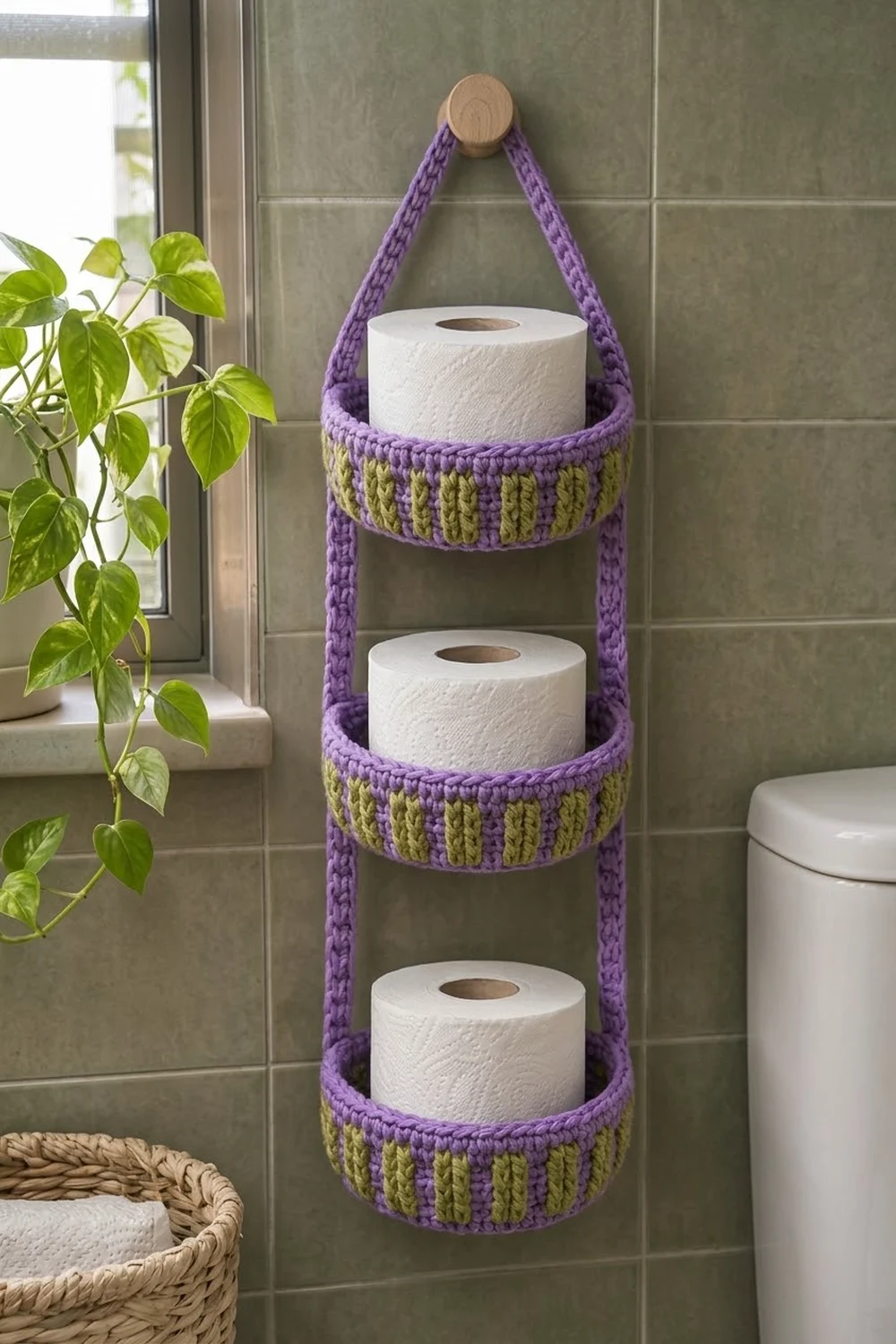
This hanging holder stacks three spare toilet rolls in a neat vertical column. Three shallow round baskets hang one above the other on two firm straps, and the straps meet at the top in a triangular loop that fits over a hook or wall knob.
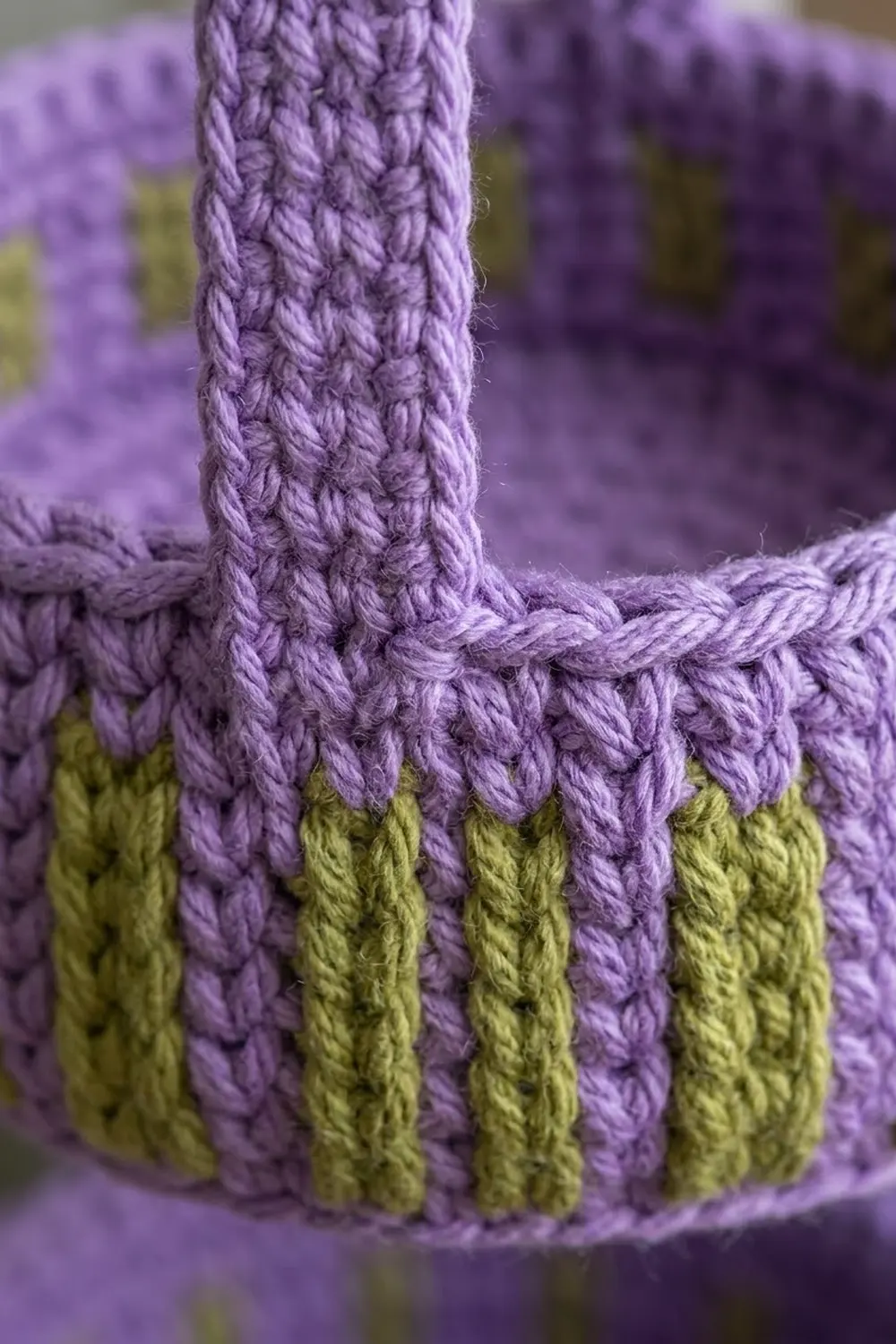
The main color is a soft lavender. The basket walls have olive green columns worked in waistcoat stitch, so they look almost knitted. A short green tick sits above each column, and a rounded crab-stitch rim finishes each basket. The overall look is calm and tidy, with a touch of retro.
This pattern uses US crochet terms. The finished holder is about 6 in (15.2 cm) wide and 19.5 in (49.5 cm) tall from the bottom basket to the top of the loop. Each basket is 5.5 in (14.0 cm) across and 2.75 in (7.0 cm) tall.
You will crochet three baskets from the base up, then two straps in rows. Each strap is sewn to the outside of all three baskets, and the strap tops are overlapped to close the loop. To finish, you add a rim to each basket and a slip-stitch edging to the loop.
Finished Size and Construction
- Finished size: about 6 in (15.2 cm) wide x 19.5 in (49.5 cm) tall
- Skill level: Intermediate (tapestry color changes, waistcoat stitch)
- Terminology: US crochet terms
- Yarn weight: worsted / #4 medium, 100% cotton
- Hook: 4.0 mm (G-6)
- Number of pieces: 5 (3 baskets, 2 straps)
- Layout: baskets stacked vertically in one column, straps on opposite sides
- Piece size: basket 5.5 in (14.0 cm) diameter x 2.75 in (7.0 cm) tall; strap 21 in (53.3 cm) x 1 in (2.5 cm)
- Size before border: basket wall 2.6 in (6.6 cm) tall
- Border depth: basket rim adds 0.15 in (0.4 cm); the loop edging adds about 1/8 in (0.3 cm)
- Tier spacing: about 5.5 in (14.0 cm) from one basket base to the next
Materials
Use a firm, smooth cotton. Cotton holds the basket shape and does not stretch under the weight of the rolls. Avoid acrylic blends and anything fuzzy, because they soften the stitch definition and can make the walls sag.
- Lavender (main color): 200 g, about 310 m
- Olive green (contrast): 50 g, about 80 m
These quantities include a safety margin of about 20%.
Tools:
- 4.0 mm (G-6) crochet hook
- Tapestry needle
- 4 stitch markers
- Scissors
- Rustproof pins or locking clips
- Tape measure
- A jar or canister about 5.25 in (13.3 cm) across, for blocking
Abbreviations (US Terms)
- ch – chain
- sc – single crochet
- inc – 2 sc in the same stitch
- sl st – slip stitch
- BLO – back loop only
- MR – magic ring
- st(s) – stitch(es)
- rnd(s) – round(s)
- wst – waistcoat stitch
- rev sc – reverse single crochet (crab stitch)
Waistcoat stitch (wst): Insert your hook through the center of the next stitch, between the two front legs of its “V” and under the horizontal strands. Then yarn over, pull up a loop, yarn over, and pull through both loops. Each wst stacks directly above the one below, which is what creates the straight vertical columns.
Reverse single crochet (rev sc): Work from left to right. Insert the hook into the next stitch to the right, pull up a loop, yarn over, and pull through both loops.
Tapestry color change: Finish the last stitch of the old color with the new color on the final yarn-over. Carry the unused strand along the top of the round and work over it so it stays hidden inside the stitches.
Gauge and Checkpoints
Gauge: 18 sc and 20 rnds = 4 in (10.2 cm) in sc worked in the round.
Make one basket base first and treat it as your gauge swatch.
- After Rnd 7 (42 sts): base measures 3 in (7.6 cm) across.
- After Rnd 10 (60 sts): base measures 4.25 in (10.8 cm).
- After Rnd 13 (78 sts): base measures 5.5 in (14.0 cm).
- After wall Rnd W13: wall is 2.6 in (6.6 cm) tall.
If your base is larger than 5.75 in (14.6 cm), go down a hook size. If it is smaller than 5.25 in (13.3 cm), go up a hook size. Don’t add or remove rounds, because the wall pattern needs exactly 78 stitches.
If the base cups like a bowl, your tension is tight. If it ruffles, your tension is loose. Adjust before you go on.
Basket (Make 3)
Work in continuous spirals and don’t join the rounds. Place a marker in the first stitch of each round and move it up as you go.
Base
With lavender:
- Rnd 1: 6 sc in MR. (6)
- Rnd 2: inc in each st around. (12)
- Rnd 3: [sc 1, inc] 6 times. (18)
- Rnd 4: [sc 2, inc] 6 times. (24)
- Rnd 5: [sc 3, inc] 6 times. (30)
- Rnd 6: [sc 4, inc] 6 times. (36)
- Rnd 7: [sc 5, inc] 6 times. (42)
- Rnd 8: [sc 6, inc] 6 times. (48)
- Rnd 9: [sc 7, inc] 6 times. (54)
- Rnd 10: [sc 8, inc] 6 times. (60)
- Rnd 11: [sc 9, inc] 6 times. (66)
- Rnd 12: [sc 10, inc] 6 times. (72)
- Rnd 13: [sc 11, inc] 6 times. (78)
From Rnd 6 onward, move the increases a few stitches along in every other round. For example, work Rnd 7 as sc 2, inc, [sc 5, inc] 5 times, sc 3. This keeps the circle round rather than hexagonal. The stitch counts stay the same.
Wall
The wall uses no increases. Every round has 78 stitches.
- Rnd W1: with lavender, sc in BLO of each st around. (78) This round folds the edge upward and makes a crisp base line.
- Rnd W2: wst in each st around. (78)
Join olive green with a tapestry color change. Carry the color you’re not using in every colorwork round.
- Rnds W3–W8: [3 wst green, 3 wst lavender] 13 times. (78 per round) These 6 rounds form the tall green bars.
- Rnd W9: with lavender, wst in each st around, carrying green. (78)
- Rnds W10–W11: [1 wst lavender, 1 wst green, 4 wst lavender] 13 times. (78 per round) Each green tick sits over the middle stitch of a bar.
- Fasten off green and weave in the tail on the inside.
- Rnds W12–W13: with lavender, wst in each st around. (78)
Sl st in the next st and leave the working loop on a marker. You’ll work the rim in the Border section.
Checkpoint: the wall is 2.6 in (6.6 cm) tall and stands upright without flaring.
Strap (Make 2)
With lavender, work in rows along the length of the strap.
- Foundation: ch 95.
- Row 1: sc in 2nd ch from hook and in each ch across. (94)
- Rows 2–5: ch 1, turn, sc in each st across. (94)
Fasten off and leave a 20 in (50.8 cm) tail for sewing.
Checkpoint: the strap measures 21 in (53.3 cm) x 1 in (2.5 cm).
Number the stitches of Row 5 from 1 at the starting end to 94 at the far end. Mark these points with removable markers or contrast thread:
- Bottom basket zone: sts 1–12
- Middle basket zone: sts 26–37
- Top basket zone: sts 51–62
- Free leg: sts 63–89
- Overlap: sts 90–94
Each 12-stitch zone is about 2.6 in (6.6 cm), which matches the wall height before the rim. The gap from the start of one zone to the start of the next is 25 sts, or about 5.5 in (14.0 cm).
Make All Pieces
- Lavender: 3 bases, 3 walls (main color), 2 straps
- Olive green: colorwork rounds W3–W11 on all 3 baskets
Layout, viewed from the front:
          /\        <- loop: straps overlap at the apex
         /  \
        /    \      <- free legs, 27 sts each
       |[ B3 ]|     <- top basket, strap sts 51-62
       |      |
       |[ B2 ]|     <- middle basket, strap sts 26-37
       |      |
       |[ B1 ]|     <- bottom basket, strap sts 1-12
   Strap A    Strap B
Joining
Placing the straps: On each basket, mark two wall columns 39 sts apart. That puts them exactly opposite each other, because 39 is half of 78. Center Strap A over one marked column and Strap B over the other. The strap’s wrong side faces the wall.
Bottom basket: Line up strap st 1 with base Rnd W1. Strap sts 1–12 run up the wall to Rnd W13. Whipstitch both long edges of the strap to the wall, one stitch for each wall round, to give 13 stitches per edge. Tack the strap’s short bottom end to the W1 ridge.
Middle and top baskets: Sew them the same way, using sts 26–37 and sts 51–62. Keep the rim round free on every basket.
Tension: Pull each whipstitch snug but not tight. If you over-tighten, the wall puckers and the strap ripples. Check that the green columns stay straight and vertical behind the strap.
Closing the loop: Bring the two free ends together above the top basket. Make sure neither strap is twisted. Lay sts 90–94 of Strap A over sts 90–94 of Strap B, an overlap of 1.1 in (2.8 cm). Whipstitch around all four edges of the overlap, then sew an X through the center for strength.
Size checkpoint: Hang the holder up. The gap from the rim of one basket to the base of the next should be about 2.75 in (7.0 cm). Each free leg should measure 6 in (15.2 cm), and the loop should peak about 5 in (12.7 cm) above the top basket.
Border
The border has two parts. Both use the same rule: one border stitch per existing stitch, so the edges stay the same length.
Border gauge: 18 rev sc = 4 in (10.2 cm), the same as the base gauge.
Basket Rims (each basket)
- Rnd R1: put the held loop back on your hook. Ch 1, rev sc in each st around. (78) Sl st to the first rev sc and fasten off.
Rnd W13 has 78 sts, so 78 rev sc fits it exactly. The rim adds 0.15 in (0.4 cm), which brings the wall to 2.75 in (7.0 cm).
Loop Edging
Join lavender at strap st 63 on the outer edge of Strap A.
- Outer edge of leg A: sl st in each st from st 63 to st 89. (27)
- Apex: sl st along the outer edge of the overlap, sts 90–94. (5)
- Outer edge of leg B: sl st from st 89 back down to st 63. (27)
Fasten off. Repeat along the inner edge with the same counts, for 59 sts per edge.
Each leg has 27 sts and the overlap has 5, so 27 + 5 + 27 = 59 sl sts per edge. That matches the stitches already there, so the edging won’t gather or ruffle the loop.
Final Blocking
- Mist each basket until it is damp, not soaked.
- Slide each basket over the blocking jar so that the base lies flat and the wall stands straight.
- Straighten the green columns by pressing them gently with your fingertips.
- Pin the loop flat into a neat triangle on a blocking mat.
- Leave everything to dry completely, for at least 12 hours.
- Remove the pins and hang the holder to check that it sits straight.
Final Quality-Control Checklist
- Every base and wall round has 78 stitches.
- All three bases measure 5.5 in (14.0 cm).
- The green bars are 3 sts wide, there are 13 of them per basket, and the ticks are centered above them.
- The straps sit exactly opposite each other, 39 sts apart.
- The baskets are evenly spaced, about 5.5 in (14.0 cm) from base to base.
- The rims are free of the straps and fully crab-stitched.
- Neither strap is twisted, and the loop is symmetrical.
- All tails are woven in on the inside.
Troubleshooting
- Base cups: your tension is too tight, so go up a hook size.
- Base ruffles: your tension is too loose, or you made extra increases. Recount each round.
- Columns lean: this is normal spiral drift. Move the start marker back one stitch every 4 rounds.
- Carried yarn shows through: keep the carried strand slack, and work over it rather than beside it.
- Wall flares outward: you may have missed the BLO round, or your waistcoat stitches are loose. Try a 3.75 mm hook for the wall.
- Holder tilts: the straps aren’t exactly opposite. Recount the 39 sts and re-sew.
- Basket sags: check that the whipstitching covers all 13 wall rounds.
Care
Hand wash in cool water and lay flat to dry, reshaping each basket over its jar. Don’t tumble dry.
Final Notes
Everything starts from gauge: 18 sc to 4 in (10.2 cm) gives a 78-stitch base 5.5 in (14.0 cm) across. Thirteen wall rounds make it 2.6 in (6.6 cm) tall, and the rim brings it to 2.75 in (7.0 cm). Each 94-stitch strap carries three 12-stitch zones 25 sts apart, and the two 27-stitch legs meet at a 5-stitch overlap. If every count matches, the holder hangs straight and holds rolls up to 4.5 in (11.4 cm) across.
Happy crocheting!