
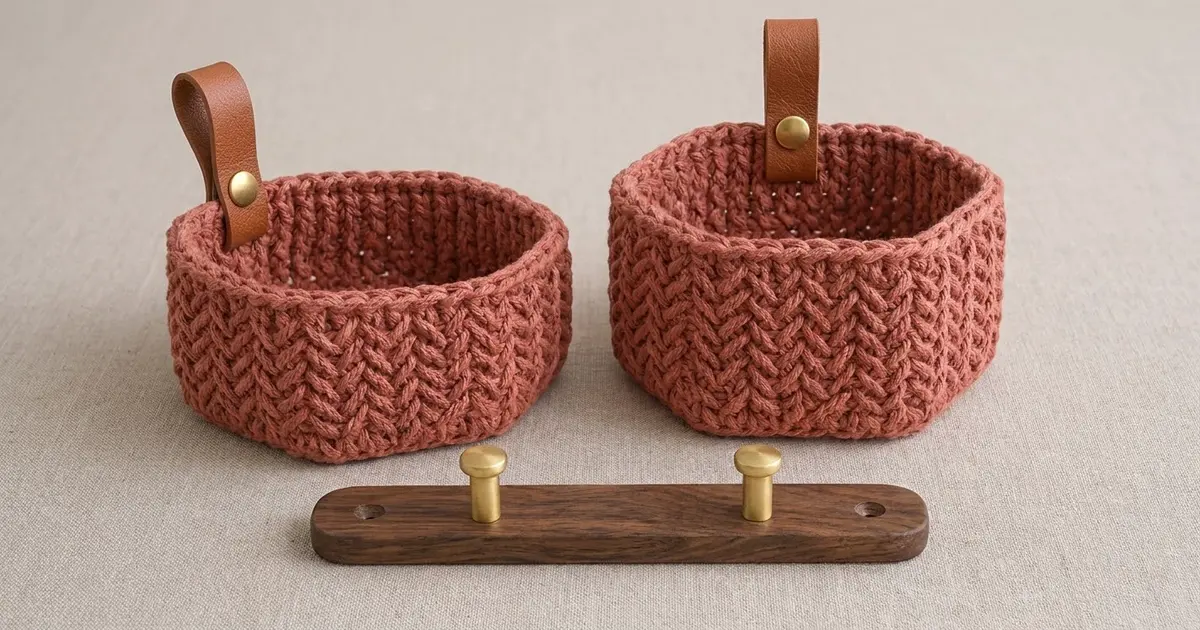
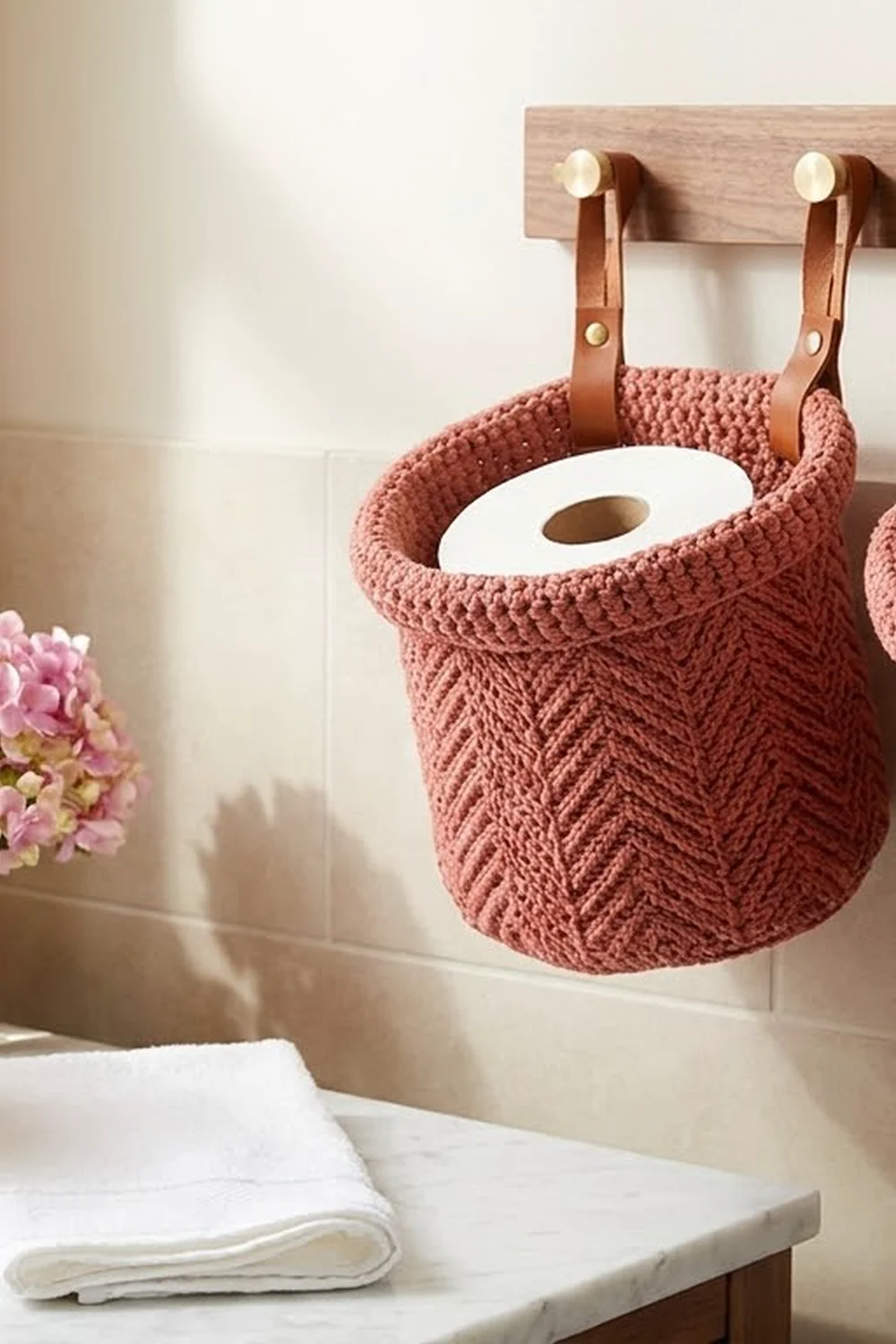
These hanging baskets are small, sturdy hexagons in a warm terracotta-rose cotton. Each one has a flat single crochet base with six crisp corners, straight walls in a dense herringbone texture, and a neat rolled rim. A cognac leather strap with a brass rivet holds each basket to a walnut rail with brass knobs. That makes them a tidy home for a spare toilet roll, washcloths, or small bathroom supplies.
The style is simple and modern. You use one yarn color, and the leather, brass, and wood add the accents. The herringbone wall stitch gives the baskets a woven, basket-weave look. It is also firm enough to hold its shape without a plastic insert.
This pattern uses US crochet terms. Each finished basket is about 6.4 in (16.3 cm) from corner to corner, 5.5 in (14.0 cm) from one flat side to the opposite flat side, and 3.5 in (8.9 cm) tall.
Each basket is crocheted in one piece. You work the hexagon base in joined rounds, turn the edge up with a back-loop round, work the walls in turned rounds of herringbone half double crochet, and finish with a two-round rim. You make two identical baskets. They are never sewn together, and each one hangs on its own leather strap.
Finished Size and Construction
- Finished size (each basket): 6.4 in (16.3 cm) corner to corner, 5.5 in (14.0 cm) flat side to flat side, 3.5 in (8.9 cm) tall
- Skill level: Easy to intermediate
- Terminology: US crochet terms
- Yarn weight: Aran / worsted (#4) cotton
- Hook: 4.5 mm (US 7)
- Number of pieces: 2 separate baskets (not joined to each other)
- Layout: 2 baskets side by side, each on its own strap and knob
- Piece size (base): 72 stitches, 12 stitches per side, each side about 3.2 in (8.1 cm) long
- Size before border (wall height): 3.0 in (7.6 cm)
- Border depth (rim): 0.5 in (1.3 cm)
Materials
Choose a smooth, tightly plied cotton or cotton blend in Aran or heavy worsted weight. Cotton holds the hexagon corners well and does not stretch much under the weight of a roll. Avoid soft, loosely spun acrylic, because the walls will slump.
- Terracotta rose: 150 g (about 255 m / 279 yd) in total. Each basket uses about 65 g (110 m / 120 yd).
These quantities include a margin for your gauge swatch and for small differences in tension.
Tools and hardware:
- 4.5 mm (US 7) crochet hook
- Stitch marker
- Tapestry needle and scissors
- 2 leather straps, 0.75 in (1.9 cm) wide and 10 in (25.4 cm) long, in cognac or tan
- 2 brass double-cap rivets and a rivet setter, or 2 brass Chicago screws
- Leather hole punch
- 1 walnut or hardwood rail, about 16 in (40.6 cm) long, with 2 brass knobs and wall screws
- Spray bottle, pins, and a hexagon-shaped box or cardboard form for blocking
Abbreviations (US Terms)
- ch – chain
- sl st – slip stitch
- sc – single crochet
- inc – 2 sc in the same stitch
- BLO – back loop only
- rev sc – reverse single crochet (crab stitch)
- hhdc – herringbone half double crochet
- MR – magic ring
- st(s) – stitch(es)
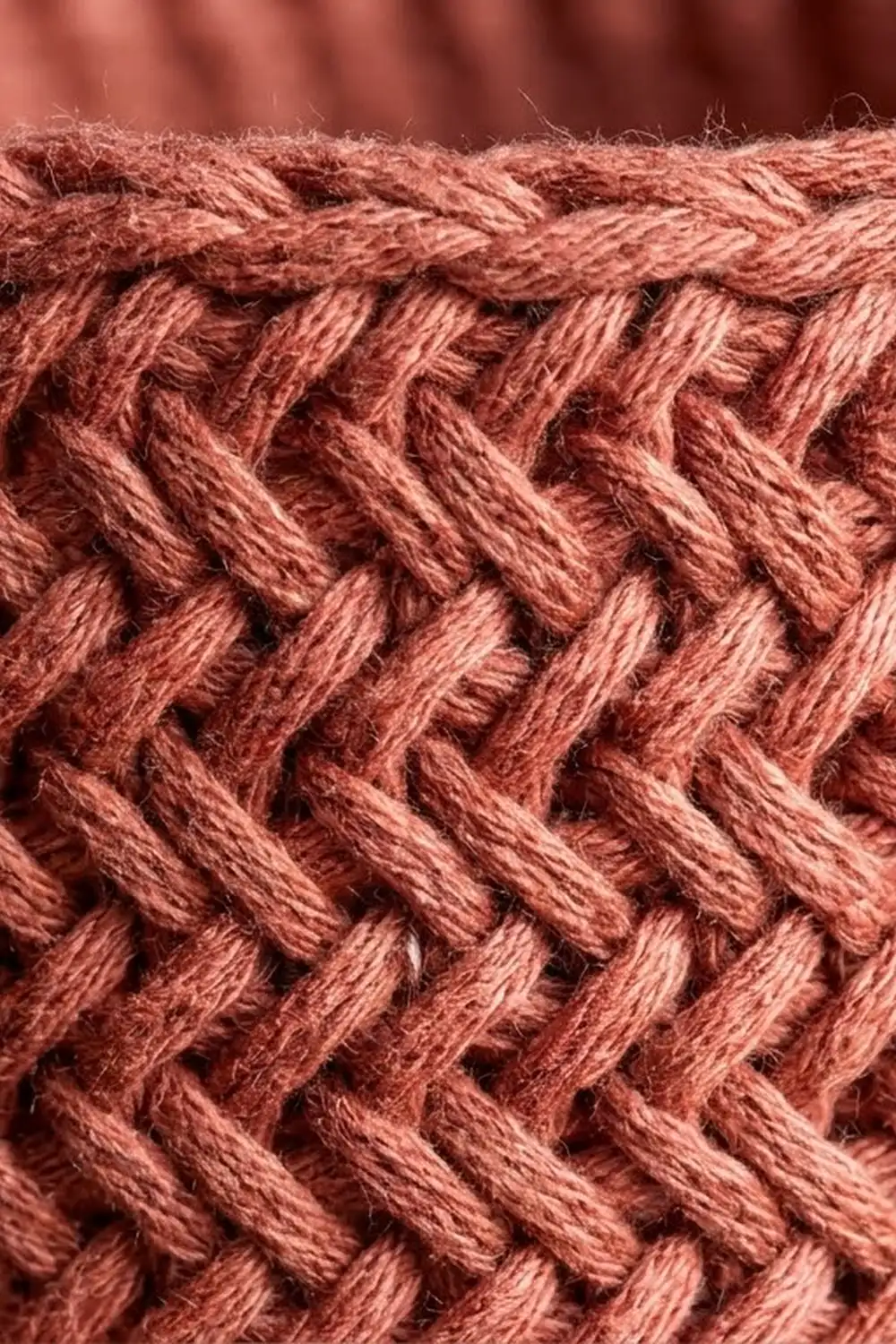
Herringbone half double crochet (hhdc): Yarn over and insert the hook into the next stitch. Yarn over, pull up a loop, and draw that loop straight through the first loop on the hook (2 loops remain). Yarn over and draw through both loops. This makes a short, slanted stitch. When you turn every round, the slant changes direction, and that builds the herringbone zigzag on the walls.
Gauge and Checkpoints
- Single crochet base: 15 sts and 17 rounds = 4 in (10.2 cm)
- Herringbone walls: 15 sts and 13 rounds = 4 in (10.2 cm)
Both fabrics have the same number of stitches per inch. This matters because the walls sit directly on the edge of the base, so the base perimeter and the wall perimeter must match.
Test one piece first. Crochet the base of your first basket before you buy all your yarn or hardware, and measure at each checkpoint:
- After Round 6 (36 sts): about 2.8 in (7.1 cm) flat side to flat side, each side about 1.6 in (4.1 cm)
- After Round 12 (72 sts): about 5.5 in (14.0 cm) flat side to flat side, 6.4 in (16.3 cm) corner to corner, each side about 3.2 in (8.1 cm)
- After Round 22 (top of herringbone): walls about 3.0 in (7.6 cm) tall, measured from the base fold
- After Round 24 (rim): total height about 3.5 in (8.9 cm)
If your base is too big, or the fabric looks loose and holey, change to a 4.0 mm hook. If it is too small, or the base cups upward, change to a 5.0 mm hook. Do not change the stitch counts. The basket needs dense fabric to stand up, so if in doubt, go tighter.
Base (Make 2)
Work in joined rounds with the right side facing you, and do not turn. The ch 1 at the start of each round does not count as a stitch. Join each round with a sl st to the first sc. Work each increase directly on top of an increase from the round before. This builds six straight sides and six corners.
Round 1: Make a MR, ch 1, 6 sc in the ring, join. (6 sts)
Round 2: Ch 1, inc in each st around, join. (12 sts)
Round 3: Ch 1, (sc in next st, inc in next st) 6 times, join. (18 sts)
Round 4: Ch 1, (sc in next 2 sts, inc in next st) 6 times, join. (24 sts)
Round 5: Ch 1, (sc in next 3 sts, inc in next st) 6 times, join. (30 sts)
Round 6: Ch 1, (sc in next 4 sts, inc in next st) 6 times, join. (36 sts)
Checkpoint: the piece should already show six faint corners and measure about 2.8 in (7.1 cm) flat side to flat side.
Round 7: Ch 1, (sc in next 5 sts, inc in next st) 6 times, join. (42 sts)
Round 8: Ch 1, (sc in next 6 sts, inc in next st) 6 times, join. (48 sts)
Round 9: Ch 1, (sc in next 7 sts, inc in next st) 6 times, join. (54 sts)
Round 10: Ch 1, (sc in next 8 sts, inc in next st) 6 times, join. (60 sts)
Round 11: Ch 1, (sc in next 9 sts, inc in next st) 6 times, join. (66 sts)
Round 12: Ch 1, (sc in next 10 sts, inc in next st) 6 times, join. (72 sts)
Each repeat in Round 12 is 12 stitches: 10 single sc plus the 2 sc of the increase. So each of the six sides has 12 stitches, and that count already includes the corner stitches. Lay the base flat and check that it is smooth, with no cupping or rippling.
Walls (Make 2)
Round 13 (turning round): Ch 1, sc BLO in each st around, join. (72 sts)
The unused front loops form a sharp ridge, which turns the edge up into the basket wall. Do not increase from here on, so the walls go straight up.
Round 14: Ch 1, turn, hhdc in each st around, join with a sl st to the first hhdc. (72 sts)
Rounds 15–22: Repeat Round 14 eight more times, turning at the start of every round. (72 sts in each round)
You now have 9 rounds of herringbone. Turning every round reverses the slant of the stitches, which creates the zigzag texture. It also keeps the join line from drifting diagonally around the basket. The walls should measure about 3.0 in (7.6 cm) from the base fold. The wall circumference should be about 19.2 in (48.8 cm), the same as the base perimeter.
Make Both Baskets
Work the base and walls twice.
- Terracotta rose: 2 baskets, about 65 g (110 m / 120 yd) each
Layout on the rail (front view):
[ knob ]--------[ knob ]
   |                |
[Basket 1]      [Basket 2]
Place the knobs 8 in (20.3 cm) apart, center to center. Each basket is 6.4 in (16.3 cm) wide from corner to corner, which leaves a gap of about 1.6 in (4.1 cm) between the baskets.
Border (Rim)
The rim uses the same single crochet gauge as the base: 15 sts = 4 in (10.2 cm). You work it into the same 72 stitches as the walls, so each side keeps 12 stitches.
Round 23: Ch 1, turn, sc in each st around, join. (72 sts; 12 sts per side)
Round 24: Ch 1. With the outside of the basket facing you (turn if needed), rev sc in each st around, working from left to right. Join with a sl st to the first st. (72 sts; 12 sts per side) Fasten off and weave in all ends on the inside.
Why the math works: The base finishes at 6 sides × 12 sts = 72 sts. The turning round, all nine wall rounds, and both rim rounds keep exactly 72 sts, so each side still has 12 sts at the top. At 15 sts per 4 in (10.2 cm), 12 sts measure 3.2 in (8.1 cm), so each rim side matches its base side. That keeps the walls straight instead of flaring out or pulling in. The rev sc twists each stitch into a rounded cord, which gives the rim its rolled look and adds about 0.5 in (1.3 cm) of height. That brings the total to 3.5 in (8.9 cm).
Hanging Assembly (No Crochet Joining)
The two baskets are not joined to each other. Each one hangs from its own strap.
Method: Punch a hole about 0.5 in (1.3 cm) from one end of each strap for the knob. Punch a second hole 1.5 in (3.8 cm) from the other end for the rivet.
Stitch logic: Choose one side of each basket as the back. It has 12 stitches, and its center is the gap between stitch 6 and stitch 7. Lay the rivet end of the strap against the inside of the back wall, centered on that gap. Bring the strap up over the rim, with the rivet hole 1.5 in (3.8 cm) below the top of the rim. The 0.75 in (1.9 cm) strap covers about 3 stitches. Push the rivet post through the leather and between the wall stitches without cutting the yarn, then set the cap on the outside.
Tension advice: Do not pull the strap tight over the rim. Let it lie flat with no gap, so the weight spreads across the rolled rim instead of resting only on the rivet.
Size checkpoint: Mount the rail level and hang both baskets. Check that their rims are level with each other and that the gap between them is about 1.6 in (4.1 cm).
Final Blocking
- Turn each basket right side out and push all the corners outward.
- Mist the basket evenly with water until it is damp but not soaking.
- Slide a hexagon box or cardboard form inside the basket. It should be about 5.5 in (14.0 cm) from flat side to flat side.
- Pinch each of the six corners from the base fold up to the rim to sharpen them.
- Press the base flat against a towel and make sure the walls stand straight up.
- Leave the basket on the form until it is completely dry, about 24 hours.
- Optional: brush a light coat of diluted fabric stiffener on the inside of the walls and let it dry on the form again.
Final Quality-Control Checklist
- Base Round 12 has 72 sts, with 12 sts per side
- The base lies flat and shows six clear corners
- The BLO ridge makes a crisp fold all the way around
- Every wall round has 72 sts, and the walls are about 3.0 in (7.6 cm) tall
- The herringbone slant changes direction every round
- The rim has 72 sts, is evenly rolled, and brings the total height to 3.5 in (8.9 cm)
- The two baskets match in size to within 0.25 in (0.6 cm)
- Each strap is centered on the back side and riveted 1.5 in (3.8 cm) below the rim
- All ends are woven in on the inside
Troubleshooting
- The base cups like a bowl: Your stitches are too tight for the increases. Go up one hook size or loosen your sc.
- The base ruffles: Your stitches are too loose. Go down one hook size.
- The corners are rounded, not pointed: Make sure each increase sits directly above an increase from the round before. Block over a hexagon form.
- The walls flare out: Your hhdc is looser than your sc. Use a hook 0.5 mm smaller for the walls only.
- The walls lean inward: You may be missing the last stitch before the join. Count to 72 every round.
- The join line slants: Turn every round as written.
- The basket sags at the strap: Add a small square of leather behind the rivet on the outside as a backing.
Care
Remove the straps and hand wash in cool water with mild soap. Reshape the basket over the blocking form and let it dry.
Final Notes
The measurement chain is short. Make a base of 72 sts (12 per side) that measures 5.5 in (14.0 cm) flat side to flat side. Add a turning round and nine straight herringbone rounds to reach 3.0 in (7.6 cm), then a two-round rim to reach 3.5 in (8.9 cm). Each side keeps 12 sts from base to rim, so the walls rise straight and the hexagon holds its crisp shape. Check your gauge on the first base and keep the count at 72, and your two baskets will hang level on the rail.
Happy crocheting!