

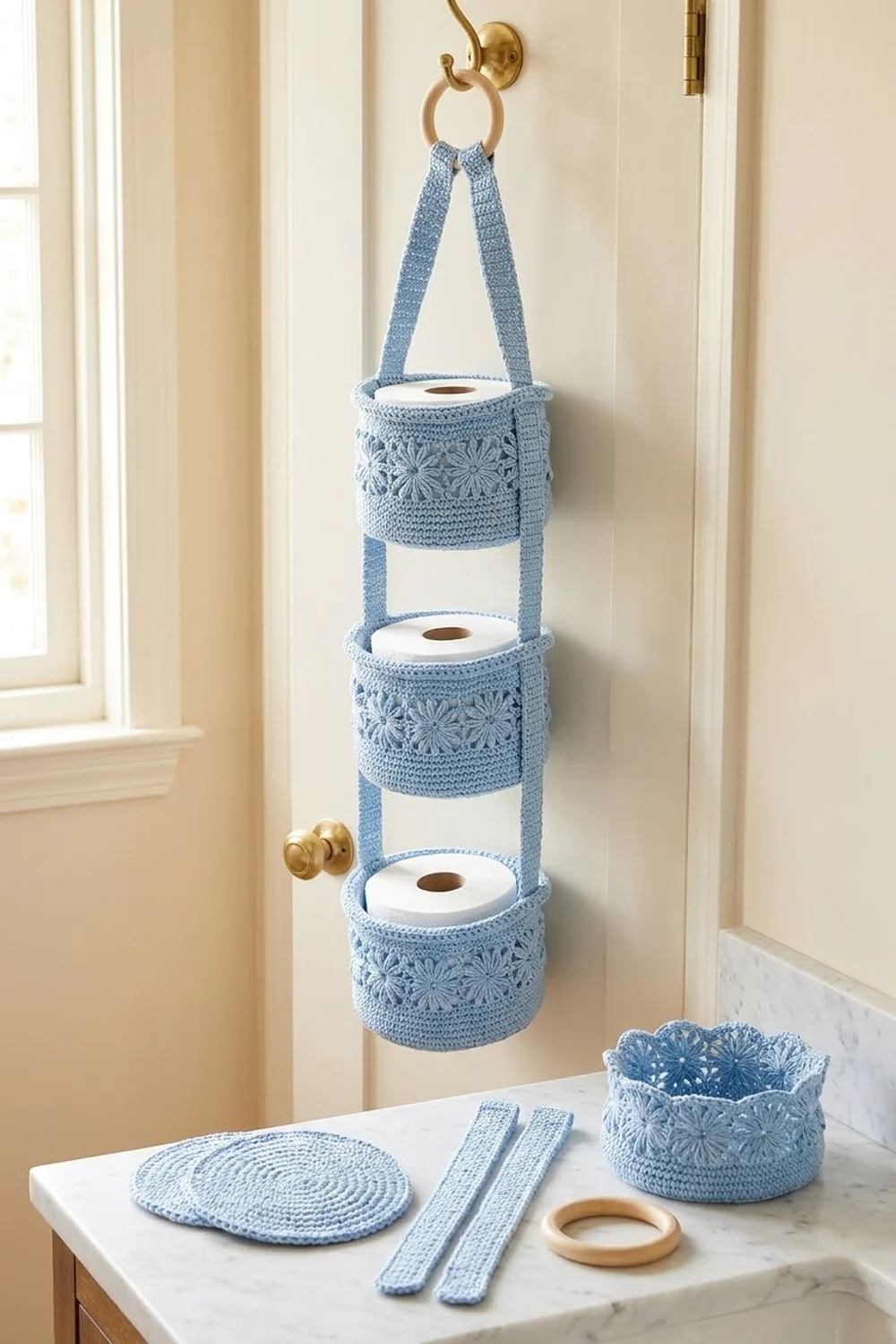
This three-tier hanging holder keeps spare toilet rolls tidy and in sight. Three round baskets hang one above the other on two flat straps. The straps meet in a triangle at a natural wooden ring. Hang it on a door hook or wall hook, and it holds one standard roll per tier.
Everything is worked in one soft powder blue. Each basket has a solid flat base, a lacy band of daisy starbursts around the wall and a rope-like crab-stitch rim. The straps are firm single crochet with a neat slip-stitch edge.
The pattern uses US crochet terms. Each basket is 6 in (15.2 cm) across and 3 in (7.6 cm) tall. Each strap is 24 in (61.0 cm) long and 1.25 in (3.2 cm) wide. When hung, the holder measures about 24 in (61.0 cm) from the top of the ring to the bottom basket.
Each basket starts as a flat circle. A back-loop round turns up the wall, then you work three lace rounds and a three-round rim. Sew the two straps to opposite sides of the baskets, then fold the strap tops over the ring.
Finished Size and Construction
- Finished size: about 24 in (61.0 cm) tall when hung
- Skill level: Intermediate
- Terminology: US crochet terms
- Yarn weight: worsted weight (#4) cotton
- Hook: 5.0 mm (H-8)
- Number of pieces: 5 crocheted pieces (3 baskets, 2 straps) plus 1 wooden ring
- Layout: 3 baskets stacked vertically, 2.5 in (6.4 cm) apart, on 2 straps
- Piece size: each basket is 6 in (15.2 cm) across x 3 in (7.6 cm) tall; each strap is 24 in (61.0 cm) x 1.25 in (3.2 cm)
- Size before border: basket wall 2.25 in (5.7 cm) tall
- Border depth: 0.75 in (1.9 cm) rim on each basket
Materials
Choose a smooth, firm worsted weight cotton or cotton blend. Cotton holds the basket shape and won’t stretch under the weight of the rolls.
- Powder blue: 250 g, about 425 m (465 yd)
Each basket uses about 50 g and each strap about 22 g, for about 195 g in total. The quantity above includes a margin of roughly 25% for swatching and tension differences.
Tools:
- 5.0 mm (H-8) crochet hook
- One wooden ring, 2.75 in (7.0 cm) outer diameter
- Tapestry needle
- 6 locking stitch markers
- Scissors and measuring tape
- Pins and a blocking mat or towel
Abbreviations (US Terms)
- ch – chain
- sl st – slip stitch
- sc – single crochet
- hdc – half double crochet
- dc – double crochet
- tr – treble crochet
- dtr – double treble crochet
- BLO – back loop only
- sk – skip
- sp – space
- st(s) – stitch(es)
- rnd – round
Special stitches:
- dc7tog (7-double-crochet cluster): [yo, insert hook in next st, yo and pull up a loop, yo and draw through 2 loops] 7 times, working into 7 consecutive sts. Yo and draw through all 8 loops on the hook.
- Eye: the ch 1 worked right after dc7tog. It closes the cluster and forms the center of the daisy.
- Crab stitch (reverse sc): working from left to right, insert the hook in the next st to the right, yo and pull up a loop, yo and draw through both loops.
Gauge and Checkpoints
Gauge: 16 sc and 16 rows/rnds = 4 in (10.2 cm) with a 5.0 mm hook.
Make one full basket before starting the others. It works as your real gauge swatch.
Checkpoints:
- After Rnd 6 (36 sts): the base is 3 in (7.6 cm) across.
- After Rnd 12 (72 sts): the base is 6 in (15.2 cm) across and lies flat.
- After Rnd 18: the wall is 2.25 in (5.7 cm) tall from the turning ridge.
- After Rnd 21: the wall is 3 in (7.6 cm) tall.
- Strap Row 1 (96 sts): 24 in (61.0 cm) long.
If your piece is too big, switch to a 4.5 mm (7) hook. If it’s too small, switch to a 5.5 mm (I-9) hook. If the base ruffles, go down a hook size. If it cups, go up one. The stitch counts never change, so change only the hook to adjust size.
Basket (Make 3)
Work in joined rnds. The ch 1 at the start of a rnd doesn’t count as a st. Join each rnd with a sl st to the first st.
Base
Rnd 1: Make a magic ring, ch 1, 6 sc in ring. Join. (6 sts)
Rnd 2: Ch 1, 2 sc in each st around. Join. (12 sts)
Rnd 3: Ch 1, sc in next st, 2 sc in next st; rep from * around. Join. (18 sts)
Rnd 4: Ch 1, sc in next 2 sts, 2 sc in next st; rep from * around. Join. (24 sts)
Rnd 5: Ch 1, sc in next 3 sts, 2 sc in next st; rep from * around. Join. (30 sts)
Rnd 6: Ch 1, sc in next 4 sts, 2 sc in next st; rep from * around. Join. (36 sts)
Check: 3 in (7.6 cm) across.
Rnd 7: Ch 1, sc in next 5 sts, 2 sc in next st; rep from * around. Join. (42 sts)
Rnd 8: Ch 1, sc in next 6 sts, 2 sc in next st; rep from * around. Join. (48 sts)
Rnd 9: Ch 1, sc in next 7 sts, 2 sc in next st; rep from * around. Join. (54 sts)
Rnd 10: Ch 1, sc in next 8 sts, 2 sc in next st; rep from * around. Join. (60 sts)
Rnd 11: Ch 1, sc in next 9 sts, 2 sc in next st; rep from * around. Join. (66 sts)
Rnd 12: Ch 1, sc in next 10 sts, 2 sc in next st; rep from * around. Join. (72 sts)
Check: 6 in (15.2 cm) across.
Wall
Rnd 13: Ch 1, sc in BLO of each st around. Join. (72 sts)
This rnd makes the turning ridge, and the work starts to rise.
Rnds 14–15: Ch 1, sc in each st around. Join. (72 sts)
The solid lower wall is now 0.75 in (1.9 cm) tall.
Daisy Lace Band
The band has 6 repeats of 12 sts. Each repeat makes one daisy starburst. Seven cluster legs fan down from the eye, and 7 tr fan up from it.
Rnd 16 (lower petals): Ch 1, sc in first st, ch 3, sk 2 sts, dc7tog over next 7 sts, ch 1 (eye), ch 3, sk 2 sts, sc in next st; rep from * around, leaving out the last sc on the final repeat. Join to first sc.
Each repeat uses 1 + 2 + 7 + 2 = 12 sts. Result: 6 sc, 6 clusters, 6 eyes and 12 ch-3 sps.
Rnd 17 (upper petals): Ch 1, sc in first sc, ch 1, sk ch-3 sp, 7 tr in next eye, ch 1, sk ch-3 sp, sc in next sc; rep from * around, leaving out the last sc on the final repeat. Join to first sc.
Count: 6 fans x 7 tr = 42 tr, plus 6 sc and 12 ch-1 sps. (60 sts including chains)
Rnd 18 (leveling round): Ch 5 (counts as dtr) in same sc as join, ch 1, sk ch-1 sp, 2 hdc in first tr of fan, hdc in next tr, sc in next 3 tr, hdc in next tr, 2 hdc in last tr, ch 1, sk ch-1 sp, dtr in next sc; rep from * around, leaving out the last dtr on the final repeat. Join to top of beg ch-5.
This is a conversion round. Count: 6 dtr + 12 ch + (6 fans x 9 sts worked into 7 tr) = 6 + 12 + 54 = 72 sts. Each dtr fills the V between two fans, so the top edge is level again.
Check: the wall is 2.25 in (5.7 cm) tall. Don’t fasten off. Continue with the rim in the Border section.
Strap (Make 2)
Foundation: Ch 97.
Row 1: Sc in 2nd ch from hook and in each ch across. Turn. (96 sts)
Check: 24 in (61.0 cm) long.
Rows 2–5: Ch 1, sc in each st across. Turn. (96 sts)
The strap is now 5 rows, or 1.25 in (3.2 cm), wide. Don’t fasten off. Work the strap edging from the Border section before joining.
Make All Pieces
All pieces use the same color.
- Baskets: 3 in powder blue, about 50 g each
- Straps: 2 in powder blue, about 22 g each
- Wooden ring: 1
Layout (front view, hung):
              [ RING ]
              /      \
        Strap A      Strap B
           |            |
           |[ BASKET 1 ]|   top tier, 3 in
           |            |   gap 2.5 in
           |[ BASKET 2 ]|   middle tier, 3 in
           |            |   gap 2.5 in
           |[ BASKET 3 ]|   bottom tier, 3 in
Joining
Weave in all ends first. Use a 24 in (61.0 cm) length of yarn and a tapestry needle, and whipstitch.
Mark the straps. Measure from the bottom end of each strap:
- 0 to 3 in (0 to 7.6 cm): bottom basket (sts 1–12)
- 3 to 5.5 in (7.6 to 14.0 cm): gap (sts 13–22)
- 5.5 to 8.5 in (14.0 to 21.6 cm): middle basket (sts 23–34)
- 8.5 to 11 in (21.6 to 27.9 cm): gap (sts 35–44)
- 11 to 14 in (27.9 to 35.6 cm): top basket (sts 45–56)
The remaining 40 sts, or 10 in (25.4 cm), make the hanging leg and the fold.
Mark the baskets. Mark the dtr of the first repeat (the beg ch-5 of Rnd 18) and the dtr of the fourth repeat. They’re exactly 36 sts apart, so the straps sit directly opposite each other.
Stitch-to-stitch logic. The strap is 1.25 in (3.2 cm) wide, the same width as 5 basket sts. Center it over the marked dtr so it covers that dtr plus 2 sts on each side. Each basket section of the strap is 12 sts, or 3 in (7.6 cm), which matches the 3 in (7.6 cm) wall. Make one whipstitch per strap st, which gives 12 stitches per long edge on each basket.
Sew. Pin Strap A to the outside of the bottom basket, with the strap end level with the turning ridge. Whipstitch both long edges, then sew across the strap width at the ridge and at the rim. Repeat for the middle and top baskets, then attach Strap B on the opposite side.
Tension. Make each stitch snug but not tight. Pulling hard puckers the lace band and pulls the basket into an oval.
Size checkpoint. With the holder lying flat, there should be 2.5 in (6.4 cm) between baskets. It should measure 14 in (35.6 cm) from the bottom basket’s ridge to the top basket’s rim.
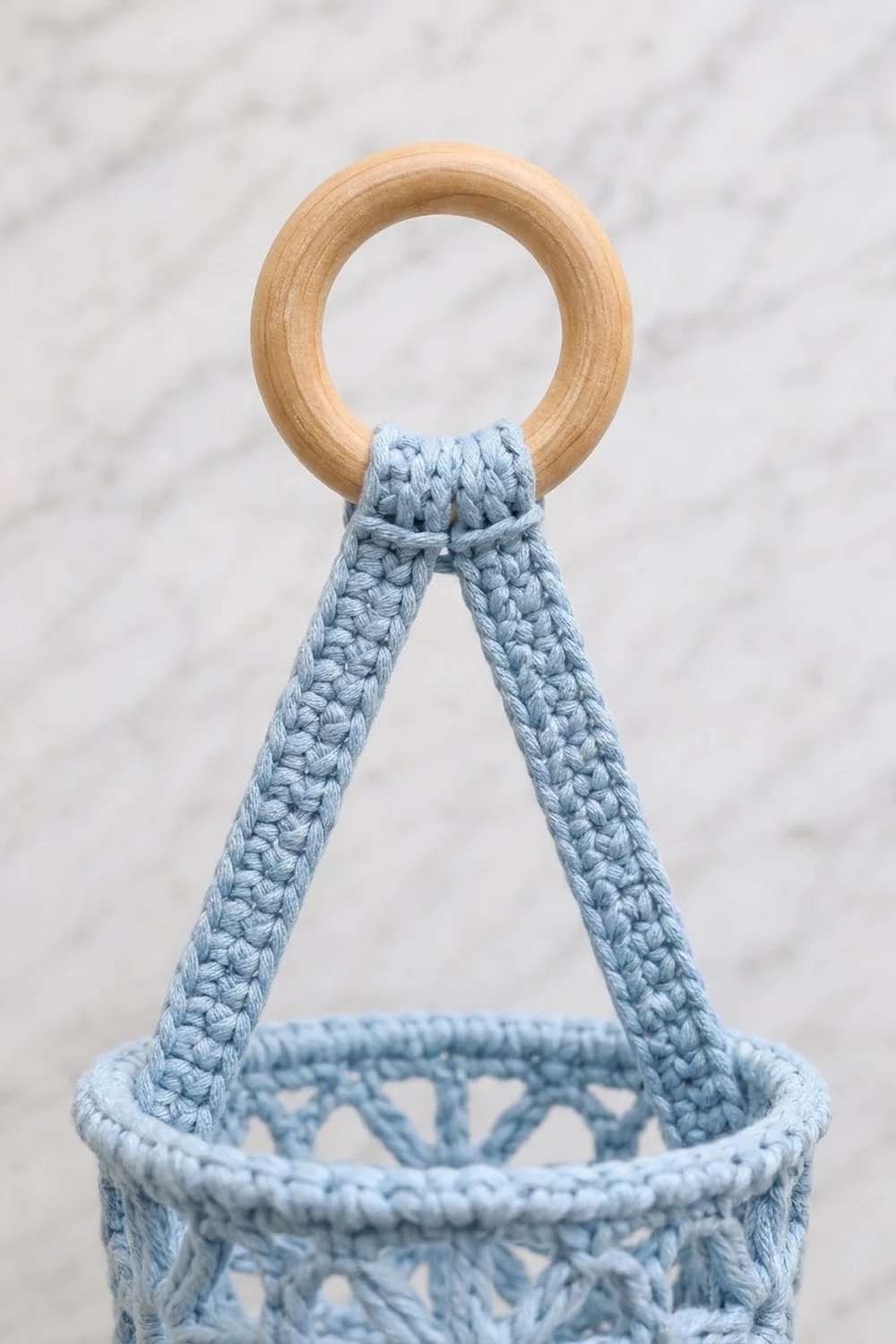
Ring. Hold the free tops of both straps together. Pass them through the ring from front to back, then fold 1.5 in (3.8 cm), or 6 sts, back over the ring. Whipstitch through all four layers across the width and along both edges. Each leg is now 8.5 in (21.6 cm) long, and the two legs form a triangle above the top basket.
Border
The border is the rim on each basket plus the slip-stitch edge on each strap. Border gauge stays at 16 sc = 4 in (10.2 cm), and each sc or crab rnd adds about a quarter inch of height.
Basket Rim
Rnd 19: Ch 1, sc in each st and each ch around. Join. (72 sts)
Rnd 20: Ch 1, sc in each st around. Join. (72 sts)
Rnd 21: Ch 1, crab stitch in each st around. Join and fasten off. (72 sts)
The rim adds 0.75 in (1.9 cm), so the wall finishes at 2.25 + 0.75 = 3 in (7.6 cm).
Why the math works: Rnd 18 brought the count back to 72, the same as the base. The rim has no increases or decreases, so the opening matches the base circumference. The walls rise straight instead of flaring out or pulling in.
Strap Edging
Edging rnd: Don’t turn. Ch 1, then work around the whole strap:
- 5 sl st across the first short end (1 per row end)
- ch 1 at the corner
- 96 sl st along the foundation side (1 per ch)
- ch 1 at the corner
- 5 sl st across the second short end
- ch 1 at the corner
- 96 sl st along the Row 5 side (1 per st)
Ch 1 at the last corner, join to the first sl st and fasten off. Total: 96 + 5 + 96 + 5 = 202 sl st, plus 4 corner ch.
Why the math works: each side gets exactly 1 sl st per existing st or row end. The strap stays 24 in (61.0 cm) by 1.25 in (3.2 cm) without rippling, and the corner ch lets the edge turn without pulling in.
Final Blocking
- Mist each basket lightly until it’s damp but not soaked.
- Fill each basket with a toilet roll or a rolled towel about 4.5 in (11.4 cm) wide so the walls stand straight.
- Open each daisy with your fingers so the petals spread evenly.
- Pin the straps flat at 24 in (61.0 cm) by 1.25 in (3.2 cm).
- Let everything dry completely, which takes about 24 hours.
- Check again: each basket should be 6 in (15.2 cm) across and 3 in (7.6 cm) tall.
Final Quality-Control Checklist
- Each base has 72 sts and lies flat.
- Each lace band has 6 complete daisies.
- Each rim has 72 sts and a smooth crab-stitch edge.
- Each strap is 96 sts long and 5 rows wide.
- The straps sit opposite each other, 36 sts apart.
- Every gap between baskets is 2.5 in (6.4 cm).
- The ring fold is sewn through all layers.
- All ends are woven in and trimmed.
Troubleshooting
Base ruffles: go down a hook size.
Base cups up: go up a hook size, and check that you have exactly 6 increases per rnd.
Wrong count in Rnd 16: recount each repeat as 1 sc + 2 skipped + 7 cluster + 2 skipped = 12.
Daisies lean: make sure all 7 tr go into the eye, not into a ch-3 sp.
Wavy top after Rnd 18: your dtr is too short or too tall. Pull up its first loop a little higher or lower.
Holder tilts: one strap is sewn higher than the other. Measure the markers on both straps again.
Care
Hand wash in cool water and dry flat, reshaping the baskets over a roll. Don’t hang the holder while it’s wet, or the straps may stretch.
Final Notes
At a gauge of 16 sts = 4 in (10.2 cm), the base grows 0.5 in (1.3 cm) across with each rnd. It reaches 72 sts and 6 in (15.2 cm) at Rnd 12. The wall is 2.25 in (5.7 cm) tall after Rnd 18, and the rim brings it to 3 in (7.6 cm). Each strap’s 96 sts make 24 in (61.0 cm). That covers three 3 in (7.6 cm) basket sections, two 2.5 in (6.4 cm) gaps, an 8.5 in (21.6 cm) hanging leg and a 1.5 in (3.8 cm) fold. If each of these measurements checks out, the holder will hang straight.
Happy crocheting!