

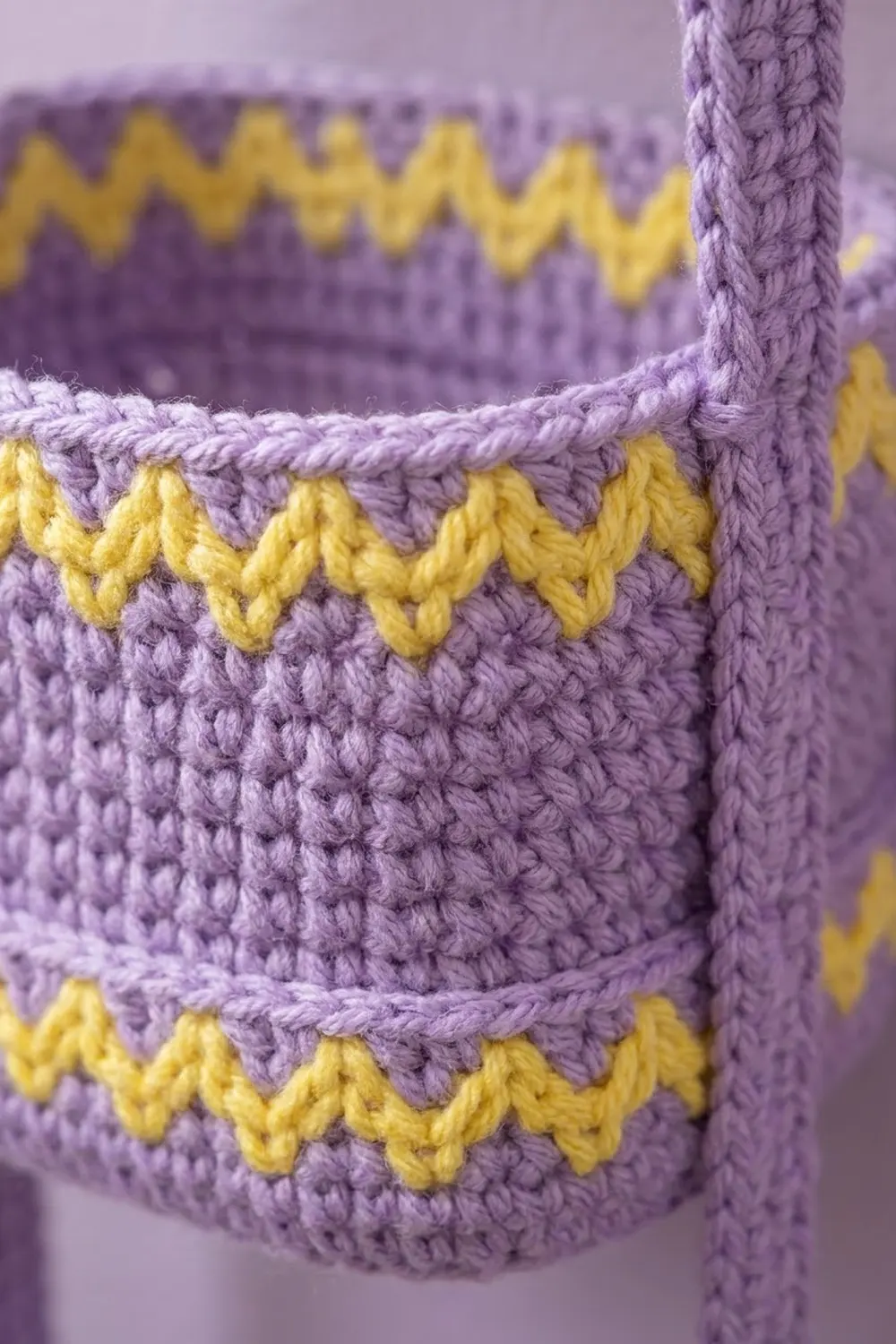
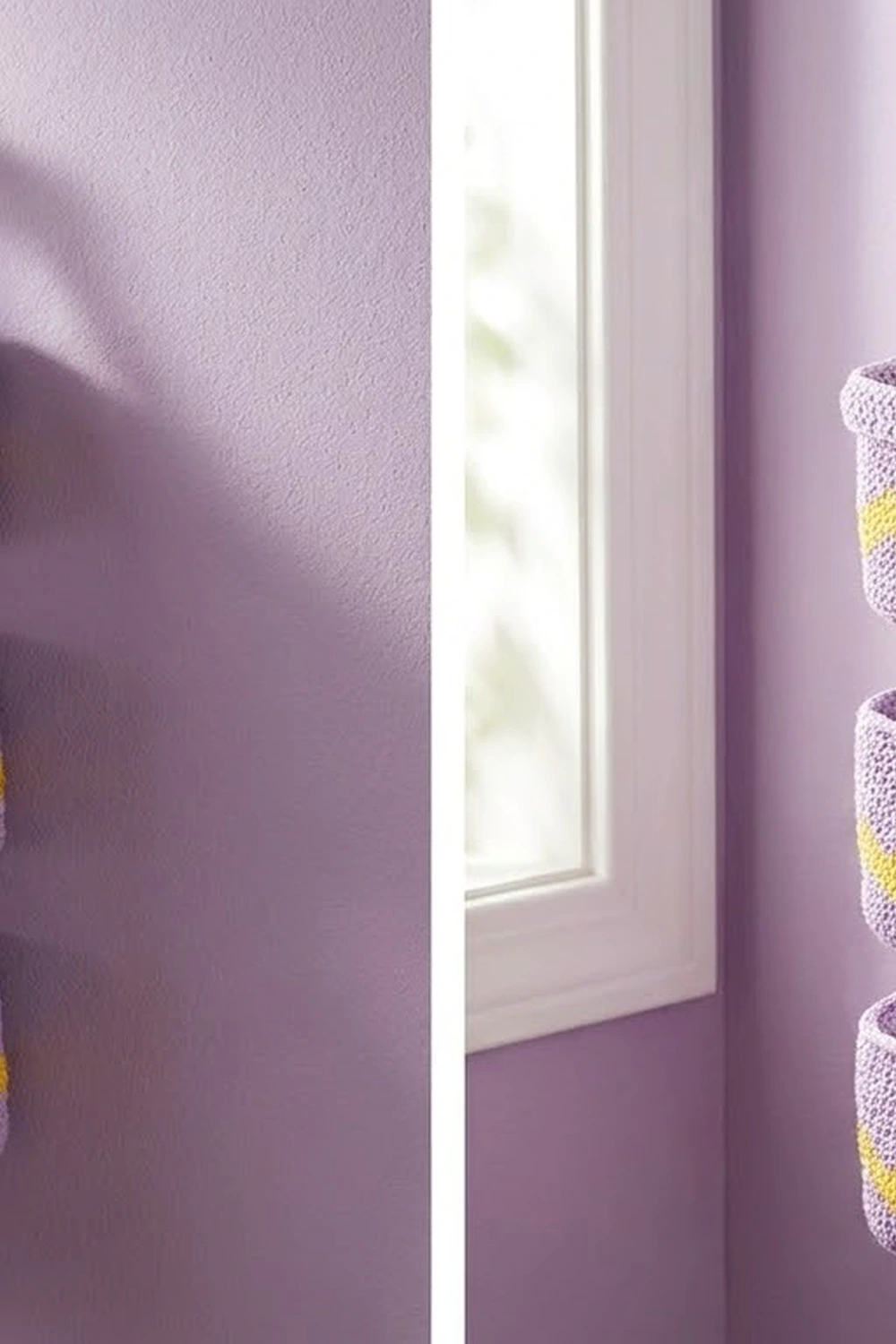
This three-tier hanging holder has three soft square baskets in lavender, each with two bright yellow zigzag bands. Two long straps join the baskets and meet at a point above the top one. The holder hangs from a single wall peg and holds one standard toilet roll per basket, which makes it a cheerful, practical piece for a small bathroom.
There are only two colors. Lavender is used for the bases, walls, rims, and straps, and sunny yellow for the zigzags. The zigzags are worked in tapestry crochet, with the unused color carried inside the stitches. This gives clean lines with no floats on the inside.
This pattern uses US crochet terms. Each basket base is about 5.3 in (13.5 cm) square, and each basket stands about 3.6 in (9.1 cm) tall. The finished holder hangs about 20.3 in (51.6 cm) from the peg to the bottom of the lowest basket.
Here is the construction in order:
1. Crochet three flat half double crochet squares.
2. Raise single crochet walls on each square to make a basket, and finish it with a two-round rim border.
3. Crochet two flat straps lengthwise.
4. Sew the straps to opposite sides of all three baskets, then seam the strap tops together to make the hanging point.
Finished Size and Construction
- Finished hanging length: about 20.3 in (51.6 cm)
- Skill level: Easy-intermediate (basic stitches plus tapestry color changes)
- Terminology: US crochet terms
- Yarn weight: Worsted weight (#4), cotton or cotton blend
- Hook: 5.0 mm (H-8)
- Number of pieces: 5 (3 baskets, 2 straps)
- Layout: 3 baskets stacked vertically, 1 strap on each side
- Basket base: 5.3 in (13.5 cm) square, 64 sts around
- Basket height before border: 3.1 in (7.9 cm)
- Border depth: 0.5 in (1.3 cm), for a total basket height of 3.6 in (9.1 cm)
- Strap: 21 in (53.3 cm) long, 0.9 in (2.3 cm) wide
Materials
Choose a firm worsted weight cotton or cotton blend. Cotton keeps the walls upright and handles bathroom humidity well. Avoid fuzzy or very stretchy acrylic, because it sags under the weight of a roll.
- Lavender (main color): about 80 g / 135 m (148 yd)
- Yellow (contrast color): about 25 g / 40 m (44 yd)
These quantities include a margin of about 20 percent for swatching and tails.
Tools:
- 5.0 mm (H-8) crochet hook
- Tapestry needle
- 4 stitch markers
- Scissors and measuring tape
- Rust-proof pins and a blocking surface
- A wall peg that projects at least 1.5 in (3.8 cm)
Abbreviations (US Terms)
- ch: chain
- sl st: slip stitch
- sc: single crochet
- hdc: half double crochet
- BLO: back loop only
- rev sc: reverse single crochet (crab stitch)
- st(s): stitch(es)
- rnd(s): round(s)
- L: lavender
- Y: yellow
Tapestry sc: Lay the unused color along the tops of the stitches you are working into, and enclose it inside each sc. To change color, work the last sc of the old color until 2 loops remain on the hook. Yarn over with the new color and pull it through. The old color is now the carried strand.
Reverse sc: Work from left to right, or right to left if you are left-handed. Insert the hook into the next stitch to the right, pull up a loop, yarn over, and pull through both loops.
Gauge and Checkpoints
- Base gauge: 12 hdc = 4 in (10.2 cm) in the round
- Wall gauge: 12 tapestry sc and 13 rnds = 4 in (10.2 cm)
- Strap gauge: 12 sc = 4 in (10.2 cm) along the foundation
Make one complete basket before you start the others. It serves as your gauge test, so check these measurements as you go:
- After base Rnd 3: 2.0 in (5.1 cm) across
- After base Rnd 6: 4.0 in (10.2 cm) across
- After base Rnd 8: 5.3 in (13.5 cm) across
- After wall Rnd 18: wall is 3.1 in (7.9 cm) tall
If the base is more than 1/4 in (0.6 cm) too big, go down half a hook size. If it is too small, go up half a size. If the walls flare outward, tighten the carried strand slightly. If they pull inward, relax it. Use the same hook throughout.
Basket Pattern (Make 3)
Base
Work the base in joined rounds. The beginning ch 2 does not count as a stitch. Start each round in the first stitch of the previous round, and join with a sl st to the first hdc. Each bracketed repeat makes one side, including one 3-hdc corner group. Mark the center stitch of each corner.
Rnd 1: With L, make a magic ring. Ch 2, work 8 hdc in the ring, and join. (8 sts)
Rnd 2: Ch 2. 3 hdc in next st, hdc in next st. Repeat from * 3 more times. Join. (16 sts, 4 per side)
Rnd 3: Ch 2. Hdc in next st, 3 hdc in next st, hdc in next 2 sts. Repeat from * 3 more times. Join. (24 sts, 6 per side) Checkpoint: 2.0 in (5.1 cm).
Rnd 4: Ch 2. Hdc in next 2 sts, 3 hdc in next st, hdc in next 3 sts. Repeat from * 3 more times. Join. (32 sts, 8 per side)
Rnd 5: Ch 2. Hdc in next 3 sts, 3 hdc in next st, hdc in next 4 sts. Repeat from * 3 more times. Join. (40 sts, 10 per side)
Rnd 6: Ch 2. Hdc in next 4 sts, 3 hdc in next st, hdc in next 5 sts. Repeat from * 3 more times. Join. (48 sts, 12 per side) Checkpoint: 4.0 in (10.2 cm).
Rnd 7: Ch 2. Hdc in next 5 sts, 3 hdc in next st, hdc in next 6 sts. Repeat from * 3 more times. Join. (56 sts, 14 per side)
Rnd 8: Ch 2. Hdc in next 6 sts, 3 hdc in next st, hdc in next 7 sts. Repeat from * 3 more times. Join. (64 sts, 16 per side) Checkpoint: 5.3 in (13.5 cm).
Each round adds exactly 8 sts, 2 at each corner. The 3-hdc corners have no chain space, which is what gives the base its softly rounded corners.
Walls
Work the walls in sc. Each round begins with ch 1, which does not count, and is joined with a sl st to the first sc. Every round has 64 sts, so the walls rise straight up.
Rnd 9 (turning round): With L, ch 1. Sc in the BLO of each st around. Join. (64 sts) The unworked front loops form a crisp ridge at the base of the wall.
Rnd 10 (zigzag A): Join Y and carry it. Ch 1. Y sc in next st, L sc in next 3 sts. Repeat from * 15 more times. Join. (64 sts: 16 Y, 48 L)
Rnd 11 (zigzag B): Ch 1. L sc, Y sc, L sc, Y sc. Repeat from * 15 more times. Join. (64 sts: 32 Y, 32 L)
Rnd 12 (zigzag C): Ch 1. L sc in next 2 sts, Y sc in next st, L sc in next st. Repeat from * 15 more times. Join. (64 sts: 16 Y, 48 L)
Across these three rounds, the yellow stitch moves from position 1, to positions 2 and 4, to position 3. The result is a continuous zigzag with 16 peaks, 4 on each side. Cut Y, leaving a 6 in (15.2 cm) tail, and carry the tail for a few stitches to secure it.
Rnds 13–15: With L only, ch 1, sc in each st around, and join. (64 sts)
Rnds 16–18: Join Y and repeat Rnds 10–12. (64 sts each round) Cut Y and secure the tail as before.
Checkpoint: the wall is 3.1 in (7.9 cm) tall, measured from the ridge. Work the border (below) now, before you join anything.
Make All Pieces
Make 3 baskets. Each one uses about 33 m (36 yd) of L and 11 m (12 yd) of Y.
Strap (Make 2)
Foundation: With L, ch 64.
Row 1: Sc in 2nd ch from hook and in each ch across. (63 sts)
Rows 2–3: Ch 1, turn. Sc in each st across. (63 sts)
Fasten off. On one strap, leave a 12 in (30.5 cm) tail for the top seam. Each strap measures 21 in (53.3 cm) by 0.9 in (2.3 cm) and uses about 6 m (6.5 yd) of L. Since 3 strap sts equal 1 in (2.5 cm), you can place everything by counting stitches.
Layout (front view):
        /\        apex: strap ends seamed
       /  \       strap sts 48–63 free (5.3 in / 13.5 cm)
     [ B3 ]       strap sts 37–47
     [ B2 ]       strap sts 19–29
     [ B1 ]       strap sts 1–11
Joining
Whipstitch with L and a tapestry needle for a flat, nearly invisible seam. Choose two opposite sides on each basket and line up the zigzag peaks from basket to basket. Center the strap over the middle 3 wall sts of the side’s 16.
Stitch-to-stitch logic: Sew one strap st to one wall round. Eleven strap sts sit over wall Rnds 9–19, with a little ease that you spread evenly.
- Basket 1 (bottom): Place strap st 1 at the Rnd 9 ridge. Whipstitch both long edges of strap sts 1–11 to Rnds 9–19, then tack the strap at Rnd 20.
- Basket 2: Leave strap sts 12–18 free (7 sts). Sew strap sts 19–29 to Basket 2 the same way.
- Basket 3: Leave strap sts 30–36 free. Sew strap sts 37–47 to Basket 3.
- Repeat steps 1–3 with the second strap on the opposite side of each basket.
- Apex: Leave strap sts 48–63 (16 sts) free on each strap. Hold the two short ends right sides together and whipstitch the 3 end sts of one strap to the 3 end sts of the other. Weave in the ends.
Tension advice: Make each whipstitch snug but not tight. Tight stitches pucker the wall and make the basket tilt.
Size checkpoint: Lay the holder flat and check these measurements:
- Basket bottoms are 6.0 in (15.2 cm) apart, which leaves a 2.4 in (6.1 cm) gap between each rim and the base above it.
- The sewn section is 15.7 in (39.9 cm) long.
- The free strap legs form a triangle about 4.6 in (11.7 cm) high.
- The total length is 20.3 in (51.6 cm).
Border
Work the rim border on each basket after Rnd 18. Border gauge matches the walls: 12 sc = 4 in (10.2 cm).
Rnd 19: With L, ch 1. Sc in each st around. Join. (64 sts, 16 per side)
Rnd 20: Ch 1. Rev sc in each st around. Join and fasten off. (64 sts, 16 per side)
Why the math works:
- Each side has 16 sts. At 3 sts per inch, that is 5.3 in (13.5 cm), the same width as the base side. The rim neither flares nor pulls in.
- Four sides of 16 sts make 64, which matches the base and every wall round.
- Both border rounds are worked one stitch into each stitch, with nothing added or skipped.
- Together they add 0.5 in (1.3 cm), bringing each basket to 3.6 in (9.1 cm).
- The rev sc gives a firm, rolled edge that keeps the top square.
Final Blocking
- Lightly mist the holder until it is damp, not wet.
- Place a 5.3 in (13.5 cm) square box, or folded washcloths, inside each basket.
- Square the corners with your fingers and press the walls straight up.
- Pin the straps flat, keeping the 2.4 in (6.1 cm) gaps even.
- Let the holder dry completely, about 24 hours.
- Remove the forms and hang the holder.
Final Quality-Control Checklist
- Each base has 64 sts and measures 5.3 in (13.5 cm).
- Each basket has 2 zigzag bands with 16 peaks each.
- Each basket stands 3.6 in (9.1 cm) tall.
- Zigzag peaks line up on all three baskets.
- Each strap has 63 sts and measures 21 in (53.3 cm).
- Basket bottoms are 6.0 in (15.2 cm) apart.
- The apex seam is secure and centered.
- All tails are woven in and hidden.
Troubleshooting
The base cups or ruffles. If it cups, go up half a hook size. If it ruffles, go down half a size.
Yellow shows through the lavender. Keep the carried strand on top of the stitches and snug it gently every few stitches.
The walls lean outward. Check that Rnd 9 was worked in the BLO, and tighten the carried strand.
The zigzag jogs at the join. This is normal in joined rounds. Turn the join toward the back, against the wall.
A basket tilts when hung. The straps are probably sewn off-center or at different heights. Recount the strap sts and re-sew.
A roll will not fit. A standard roll is about 4.5 in (11.4 cm) across and needs the full 5.3 in (13.5 cm) base. Recheck your gauge.
Care
Hand wash in cool water with mild soap. Reshape the baskets while damp and lay flat to dry. Do not tumble dry.
Final Notes
The measurement chain is simple:
- The 64-st base measures 5.3 in (13.5 cm).
- The walls rise straight up on the same 64 sts to 3.1 in (7.9 cm).
- The 2-round border brings each basket to 3.6 in (9.1 cm).
- The 63-st straps are 21 in (53.3 cm) long and hold the baskets 6.0 in (15.2 cm) apart.
- The free strap legs finish in a triangle, for a total length of about 20.3 in (51.6 cm).
Check each link as you go, and the holder will hang straight and square.
Happy crocheting!