

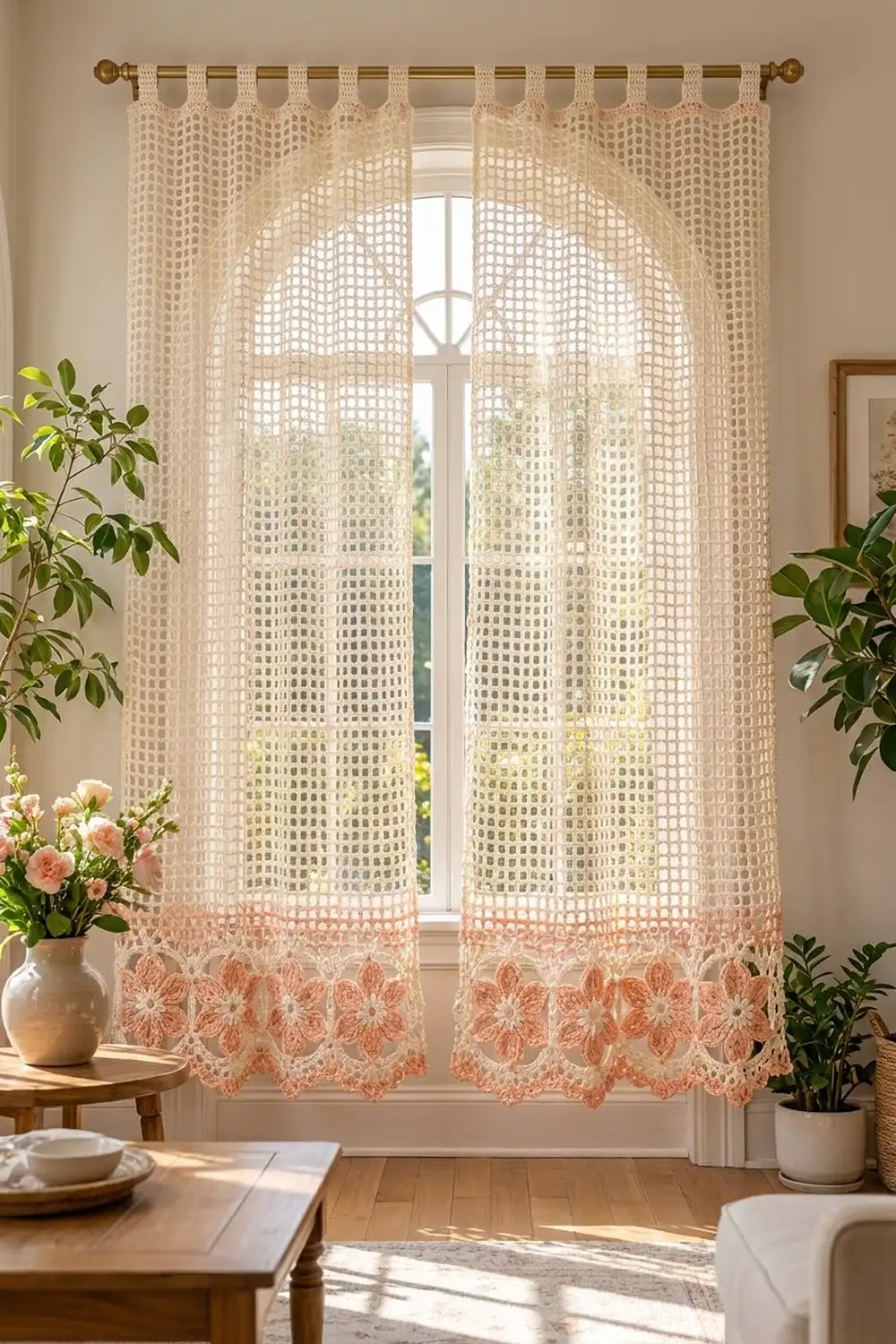
This curtain panel combines a light cream filet mesh with a band of peach flower medallions along the hem. Each flower sits inside its own cream ring, and the rings are joined into one straight band. A soft peach scallop finishes the bottom edge.
The palette is just two colors, cream and peach, so the panel looks fresh and works well in a sunny kitchen or breakfast nook. The pair in the photo hangs from a rod on cream tabs. Make two panels to match it.
The pattern uses US crochet terms. One finished panel measures 30 in (76.2 cm) wide and 60¼ in (153.0 cm) long from the top edge to the scallop tips. The tab loops add another 3 in (7.6 cm) above that.
Construction is simple. First you make five medallions and whipstitch them into a strip. Next, two cream rows straighten the top of the strip, and two peach rows follow. The filet mesh is then worked upward from the peach rows. A scalloped peach edging goes along the bottom, and the tabs are worked last.
Finished Size and Construction
- Finished size (one panel): 30 in × 60¼ in (76.2 cm × 153.0 cm), plus 3 in (7.6 cm) tab loops
- Skill level: Intermediate
- Terminology: US
- Yarn weight: DK (light, #3) cotton
- Hook: 4.0 mm (G-6)
- Number of pieces: 5 medallions per panel, plus the mesh and tabs worked directly onto them; 2 panels for the pair
- Layout: 5 medallions in 1 row
- Medallion size: 6 in (15.2 cm) across
- Size before border: 30 in × 59¼ in (76.2 cm × 150.5 cm)
- Border depth: 1 in (2.5 cm)
Materials
Use a smooth, mercerized or combed 100% cotton DK yarn of about 115 m per 50 g. Cotton holds the mesh square and drapes nicely in sunlight. Avoid fuzzy yarns, which blur the open grid.
- Cream: 200 g / 460 m per panel (400 g / 920 m for the pair)
- Peach: 50 g / 115 m per panel (100 g / 230 m for the pair)
Tools:
– 4.0 mm (G-6) crochet hook
– Tapestry needle
– 4 locking stitch markers
– Rust-proof pins and a large blocking surface
– Measuring tape
– Spray bottle
These quantities include a margin of about 20% for swatching and blocking.
Abbreviations (US Terms)
- ch – chain
- sl st – slip stitch
- sc – single crochet
- hdc – half double crochet
- dc – double crochet
- tr – treble crochet
- sc2tog – single crochet 2 together
- sp – space
- st(s) – stitch(es)
- RS / WS – right side / wrong side
Special stitches
- qtr (quadruple treble): Yo 5 times, insert hook, pull up a loop, then (yo, pull through 2 loops) 6 times.
- qtr2tog: Yo 5 times, insert in the first st, pull up a loop, then (yo, pull through 2) 5 times; 2 loops remain on the hook. Yo 5 times, insert in the second st, pull up a loop, then (yo, pull through 2) 5 times; 3 loops remain. Yo and pull through all 3.
- Picot: Ch 3, sl st in 3rd ch from hook.
- Shell: (2 dc, picot, 2 dc) all in the same st.
Gauge and Checkpoints
- 18 sc and 20 rows = 4 in (10.2 cm)
- Filet mesh: 6 squares and 7 rows = 4 in (10.2 cm)
- One blocked medallion = 6 in (15.2 cm) across
Make one complete medallion first and block it before you go further. Check it at these points:
- After Round 2: 1¾ in (4.4 cm)
- After Round 4 (flower): 3¾ in (9.5 cm)
- After Round 6: 5¼ in (13.3 cm)
- After Round 7: 6 in (15.2 cm)
If the medallion is too big, go down 0.5 mm. If it is too small, go up 0.5 mm. If the ring ruffles but the flower is correct, tighten your chains in Round 5. Swatch the mesh separately. If it is too wide, go down a hook size for the mesh only.
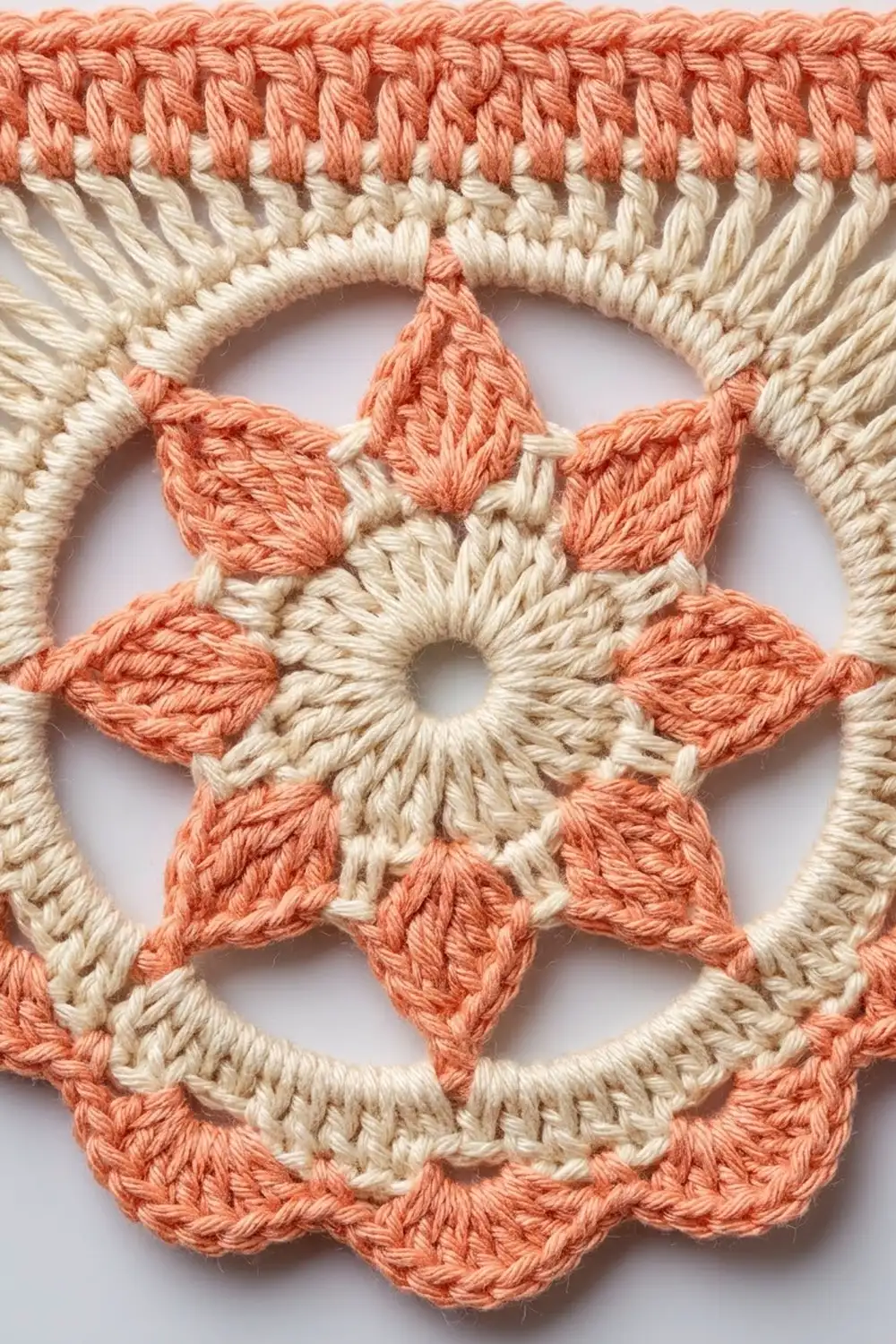
Medallion (make 5 per panel)
Number the 84 stitches of Round 7 as you will use them later.
Round 1 (cream): Magic ring, ch 1, 12 sc in ring, sl st to first sc. (12 sts)
Round 2: Ch 3 (counts as dc), dc in same st, 2 dc in each st around, sl st to top of ch-3. (24 dc) Fasten off.
Round 3 (peach): Join in any dc. Ch 1, sc in same st, ch 5, skip 3. [Sc in next st, ch 5, skip 3] 5 times. Sl st to first sc. (6 sc, 6 ch-5 sps)
Round 4 (petals): In each ch-5 sp work (sc, hdc, 2 dc, tr, ch 2, tr, 2 dc, hdc, sc). Sl st to first sc. (6 petals; 60 sts + 6 ch-2 tips) Fasten off.
Round 5 (cream): Join in any ch-2 petal tip. Ch 1, sc in same sp, ch 9. [Sc in next tip, ch 9] 5 times. Sl st to first sc. (6 sc, 6 ch-9 sps) These chains are the bars that link each petal to the ring.
Round 6: Ch 3 (counts as dc), 11 dc in next ch-9 sp. [Dc in next sc, 11 dc in next ch-9 sp] 5 times. Sl st to top of ch-3. (6 + 66 = 72 dc)
Round 7: Ch 1, sc in same st, sc in next 4, 2 sc in next. [Sc in next 5, 2 sc in next] 11 times. Sl st to first sc. (84 sc) Fasten off.
Numbering: The first sc of Round 7 is st 1. It sits directly above a petal tip, and it is the top of the medallion. With the RS facing, count counterclockwise: st 22 is the left point, st 43 is the bottom, and st 64 is the right point. Mark sts 1 and 22.
Make All Pieces
- Per panel: 5 medallions. Each one uses cream for Rounds 1–2 and 5–7, and peach for Rounds 3–4.
- For the pair: 10 medallions.
Layout, RS facing, with every st 1 pointing up:
ROW 1: MOTIF 5 – MOTIF 4 – MOTIF 3 – MOTIF 2 – MOTIF 1
Motif 1 is at the right end of the band.
Joining
Place each motif so it touches the next one only at its side point. Thread cream yarn on a tapestry needle and whipstitch through 3 matching pairs of stitches:
- st 21 of Motif 1 to st 65 of Motif 2
- st 22 to st 64
- st 23 to st 63
Repeat for each pair along the row: Motif 2 to 3, 3 to 4, and 4 to 5. Join through both loops and pull just snug. The rings should touch flat without puckering or overlapping.
Checkpoint: Two joined motifs measure 12 in (30.5 cm). The full strip of five measures 30 in (76.2 cm).
Header Rows
Row 1 (cream, RS): Join at st 70 of Motif 1.
1. Ch 7 (counts as qtr), ch 4, tr in st 76, ch 4, sc in st 82, ch 6, sc in st 4, ch 4, tr in st 10, ch 4.
2. Qtr2tog (first leg in st 16 of the current motif, second leg in st 70 of the next motif), ch 4, tr in st 76, ch 4, sc in st 82, ch 6, sc in st 4, ch 4, tr in st 10, ch 4. Repeat from * 3 more times.
3. Qtr in st 16 of Motif 5.
(26 sts: 2 end qtr, 4 qtr2tog, 20 tr/sc; 25 ch-sps)
The tall stitches fill the V-shaped gaps between the rings, and the sc at the tops of the rings keep the row level.
Row 2 (WS): Ch 1, turn. Sc in each st, 4 sc in each ch-4 sp, and 6 sc in each ch-6 sp. (26 + 110 = 136 sc)
Each motif section has 4 sts and 22 chains, which give 26 sc. Five sections plus the 6 point stitches gives 136 sc.
Row 3 (peach, RS): Change to peach. Ch 1, turn, sc in each st. (136 sc)
Row 4 (WS): Ch 3 (counts as dc), turn, dc in each st. (136 dc) Change to cream.
Checkpoint: The band measures 30 in × 7 in (76.2 cm × 17.8 cm).
Filet Mesh
Row 5 (RS): Ch 5 (counts as dc + ch 2), turn, skip 2. Dc in next st. [Ch 2, skip 2, dc in next st] across. (46 dc, 45 squares) The math: 136 = 1 + 3 × 45.
Rows 6–95: Ch 5, turn. Dc in next dc, ch 2; repeat across. Dc in 3rd ch of the turning ch. (46 dc, 45 squares)
Checkpoint: After 14 mesh rows, the mesh is 8 in (20.3 cm) tall. Rows 5–95 make 91 mesh rows, or 52 in (132.1 cm).
Row 96 (WS): Ch 1, turn. Sc in each dc and 2 sc in each ch-2 sp. (46 + 90 = 136 sc) This row adds ¼ in (0.6 cm).
Tabs (make 7)
Space the tabs across Row 96 like this: tab, 11-st gap, tab, and so on. Seven tabs of 10 sts plus six gaps of 11 sts gives 70 + 66 = 136.
The tabs start at sts 1, 22, 43, 64, 85, 106, and 127.
Row 1: Join cream at the starting st, ch 1, sc in 10 sts.
Rows 2–30: Ch 1, turn, sc in 10 sts.
Each tab is 2¼ in (5.7 cm) wide and 6 in (15.2 cm) long. Fold the tab to the WS and sew its last row to the base of the tab. This makes a 3 in (7.6 cm) loop. The gaps between tabs are 2.4 in (6.1 cm).
Border
The border runs along the bottom edge only, following the lower curves of the rings. The mesh sides are finished by their own dc columns.
Border gauge: 1 sc per Round 7 st along the curve.
Round 1 (peach, RS): Join at st 19 of Motif 5. Work toward Motif 1:
1. Ch 1, sc in sts 19–62 of Motif 5. (44 sc)
2. Sc2tog (one leg in st 63 of Motif 5, one leg in st 23 of Motif 4).
3. Sc in sts 24–62 of Motif 4. (39 sc)
4. Repeat steps 2–3 for Motifs 3 and 2.
5. Sc2tog, then sc in sts 24–67 of Motif 1. (44 sc)
Count: 44 + 3 × 39 + 4 + 44 = 209 sc
Round 2: Ch 1, turn so the RS still faces you, or work in the same direction if you prefer. Sc in first st. [Skip 1, shell in next st, skip 1, sc in next st] 52 times. (52 shells, 53 sc) Fasten off.
Why the math works: Each shell repeat uses 4 sts, so you need 4 × 52 + 1 = 209. Each end motif has 44 sts, which is exactly 11 repeats. Each inner motif plus its join has 40 sts, which is 10 repeats. Because of this, every sc2tog lands on a valley sc (sts 45, 85, 125, and 165 of the round), and each ring gets its own complete scallop.
Final Blocking
- Weave in all ends along stitches of the same color.
- Soak the panel in cool water for 15 minutes, then gently press out the water. Do not wring it.
- Lay it flat on towels or blocking mats.
- Pin the band to 30 in (76.2 cm) wide and shape each ring into a 6 in (15.2 cm) circle.
- Pin the mesh to 52 in (132.1 cm) long, keeping the squares square and the sides straight.
- Pin out each scallop picot.
- Let it dry completely before you unpin.
Final Quality-Control Checklist
- Each medallion has 84 sc and 6 petals.
- The joins sit at sts 21–23 and 63–65.
- Row 2 has 136 sc.
- Every mesh row has 46 dc and 45 squares.
- The panel is 30 in (76.2 cm) wide all the way up.
- Border Round 1 has 209 sc, and Round 2 has 52 shells.
- The 7 tabs are evenly spaced and folded to the WS.
- The panel is 60¼ in (153.0 cm) long without the tabs.
Troubleshooting
- Ring ruffles: The Round 5 chains are too loose. Redo them more tightly, or use ch 8.
- Flower cups: Your petal tr are too tight. Loosen them, or go up a hook size for Round 4.
- Gaps in the header: Pull each qtr leg up fully before you yo, so the stitch keeps its full height.
- Mesh is getting wider: Make sure every dc lands on a dc and never in a chain.
- Mesh slants: Count 46 dc at the end of every row.
- Scallops flare: Use 4 dc per shell (2 + 2), not 5.
- Tabs twist: Sew all tabs to the same depth.
Care
Hand wash in cool water with a mild detergent, then lay flat and reshape to dry. Avoid wringing and hot dryers, which distort the mesh.
Final Notes
The size depends on each stage measuring correctly:
- One medallion: 6 in (15.2 cm)
- Five medallions joined: 30 in (76.2 cm)
- 136 header stitches keep that width, and the band is 7 in (17.8 cm) tall
- 91 mesh rows add 52 in (132.1 cm)
- The top row adds ¼ in (0.6 cm) and the scallop border adds 1 in (2.5 cm)
- Finished panel: 30 in × 60¼ in (76.2 cm × 153.0 cm), with 3 in (7.6 cm) tab loops
Make two panels for a matching pair. Happy crocheting!