

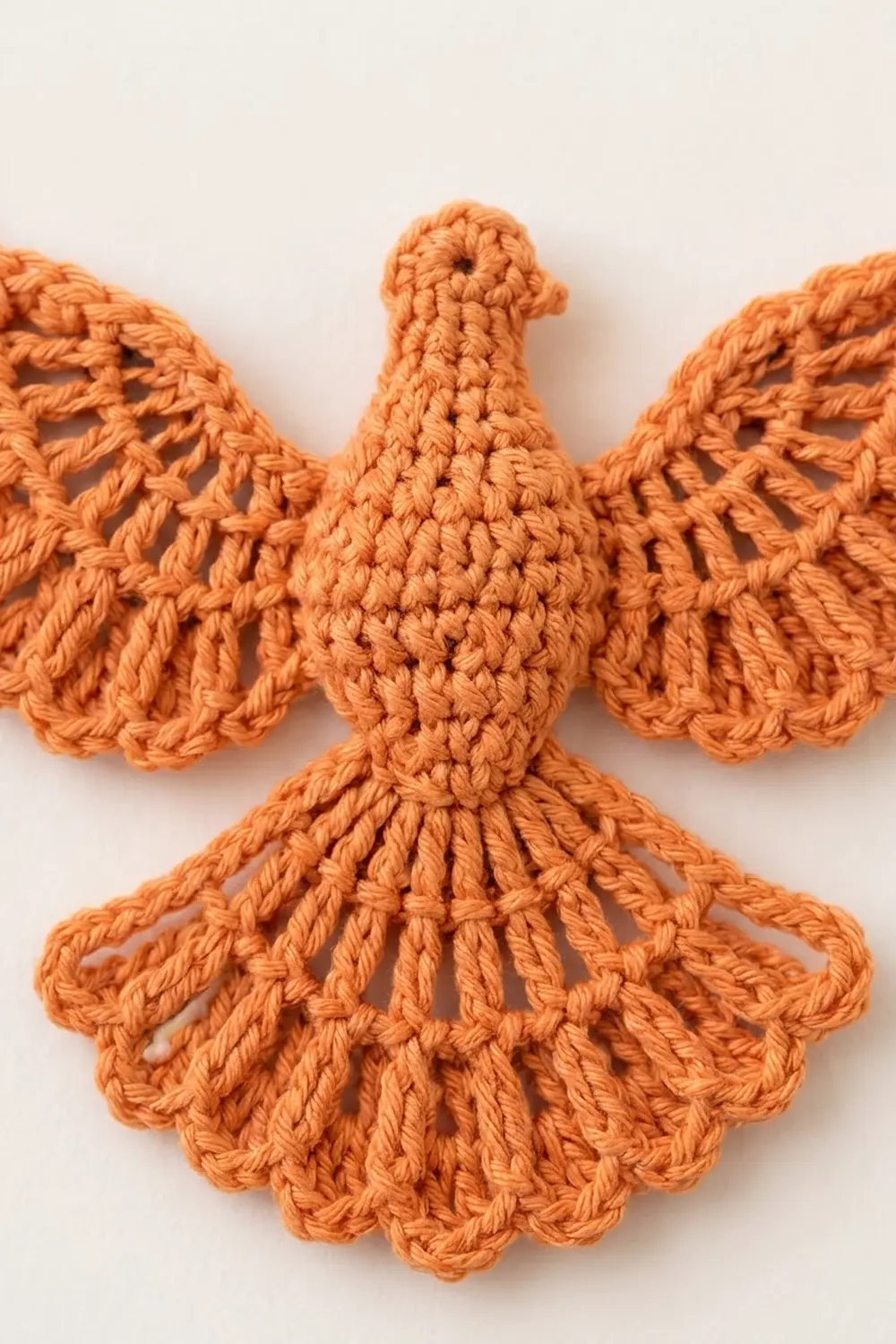
This little dove is a single flat motif with a solid body, a neat round head, two lacy upswept wings, and a scalloped fan tail. It looks delicate and festive, but it is made from simple stitches and steady fan shaping.
The sample is worked in one warm apricot-orange cotton. Using one color keeps the outline crisp and lets the openwork stand out. The style is light, lacy, and graphic, so the dove works as an ornament, a gift-tag topper, or an appliqué.
The pattern uses US crochet terms throughout. The finished dove measures 5.5 in (14.0 cm) wide across the wings and 5 in (12.7 cm) tall from head to tail edge.
The whole dove is made in one piece. You work a small sc oval for the body, then add the head in short rows at the top. Each wing is worked in rows off one side of the body, and the tail is worked in rows off the bottom. A final scallop edging finishes the wings and the tail.
Finished Size and Construction
- Finished size: 5.5 in (14.0 cm) wide x 5 in (12.7 cm) tall
- Skill level: Intermediate (tall stitches and short-row shaping)
- Terminology: US crochet terms
- Yarn weight: DK (#3) cotton
- Hook: 3.5 mm (US E-4)
- Number of pieces: 1 (one single dove motif)
- Layout: single motif; head, wings, and tail grow from one body oval
- Body size: 1.25 in (3.2 cm) wide x 2.25 in (5.7 cm) tall
- Size before edging: 5 in (12.7 cm) wide x 4.6 in (11.7 cm) tall
- Edging depth: 0.25 in (0.6 cm) on the wings, 0.4 in (1.0 cm) on the tail
Materials
Choose a smooth, mercerized or combed DK cotton. Cotton holds the lace spokes open and blocks flat with clean scallops. Acrylic works, but the fans may curl more and need firmer blocking.
- Apricot orange: 10 g / 23 m (DK cotton at about 113 m per 50 g)
Tools:
- 3.5 mm (US E-4) crochet hook
- 4 locking stitch markers
- Tapestry needle
- Scissors
- Blocking mat, rust-proof pins, and a spray bottle
- Optional: light spray starch for hanging ornaments
The quantity includes a margin of about 40% for your gauge check, yarn tails, and any frogging. One dove uses about 7 g.
Abbreviations (US Terms)
- ch: chain
- sl st: slip stitch
- sc: single crochet
- hdc: half double crochet
- dc: double crochet
- tr: treble crochet (yarn over twice)
- dtr: double treble crochet (yarn over 3 times, then pull through 2 loops 4 times)
- sc2tog: single crochet 2 together
- sp(s): space(s)
- st(s): stitch(es)
- tch: turning chain
- RS / WS: right side / wrong side
Special stitch: picot loop. (Sc, ch 3, sc) worked into the same space. This makes the small feather loops on the wing edges.
Special stitch: shell. 3 dc worked into the same space. This makes the rounded scallops on the tail.
Gauge and Checkpoints
Gauge: 20 sc x 22 rows = 4 in (10.2 cm) in sc with a 3.5 mm hook. That is 5 sc per 1 in (2.5 cm).
Gauge matters for the outline more than for fit. If your dove comes out much larger, the fans get floppy and the spokes lose their shape. Make one body oval first and measure it before you add anything else.
Checkpoints:
- After body Rnd 3: 1.25 in (3.2 cm) wide x 2.25 in (5.7 cm) tall.
- After the head: 3 in (7.6 cm) from the bottom of the body to the top of the head.
- After Row 4 of both wings: 5 in (12.7 cm) wingspan, measured flat.
- After tail Row 4: 4.6 in (11.7 cm) from head to tail edge.
- After edging and blocking: 5.5 in (14.0 cm) x 5 in (12.7 cm).
If the body is too big, go down to a 3.25 mm hook. If it is too small, go up to a 3.75 mm hook. A difference of 0.25 in (0.6 cm) at the body grows to about 0.75 in (1.9 cm) at the wingtips, so fix it early.
Body
The body is a sc oval worked in joined rounds. Do not turn.
Rnd 1 (RS): Ch 8. Sc in 2nd ch from hook, sc in next 5 ch, 3 sc in last ch. Working along the opposite side of the chain, sc in next 5 ch, 2 sc in last ch (the same ch as the first sc). Join with sl st to first sc. (16 sc)
Rnd 2: Ch 1 (does not count as a st here and throughout). 2 sc in first st, sc in next 5 sts, 2 sc in each of next 3 sts, sc in next 5 sts, 2 sc in each of last 2 sts. Join. (22 sc)
Rnd 3: Ch 1. [Sc in next st, 2 sc in next st] once, sc in next 5 sts, [sc in next st, 2 sc in next st] 3 times, sc in next 5 sts, [sc in next st, 2 sc in next st] twice. Join. (28 sc)
Number the Rnd 3 stitches 1 to 28, starting with the first sc of the round. They fall like this:
- Top end (head end): sts 23–28 and 1–3 (9 sts)
- Side 1: sts 4–8 (5 sts)
- Bottom end (tail end): sts 9–17 (9 sts)
- Side 2: sts 18–22 (5 sts)
Check: 9 + 5 + 9 + 5 = 28. Place markers in st 4, st 9, st 18, and st 25. Fasten off.
Head
The head is worked in short rows on the 5 center sts of the top end (sts 25, 26, 27, 28, and 1). St 27 is the exact center.
Row 1 (RS): Join yarn with sl st in st 25. Ch 1, sc in same st and in next 4 sts. (5 sc)
Row 2 (WS): Ch 1, turn. Sc in each st across. (5 sc)
Row 3: Ch 1, turn. Sc2tog, sc in next st, sc2tog. (3 sc)
Row 4 (beak): Ch 1, turn. Sc in first st, sc2tog over last 2 sts. Ch 3, sl st in 2nd ch from hook, sl st in next ch, sl st in top of the sc2tog. (2 sts + beak)
Fasten off. The beak points to one side, so the head looks turned. The head measures about 1 in (2.5 cm) wide x 0.75 in (1.9 cm) tall.
Wings
Each wing is a 4-row fan worked off one 5-st body side. The fan opens because each row has more space between its spokes than the row before. The upper end of Row 4 uses the tallest stitches, so the wing sweeps upward.
Wing A (on Side 2, sts 18–22)
Row 1 (RS): With RS facing, join with sl st in st 18 (nearest the tail). Ch 3 (counts as dc), 2 dc in st 19, dc in st 20, 2 dc in st 21, dc in st 22. (7 dc)
Row 2 (WS): Ch 4 (counts as dc + ch 1), turn. [Dc in next dc, ch 1] 5 times, dc in top of tch. (7 dc, 6 ch-1 sps)
Row 3: Ch 4 (counts as dc + ch 1), turn. Dc in next ch-1 sp, ch 1, dc in next dc, ch 1, dc in next ch-1 sp; repeat from * 4 more times, ch 1, dc in 3rd ch of tch. (13 dc, 12 ch-1 sps)
Check: 1 tch + 1 + (5 x 2) + 1 = 13 dc. Row 3 ends at the upper (shoulder) end.
Row 4: Ch 5 (counts as dtr), turn. [Ch 2, dtr in next dc] 3 times, [ch 2, tr in next dc] 4 times, [ch 2, dc in next dc] 4 times, ch 2, hdc in 3rd ch of tch. (13 sts, 12 ch-2 sps)
Check: 1 + 3 + 4 + 4 + 1 = 13 sts. Do not fasten off. Put the live loop on a locking marker for the edging.
Wing B (on Side 1, sts 4–8)
Wing B is a mirror image. Turn the body so the WS faces you. Row 1 then starts at the tail end, so the long feathers land at the top, as they do on Wing A.
Row 1: With WS facing, join with sl st in st 8 (nearest the tail). Ch 3 (counts as dc), 2 dc in st 7, dc in st 6, 2 dc in st 5, dc in st 4. (7 dc)
Rows 2–4: Work exactly as Wing A Rows 2–4. (13 sts, 12 ch-2 sps after Row 4)
Put the live loop on a marker.
Checkpoint: Lay the dove flat. The wingspan should be 5 in (12.7 cm).
Tail
The tail is a wider fan worked off the 9 bottom-end sts (sts 9–17).
Row 1 (RS): With RS facing, join with sl st in st 9. Ch 3 (counts as dc), dc in each of sts 10–17. (9 dc)
Row 2 (WS): Ch 4 (counts as dc + ch 1), turn. [Dc in next dc, ch 1] 7 times, dc in top of tch. (9 dc, 8 ch-1 sps)
Row 3: Ch 4 (counts as dc + ch 1), turn. Dc in next ch-1 sp, ch 1, dc in next dc, ch 1, dc in next ch-1 sp; repeat from * 6 more times, ch 1, dc in 3rd ch of tch. (17 dc, 16 ch-1 sps)
Check: 1 tch + 1 + (7 x 2) + 1 = 17 dc.
Row 4: Ch 4 (counts as tr), turn. [Ch 2, tr in next dc] 16 times. (17 tr, 16 ch-2 sps)
Checkpoint: The dove should measure 4.6 in (11.7 cm) from the top of the head to the top of tail Row 4.
Border (Scallop Edging)
The border is a single edging row on each of the three fans. Work each one from its live loop. The body and head get no edging because their sc edges are already smooth.
Border gauge: One picot-loop unit (picot loop + sc) is about 0.4 in (1.0 cm) wide. One shell unit (shell + sc) is about 0.35 in (0.9 cm) wide. One Row 4 unit (ch-2 sp + spoke) is about 0.3 in (0.8 cm) wide.
Wing Edging (each wing)
Row 5: Put the live loop back on the hook. Ch 1, turn. Sc in first st (the hdc), picot loop in next ch-2 sp, sc in next st; repeat from * 11 more times, working the last sc in the top of the ch-5 tch. Fasten off.
Count per wing: 13 sc in the spokes + 24 sc in the picot loops = 37 sc and 12 ch-3 loops.
Tail Edging
Row 5 (RS): Ch 1, turn. Sc in first tr, shell in next ch-2 sp, sc in next tr; repeat from * 15 more times, working the last sc in the top of the ch-4 tch. Fasten off.
Tail count: 17 sc + 48 dc = 65 sts (16 shells).
Why the Math Works
Row 4 of each fan has one fewer space than it has stitches: 13 sts give 12 spaces on each wing, and 17 sts give 16 spaces on the tail. Every space gets exactly one scallop and every spoke gets exactly one sc. So each edging row starts and ends with a sc, and the fans finish evenly.
The widths work too. Each edging unit is a little wider than the 0.3 in (0.8 cm) Row 4 unit under it. On the wings, the picot loops flare slightly and splay into feathers. On the tail, the shells ripple gently into rounded scallops without cupping.
Final Blocking
- Weave in all ends on the WS, hiding them inside the body and head stitches.
- Spray the dove until it is damp but not dripping.
- Lay it RS up on the blocking mat. Pin the body flat first, then the head.
- Pin each wing tip so the wingspan is 5.5 in (14.0 cm). Angle the upper dtr spokes slightly upward.
- Pin the tail so the overall height is 5 in (12.7 cm). Fan the spokes out evenly.
- Pin each picot loop and each shell so the scallops open fully.
- For a hanging ornament, mist lightly with spray starch.
- Let the dove dry completely before you unpin it.
Final Quality-Control Checklist
- Body Rnd 3 has 28 sc and measures 1.25 in (3.2 cm) x 2.25 in (5.7 cm).
- The head is centered on st 27, and the beak points to one side.
- Row 4 of each wing has 13 sts and 12 ch-2 sps, with the dtrs at the top.
- Both wings sweep upward and neither one is flipped.
- Tail Row 4 has 17 tr and 16 ch-2 sps.
- Each wing has 12 picot loops and the tail has 16 shells.
- The finished size is 5.5 in (14.0 cm) x 5 in (12.7 cm).
- All ends are woven in and none show on the RS.
Troubleshooting
The body cups or curls. Your Rnd 2 or Rnd 3 increases are off. Recount: 22 sc after Rnd 2 and 28 after Rnd 3.
A wing points downward. The tall stitches ended up at the tail end. For Wing B, make sure the WS is facing when you join in st 8.
The wings are different sizes. Recount Row 4 on each wing (13 sts). Check that both wings use dtr, tr, dc, and hdc in the same order.
The tail ruffles too much. Use 2 dc instead of 3 dc in each shell, or use a hook 0.25 mm smaller for the edging only.
The fan edges cup inward. Your chains are too tight. Loosen the ch-1 and ch-2 spaces, or use a hook one size larger for the fans.
The beak disappears. Pull the ch-3 snug before the sl sts and pin the beak out during blocking.
Care
Hand wash in cool water with mild soap, press out the water in a towel, and re-block flat to dry. Starch hanging ornaments again after washing if you want them stiff.
Final Notes
The measurements build in a short chain. The body oval is 1.25 in (3.2 cm) x 2.25 in (5.7 cm) after Rnd 3. The head brings the height to 3 in (7.6 cm). The two wings give a 5 in (12.7 cm) span, and the tail brings the height to 4.6 in (11.7 cm) before edging. The scallop edging adds 0.25 in (0.6 cm) to each wing and 0.4 in (1.0 cm) to the tail, for a finished dove of 5.5 in (14.0 cm) x 5 in (12.7 cm).
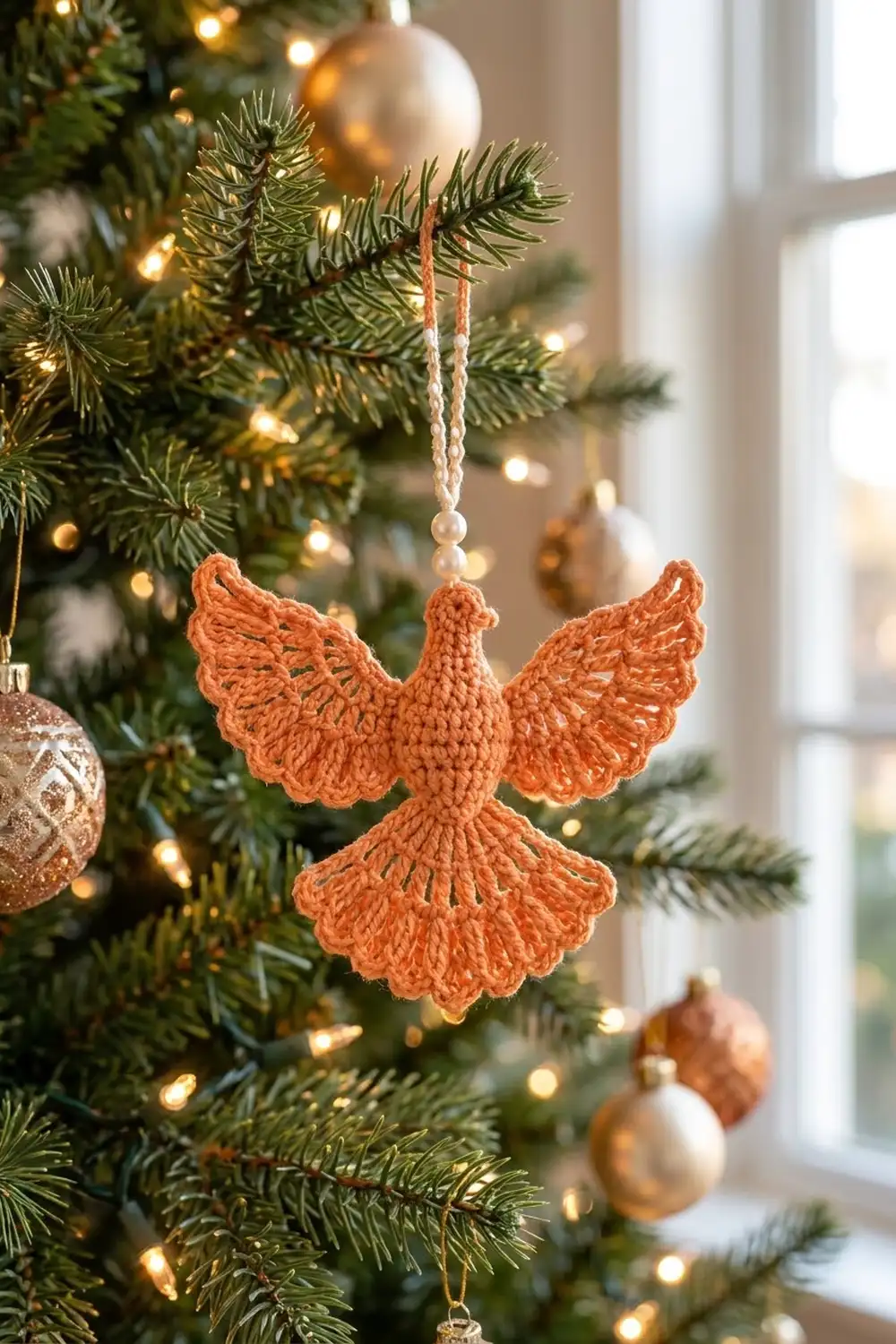
Count Row 4 on every fan before you edge it, and the whole outline will fall into place. A single dove makes a lovely ornament, and a small sl st loop at the head turns it into a hanger in seconds.
Happy crocheting!