

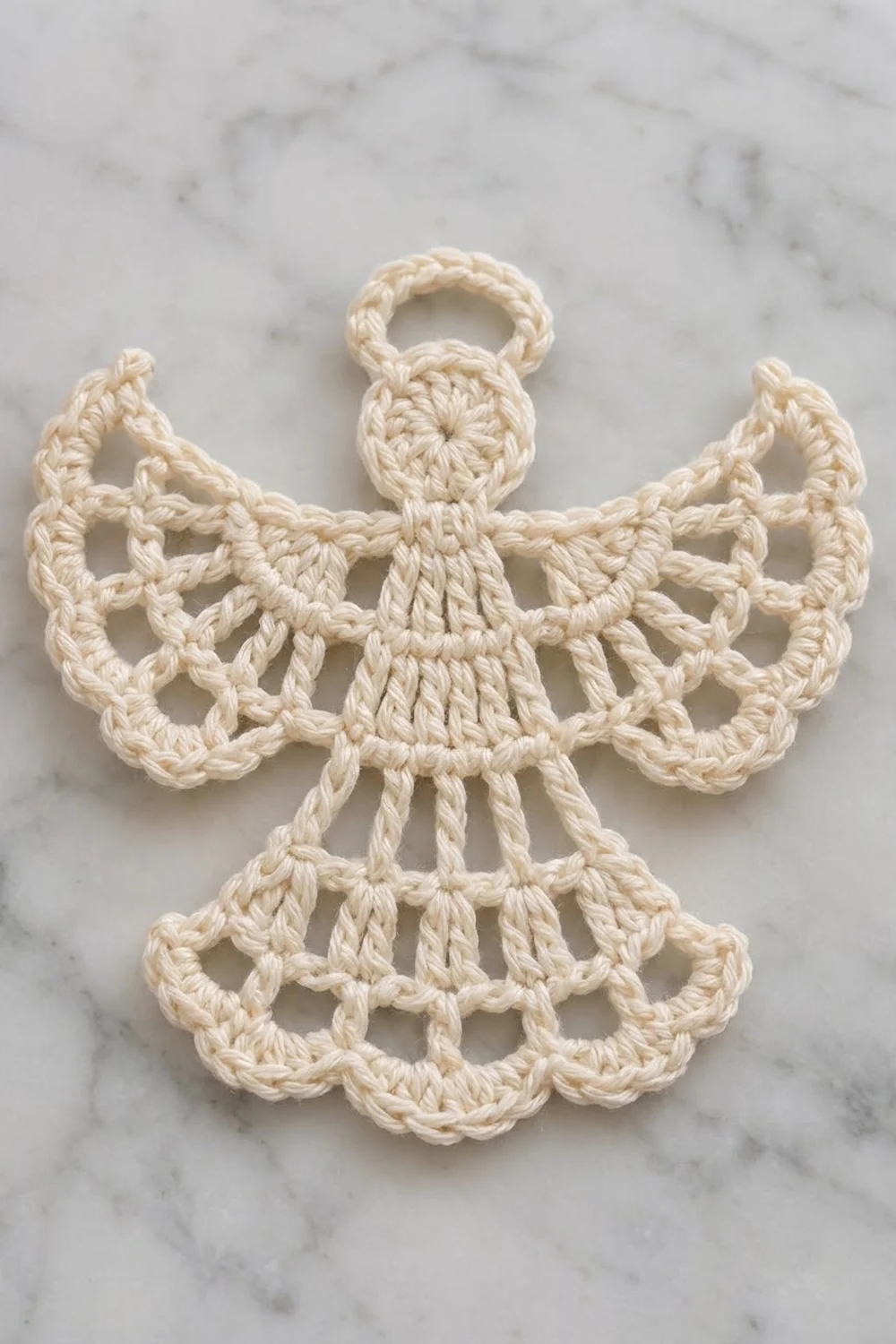
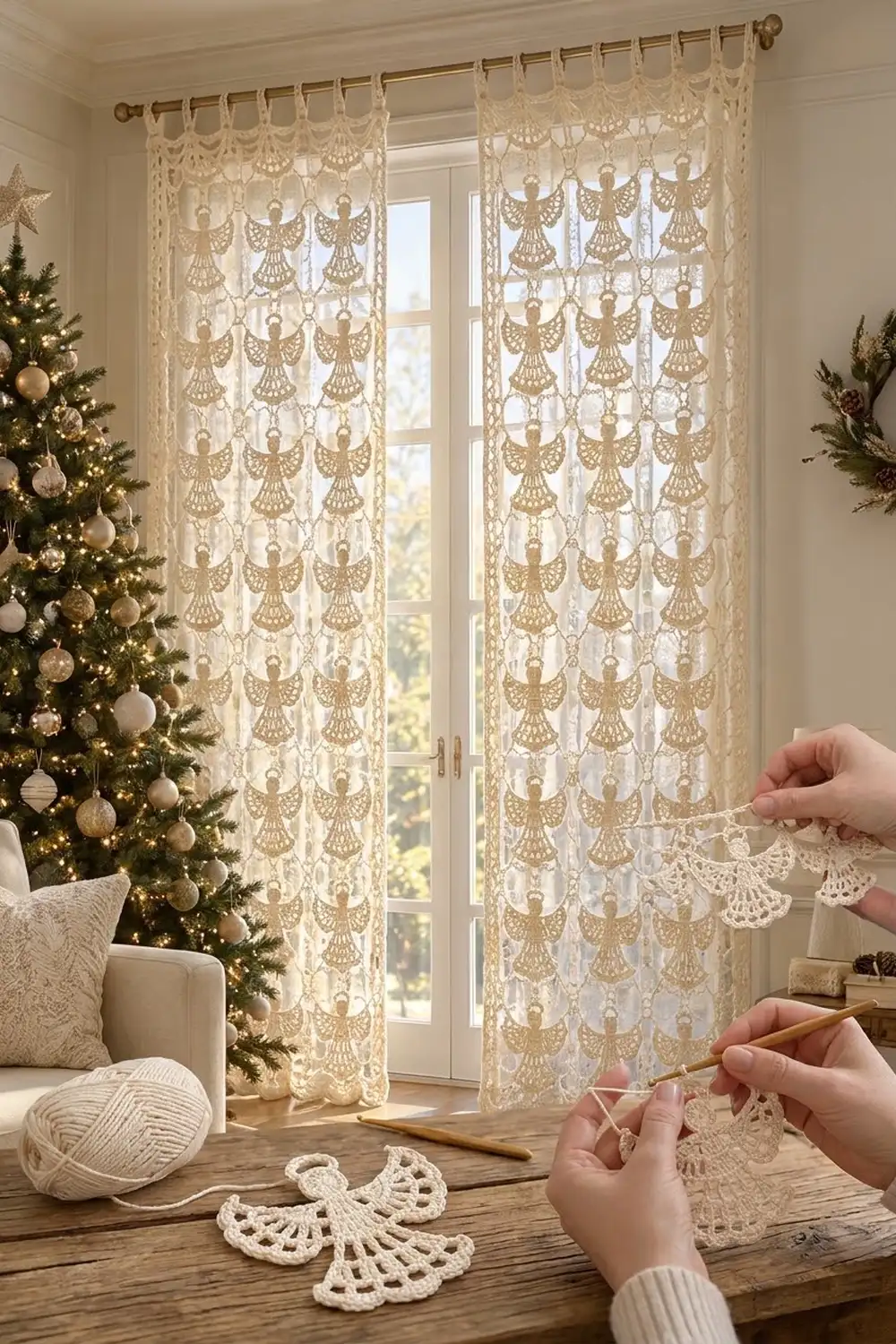
The Gloria Angel Lace Curtain Panel is made from rows of small cream angels. Each angel has a round halo, a solid round head, fan-shaped wings with open spokes, and a bell skirt that ends in a scalloped hem. Chain lattices link the angels, so light shows through the panel the way it does through vintage filet lace.
The whole panel uses one color, a soft ivory cream. It looks airy and calm, and it suits a Christmas window, a nursery, or a bright hallway all year round. Choose a smooth cotton so the scallops keep their shape.
All instructions use US crochet terms. One finished panel measures 22.6 in wide x 75.5 in long (57.4 x 191.8 cm) from the hem to the top of the band. The hanging tabs add 1.5 in (3.8 cm), so the panel is 77 in (195.6 cm) long overall. Make two panels for a pair.
Each angel is made in one piece: first the head in the round, then the halo, then the skirt in rows going down, then one wing on each side. The angels are joined at the wingtips into strips of four. Chain lattices link the strips, and a sc band with tabs plus a side edging finish the panel.
Finished Size and Construction
- Finished size (one panel): 22.6 x 75.5 in (57.4 x 191.8 cm), plus 1.5 in (3.8 cm) tabs
- Skill level: Intermediate
- Terminology: US
- Yarn weight: DK (#3) cotton
- Hook: 3.5 mm (E-4)
- Number of pieces: 48 angel motifs per panel (96 for a pair)
- Layout: 4 angels across x 12 angels down
- Piece size: 5.5 in wide x 5 in tall (14.0 x 12.7 cm), wingtip to wingtip and halo to hem
- Size before border: 22 x 74.3 in (55.9 x 188.7 cm)
- Border depth: top band 1.2 in (3.0 cm) plus 1.5 in (3.8 cm) tabs; side edging 0.3 in (0.8 cm) per side. The bottom edge is formed by the angels’ own scalloped hems.
Materials
Choose a smooth DK cotton or cotton blend of about 230 m per 100 g. Mercerized cotton shows the stitches most clearly. Avoid fuzzy yarn, because it blurs the open spaces in the skirts and wings.
- Ivory cream: 550 g (about 1,265 m) per panel; 1,100 g (about 2,530 m) for a pair
- One test angel uses about 9 g (21 m)
These amounts include a margin of about 15% for the test motif, joins and weaving in ends.
Tools:
- 3.5 mm (E-4) crochet hook
- Tapestry needle
- Scissors
- 4 locking stitch markers
- Tape measure
- Blocking mats (or a clean sheet over carpet), rustproof pins, and a spray bottle
Abbreviations (US Terms)
- ch: chain
- sl st: slip stitch
- sc: single crochet
- dc: double crochet
- sp(s): space(s)
- st(s): stitch(es)
- tch: turning chain
- RS: right side
- rep: repeat
Joining sc (jsc): insert the hook through the stitch named on the current angel and then through the stitch named on the neighboring angel. Yarn over and pull up a loop through both, then yarn over and pull through 2 loops.
Gauge and Checkpoints
Make one complete angel before you buy all the yarn. Block it lightly and measure it.
- Main gauge: one angel = 5.5 in (14.0 cm) wingtip to wingtip and 5 in (12.7 cm) from halo top to hem.
- Chain gauge: 6 ch = 1 in (2.5 cm), slightly relaxed.
- Sc gauge (band and edging): 24 sc = 4 in (10.2 cm); 10 sc rows = 3 in (7.6 cm).
Checkpoints:
- After Head Round 2: head diameter 1.25 in (3.2 cm).
- After Body Row 3: torso width about 2.4 in (6.1 cm).
- After Body Row 6: hem width about 5 in (12.7 cm).
- After both wings: wingspan 5.5 in (14.0 cm).
- One strip of 4 angels: 22 in (55.9 cm) wide.
- Two strips plus one lattice: 11.3 in (28.7 cm) tall.
If the head is 0.125 in (0.3 cm) or more too big, use a hook one size smaller. If it is too small, use a hook one size larger. Check gauge again every few motifs, because tension often loosens over a big project.
Angel Motif (make 48 per panel)
Head
Round 1: Make a magic ring, ch 3 (counts as dc), 11 dc in ring, sl st in top of ch-3. Pull the ring closed. (12 dc)
Round 2: Ch 1, sc in same st, 2 sc in next st, sc in next st, 2 sc in next st; rep from * 7 more times, sl st in first sc. (18 sc)
The joining sl st marks the top of the head.
Halo
Ch 14, then sl st in the same sc as the Round 2 join to make a loop. Work 20 sc into the ch-14 loop, then sl st in the same base sc. (20 sc in the halo)
Place a marker in the 10th halo sc. This is the halo top, which you will use for joining later.
Sl st in the next 7 sc of the head. You are now at the 8th head sc, at the bottom of the head.
Body
Row 1: Ch 3 (counts as dc), dc in same st, 2 dc in each of next 3 sts. (8 dc)
Row 2: Ch 3, turn, dc in first st, dc in next 6 sts, 2 dc in top of tch. (10 dc)
Row 3: Ch 3, turn, dc in first st, dc in next 8 sts, 2 dc in top of tch. (12 dc)
Rows 1–3 form the solid torso.
Row 4: Ch 4 (counts as dc + ch 1), turn, skip first st, dc in next st, ch 1; rep from * 9 more times, dc in top of tch. (12 dc, 11 ch-1 sps)
Row 5: Ch 5 (counts as dc + ch 2), turn, dc in next dc, ch 2; rep from * 9 more times, dc in 3rd ch of tch. (12 dc, 11 ch-2 sps)
Row 6 (hem): Ch 1, turn, sc in first dc, 3 dc in next ch-2 sp, sc in next dc; rep from * 10 more times, working the last sc in 3rd ch of tch. Fasten off. (12 sc + 33 dc = 45 sts, 11 scallops)
The first and last sc of Row 6 are the hem corners.
Wings (make 2)
Work the right wing first. On every angel except the first one in each strip, the left wing is worked during joining.
Row 1: With RS facing, join yarn with sl st around the end post of Body Row 2. Ch 4 (counts as dc + ch 1), (dc, ch 1) 5 times around the same post, dc around same post. (7 dc, 6 ch-1 sps)
Row 2: Ch 5 (counts as dc + ch 2), turn, dc in next dc, ch 2; rep from * 4 more times, dc in 3rd ch of tch. (7 dc, 6 ch-2 sps)
Row 3: Ch 6 (counts as dc + ch 3), turn, dc in next dc, ch 3; rep from * 4 more times, dc in 3rd ch of tch. (7 dc, 6 ch-3 sps)
Row 4: Ch 1, turn, sc in first dc, 4 dc in next ch-3 sp, sc in next dc; rep from * 5 more times. Fasten off. (7 sc + 24 dc = 31 sts, 6 scallops)
The 4th sc of Row 4 sits at the end of the middle spoke. This is the wingtip. The 7 spokes spread into a half circle about 1.8 in (4.6 cm) deep, so the wings sit level with the shoulders.
Make All Pieces
Make 48 angels per panel (96 for a pair), all in ivory cream. Finish the right wing on every angel as you go. Leave the left wing unworked on 36 angels per panel, because those wings are worked during joining. The first angel of each strip (12 per panel) gets both wings.
ROW 1:  ANGEL ANGEL ANGEL ANGEL
ROW 2:  ANGEL ANGEL ANGEL ANGEL
ROW 3:  ANGEL ANGEL ANGEL ANGEL
ROW 4:  ANGEL ANGEL ANGEL ANGEL
ROW 5:  ANGEL ANGEL ANGEL ANGEL
ROW 6:  ANGEL ANGEL ANGEL ANGEL
ROW 7:  ANGEL ANGEL ANGEL ANGEL
ROW 8:  ANGEL ANGEL ANGEL ANGEL
ROW 9:  ANGEL ANGEL ANGEL ANGEL
ROW 10: ANGEL ANGEL ANGEL ANGEL
ROW 11: ANGEL ANGEL ANGEL ANGEL
ROW 12: ANGEL ANGEL ANGEL ANGEL
All angels stand upright with their halos at the top.
Joining
Step 1: Wingtip joins (strips)
Lay angel A face up and place angel B to its right. Work Rows 1–3 of B’s left wing as usual. On Row 4, work up to the wingtip, then make the wingtip as a jsc through B’s dc and A’s right wingtip sc together. Finish the row as written. The count stays at 31 sts, because the jsc replaces a sc rather than adding one.
Add angels C and D the same way. Each strip is 4 angels and 22 in (55.9 cm) wide (4 x 5.5 in). Make 12 strips.
Step 2: Lattice rows
Each lattice row links one strip (the upper strip) to the strip below it (the lower strip). Lay both strips RS up, with a gap of about 1.3 in (3.3 cm) between the upper hems and the lower halos.
Lattice Row: Join yarn with sc in the outer left hem corner of upper angel 1. Ch 17, sc in halo top of the lower angel directly below, ch 17, sc in the right hem corner of the same upper angel; ch 3, sc in the left hem corner of the next upper angel; rep from * across, ending at *. Fasten off.
Per angel: 1 hem sc + 17 ch + 1 halo sc + 17 ch + 1 hem sc = 37 sts. Across the strip: 4 x 37 + 3 bridges x 3 ch = 157 sts.
Each ch-17 is about 2.8 in (7.1 cm) long and runs at an angle from a hem corner down to a halo, which creates the 1.3 in (3.3 cm) vertical gap. The ch-3 bridge closes the 0.5 in (1.3 cm) gap between neighboring hem corners.
Work 11 lattice rows to join all 12 strips. The bottom strip has no lattice below it, so bridge its hems separately: join yarn in the right hem corner of an angel, ch 3, sl st in the left hem corner of the next angel, and fasten off. Do this 3 times.
Tension: keep the chains relaxed and even. Count every chain, because one short chain will make a halo tilt.
Size checkpoint: two joined strips measure 11.3 in (28.7 cm) from halo top to lower hem. The full field is 22 x 74.3 in (55.9 x 188.7 cm): 12 angels x 5 in plus 11 gaps x 1.3 in.
Border
Border gauge: 24 sc = 4 in (10.2 cm), 6 ch = 1 in (2.5 cm), 10 sc rows = 3 in (7.6 cm).
Top band
Row 1: Ch 16, sc in halo top of angel 1 in the top strip, ch 32, sc in halo top of next angel; rep from * 2 more times, ch 16. (16 + 1 + 3 x 33 + 16 = 132 sts)
Row 2: Ch 1, turn, sc in each st across. (132 sc)
Row 3: Ch 1, turn, sc in each sc across. (132 sc)
Row 4 (tabs): Ch 1, turn, sc in first 4 sc, ch 20, skip 4 sc, sc in next 16 sc; rep from * 5 more times, ch 20, skip 4 sc, sc in last 4 sc. (104 sc, 7 ch-20 loops)
Row 5: Ch 1, turn, sc in each sc, 24 sc in each ch-20 loop. (104 sc worked 1 per sc + 168 sc in loops = 272 sts) Fasten off.
Why the math works: each angel gets 33 top stitches: 16 to its left, its halo sc, and 16 to its right. Between two angels, that makes 16 + 16 = 32 ch. So 4 x 33 = 132 sts, and 132 / 6 = 22 in, which matches the strip width exactly. Row 4 uses 4 + 6 x 20 + 4 + 4 = 132 sts and places a tab every 20 sts, about every 3.3 in (8.4 cm). Rows 2–5 add 1.2 in (3.0 cm) above the halos.
Side edging (work on each long side)
Row 1: Join yarn with sc in the row-end of Top Band Row 1 at the corner. Ch 17, sc in the outer wingtip of the top angel, ch 13, sc in the outer hem corner of the same angel*; ch 25, sc in the outer wingtip of the next angel down; rep from * down the side, ending at ** on the bottom angel. (1 + 17 + 12 x 15 + 11 x 25 = 473 sts)
Row 2: Ch 1, turn, sc in each ch, skipping the 25 anchor sc. (17 + 12 x 13 + 11 x 25 = 448 sc) Fasten off.
Why the math works: ch 17 spans the 2.8 in (7.1 cm) from band to wingtip, ch 13 spans the 2.2 in (5.6 cm) from wingtip to hem, and ch 25 spans the 4.1 in (10.4 cm) from a hem to the next wingtip. 448 sc / 6 = about 74.7 in (189.7 cm). That is within 0.5 in (1.3 cm) of the 74.3 in (188.7 cm) field, and blocking evens out the difference. Each side adds 0.3 in (0.8 cm), so the finished panel is 22.6 in (57.4 cm) wide.
Final Blocking
- Weave in all ends along solid stitches, never across open spaces.
- Lay the panel RS up on the mats or sheet.
- Pin the top band straight at 22 in (55.9 cm).
- Pin each side edge in a straight line, 74.3 in (188.7 cm) down from the halos.
- Pin every halo round, every wingtip outward, and every hem scallop.
- Check that each angel measures 5.5 x 5 in (14.0 x 12.7 cm).
- Mist until damp, not soaked. Let it dry fully before you unpin it.
Final Quality-Control Checklist
- 48 angels, each with a 45-st hem and 31-st wings
- All 12 strips measure 22 in (55.9 cm)
- 11 lattice rows of 157 sts each, with every halo centered
- Band Row 1 = 132 sts, with 7 evenly spaced tabs
- Side Row 2 = 448 sc on both sides
- Panel measures 22.6 x 75.5 in (57.4 x 191.8 cm) without the tabs
- No twisted chains and no loose ends showing
Troubleshooting
- Skirt ruffles: the ch-2 spaces are loose. Work Row 5 with tighter chains or use a hook one size smaller.
- Wings cup: the ch-3 spaces in Row 3 are too tight. Loosen them, then block flat.
- Halo leans: the two ch-17 lattice chains are different lengths. Recount and redo.
- Strip too wide: make sure the wingtip joins are a jsc, not an extra sc.
- Top band waves: the Row 1 chains are too tight. Redo them with looser chains.
- Side edge pulls in: loosen Row 2, or add 1 ch to each ch-25 section and 1 matching sc in Row 2.
Care
Hand wash in cool water with mild soap, then roll the panel in a towel to press out the water. Dry flat, and pin the wings and scallops again if needed.
Final Notes
The measurements build on each other. A 1.25 in (3.2 cm) head gives a 5.5 x 5 in (14.0 x 12.7 cm) angel. Four angels make a 22 in (55.9 cm) strip. Twelve strips with 1.3 in (3.3 cm) lattice gaps make a 74.3 in (188.7 cm) field. The 132-st band, the 448-sc side edges and the tabs bring the panel to 22.6 x 77 in (57.4 x 195.6 cm). If each step measures correctly, the whole panel will too.
Happy crocheting!