

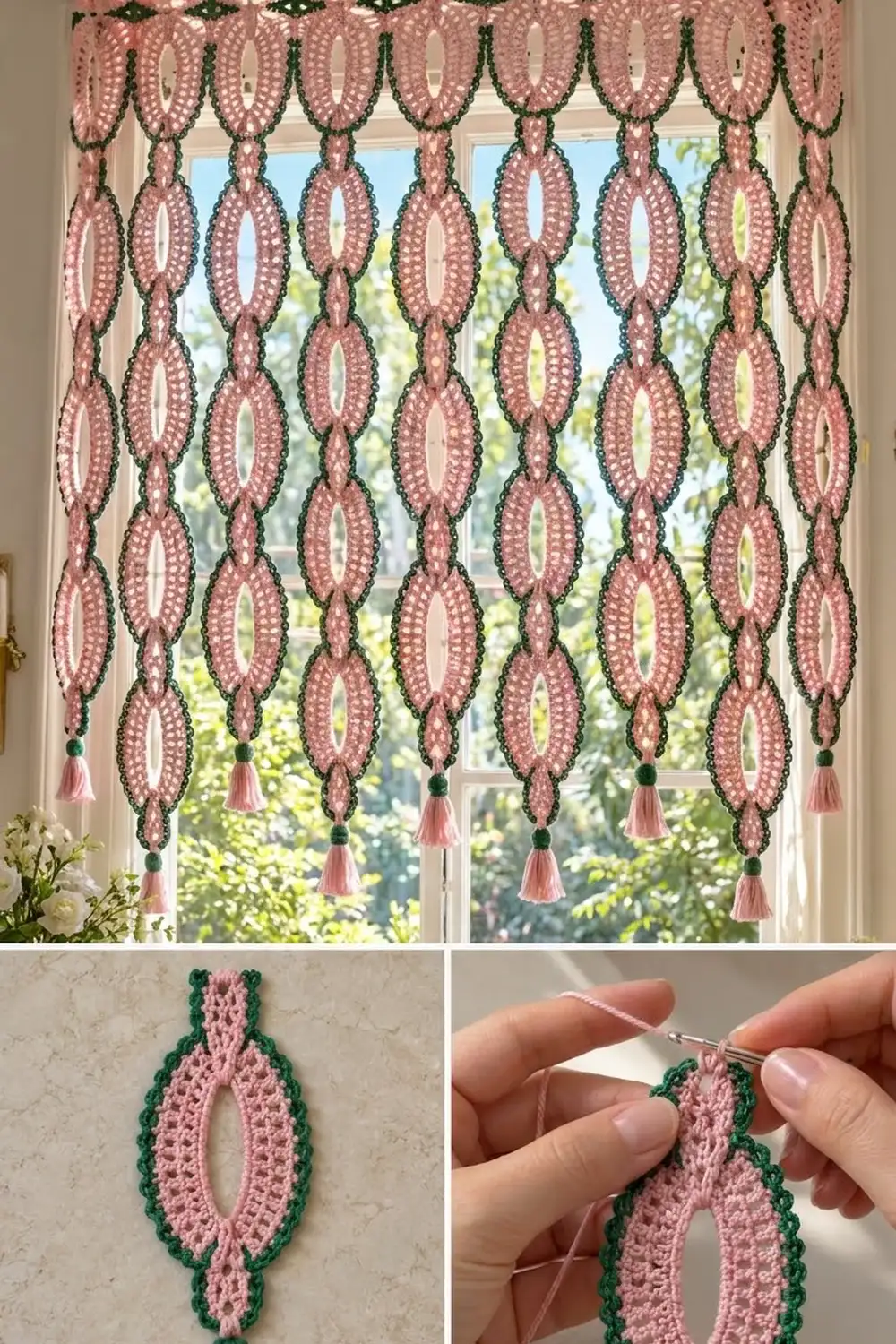
The Rose Trellis Curtain is a light, airy window panel made from long pointed oval motifs linked into hanging strands. Each oval has an open center, blush-pink openwork rounds, and a bumpy forest-green edge down both long sides. Narrow pink lattice connectors made of crossed double crochets link the points of the ovals, and every strand ends in a pink tassel wrapped in green.
The palette is just two colors: blush pink as the main color and deep forest green as the accent. The style is vintage and garden-inspired, and light shining through the open centers makes it a good choice for a sunny window.
This pattern uses US crochet terms. The finished curtain is 45 in (114.3 cm) wide. The shorter strands measure 58 in (147.3 cm) and the longer strands 60 in (152.4 cm) from the top of the header to the tassel tips.
The curtain is made in modules. You make 54 oval motifs, link them point to point into 9 strands of 6, and add a widening top tab to each strand. Then you join all the tabs in one long row and work a striped header across the top. Clip rings hang it from any rod.
Finished Size and Construction
- Finished size: 45 in (114.3 cm) wide x 58–60 in (147.3–152.4 cm) long, including tassels
- Skill level: Intermediate
- Terminology: US
- Yarn weight: Sport (CYC 2) mercerized cotton
- Hook: 3.0 mm
- Number of pieces: 54 oval motifs, joined into 9 strands
- Layout: 9 strands side by side, 6 motifs each, with every other strand hanging about 2 in (5.1 cm) lower
- Motif size: 4.25 in (10.8 cm) wide x 7 in (17.8 cm) tall, point to point
- Size before border (header): 45 in (114.3 cm) across the joined tabs; strands 52.5 in (133.4 cm) or 54.5 in (138.4 cm) long without tassels
- Border (header) depth: 2 in (5.1 cm)
Materials
Use a smooth mercerized cotton in sport weight, about 155 m per 50 g. Cotton keeps the oval shape crisp, shows off the crossed stitches, and stretches very little as it hangs.
- Color A, blush pink: 600 g (about 1,860 m)
- Color B, forest green: 150 g (about 465 m)
These quantities include a margin of about 15 percent for gauge differences and tassels.
Tools:
- 3.0 mm crochet hook
- Tapestry needle and scissors
- Stitch markers
- Stiff card, 7 in (17.8 cm) long, for tassels
- 10 clip curtain rings
- Rust-proof pins, blocking mats, spray bottle
Abbreviations (US Terms)
- ch – chain
- sl st – slip stitch
- sc – single crochet
- hdc – half double crochet
- dc – double crochet
- sk – skip
- sp(s) – space(s)
- st(s) – stitch(es)
- rep – repeat
- RS – right side
- rev sc – reverse single crochet (crab stitch): without turning, work from left to right. Insert your hook in the next st to the right, yo, pull up a loop, yo, and pull through both loops.
Special stitch – crossed dc pair: Skip the next st and dc in the st after it. Then dc in the skipped st, working behind the first dc. Each pair uses 2 sts and makes 2 sts.
Gauge and Checkpoints
Gauge: 20 sc and 22 rows = 4 in (10.2 cm). Each dc row is about 0.5 in (1.3 cm) tall.
Make one complete motif before you start production. It works as your gauge swatch because it tests the ring length, the stitch heights, and the edging all at once.
Motif checkpoints (measured flat, with the center gently opened):
- After Round 1: 6 in (15.2 cm) tall x 1.75 in (4.4 cm) wide
- After Round 3: 7 in (17.8 cm) tall x 3.75 in (9.5 cm) wide
- After the edging: 7 in (17.8 cm) tall x 4.25 in (10.8 cm) wide
If the motif comes out more than 0.25 in (0.6 cm) too big, switch to a 2.75 mm hook. If it comes out more than 0.25 in (0.6 cm) too small, switch to a 3.25 mm hook. Always change the hook, never the stitch counts, because the header math depends on them.
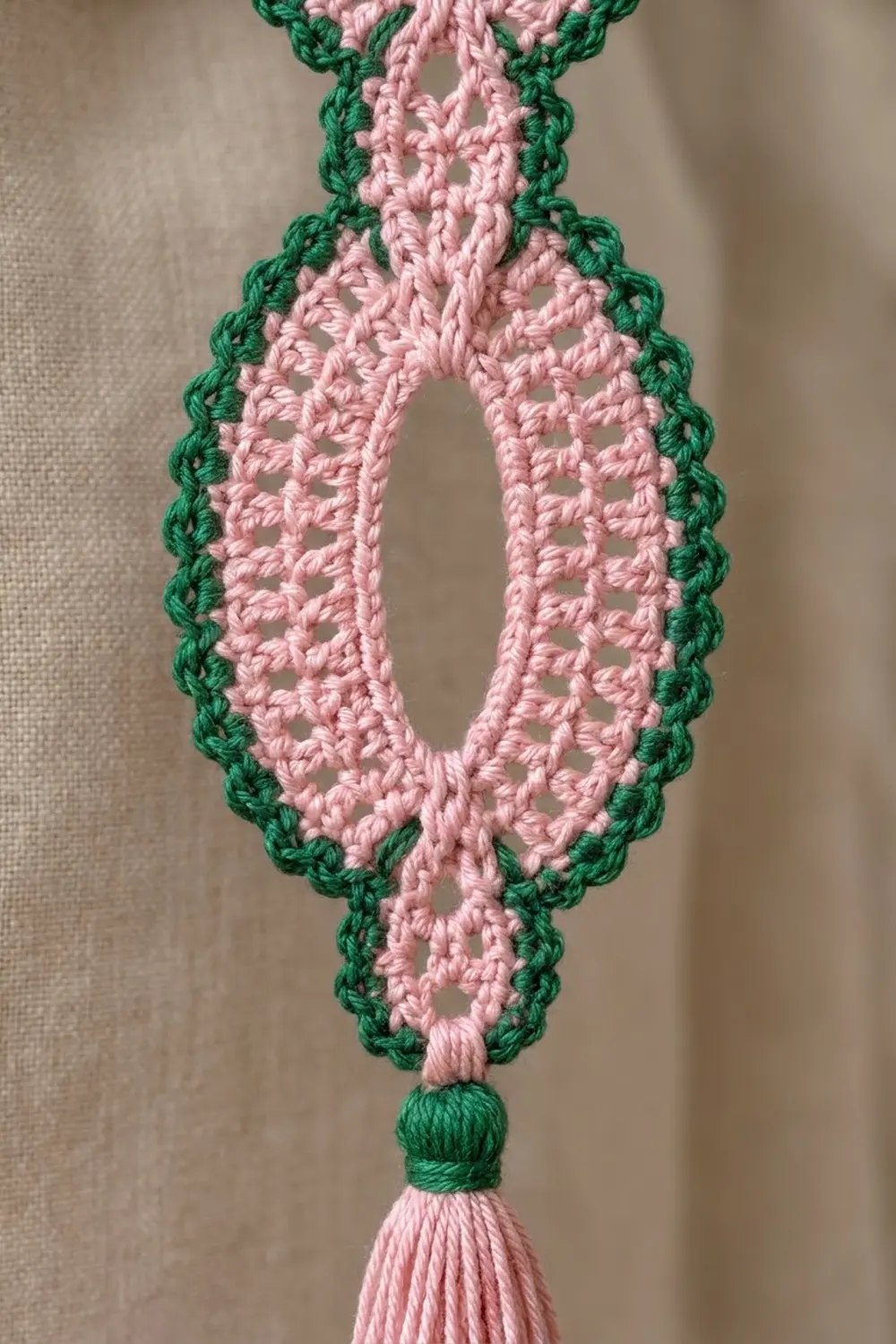
Oval Motif (make 54)
The motif is worked in rounds around a long chain ring. Short stitches at the ends and tall stitches along the sides make the pointed lens shape.
With A, ch 60 and sl st in the first ch to form a ring. Lay it flat as a long, narrow oval and mark the join as the top point.
Round 1: Ch 1, sc in next 2 ch, hdc in next 3 ch, dc in next 20 ch, hdc in next 3 ch, sc in next 2 ch; rep from * once, sl st in first sc. (60 sts: 30 per side)*
The first repeat is the right side and ends at the bottom point. The second repeat is the left side and ends at the top point.
Round 2: Ch 1, sc in next 2 sts, hdc in next 3 sts, [2 dc in next st, dc in next st] 10 times, hdc in next 3 sts, sc in next 2 sts, ch 3; rep from * once, sl st in first sc. (80 sts: 40 per side, plus 2 ch-3 point loops)*
Each side grows from 20 dc to 30 dc. The sc and hdc at the ends stay the same, so only the sides widen.
Round 3 (openwork): Ch 1, sc in next 2 sts, hdc in next 3 sts, [dc in next st, ch 1] 29 times, dc in next st, hdc in next 3 sts, sc in next 2 sts, (sc, ch 3, sc) in ch-3 point loop; rep from * once, sl st in first sc. Fasten off. (Per side: 40 sts and 29 ch-1 sps. Points: 4 sc and 2 ch-3 loops. Total: 84 sts.)*
Green side edging (work on each side): Edging row 1: With the RS facing, join B with a sc in the first sc of a side. Sc in each st and each ch-1 sp across, ending in the last sc before the point. (69 sc: 40 sts + 29 sps)
Edging row 2: Ch 1 and do not turn. Rev sc in each sc back across. (69 rev sc) Fasten off.
Repeat the edging on the second side. The green stops at the points, leaving the pink point sc and the ch-3 loops free for the connectors.
Make All Pieces
- Motifs: 54. Each uses A for Rounds 1–3 and B for two side edgings.
- Connectors: 45 (5 per strand), in A
- Top tabs: 9 in A. Strands 1, 3, 5, 7, and 9 get short tabs; strands 2, 4, 6, and 8 get long tabs.
- Bottom stubs and tassels: 9 each
Weave in the ends on every motif before joining.
Layout grid (M = motif, T = short tab, LT = long tab, X = stub and tassel):
        S1  S2  S3  S4  S5  S6  S7  S8  S9
Header  ====================================  225 sts
Tab     T   LT  T   LT  T   LT  T   LT  T
Row 1   M   M   M   M   M   M   M   M   M
Row 2   M   M   M   M   M   M   M   M   M
Row 3   M   M   M   M   M   M   M   M   M
Row 4   M   M   M   M   M   M   M   M   M
Row 5   M   M   M   M   M   M   M   M   M
Row 6   M   M   M   M   M   M   M   M   M
End     X   X   X   X   X   X   X   X   X
Joining
Connector (links two motifs): Each connector starts at the bottom point of one motif, and its last row joins to the top point of the next motif. It stays 5 sts wide the whole way.
Row 1: With A, join in the bottom ch-3 point loop. Ch 1 and work 5 sc in the loop, then turn. (5 sc)
Row 2: Ch 3 (counts as dc), [crossed dc pair] twice, turn. (5 sts)
Row 3: Ch 1, sc in each st across, turn. (5 sc)
Row 4: Repeat Row 2. (5 sts)
Row 5 (joining): Hold the next motif with its top point loop above the strip and both pieces RS facing. Ch 1. Insert your hook in the next st, then through the top ch-3 point loop of the next motif, and complete a sc; rep from * 4 more times. (5 sc)* Fasten off.
Each connector is 1.5 in (3.8 cm) long. Keep your tension even. If the joining sc are too tight, the point puckers. If they are too loose, the strand twists.
Top tab: At the top point loop of the first motif, work connector Rows 1–4.
Long tab only: repeat Rows 3 and 4 three more times. This adds 2 in (5.1 cm).
Row 5: Ch 1 and work 3 sc in each st, then turn. (15 sc)
Row 6: Ch 1, [2 sc in next st, 2 sc in next st, sc in next st] 5 times, turn. (25 sc)
Row 7: Ch 1 and sc in each st across. (25 sc) Fasten off.
The tab is 5 in (12.7 cm) wide and 2 in (5.1 cm) tall. The long tab is 4 in (10.2 cm) tall.
Bottom stub: At the bottom point of the sixth motif, work connector Rows 1–3, about 1 in (2.5 cm) long, and fasten off.
Tassel: Wrap A 30 times around the 7 in (17.8 cm) card. Tie the loops at the top with a strand of A threaded through the stub and cut the bottom loops. Wrap B tightly around the neck to make a 0.5 in (1.3 cm) band, then trim the tassel to 3.5 in (8.9 cm).
Strand checkpoint: A short strand measures 2 + (6 x 7) + (5 x 1.5) + 1 = 52.5 in (133.4 cm) without its tassel. A long strand measures 54.5 in (138.4 cm).
Border: Top Header Band
Border gauge: 20 sc = 4 in (10.2 cm), so 225 sts = 45 in (114.3 cm).
Header Row 1 is also the final join. It links all 9 tabs into one panel.
Row 1 (A): Lay the strands out in order with the RS facing. Join A in the first st of tab 1’s Row 7. Ch 1 and sc in each of its 25 sts. Then continue straight into the first st of tab 2 with no chain and no extra stitch, and work across all 9 tabs this way. Turn. (225 sc = 9 tabs x 25)
Row 2 (A): Ch 3 (counts as dc), dc in each st across, turn. (225 sts)
Row 3 (B): Ch 1, sc in each st across, turn. (225 sc)
Row 4 (A): Ch 3 (counts as dc), [crossed dc pair] 112 times, turn. (1 + 224 = 225 sts)
Row 5 (A): Ch 1, sc in each st across. (225 sc)
Row 6 (B): Ch 1, sc in each st across. (225 sc)
Row 7 (B): Ch 1 and do not turn. Rev sc in each st back across. (225 rev sc) Fasten off.
Why the math works: Each tab ends with exactly 25 sts, and the seams add nothing, so Row 1 has 9 x 25 = 225 sts. Every later row keeps 225. The crossed row works because 225 is odd: one ch-3 plus 112 pairs gives 225. At 5 sts per inch, 225 sts measure 45 in (114.3 cm).
Attach 10 clip rings at sts 1, 25, 50, 75, 100, 125, 150, 175, 200, and 225, about 5 in (12.7 cm) apart.
Final Blocking
- Wet the curtain thoroughly and gently squeeze out the water. Do not wring it.
- Lay the header flat and pin it to 45 in x 2 in (114.3 cm x 5.1 cm).
- Lay each strand straight below its tab.
- Pin each motif to 4.25 in x 7 in (10.8 cm x 17.8 cm), opening the center hole evenly.
- Pin each connector straight at 1.5 in (3.8 cm) long.
- Comb out the tassels and leave everything to dry completely.
- Unpin and hang. Gravity will finish the shaping.
Final Quality-Control Checklist
- All 54 motifs measure 4.25 in x 7 in (10.8 cm x 17.8 cm)
- The green edging is on both sides of every motif and stops at the points
- Each connector is 5 sts wide and 1.5 in (3.8 cm) long
- The strands alternate short and long tabs, starting with short
- The header has 225 sts in every row and measures 45 in (114.3 cm)
- No strand is twisted
- All ends are woven in and the tassels are trimmed evenly
Troubleshooting
- Motif cups: Round 2 is tight. Go up a hook size for that round.
- Motif ruffles: The ch-1 sps in Round 3 are too loose. Keep them snug.
- Green edge waves: Make sure you work exactly 1 sc per st and per sp.
- Strand twists: One motif was joined wrong side up. Undo the connector’s Row 5 and rejoin it with the RS facing.
- Header narrower than 45 in (114.3 cm): Recount the tabs, which must have 25 sts each, and loosen Row 1.
- Points pucker: Work the joining row a little looser.
Care
Hand wash in cool water with mild detergent, roll in a towel, and lay flat to dry. Re-pin the motifs if needed.
Final Notes
The measurement chain is simple. A 60-ch ring makes a motif of 4.25 in x 7 in (10.8 cm x 17.8 cm). Six motifs, five connectors, a tab, and a stub make a strand of 52.5 in (133.4 cm) or 54.5 in (138.4 cm). Nine 25-st tabs make a 225-st header 45 in (114.3 cm) wide. Check each link in the chain, and the finished curtain will hang straight and even.
Happy crocheting!