

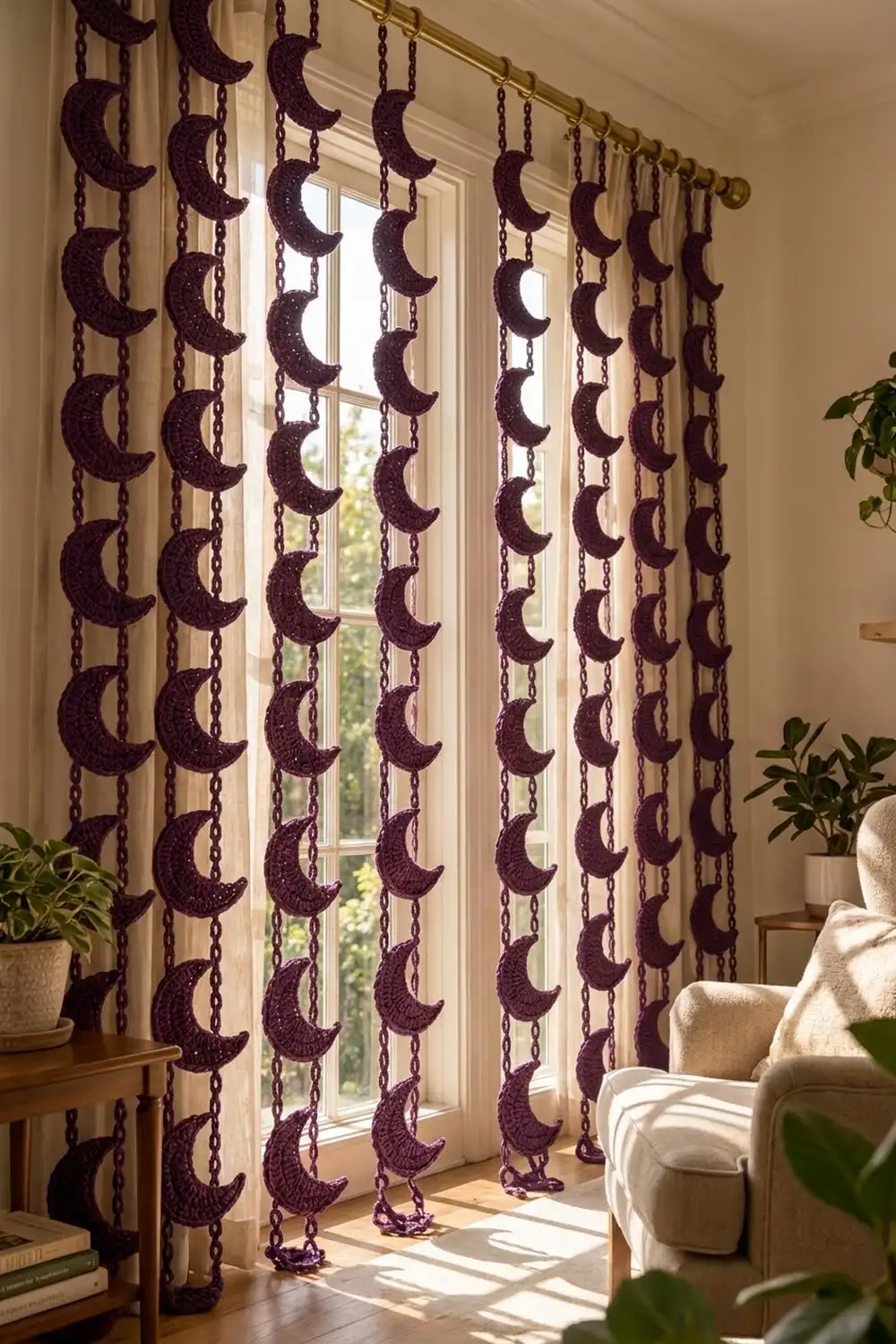
This curtain is a column of crescent moons hanging in front of a window. Solid plum moons sit on open chain strands, so light passes between them and their shadows fall across the floor. It looks dramatic but is easy to make: one small motif repeated many times, linked with simple chains.
The whole curtain uses one deep plum or aubergine yarn. A single dark color keeps the curved stitch ridges of each moon easy to see and gives the panel a clean, modern-boho look. It also works well in midnight blue, charcoal, or antique gold.
This pattern uses US crochet terms. The finished panel measures 36 in (91.4 cm) wide and 81 in (205.7 cm) long, including a 2 in (5.1 cm) rod-pocket header.
You will make 144 crescent moons, link them into 12 strands of 12 moons each, and finish with a folded single crochet header band that holds the strands and slides onto your curtain rod.
Finished Size and Construction
- Finished panel: 36 in (91.4 cm) wide × 81 in (205.7 cm) long
- Skill level: Easy
- Terminology: US crochet terms
- Yarn weight: Worsted (#4)
- Hook: 5 mm (H-8)
- Number of pieces: 144 crescent moons + 1 header band
- Layout: 12 strands across × 12 moons down
- Piece size (one moon): 3.5 in (8.9 cm) tip to tip × 2.25 in (5.7 cm) deep
- One strand repeat (chain + moon): 6.5 in (16.5 cm)
- Size before border: 12 strands spaced 3 in (7.6 cm) apart = 36 in (91.4 cm) wide; strands 79 in (200.7 cm) long
- Border (header) depth: 2 in (5.1 cm) folded
Materials
Yarn: Choose a smooth worsted-weight cotton or cotton blend, about 200 m per 100 g. Cotton keeps the moons flat and crisp and doesn’t stretch much while hanging. Do not use fuzzy or very stretchy acrylic, because the long chains will grow over time.
- Plum: 650 g / 1,300 m (seven 100 g skeins)
The quantity includes a margin of about 15% for gauge swatches, tails, and differences between dye lots. Buy all skeins from the same dye lot.
Tools:
- 5 mm (H-8) crochet hook
- Tapestry needle
- Stitch markers
- Rust-proof pins and a blocking mat
- Spray bottle
- Measuring tape
- Scissors
Abbreviations (US Terms)
- ch – chain
- sl st – slip stitch
- sc – single crochet
- hdc – half double crochet
- dc – double crochet
- st(s) – stitch(es)
- [ ] × n – repeat the bracketed sequence n times
Special technique – inner-edge slip stitch run: Work a sl st into each row end and each foundation loop along the inner curve of a moon, so the strand yarn passes through the moon from one horn to the other. This joins the moon and trims its inner edge in one pass.
Gauge and Checkpoints
Gauge: 16 sc and 18 rows = 4 in (10.2 cm). Chain gauge: 12 ch = 3 in (7.6 cm), measured unstretched.
Before you start the full curtain, make one moon and one 12-ch link as a test. Moons that are only a little off become a big problem when you have 144 of them.
Checkpoints for one moon:
- After Row 1: straight distance between the ends is about 3 in (7.6 cm).
- After Row 2: the band is about 1.25 in (3.2 cm) thick at the center.
- After Row 3: 3.5 in (8.9 cm) tip to tip, 1.5 in (3.8 cm) thick at the center, and 2.25 in (5.7 cm) from the deepest point of the outer curve to an imaginary line between the tips.
Too big? Go down to a 4.5 mm hook. Too small? Go up to a 5.5 mm hook. If only the chains are off, change your chain tension and keep the same hook for the moons.
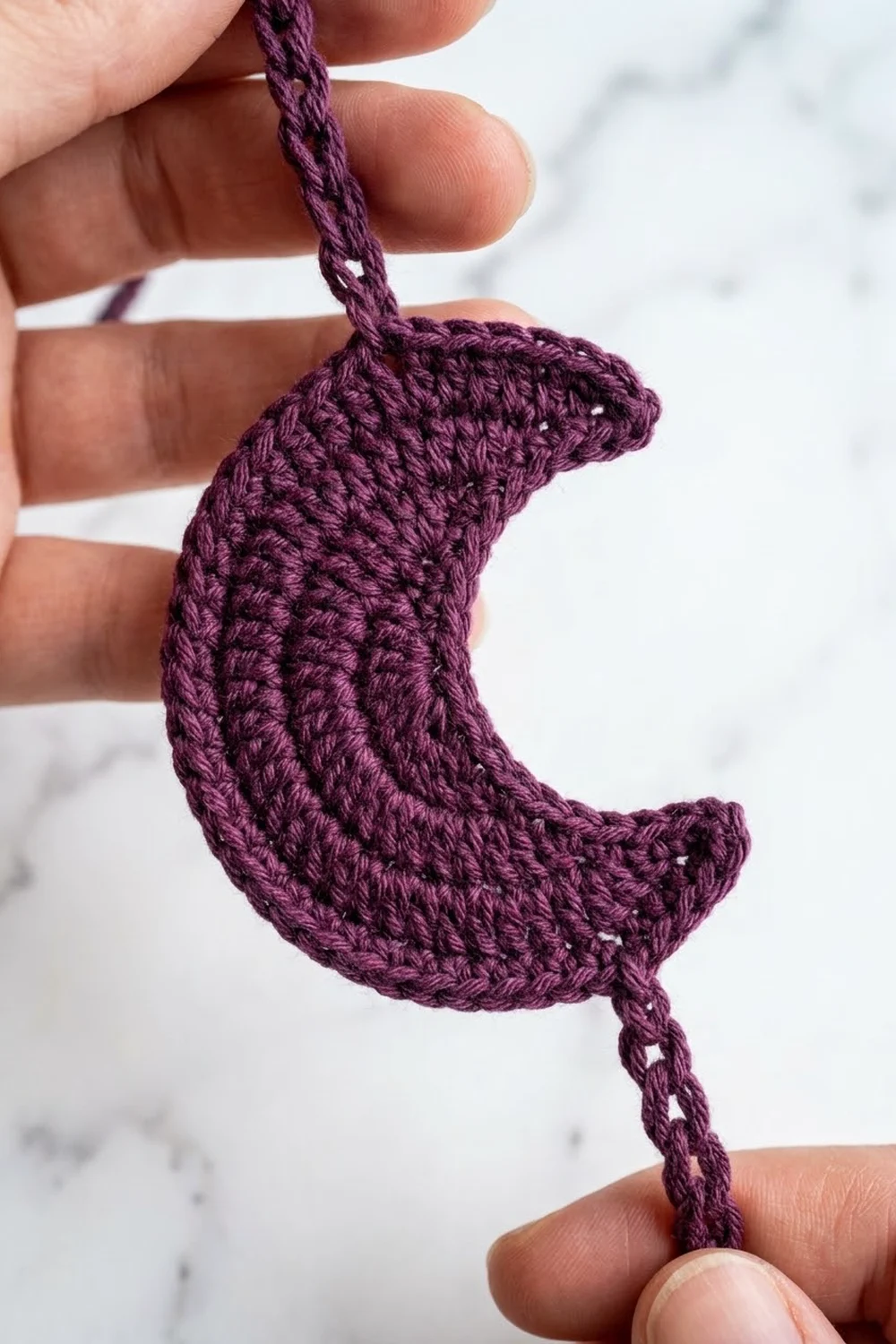
Crescent Moon (Make 144)
Each moon is worked flat in 3 rows along a foundation chain. The increases sit in the middle of each row, so the outer edge gets longer than the foundation edge and the piece curves into a crescent. Short stitches at both ends make the horns.
Ch 17.
Row 1: Sc in 2nd ch from hook, hdc in next ch, dc in next 2 ch, 2 dc in each of next 8 ch, dc in next 2 ch, hdc in next ch, sc in last ch. (24 sts)
Check: 1 + 1 + 2 + 16 + 2 + 1 + 1 = 24 sts, worked into 16 chains.
Row 2: Ch 1 (does not count as a st), turn. Sc in first 2 sts, hdc in next 2 sts, [dc in next st, 2 dc in next st] × 8, hdc in next 2 sts, sc in last 2 sts. (32 sts)
Check: 2 + 2 + 24 + 2 + 2 = 32 sts. The 16 middle stitches you work into are the 16 dc of Row 1’s increase section.
Row 3: Ch 1, turn. Sc in first 8 sts, [2 sc in next st, sc in next 3 sts] × 4, sc in last 8 sts. (36 sts)
Check: 8 + 20 + 8 = 36 sts. This row gives the moon its smooth outer edge.
Fasten off and weave in both tails now. The inner edge stays unfinished until the strand is joined.
Horn tips: With the outer curve on your left and the foundation edge on your right, the top horn tip is the end of Row 3 nearest the top, and the bottom horn tip is the other end. Every moon must face the same way so the whole curtain matches.
Make All Pieces
Make 144 plum moons in total, which is 12 moons for each of the 12 strands. Keep them in bags of 12 so you can count easily.
Measure every tenth moon against your test moon. Tip-to-tip length should be within 0.25 in (0.6 cm) of 3.5 in (8.9 cm).
Layout grid (S = strand, M = moon, | = 12-ch link):
HEADER BAND — 144 sts — 36 in (91.4 cm)
S1  S2  S3  S4  S5  S6  S7  S8  S9  S10 S11 S12
|   |   |   |   |   |   |   |   |   |   |   |
M1  M1  M1  M1  M1  M1  M1  M1  M1  M1  M1  M1
|   |   |   |   |   |   |   |   |   |   |   |
M2  M2  M2  M2  M2  M2  M2  M2  M2  M2  M2  M2
 .   .   .   (repeat links and moons)   .   .
M12 M12 M12 M12 M12 M12 M12 M12 M12 M12 M12 M12
o   o   o   o   o   o   o   o   o   o   o   o
(o = drop loop)
Every strand gets 12 moons, and every moon faces the same way.
Joining: Building the Strands
Each strand is a single length of yarn. It chains a link, goes through a moon along its inner edge, comes out, and chains the next link.
Strand (make 12):
- Leaving an 8 in (20.3 cm) tail, ch 12. This is the top link.
- Join moon: With the right side of the moon facing you, sl st into the top horn tip st.
- Inner-edge run: Sl st in each of the 3 row ends going down to the foundation, sl st in each of the 16 foundation loops along the inner curve, then sl st in each of the 3 row ends going up to the bottom horn tip. (22 sl sts) Count: 16 (one per foundation loop) + 6 (row ends) = 22.
- Ch 12 for the next link.
- Repeat steps 2–4 until 12 moons are joined. After moon 12, do not work step 4.
- Drop loop: Ch 8, sl st in 5th ch from hook. Fasten off.
Stitch-to-stitch logic: The chain goes into one horn and comes out the other, so the weight of each moon pulls straight down through the tips. That keeps every moon hanging in the same position with the horns to the right.
Per-strand counts: 12 links × 12 ch = 144 ch; 12 moons × 22 sl sts = 264 sl sts; plus the 8-ch drop loop.
Tension: Keep the inner-edge slip stitches loose enough that the inner curve keeps its shape. If you pull them tight, the horns curl toward each other. Make every chain the same size, because 11 uneven links in a strand add up quickly.
Size checkpoint: Let the strand hang freely for a few minutes, then measure. Top link 3 in (7.6 cm) + 12 moons × 3.5 in (8.9 cm) + 11 links × 3 in (7.6 cm) + drop loop about 1 in (2.5 cm) = 79 in (200.7 cm). All 12 strands should be within 0.5 in (1.3 cm) of each other.
Border: Folded Header Band
The header band is the border of this curtain. It holds all 12 strands and forms the rod pocket.
Border gauge: 16 sc and 18 rows = 4 in (10.2 cm), the same as the main gauge.
Ch 145.
Row 1: Sc in 2nd ch from hook and in each ch across. (144 sc) Long side: 144 sts; short sides: 1 row each.
Rows 2–18: Ch 1, turn, sc in each st across. (144 sc per row) Short sides now measure 18 rows = 4 in (10.2 cm).
Row 19 (closing and strand join): Fold the band in half lengthwise so Row 18 lies on top of the foundation chain. Ch 1. Work through both layers (a Row 18 st plus the matching foundation loop):
- [Sl st in next 5 sts; on the 6th st, put the hook through both layers and the first ch of a strand’s top link, then sl st; sl st in next 6 sts] × 12. (144 sl sts, 12 strands joined)
Pull each strand’s 8 in (20.3 cm) tail to the back, knot it around a nearby stitch, and weave it in.
Short sides: Leave both ends open so the rod can slide through. Each end has 18 row ends, folded to 9 rows = 2 in (5.1 cm) deep.
Why the math works: Each strand gets 12 header stitches. 12 strands × 12 sts = 144 sts, and at 16 sts per 4 in (10.2 cm), that is 144 ÷ 4 = 36 in (91.4 cm). Strands are attached at sts 6, 18, 30 … 138, so they are exactly 12 sts, or 3 in (7.6 cm), apart. The margins differ by only one stitch, 0.25 in (0.6 cm), which you won’t see once the curtain gathers on the rod. The folded pocket fits a rod up to about 1.25 in (3.2 cm) across.
Final Blocking
- Before joining, lightly spray each moon until it’s damp.
- Pin each moon flat in its crescent shape, 3.5 in (8.9 cm) tip to tip, with both horns tapered to sharp points.
- Let the moons dry completely before you build the strands.
- Once the curtain is finished, pin the header band flat at 36 in × 2 in (91.4 cm × 5.1 cm), spray it, and let it dry.
- Hang the curtain on its rod and spray the strands lightly. Let them hang for 24 hours so the chains settle to their final length.
- Measure again: 81 in (205.7 cm) overall. If the strands are uneven, adjust the drop loops.
Final Quality-Control Checklist
- 144 moons, each with 36 sts in Row 3
- Every moon faces the same way: outer curve left, horns right
- 22 sl sts along every inner edge
- Every link is 12 ch
- 12 strands, each 79 in (200.7 cm) after hanging
- Header has 144 sts, measures 36 in (91.4 cm), and is closed along the bottom
- Strands are evenly spaced 3 in (7.6 cm) apart
- All tails are knotted and woven in, and both pocket ends are open
Troubleshooting
Moon is flat, not curved: You probably missed increases in Row 1 or Row 2. Count 24 and then 32 sts.
Moon ruffles: Your tension is too loose or you added extra increases. Use a smaller hook and recount.
Horns curl inward: The inner-edge slip stitches are too tight. Work them more loosely, or use a hook one size larger for the inner-edge run only.
Strands are different lengths: Check your link counts. One extra 12-ch link adds 3 in (7.6 cm) to a strand.
Moons twist on the strand: You joined some of them at the bottom horn instead of the top horn. Rejoin so every moon starts at its top tip.
Header is wavy: Your foundation chain is too tight. Remake it with a hook one size larger.
Care
Hand wash in cool water with mild soap, press the water out in a towel, and dry the curtain flat with every moon smoothed into shape. Rehang it while it’s still slightly damp so the chains straighten out.
Final Notes
The measurements build on each other. Each moon is 3.5 in (8.9 cm) tip to tip. A link plus a moon makes a 6.5 in (16.5 cm) repeat. Twelve repeats and a drop loop make a 79 in (200.7 cm) strand. Twelve strands set 12 sts, or 3 in (7.6 cm), apart fill a 144-stitch header that is 36 in (91.4 cm) wide. The 2 in (5.1 cm) header brings the full panel to 81 in (205.7 cm).
If your first moon matches gauge, the rest of the curtain will come out to the right size. Count your stitches, make every moon face the same way, and let the strands hang before you measure.
Happy crocheting!