

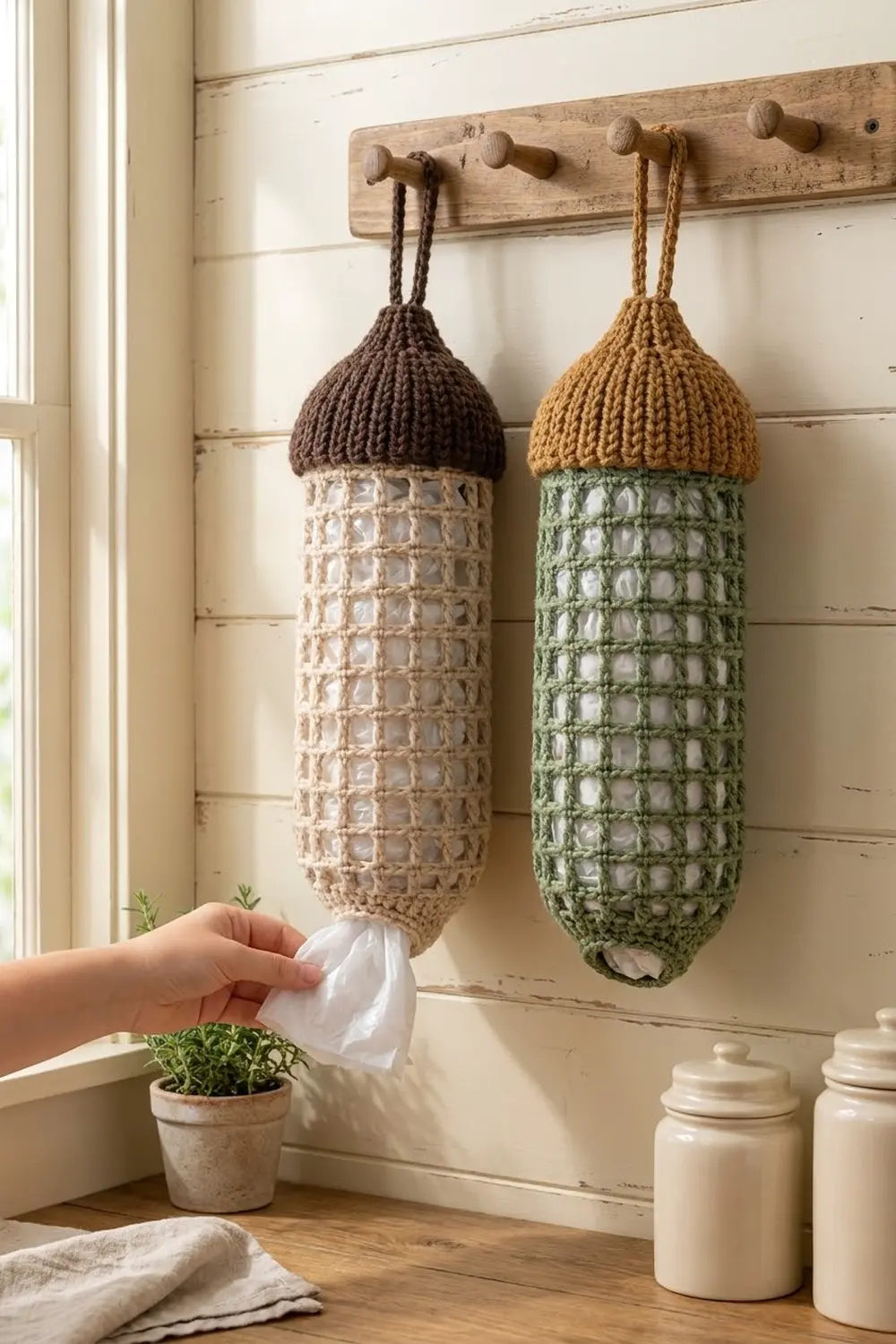
The Acorn Pantry Grocery Bag Holder brings a little woodland charm to a kitchen wall. It’s a long, open-mesh tube shaped like an acorn, with a dense, knit-look cap and a narrow strap loop for hanging. You stuff plastic bags in at the top and pull them out one at a time through the small opening at the bottom.
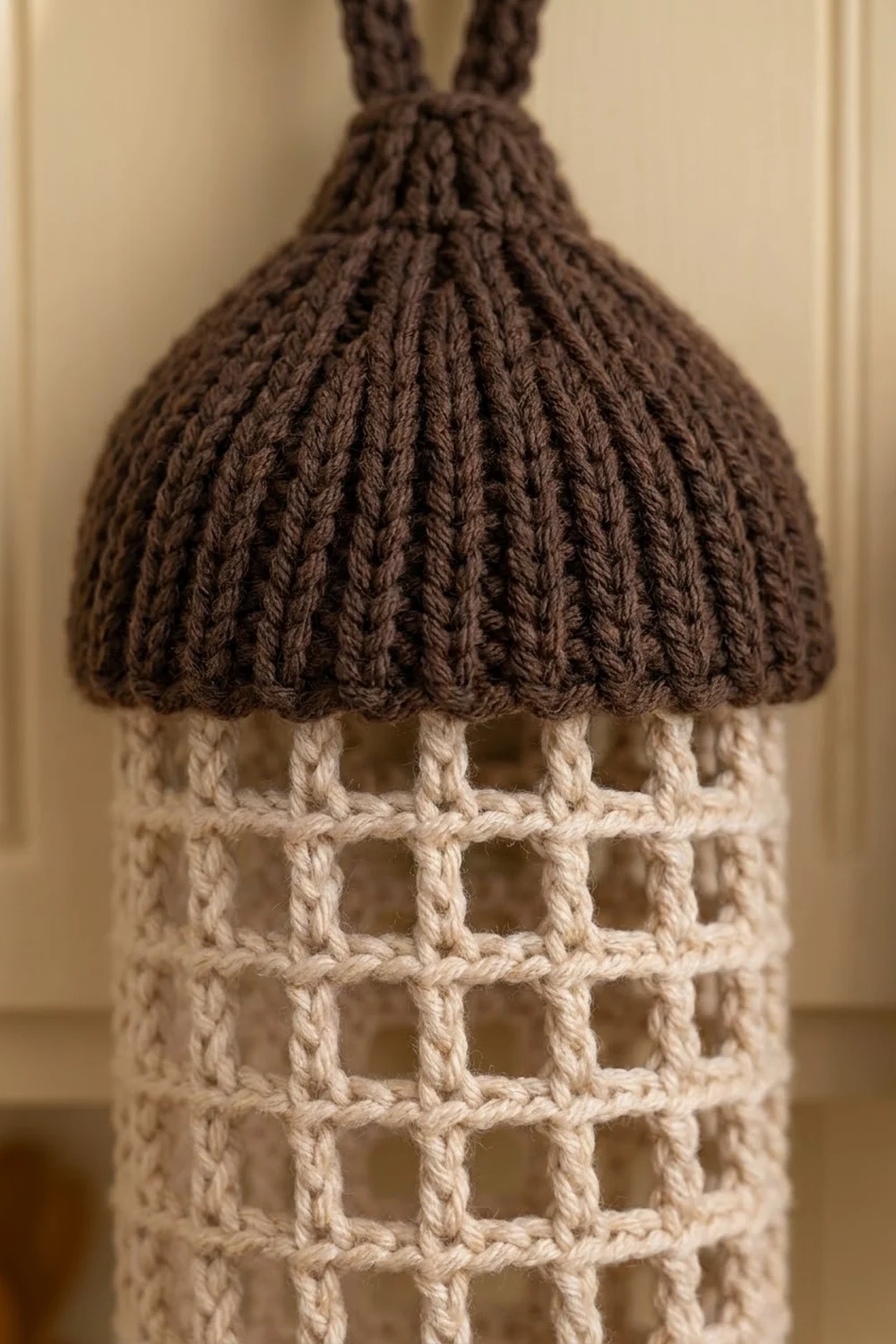
The sample uses a cream body with a dark chocolate-brown cap. A sage-green body with a golden-brown cap works just as well. The mesh shows the white bags inside, and the cap’s vertical V-columns look like knitting but are crocheted with the waistcoat stitch.
This pattern uses US crochet terms. The finished holder is about 19 in (48.3 cm) tall without the loop, or about 21.6 in (54.9 cm) including the loop. It is about 6 in (15.2 cm) wide when laid flat.
The holder is one continuous piece worked in joined rounds from the bottom up. You start with a solid single-crochet base around a small opening, then work the filet mesh body, change color for the waistcoat-stitch cap, and finish with a slip-stitch edging and a strap handle.
Finished Size and Construction
- Finished size: 19 in (48.3 cm) tall without the loop; 21.6 in (54.9 cm) including the loop
- Flat width of body: 6 in (15.2 cm); circumference 12 in (30.5 cm)
- Flat width of cap rim: 6.75 in (17.1 cm)
- Skill level: Easy+ (the waistcoat stitch takes a little practice)
- Terminology: US
- Yarn weight: Worsted (#4), cotton or cotton blend
- Hook: 5.0 mm (H-8)
- Number of pieces: 1 (one continuous piece)
- Layout: Vertical tube: base, mesh body, cap, handle
- Piece size: 6 in × 19 in (15.2 cm × 48.3 cm), laid flat
- Size before border: Same as finished; the edging adds no width
- Border depth: One slip-stitch round at each opening, under 0.25 in (0.6 cm)
Materials
Yarn: Use worsted-weight cotton or a cotton blend. Cotton holds its shape, doesn’t stretch much under the weight of the bags, and makes crisp mesh squares. Avoid pure acrylic, which can sag lengthwise over time.
- Main color (MC), cream: 35 g (60 m)
- Contrast color (CC), dark chocolate brown: 25 g (40 m)
- Alternate colorway: sage green for MC, golden brown for CC, in the same amounts
These amounts include a margin of about 25% for your gauge swatch and small differences in tension.
Tools:
– 5.0 mm (H-8) crochet hook
– Stitch marker
– Tapestry needle
– Scissors
– Measuring tape
– Rust-proof pins and a rolled towel or tall jar for blocking
Abbreviations (US Terms)
- ch: chain
- sl st: slip stitch
- sc: single crochet
- dc: double crochet
- sk: skip
- sp: space
- st(s): stitch(es)
- rnd(s): round(s)
- inc: 2 sc in the same st
- ksc: waistcoat stitch (knit stitch)
- ksc2tog: waistcoat-stitch decrease
- MC / CC: main color / contrast color
Waistcoat stitch (ksc): Look at the stitch below from the front. Its two vertical legs form a V. Insert your hook between those legs, right through the center of the post (not under the top loops), yarn over, pull up a loop, then yarn over and draw through both loops. Stacked rounds of ksc line up into vertical V-columns that look like stockinette knitting.
ksc2tog: Insert the hook through the center of the next st, pull up a loop, insert through the center of the following st, pull up a loop, then yarn over and draw through all 3 loops.
Gauge and Checkpoints
Solid gauge (sc and ksc): 16 sts and 18 rnds = 4 in (10.2 cm)
Mesh gauge: 4 mesh squares = 3 in (7.6 cm) wide; 5 mesh rnds = 3 in (7.6 cm) tall. Each square is about 0.75 in (1.9 cm) wide and 0.6 in (1.5 cm) tall.
Make the base (Rnds 1–10) as your gauge test, because it is the first part of the holder anyway. At that point it should measure 6 in (15.2 cm) across when flattened at its widest round.
Checkpoints:
– After Rnd 2: the bottom opening is about 1.4 in (3.6 cm) across, with a circumference of 4.5 in (11.4 cm).
– After Rnd 10: the base is about 2.2 in (5.6 cm) tall and 6 in (15.2 cm) wide flat.
– After Rnd 15 (5 mesh rnds): the mesh is 3 in (7.6 cm) tall.
– After Rnd 32: the mesh is 13.2 in (33.5 cm) tall and the whole piece is 15.4 in (39.1 cm).
– After Rnd 48: the piece is 19 in (48.3 cm) tall.
If your piece is too big, go down one hook size, to 4.5 mm (US 7). If it is too small, go up to 5.5 mm (I-9). Change the hook rather than the stitch counts. Every round below depends on a multiple of 6 for shaping and a multiple of 3 for the mesh.
Base (MC)
Foundation: With MC, ch 18. Sl st into the first ch to form a ring, taking care not to twist the chain.
Rnd 1: Ch 1, sc in each ch around, then sl st into the first sc to join. (18 sc)
Rnd 2: Ch 1, sc in each st around, join. (18 sc)
Rnd 3: Ch 1, sc in next 2 sts, inc 6 times, join. (24 sc)
Rnd 4: Ch 1, sc in each st around, join. (24 sc)
Rnd 5: Ch 1, sc in next 3 sts, inc 6 times, join. (30 sc)
Rnd 6: Ch 1, sc in each st around, join. (30 sc)
Rnd 7: Ch 1, sc in next 4 sts, inc 6 times, join. (36 sc)
Rnd 8: Ch 1, sc in next 5 sts, inc 6 times, join. (42 sc)
Rnd 9: Ch 1, sc in next 6 sts, inc 6 times, join. (48 sc)
Rnd 10: Ch 1, sc in each st around, join. (48 sc)
The plain rounds between the early increase rounds make the base a gentle cone rather than a flat disc. This gives the tapered bottom seen on the finished holder.
Mesh Body (MC)
Rnd 11 (set-up): Ch 5 (counts as dc + ch 2), sk next 2 sts, dc in next st, ch 2, sk next 2 sts 15 times, then sl st into the 3rd ch of the beginning ch-5. (16 dc + 16 ch-2 sps = 48 sts; 16 mesh squares)
The dcs land on sts 1, 4, 7, and so on up to 46. The last ch-2 skips sts 47 and 48, so the round closes evenly.
Rnds 12–32: Ch 5 (counts as dc + ch 2), sk ch-2 sp, dc in next dc, ch 2, sk ch-2 sp 15 times, then sl st into the 3rd ch of the beginning ch-5. (16 dc + 16 ch-2 sps = 48 sts; 16 mesh squares)
That gives 22 mesh rounds in total (Rnds 11–32). At 5 rounds per 3 in (7.6 cm), the mesh is 13.2 in (33.5 cm) tall. Each dc sits directly on top of the dc below, so the grid forms clean, straight columns.
Fasten off MC.
Cap (CC)
Rnd 33 (conversion round): Join CC with a sl st in any dc. Ch 1, then work around: sc in each dc and 2 sc in each ch-2 sp. Join. That is (16 sc, one per dc) + (32 sc, two per ch-2 sp) = 48 sc.
Rnd 34: Ch 1, sc in next 7 sts, inc 6 times, join. (54 sc)
This increase round makes the cap rim slightly wider than the mesh: 13.5 in (34.3 cm) around, or 6.75 in (17.1 cm) flat. That gives the acorn-cap overhang.
Rnds 35–39: Ch 1, ksc in each st around, join. (54 ksc)
Rnd 40: Ch 1, ksc in next 7 sts, ksc2tog 6 times, join. (48 sts)
Rnd 41: Ch 1, ksc in each st around, join. (48 sts)
Rnd 42: Ch 1, ksc in next 6 sts, ksc2tog 6 times, join. (42 sts)
Rnd 43: Ch 1, ksc in each st around, join. (42 sts)
Rnd 44: Ch 1, ksc in next 5 sts, ksc2tog 6 times, join. (36 sts)
Rnd 45: Ch 1, ksc in next 4 sts, ksc2tog 6 times, join. (30 sts)
Rnd 46: Ch 1, ksc in next 3 sts, ksc2tog 6 times, join. (24 sts)
Rnds 47–48: Ch 1, ksc in each st around, join. (24 sts)
The cap has 16 rounds (Rnds 33–48), which is about 3.6 in (9.1 cm) tall. It closes into a narrow neck that is 6 in (15.2 cm) around and about 1.9 in (4.8 cm) across. This is the top loading opening. Don’t fasten off yet.
Border (Edgings)
Because this is a tube, the “border” is a firm slip-stitch edging around each opening. It stops the openings from stretching as bags are pushed in and pulled out.
Border gauge: 1 sl st per st. The edging adds no stitches and removes none, so neither opening changes size.
Top edging (Rnd 49): Still holding CC, sl st loosely in each st around and join to the first sl st. That is 24 sl sts, or 12 per half when the neck is flattened.
Handle: Ch 28. Count to the 13th st of Rnd 48, directly across the neck, and sl st into it. There are 11 sts on each side between the two anchor points, so the strap sits exactly centered. Ch 1, turn, and sc in each of the 28 ch. Sl st into the starting st and fasten off.
The 28-ch strap is 7 in (17.8 cm) long. Stretched across the 1.9 in (4.8 cm) neck, it rises about 2.6 in (6.6 cm) into a narrow loop. The neck stays open on both sides of the strap so you can stuff bags in.
Bottom edging: Turn the holder upside down. Join MC in any free loop of the foundation chain. Sl st loosely in each free loop around and join. That is 18 sl sts, or 9 per half when flattened. Fasten off.
Why the math works: Each edging places exactly one sl st in each existing st, 24 at the top and 18 at the bottom. The openings stay 6 in (15.2 cm) and 4.5 in (11.4 cm) around. The handle’s anchors at st 1 and st 13 split the 24 sts into two equal groups of 11 plus the 2 anchors (11 + 11 + 2 = 24).
Weave in all ends along the solid rounds, never through the mesh, where tails would show.
Final Blocking
- Wet the holder in cool water and gently squeeze it out. Don’t wring it.
- Roll it in a towel and press to remove most of the water.
- Slide the holder over a tall jar, bottle, or rolled towel about 3.8 in (9.7 cm) across.
- Line up the mesh columns so each dc stands straight. Nudge the squares until they are even.
- Pull the piece lengthwise to 19 in (48.3 cm), not counting the loop.
- Shape the cap over the top into a smooth dome, with the rim slightly flared.
- Pin the handle straight up and leave everything to dry completely.
Final Quality-Control Checklist
- [ ] The base is a gentle cone around an opening about 1.4 in (3.6 cm) across.
- [ ] All mesh rounds have 16 squares, with dc columns aligned.
- [ ] The mesh is 13.2 in (33.5 cm) tall.
- [ ] Rnd 33 has 48 sc and Rnd 34 has 54 sc.
- [ ] The ksc V-columns run straight up the cap.
- [ ] The neck has 24 sts and an opening about 1.9 in (4.8 cm) across.
- [ ] The handle is centered, with 11 sts on each side.
- [ ] Both edgings lie flat and don’t ripple.
- [ ] The total height is 19 in (48.3 cm) without the loop.
- [ ] All ends are hidden in the solid sections.
Troubleshooting
The mesh squares lean or spiral. Make sure each round’s dcs go into the dcs below, not into the ch-2 spaces. Also join into the 3rd ch of the beginning ch-5 every time.
The base is flat instead of cone-shaped. You probably skipped the plain rounds (Rnds 4 and 6). Work them as written.
The cap is too tight to work ksc. Waistcoat stitch is dense. Loosen your pull-up loops slightly, or work the cap with a 5.5 mm (I-9) hook while keeping the same stitch counts.
The cap rim ruffles. Your tension may be loose. Check that Rnd 34 has exactly 54 sts.
Bags fall out of the bottom on their own. Work the bottom edging more firmly, or add a second round of sl sts on top of the first.
The handle stretches. Work a second row of sc back along the strap before you fasten off.
Care
Machine-wash cool on a gentle cycle inside a mesh laundry bag, then reshape it and lay it flat to dry. Cotton may shrink a little, so reblock to 19 in (48.3 cm) if needed.
Final Notes
Here is the full measurement chain. The 18-st opening (4.5 in / 11.4 cm around) grows to 48 sts, which is 6 in (15.2 cm) flat. The 22 mesh rounds add 13.2 in (33.5 cm) of height. The 16-round cap flares to 6.75 in (17.1 cm) flat and closes to a 24-st neck. Together that makes 19 in (48.3 cm) of holder, topped by a 2.6 in (6.6 cm) loop.
If you match the gauge on the base, every later section will measure right. Make one in cream and brown, another in sage and gold, and hang them side by side.
Happy crocheting!