
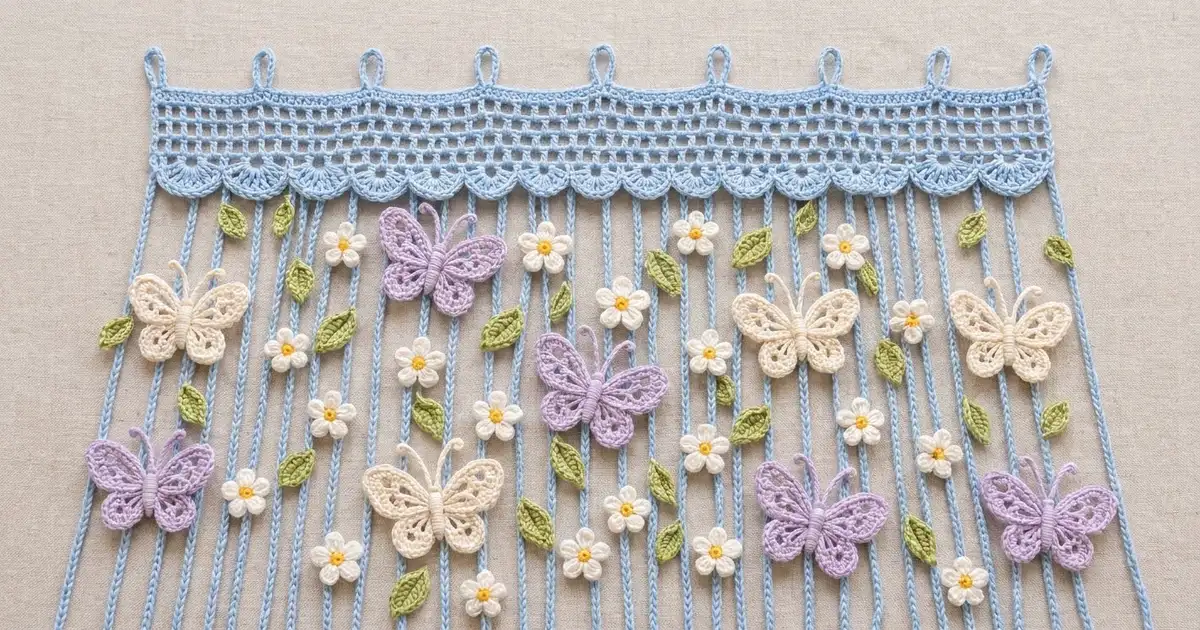
This curtain brings a garden to your window. A soft blue filet mesh header holds a row of long, twisted cords. Lavender and cream butterflies, white daisies and small green leaves are sewn along the cords, so they seem to float in front of the glass.
The colors are light blue, lavender, cream, white, yellow and leaf green. They give the curtain a gentle cottage look. Because the cords are open, light still comes through and the view outside stays visible.
The pattern uses US crochet terms. The curtain is about 36 in (91.4 cm) wide and 48 in (121.9 cm) long, not counting the hanging loops.
You will work the header in flat rows and finish it with a shell scallop edge. Next you add 28 chain cords at the scallop points, crochet 98 small motifs, and sew them on following a repeating layout. A single border row along the top edge adds the rod loops.
Finished Size and Construction
- Finished size: 36 in x 48 in (91.4 cm x 121.9 cm), not counting the loops
- Skill level: Intermediate
- Terminology: US
- Yarn weight: DK (light #3) cotton
- Hook: 4.0 mm (G-6)
- Number of pieces: 1 header, 28 cords (worked directly onto the header), and 98 appliqué motifs
- Layout: 28 cords spaced about 1.33 in (3.4 cm) apart, with motifs placed in a repeating 4-cord block
- Header size: 36 in x 5 in (91.4 cm x 12.7 cm)
- Size before border: 36 in x 4.75 in (91.4 cm x 12.1 cm)
- Border depth: 0.25 in (0.6 cm), plus loops about 1.75 in (4.4 cm) tall
Materials
Use a smooth, mercerized DK cotton or cotton blend. Cotton holds the cord twist and hangs straight. Avoid fuzzy yarns, because they catch on each other and the cords tangle. The weights below assume about 2.5 m per gram (about 125 m per 50 g).
- Light blue: 220 g / 550 m (header and cords)
- Lavender: 35 g / 88 m (7 butterflies)
- Cream: 35 g / 88 m (7 butterflies)
- White: 45 g / 113 m (49 daisy petals)
- Yellow: 12 g / 30 m (49 daisy centers)
- Leaf green: 30 g / 75 m (35 leaves)
Tools: 4.0 mm hook, tapestry needle, stitch markers, measuring tape, rust-proof pins, a spray bottle and a blocking surface.
All quantities include a margin of about 15 percent for swatching and weaving in ends.
Abbreviations (US Terms)
- ch – chain
- sl st – slip stitch
- sc – single crochet
- hdc – half double crochet
- dc – double crochet
- tr – treble crochet
- sk – skip
- sp – space
- st(s) – stitch(es)
- RS – right side
Special stitches
- Shell: 7 dc in the same stitch.
- Picot: ch 3 worked between two sc in the same stitch.
- Twisted cord: a chain with sl st worked back along the back bump of each chain. This makes a firm, round cord that does not stretch much.
Gauge and Checkpoints
Gauge: 18 sts and 8 dc rows = 4 in (10.2 cm) in filet mesh. That equals 9 mesh squares across 4 in (10.2 cm).
Cord gauge: 4 ch = 1 in (2.5 cm) after the slip stitches are worked back along the chain.
Make a test swatch first. Chain 20, then work 1 sc row, 8 rows of mesh, and 1 scallop row with 3 shells. Wash the swatch, let it dry flat, and measure it. Also make one test cord 20 ch long and one daisy.
Checkpoints:
– After Row 2, the header is 36 in (91.4 cm) wide.
– After Row 9, the header is 4.25 in (10.8 cm) tall.
– After Row 10, the header is 4.75 in (12.1 cm) tall.
– Each cord hangs 43 in (109.2 cm) below its scallop point.
If your work is too big, go down 0.5 mm in hook size. If it is too small, go up 0.5 mm. If only the cords are off, change the hook for the cords only.
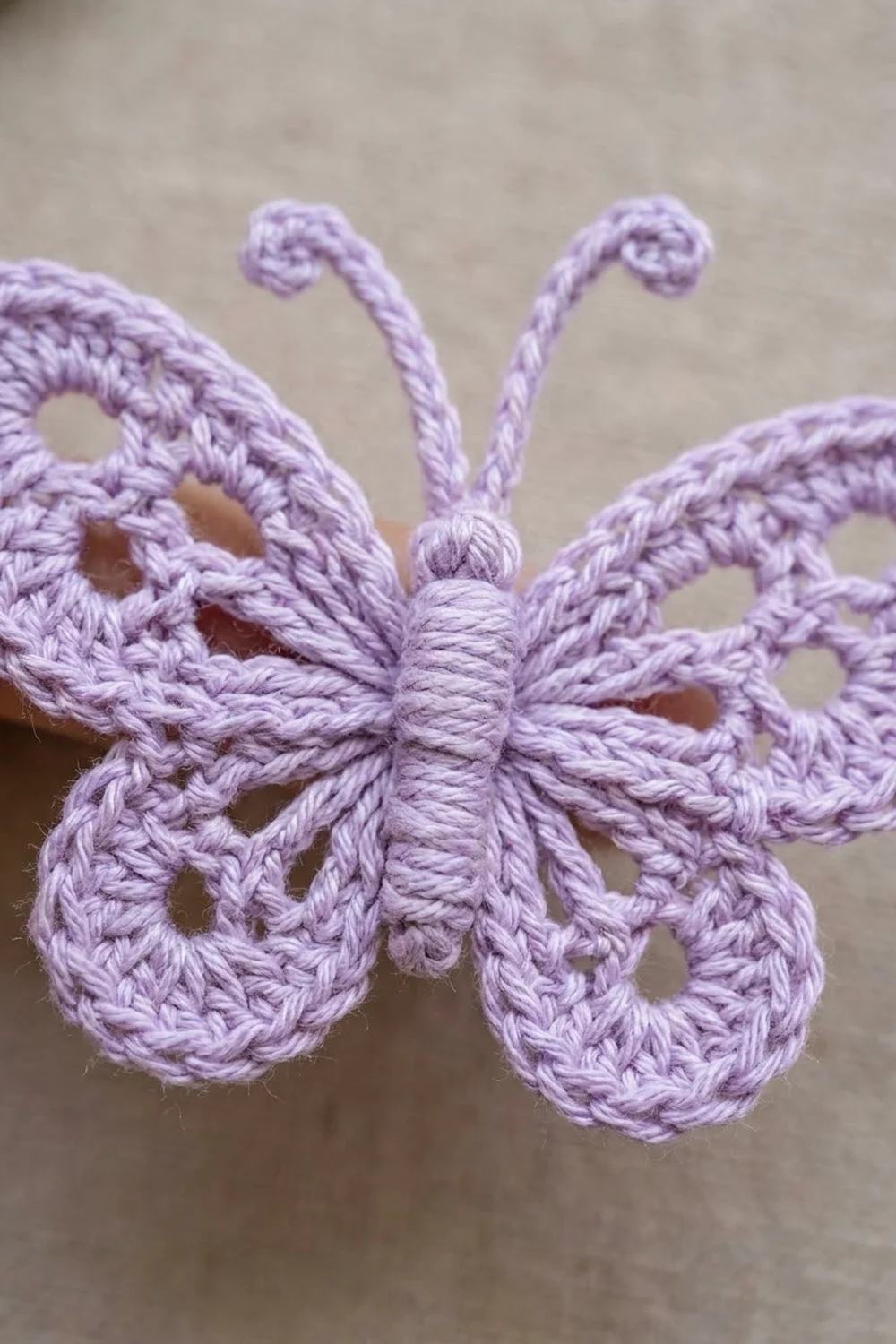
Header
With light blue, ch 164.
Row 1 (WS): Sc in the 2nd ch from the hook and in each ch across, turn. (163 sc)
Row 2 (RS): Ch 3 (counts as dc), dc in each sc across, turn. (163 dc)
Row 3: Ch 4 (counts as dc + ch 1), sk next dc, dc in next dc. Ch 1, sk next dc, dc in next dc. Repeat from * 79 more times, turn. (82 dc + 81 ch-1 sps = 163 sts, 81 squares)
Rows 4–8: Ch 4 (counts as dc + ch 1), sk ch-1 sp, dc in next dc. Ch 1, sk ch-1 sp, dc in next dc. Repeat from * 78 more times. Ch 1, sk last ch-1 sp, dc in 3rd ch of the turning ch-4, turn. (81 squares, 163 sts per row)
Row 9: Ch 3 (counts as dc), dc in the first ch-1 sp. Dc in next dc, dc in next ch-1 sp. Repeat from * across, ending with dc in 3rd ch of the turning ch-4, turn. (1 + 81 sps + 80 dc + 1 = 163 dc)
Checkpoint: The piece is 36 in x 4.25 in (91.4 cm x 10.8 cm).
Row 10 (scallop row, RS): Ch 1, sc in the first dc. Sk 2 dc, shell in next dc, sk 2 dc, sc in next dc. Repeat from * 26 more times. Do not fasten off yet. (27 shells and 28 sc)
This is a conversion row. Each repeat uses 6 stitches of Row 9 (1 + 27 x 6 = 163). It produces 189 dc + 28 sc = 217 stitches. The 28 sc are the scallop points, and each one holds a cord.
Fasten off. Place a marker in each of the 28 scallop-point sc.
Checkpoint: The header is 36 in x 4.75 in (91.4 cm x 12.1 cm).
Make All Pieces
Make the following motifs. Leave an 8 in (20.3 cm) tail on each one for sewing.
| Motif | Color | Quantity |
|---|---|---|
| Butterfly | Lavender | 7 |
| Butterfly | Cream | 7 |
| Daisy | Yellow + white | 49 |
| Leaf | Green | 35 |
Butterfly (finished size 3.25 in x 2.5 in / 8.3 cm x 6.4 cm)
Rnd 1: Make a magic ring. Ch 1, 8 sc in the ring, sl st to the first sc. (8 sc)
Rnd 2: Ch 1, sc in sc 1, ch 8, sk sc 2, sc in sc 3, ch 6, sk sc 4, sc in sc 5, ch 6, sk sc 6, sc in sc 7, ch 8, sk sc 8, sl st to the first sc. (4 sc, 2 ch-8 loops for the upper wings, 2 ch-6 loops for the lower wings) Each skipped sc leaves an open eyelet inside its wing.
Rnd 3: Work each wing into its own loop:
– Upper wing (ch-8 loop): (sc, hdc, 3 dc, 3 tr, 3 dc, hdc, sc). (13 sts)
– Lower wing (ch-6 loop): (sc, hdc, 5 dc, hdc, sc). (9 sts)
Work a sl st in each Rnd 2 sc between the wings. (13 + 9 + 9 + 13 = 44 sts, plus 4 sl st)
Rnd 4:
– Upper wing: Sc in the next 6 sts, (sc, ch 3, sc) in the center tr, sc in the next 6 sts. (14 sc + 1 picot)
– Lower wing: Sc in the next 4 sts, (sc, ch 3, sc) in the center dc, sc in the next 4 sts. (10 sc + 1 picot)
Sl st in each sl st between the wings. (48 sc + 4 picots) Fasten off.
Body: Use the same color. Ch 9, hdc in the 3rd ch from the hook and in the next 6 ch. (7 hdc) Fasten off, leaving a 10 in (25.4 cm) tail. Fold the body in half lengthwise to make a rolled tube. Sew it over the center ring, running from the upper wings down to the lower wings.
Antennae: Join yarn at the top of the body. Ch 7, sl st in the 2nd ch from the hook and in the next 5 ch (6 sl st), then sl st into the body. Repeat once for the second antenna. Pull each antenna gently so it curls.
Daisy (finished size 1.25 in / 3.2 cm)
Rnd 1 (yellow): Make a magic ring. Ch 1, 5 sc in the ring, sl st to the first sc. (5 sc) Fasten off.
Rnd 2 (white): Join in any sc. (Ch 2, 3 dc, ch 2, sl st) in the same sc, then move to the next sc. Repeat from * around. (5 petals) Fasten off.
Leaf (finished size 1.5 in / 3.8 cm long)
With green, ch 7.
Work along the first side of the chain: sc in the 2nd ch from the hook, then hdc, dc, dc, hdc, sc in the next 5 ch. (6 sts)
Ch 2 for the tip. Rotate the work and continue along the other side of the foundation ch: sc, hdc, dc, dc, hdc, sc. (6 sts)
Sl st to the first sc. (12 sts + ch-2 tip) Fasten off.
Layout grid
The motifs sit at 7 levels, measured down from the scallop point:
- L1 = 5 in (12.7 cm)
- L2 = 11 in (27.9 cm)
- L3 = 17 in (43.2 cm)
- L4 = 23 in (58.4 cm)
- L5 = 29 in (73.7 cm)
- L6 = 35 in (88.9 cm)
- L7 = 41 in (104.1 cm)
Repeat this 4-cord block 7 times across the 28 cords. In the grid, D = daisy, Lf = leaf, BL = lavender butterfly, BC = cream butterfly and – = empty.
Level:   L1   L2   L3   L4   L5   L6   L7
Cord a:  D    –    BL   –    D    –    Lf
Cord b:  –    D    –    Lf   –    D    –
Cord c:  Lf   –    D    –    BC   –    D
Cord d:  –    Lf   –    D    –    Lf   –
Each block uses 7 daisies, 5 leaves, 1 lavender butterfly and 1 cream butterfly. Seven blocks give 49 daisies, 35 leaves and 14 butterflies, which matches the table above.
Joining
Cords
Lay the header flat with the RS facing. Start at the left end.
Each cord: Join light blue with a sl st in a marked scallop-point sc. Ch 173. Sl st in the back bump of the 2nd ch from the hook and of each remaining ch. (172 sl st) Sl st into the same scallop-point sc and fasten off.
Make one cord at each of the 28 scallop points. Since the points are 6 stitches apart, the cords are about 1.33 in (3.4 cm) apart. There are 27 spaces between the first and last cord: 27 x 1.33 in = 36 in (91.4 cm), the full header width.
Tension: Keep the slip stitches loose enough to fit the hook easily. If they are tight, the cord curls into a spiral. Lift each cord after you finish it and let it hang. If it is tight or wavy, rework it.
Checkpoint: Each cord measures 43 in (109.2 cm). The full curtain measures 36 in x 48 in (91.4 cm x 121.9 cm).
Motifs
Hang the curtain, or lay it flat with the cords straight. Pin each motif at its level from the grid, measuring from the scallop point.
Using the motif’s own tail, sew through the center back of the motif and around 2–3 sl sts of the cord. Then sew back through the motif. For butterflies, sew along the body so that the cord runs straight behind it.
Do not pull the cord tight while you sew. A gathered cord shortens and hangs crooked. Knot the tail on the back and weave it into the motif only, not into the cord.
Border
Border gauge: 18 sc = 4 in (10.2 cm), which matches the header gauge.
Border Row (top edge, RS): Turn the header upside down. Join light blue in the first free loop of the foundation ch at the right corner. Ch 1, then sc in each of the 163 free loops.
At stitches 1, 19, 37, 55, 73, 91, 109, 127, 145 and 163, add a loop: after you make the sc, ch 16 and sl st into the top of that same sc. Fasten off.
Count: 163 sc and 10 ch-16 loops along the top. The sides have no border, because the turning-chain edges stay neat as they are. The bottom edge is the scallop row.
Why the math works: The foundation chain has exactly 163 free loops, so one sc in each loop keeps the top the same width as the body. The loop positions are 18 sts apart, and 1 + 9 x 18 = 163, so the first and last loops land exactly at the corners. Each loop sits 4 in (10.2 cm) from the next one.
The loops also line up with every third cord, because 18 = 3 x 6. This lets the weight of the cords hang straight under each loop.
Final Blocking
- Weave in all the remaining ends on the header.
- Pin the header flat at 36 in x 5 in (91.4 cm x 12.7 cm). Square off the mesh grid and open each scallop.
- Mist the header until it is damp and let it dry fully.
- Mist the butterflies. Pin the wings open, shape the picots and curl the antennae.
- Hang the curtain from the rod. Mist the cords lightly and let them dry while hanging so they settle straight.
- Check the length again: it should be 48 in (121.9 cm).
Final Quality-Control Checklist
- The header has 81 mesh squares, 27 shells and 28 scallop points.
- There are 10 loops, each 4 in (10.2 cm) apart.
- All 28 cords measure 43 in (109.2 cm) and hang without twisting.
- The 98 motifs are attached at the correct grid levels.
- No motif gathers or shortens its cord.
- All ends are woven in on the back.
- The finished size is 36 in x 48 in (91.4 cm x 121.9 cm).
Troubleshooting
- The mesh slants: You missed a dc at the end of a row. Count the squares on every row.
- The scallops ruffle: Your shells are too loose. Go down one hook size for Row 10.
- The cords spiral: Your slip stitches are too tight. Rework the cord more loosely, or steam it while it hangs.
- The cords are uneven: Count your chains. Each cord has 173 ch and 172 sl st.
- The butterfly wings cup: Rnd 4 is too tight. Block the wings flat with pins.
- A motif spins on its cord: Add a second tack stitch at the top edge of the motif.
Care
Hand wash in cool water with a mild soap. Roll the curtain in a towel to remove water, then hang it to dry with the cords straight.
Final Notes
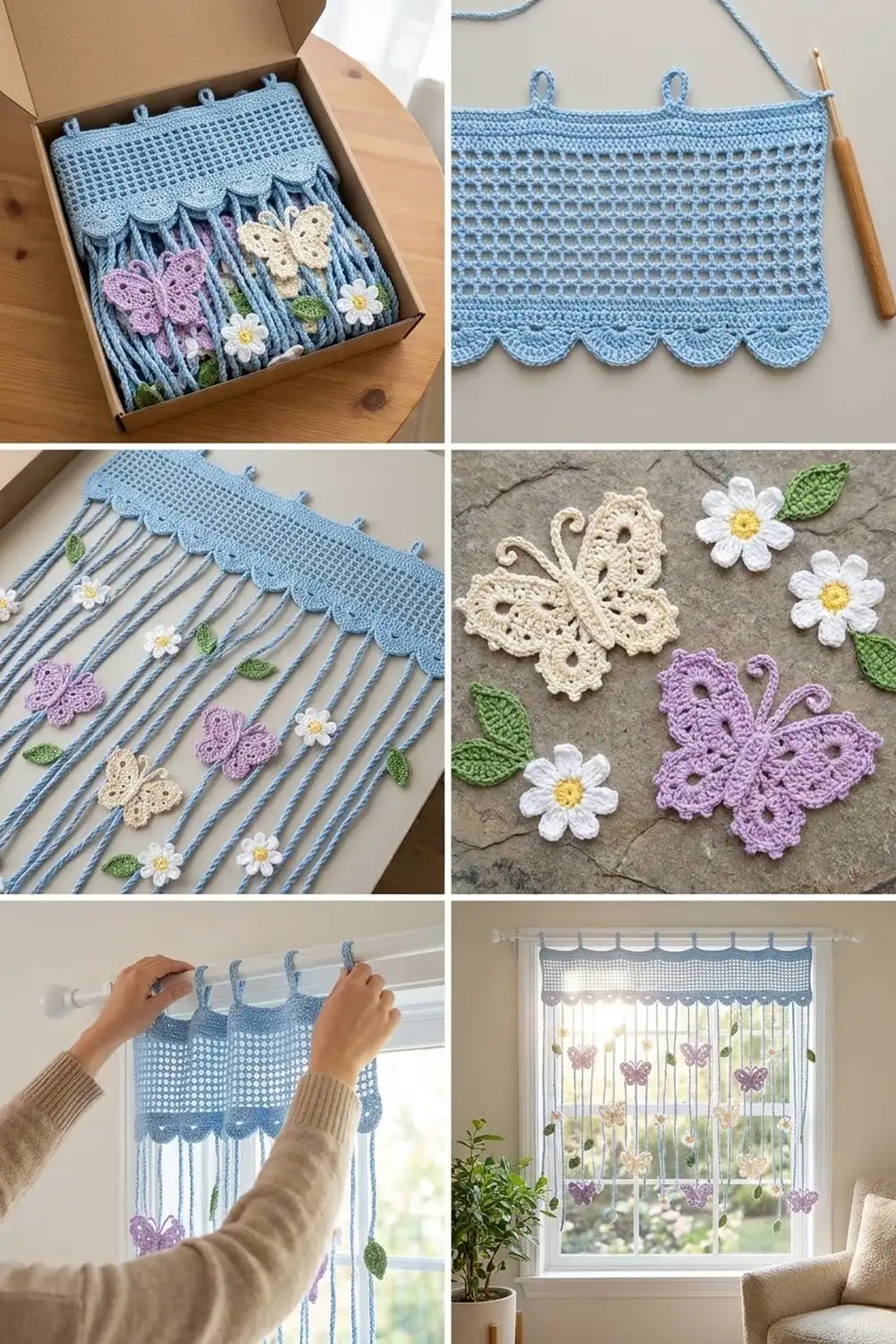
The measurements build on each other in this order:
- 9 mesh squares = 4 in (10.2 cm), so 81 squares make a 36 in (91.4 cm) header.
- 27 shells over 163 stitches give 28 cords spaced about 1.33 in (3.4 cm) apart.
- 172 slip stitches make a 43 in (109.2 cm) cord.
- The 5 in (12.7 cm) header plus the 43 in (109.2 cm) cords equal the finished 48 in (121.9 cm) length.
Check your gauge first, count your stitches at every checkpoint, and the curtain will fit your window.
Happy crocheting!