
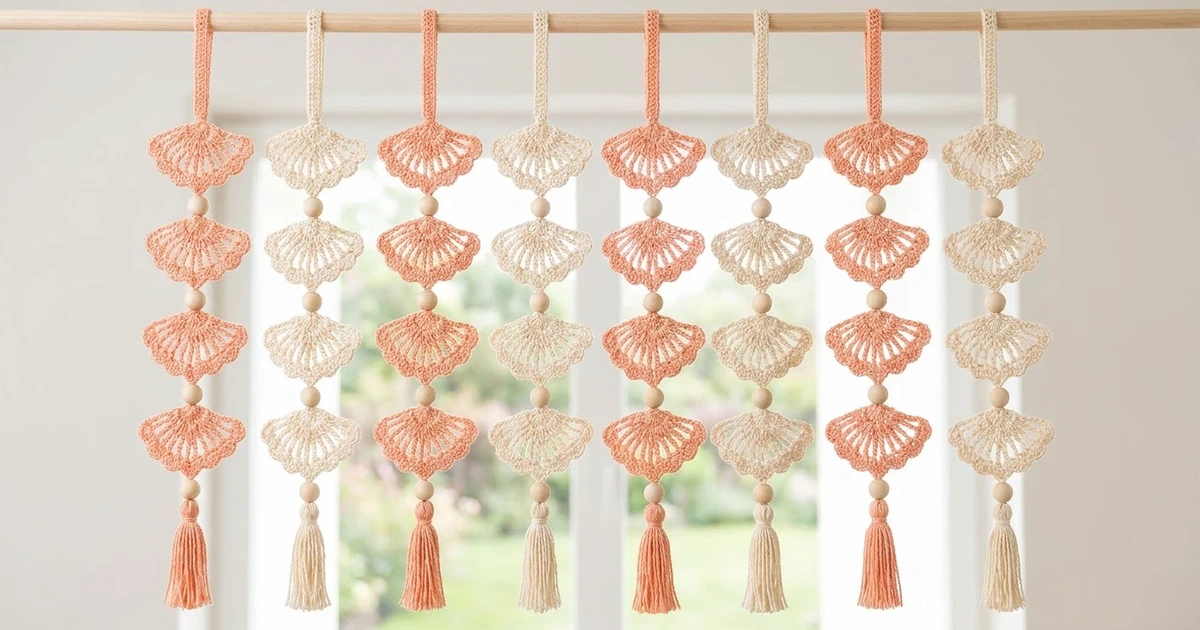
The Coral Tide Shell Strand Curtain is a light, airy window hanging made from openwork fan-shell motifs, natural wooden beads, and soft yarn tassels. Eight separate strands hang side by side from a wooden rod. Four are peach and four are cream, and they alternate across the rod for a gentle, beachy rhythm.
Each shell has a solid fan-shaped base, five tall spokes, and four open petals. A scalloped edge caps the petals, with a small loop at the top center and another at the bottom of the base. These loops link the shells to the beads, so each strand moves freely and catches the light.
This pattern uses US crochet terms. One shell measures 3.75 in (9.5 cm) wide and 2.75 in (7.0 cm) tall, not counting its loops. A finished strand is about 25.25 in (64.1 cm) long, and the eight-strand curtain spans 33.5 in (85.1 cm) on the rod.
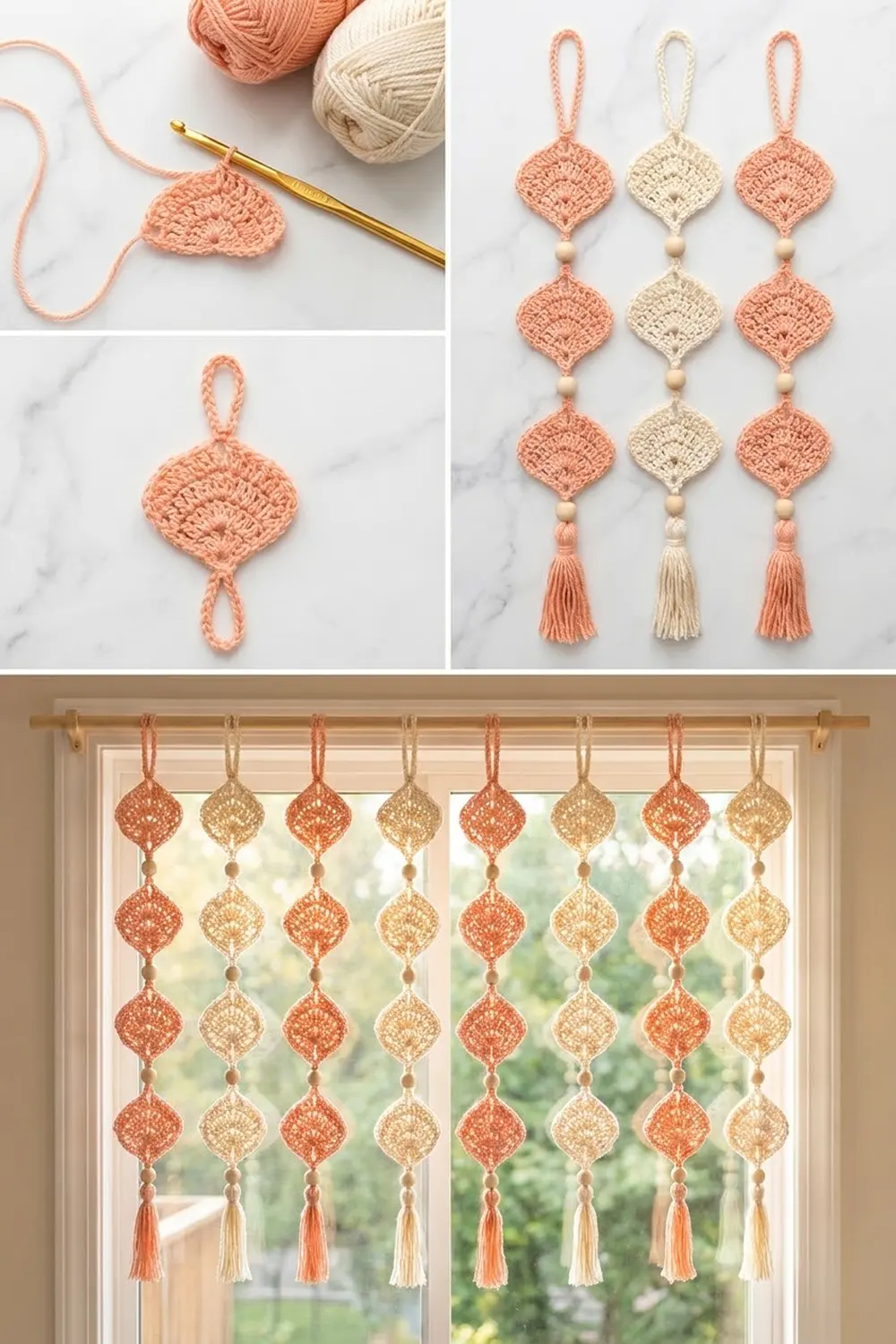
Construction is simple. Each shell is worked flat from a small ring in four steps: a dc base fan, a row of double treble spokes, a scallop row, and one edging round that adds both loops. You then link four shells per strand with wooden beads, add a tassel, and hang the strands on a rod.
Finished Size and Construction
- Finished curtain: 33.5 in (85.1 cm) wide x 25.25 in (64.1 cm) long
- Skill level: Advanced beginner
- Terminology: US crochet terms
- Yarn weight: Worsted weight (#4) cotton or cotton blend
- Hook: 4.5 mm (US 7)
- Number of pieces: 32 crocheted shells (16 peach, 16 cream) and 8 tassels
- Layout: 8 strands of 4 shells each, colors alternating peach and cream
- Shell size: 3.75 in (9.5 cm) wide x 2.75 in (7.0 cm) tall
- Shell size before edging: 3.5 in (8.9 cm) wide x 2.5 in (6.4 cm) tall
- Edging depth: about 1/8 in (0.3 cm) per side
Materials
Choose a smooth, mercerized or matte worsted-weight cotton with about 85 m per 50 g. Cotton holds the open shell shape and resists stretching when the strands hang. It also shows the stitches clearly, so the spokes stand out.
- Peach: 120 g (about 205 m)
- Cream: 120 g (about 205 m)
Each color covers 16 shells, 4 tassels, and the link cords for 4 strands. These amounts include a margin of about 25% for your gauge swatch, a test shell, and tassel trimming.
Tools and notions:
- 4.5 mm (US 7) crochet hook
- 32 natural wooden beads, 16 mm, with holes of at least 5 mm
- Tapestry needle and a bead threader (or a loop of thin wire)
- Stiff card 4.5 in (11.4 cm) wide for the tassels
- Scissors, stitch markers, and a measuring tape
- Blocking mat and rust-proof pins
- Wooden curtain rod at least 36 in (91.4 cm) long
Abbreviations (US Terms)
- ch: chain
- sl st: slip stitch
- sc: single crochet
- dc: double crochet
- dtr: double treble crochet
- sk: skip
- sp: space
- st(s): stitch(es)
Double treble (dtr): Yarn over 3 times. Insert the hook in the stitch and pull up a loop (5 loops on hook). [Yarn over, pull through 2 loops] 4 times.
Gauge and Checkpoints
Gauge: 16 sc and 18 rows = 4 in (10.2 cm) with the 4.5 mm hook.
Make one complete test shell before you start the full batch. Its size sets the length of every strand and the spacing on the rod.
Checkpoints:
- After Row 1: The base fan is 1.5 in (3.8 cm) across and 0.75 in (1.9 cm) tall.
- After Row 2: The spokes reach 2 in (5.1 cm) up from the bottom of the ring, and the spoke tops span 3.25 in (8.3 cm).
- After Row 3: The shell is 3.5 in (8.9 cm) wide x 2.5 in (6.4 cm) tall.
- After the edging: The shell is 3.75 in (9.5 cm) wide x 2.75 in (7.0 cm) tall.
If your shell is too big, switch to a 4 mm (US G-6) hook. If it is too small, switch to a 5 mm (US H-8) hook. An error of 0.25 in (0.6 cm) per shell adds up to 1 in (2.5 cm) over a strand, so match the size before you go on.
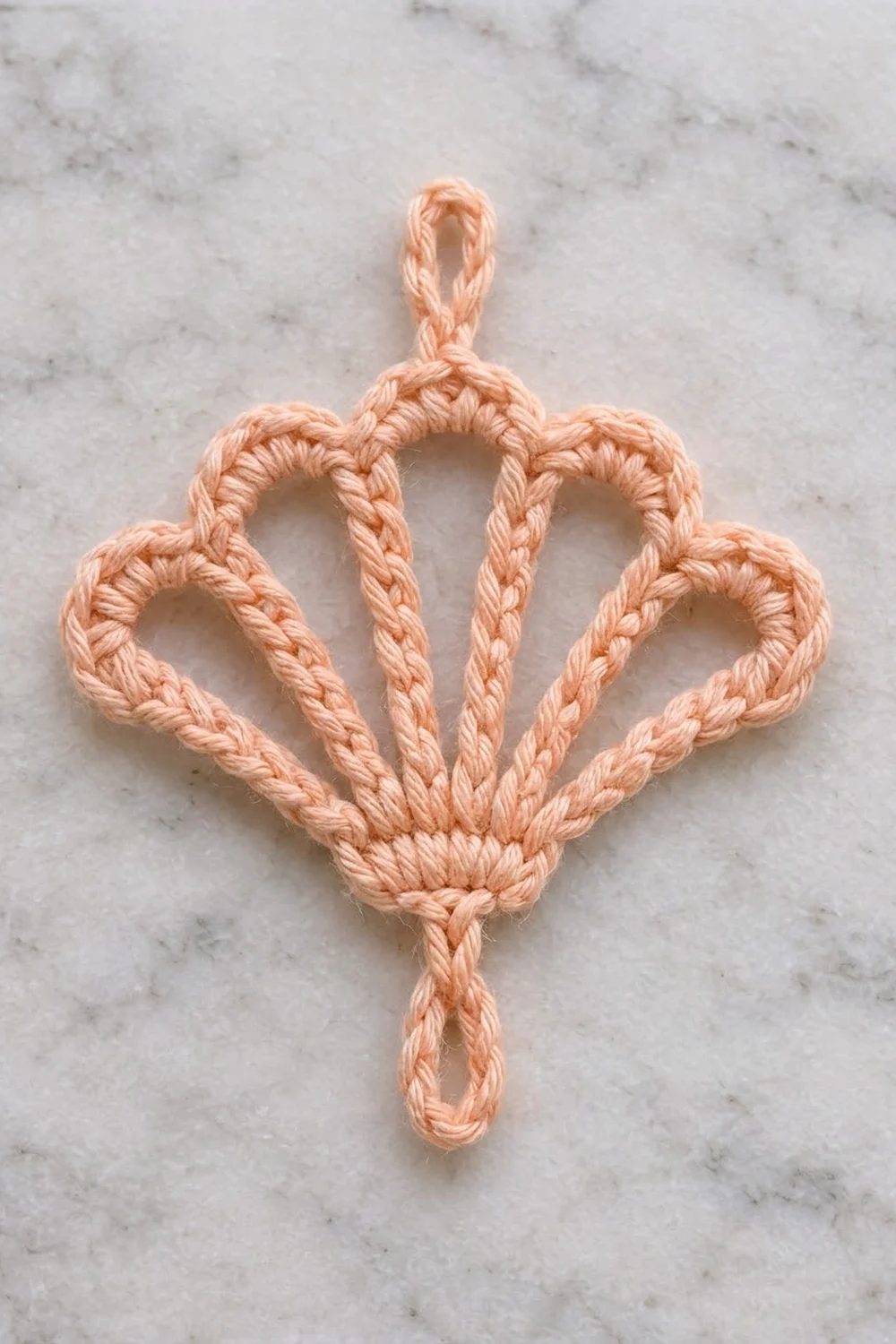
Shell Motif
Make 16 in peach and 16 in cream. Leave a 6 in (15.2 cm) tail at the start and at the end.
Ring: Ch 5, sl st in the first ch to form a ring.
Row 1 (base fan): Ch 3 (counts as dc), 8 dc in the ring. Do not join. Turn. (9 sts)
The stitches sit around the top half of the ring and fan out into a dense half circle. The lower half of the ring stays bare for now.
Row 2 (spokes): Ch 5 (counts as dtr), [ch 4, sk next st, dtr in next st] 4 times. Turn. (5 dtr spokes, 4 ch-4 sps)
The spokes land in sts 1, 3, 5, 7, and 9, so the center spoke rises straight up from the center dc. Gently ease the two outer spokes outward. They become the curved outside edges of the outer petals.
Row 3 (scallops): Ch 1, sc in first dtr, [7 sc in next ch-4 sp, sc in next dtr] 4 times. Work the last sc in the top ch of the turning ch-5. Do not turn. (33 sc: 5 over spokes + 28 in spaces)
Packing 7 sc into each ch-4 sp pushes the edge up into a rounded arch. That gives four scallops above four open petals. Stitch 17 sits directly on top of the center spoke. Place a marker in it.
Make All Pieces
Shells: Make 16 peach and 16 cream. Add the edging (see the Border section) to each shell as soon as you finish its Row 3.
- Top shells: 4 peach and 4 cream, each with a long ch-30 hanging loop.
- Standard shells: 12 peach and 12 cream, each with a ch-8 top loop.
Tassels: 4 peach and 4 cream.
Beads: 4 per strand, 32 total.
Layout grid (front view, left to right):
Strand:  1  2  3  4  5  6  7  8
Shell 1: P  C  P  C  P  C  P  C   (top shells)
Shell 2: P  C  P  C  P  C  P  C
Shell 3: P  C  P  C  P  C  P  C
Shell 4: P  C  P  C  P  C  P  C
Tassel:  P  C  P  C  P  C  P  C
P = peach, C = cream. Each strand is a single color.
Joining
The strands are never joined to each other. Each one hangs on its own from the rod. Within a strand, each shell links to the next, loop to loop, through a wooden bead.
Link logic: The bottom loop is anchored at the center of the base. The top loop sits on stitch 17, directly above the center spoke. Because both loops lie on the shell’s center line, every link pulls straight down and the shells hang level.
To link two shells:
- Cut a 14 in (35.6 cm) strand of matching yarn and fold it in half.
- Push the fold through the bottom loop of the upper shell, then pull the tails through the fold to make a lark’s head knot.
- Use the bead threader to pass both tails through one bead.
- Pass both tails through the top loop of the lower shell and tie a square knot, but don’t tighten it yet.
- Adjust the link until it measures 2 in (5.1 cm) from the base of the upper shell to the top edge of the lower shell. Then tighten the knot.
- Weave the tails back up through the bead and trim them.
Tension advice: Tie every link on a flat surface with a tape measure beside you. If one link is just 0.25 in (0.6 cm) short, that strand will sit visibly higher than its neighbors.
Strand checkpoint: The top edge of one shell should be 4.75 in (12.1 cm) from the top edge of the next. That is 2.75 in (7.0 cm) of shell plus 2 in (5.1 cm) of link.
Tassels: Wrap yarn 30 times around the 4.5 in (11.4 cm) card. Slide a 12 in (30.5 cm) tie strand under the wraps at the top, knot it tightly, and cut through the wraps at the bottom. Wrap a separate strand around the tassel 0.5 in (1.3 cm) below the top to form the neck, and knot it. Trim the tassel to 4 in (10.2 cm). Thread the tie tails through one bead, knot them to the bottom loop of shell 4, and weave in the ends. From the base of shell 4 to the top of the tassel should measure 1.25 in (3.2 cm).
Full strand length: 3 in (7.6 cm) hanging loop + 11 in (27.9 cm) of shells + 6 in (15.2 cm) of links + 1.25 in (3.2 cm) bead section + 4 in (10.2 cm) tassel = 25.25 in (64.1 cm).
Hanging: Slide the long loops onto the rod in the order shown in the layout grid, with strand centers 4.25 in (10.8 cm) apart. That leaves a 0.5 in (1.3 cm) gap between neighboring shells. Seven spaces of 4.25 in (10.8 cm) plus one shell width of 3.75 in (9.5 cm) gives the 33.5 in (85.1 cm) total width.
Border: Shell Edging Round
Each shell gets its own one-round edging. This round outlines the sides, covers the bare part of the base ring, and adds both loops.
Edging gauge: Along each side, 8 sc cover the 2.5 in (6.4 cm) height of Rows 1 to 3. Across the top, you work 1 sl st into each Row 3 sc, so the top edge keeps its 3.5 in (8.9 cm) width before blocking.
Edging Round: Continue from the end of Row 3 without turning.
- Side 1 (down): 8 sc evenly down the side: 6 sc along the post of the outer dtr, then 2 sc along the post of the end dc. (8 sc)
- Base: 2 sc into the bare lower half of the ring. Ch 8, then sl st in the last sc made to form the bottom loop. 2 more sc into the ring. (4 sc + bottom loop)
- Side 2 (up): 8 sc evenly up the other side: 2 sc along the dc post, then 6 sc along the dtr post. (8 sc)
- Top: Sl st in each of the first 16 sc of Row 3. In the marked 17th sc, work (sl st, ch 8, sl st) to make the top loop. Sl st in each of the remaining 16 sc. (33 sts worked into + top loop)
- Sl st in the first sc of Side 1 to join. Fasten off.
For top shells, work (sl st, ch 30, sl st) in the 17th sc instead. This makes a hanging loop about 3 in (7.6 cm) long, big enough for a rod up to 1.5 in (3.8 cm) thick.
Edging total: 8 + 4 + 8 + 33 = 53 stitch positions, plus 2 loops.
Why the math works: The top takes exactly one sl st per Row 3 sc (33 into 33), so it firms the scallops without gathering or ruffling them. Both sides get the same 8 sc, which keeps the shell symmetrical. The base splits its 4 sc into 2 and 2 around the bottom loop, which puts the loop on the center line under the center spoke. The top loop sits on stitch 17, the exact middle of 16 + 1 + 16, directly over the same spoke.
Final Blocking
- Weave in all shell tails, hiding them along the spoke posts.
- Soak the shells in cool water for 10 minutes. Roll them in a towel and press out the water. Do not wring.
- Pin each shell flat to 3.75 in (9.5 cm) x 2.75 in (7.0 cm).
- Pin the five spokes so they fan out evenly, then pin each scallop into a smooth arch.
- Pin each petal space open so it dries round.
- Lay both loops straight along the center line.
- Let the shells dry completely, usually 12 to 24 hours.
- Link the strands and add the tassels after blocking. Steam the tassels lightly and trim them evenly to 4 in (10.2 cm).
Final Quality-Control Checklist
- [ ] Every shell measures 3.75 in (9.5 cm) x 2.75 in (7.0 cm).
- [ ] Every shell has 5 spokes, 4 open petals, and 4 even scallops.
- [ ] Both loops sit on the center line of every shell.
- [ ] All 24 links measure 2 in (5.1 cm).
- [ ] All 8 tassels measure 4 in (10.2 cm).
- [ ] Every strand measures 25.25 in (64.1 cm).
- [ ] The strands alternate peach and cream, with centers 4.25 in (10.8 cm) apart.
- [ ] All ends are woven in and secure.
Troubleshooting
The scallops ruffle. Your Row 3 tension is loose. Go down a hook size and keep the 7 sc per space, since the edging count depends on it.
The spokes lean or twist. Keep your dtr tension even, and pin each spoke tip when blocking.
A shell hangs crooked. One loop is off-center. Check that the top loop is on stitch 17 and the base sc are split 2 and 2.
Two strands won’t fit through a bead. Use beads with larger holes or a thinner wire threader.
The strands sit at different heights. Re-measure the links and hanging loops, then retie any that are off.
The tassels splay. Tighten the neck wrap and steam the tassels.
Care
Hand wash in cool water with mild soap, then lay flat and reshape to the blocked size. Keep unsealed wooden beads as dry as possible, and only spot clean them.
Final Notes
Here is the measurement chain from start to finish. At a gauge of 16 sc = 4 in (10.2 cm), each shell is 3.5 in (8.9 cm) wide after Row 3 and 3.75 in (9.5 cm) x 2.75 in (7.0 cm) after the edging. Four shells, three 2 in (5.1 cm) links, the hanging loop, the bead, and the tassel make a 25.25 in (64.1 cm) strand. Eight strands spaced 4.25 in (10.8 cm) apart make a 33.5 in (85.1 cm) curtain. Check each stage, and the finished curtain will hang straight and even.
Happy crocheting!