

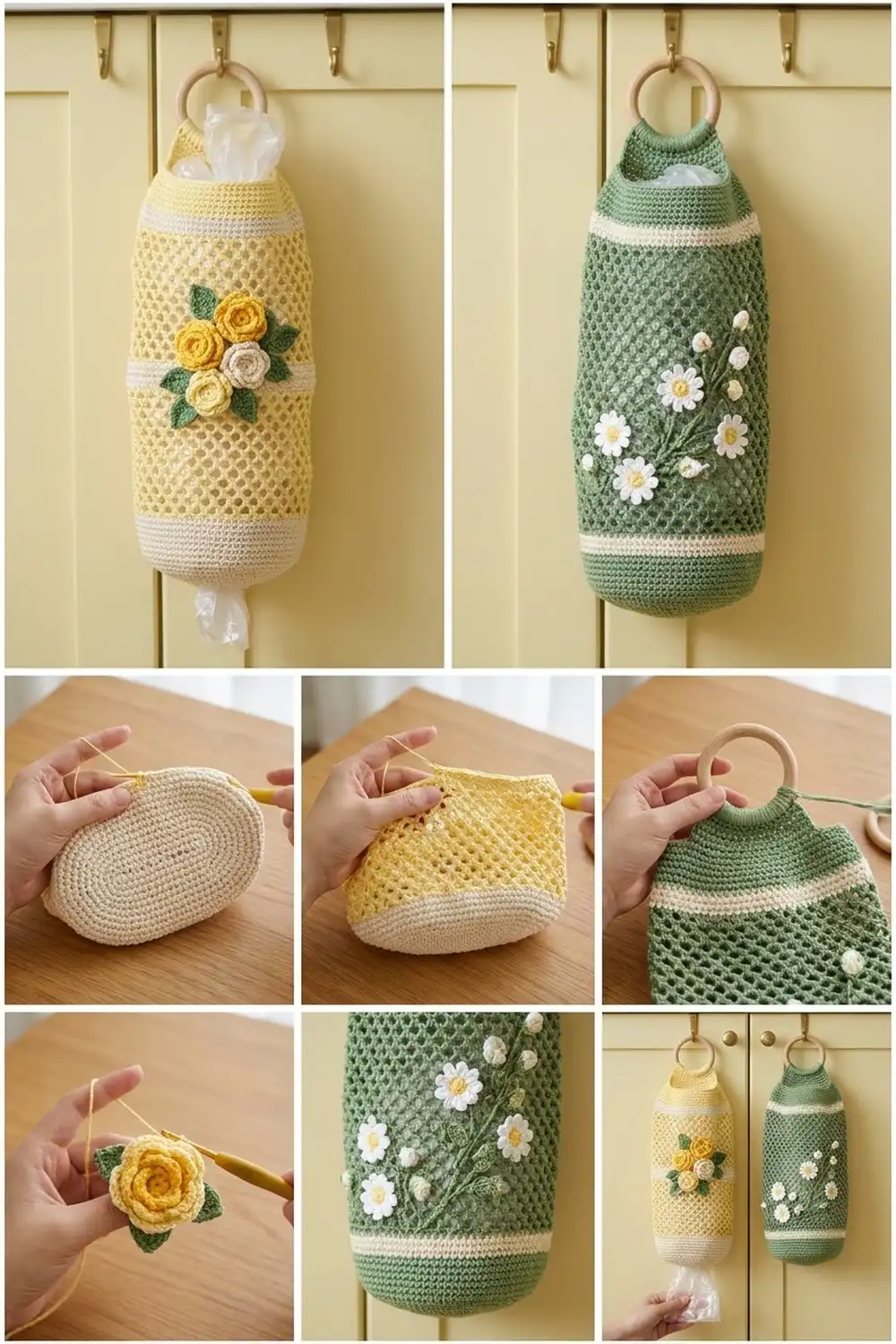
This plastic bag holder is a tall, open-mesh tube. It has a solid oval base, a smooth band of single crochet at the bottom and top, and a small oval opening near the bottom so you can pull bags out one at a time. A short tab at the top loops through a wooden ring, so you can hang it on a cabinet hook or door knob.
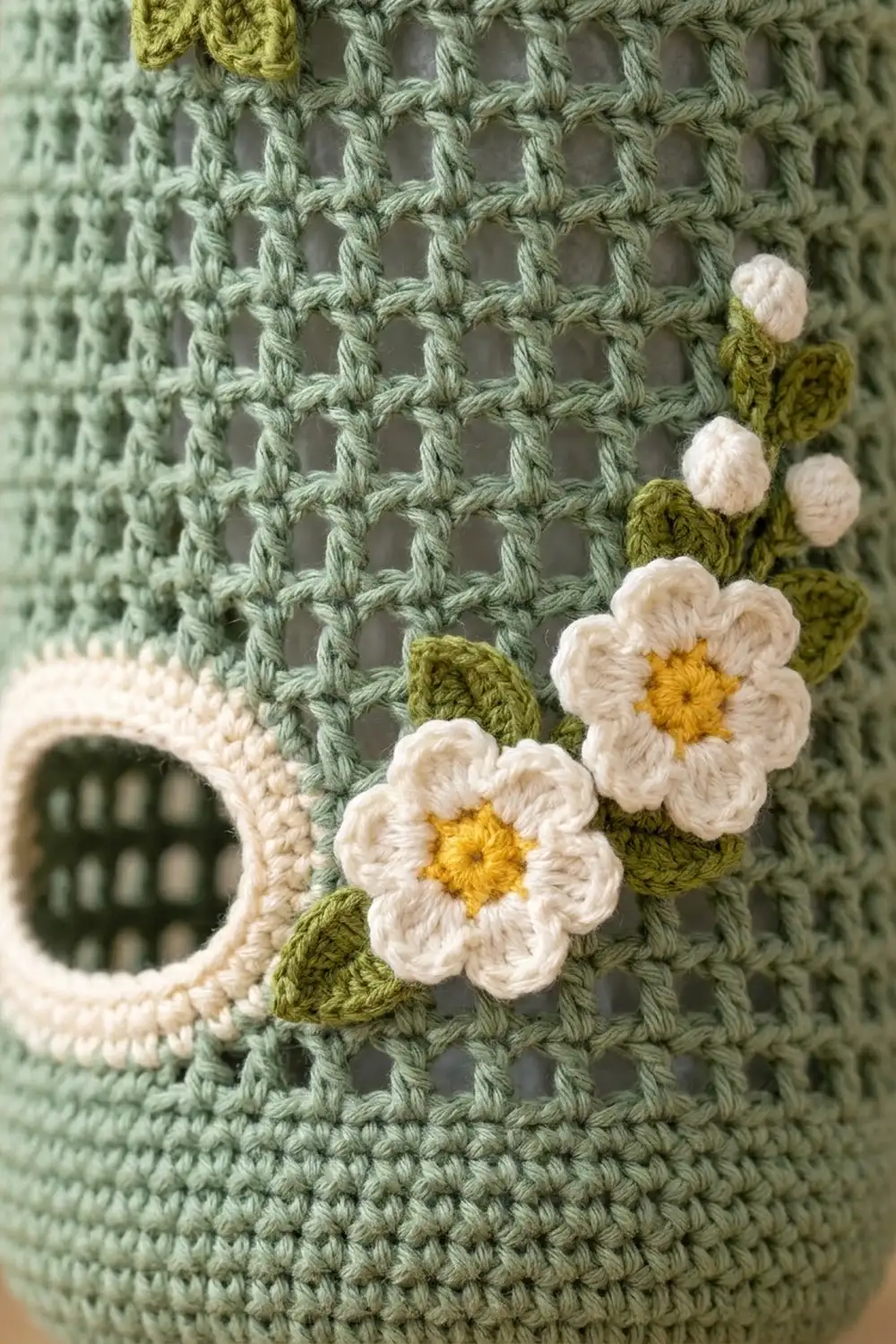
The pattern gives two colorways. The Butter version has a pale yellow mesh, cream bands and a cream neck, with a cluster of stacked yellow and cream roses and green leaves at the upper left. The Sage version has a sage green mesh and neck, cream stripes, and two sprays of white daisies with yellow centers, tiny white buds and green leaves along the right side. Both have a cottage-kitchen look: soft colors, a crisp grid and a few hand-made flowers.
All instructions use US crochet terms. The finished body is 15 in (38.1 cm) tall with a circumference of 14.5 in (36.8 cm), which is about 4.6 in (11.7 cm) across when filled. Hanging length to the top of the ring is about 19 in (48.3 cm).
Construction is simple and seamless. You work an oval base in joined rounds and turn up the wall with a back-loop round. Then you work a single crochet band, a filet-style mesh with a two-row dispensing opening, and a top band that decreases into a neck. Last, you work a ring tab, then crochet the flowers and leaves separately and sew them on.
Finished Size and Construction
- Finished size: 15 in (38.1 cm) tall × 14.5 in (36.8 cm) around; laid flat, 7.25 in (18.4 cm) wide
- Skill level: Easy-intermediate
- Terminology: US
- Yarn weight: Worsted (#4), cotton or cotton blend
- Hook: 5.0 mm (H-8)
- Number of pieces: 1 body plus sewn-on appliqués (Butter: 4 roses and 4 leaves; Sage: 5 daisies, 3 buds and 6 leaves)
- Layout: One seamless tube with the opening at the front, appliqués at the upper front, and the ring tab centered at the back
- Base size: 5.75 × 3 in (14.6 × 7.6 cm) oval
- Size before top band: 13 in (33.0 cm) tall (2 in / 5.1 cm bottom band + 11 in / 27.9 cm mesh)
- Top band depth: 2 in (5.1 cm), plus a 2.25 in (5.7 cm) ring tab
Materials
Use a smooth worsted cotton, about 170 m per 100 g. Cotton holds its shape, doesn’t stretch out under the weight of the bags, and makes crisp mesh squares. Acrylic works too, but the tube will be softer and a little longer. Choose a cream that is clearly lighter than your mesh color so the bands stand out.
Butter colorway
– Cream: 50 g (85 m), for the base, bands, neck, tab, opening trim and 2 roses
– Butter yellow: 60 g (102 m), for the mesh and 2 roses
– Leaf green: 5 g (9 m)
Sage colorway
– Sage green: 95 g (162 m), for the base, lower band, mesh, neck and tab
– Cream: 15 g (26 m), for the stripes and opening trim
– White: 8 g (14 m), for the daisy petals and buds
– Yellow: 3 g (5 m), for the daisy centers
– Leaf green: 5 g (9 m)
All quantities include a margin of about 15%.
Tools
– 5.0 mm (H-8) hook
– 3 in (7.6 cm) unfinished wooden ring
– Tapestry needle
– 4 stitch markers
– Measuring tape
– Spray bottle and a rolled towel for blocking
Abbreviations (US Terms)
- ch: chain
- sl st: slip stitch
- sc: single crochet
- hdc: half double crochet
- dc: double crochet
- sk: skip
- sp: space
- BLO: back loop only
- sc2tog: single crochet 2 together: (insert hook in next st, yarn over, pull up a loop) twice, yarn over, pull through all 3 loops
- st(s): stitch(es)
Special stitch – Bud cluster: Ch 3. In the 3rd ch from the hook, (yarn over, insert hook, pull up a loop, yarn over, pull through 2 loops) 4 times, then yarn over and pull through all 5 loops.
Gauge and Checkpoints
- Single crochet: 16 sts × 18 rounds = 4 in (10.2 cm)
- Mesh: 4 squares (8 sts) × 4 rounds = 2 in (5.1 cm), so each square is 0.5 in (1.3 cm)
Make the base first; it doubles as your gauge test. Measure it flat, without stretching. Check your work against these numbers as you go:
- After base Rnd 6: the oval measures 5.75 × 3 in (14.6 × 7.6 cm).
- After Rnd 15: the bottom band is 2 in (5.1 cm) tall and the tube measures 14.5 in (36.8 cm) around.
- After mesh Rnd 10: the mesh is 5 in (12.7 cm) tall and the squares are square.
- After mesh Rnd 22: the body is 13 in (33.0 cm) tall.
- After top band Rnd 9: the body is 15 in (38.1 cm) tall.
If your piece is too big, go down half a hook size. If it’s too small, go up half a size. If only the mesh is tall, keep the hook and work your ch-1s more tightly. Tall mesh usually comes from loose chains, not loose dc.
Base and Bottom Band
Join each round with a sl st in the first st. The ch 1 at the start of sc rounds doesn’t count as a stitch. Butter uses cream here; Sage uses sage.
Foundation: Ch 14.
Rnd 1: Sc in 2nd ch from hook, sc in next 11 ch, 3 sc in last ch. Working on the other side of the chain, sc in next 11 ch, 2 sc in last ch (the same ch as the first sc). Join. (28 sts)
Rnd 2: Ch 1, 2 sc in first st, sc in next 11, 2 sc in each of next 3, sc in next 11, 2 sc in each of last 2. Join. (34 sts)
Rnd 3: Ch 1, (sc in next, 2 sc in next) once, sc in next 11, (sc in next, 2 sc in next) 3 times, sc in next 11, (sc in next, 2 sc in next) twice. Join. (40 sts)
Rnd 4: Ch 1, (sc in next 2, 2 sc in next) once, sc in next 11, (sc in next 2, 2 sc in next) 3 times, sc in next 11, (sc in next 2, 2 sc in next) twice. Join. (46 sts)
Rnd 5: Ch 1, (sc in next 3, 2 sc in next) once, sc in next 11, (sc in next 3, 2 sc in next) 3 times, sc in next 11, (sc in next 3, 2 sc in next) twice. Join. (52 sts)
Rnd 6: Ch 1, (sc in next 4, 2 sc in next) once, sc in next 11, (sc in next 4, 2 sc in next) 3 times, sc in next 11, (sc in next 4, 2 sc in next) twice. Join. (58 sts)
Each growth round adds 6 sts, 3 at each curved end. The two straight sides stay at 11 sts.
Rnd 7 (turning round): Ch 1, sc BLO in each st around. Join. (58 sts) The unused front loops form a neat ridge where the wall turns up.
Rnds 8–15: Ch 1, sc in each st around. Join. (58 sts)
For Sage, change to cream at the end of Rnd 11 and work Rnds 12–15 in cream.
The round seam marks the front center. Place a marker there.
Mesh Body with Dispensing Opening
Change to butter yellow (Butter) or sage (Sage).
Mesh Rnd 1 (conversion round): Ch 4 (counts as dc + ch 1), sk next st, [dc in next st, ch 1, sk next st] 28 times. Join with a sl st in the 3rd ch of the beginning ch-4. (29 dc + 29 ch-1 sps = 58 sts)
Mesh Rnd 2: Ch 4, [dc in next dc, ch 1] 28 times. Join in the 3rd ch of ch-4. (29 dc, 58 sts)
Mesh Row 3 (opening, worked as a row): Ch 4, [dc in next dc, ch 1] 24 times, dc in next dc. Turn. (26 dc + 25 ch-1 sps) The last 3 dc of the round are left unworked; this is the gap.
Mesh Row 4: Ch 4, [dc in next dc, ch 1] 24 times, dc in 3rd ch of turning ch. Turn. (26 dc)
Mesh Rnd 5 (closing round): Ch 4, [dc in next dc, ch 1] 24 times, dc in 3rd ch of turning ch, ch 7, join in the 3rd ch of beginning ch-4. (26 dc + 25 ch-1 sps + 7 ch = 58 sts)
Mesh Rnd 6: Ch 4, [dc in next dc, ch 1] 24 times, dc in next dc, ch 1, sk 1 ch, [dc in next ch, ch 1, sk next ch] 3 times. Join. (29 dc, 58 sts)
You now have a 4-square by 2-round opening, about 2 × 1 in (5.1 × 2.5 cm). Mesh Rnd 5 goes in the original direction again, so the right side stays facing out.
Mesh Rnds 7–22: Ch 4, [dc in next dc, ch 1] 28 times. Join. (29 dc, 58 sts) Fasten off.
Don’t let the round seam drift. Always join in the 3rd ch of the ch-4 so the opening stays at the front center.
Edging: Top Band, Opening Trim and Ring Tab
The edging uses the sc gauge: 16 sts × 18 rounds = 4 in (10.2 cm). Butter works the whole top band in cream. Sage works Rnds 1–3 in cream and Rnds 4–9 and the tab in sage.
Top Band Rnd 1 (conversion round): Ch 1, sc in first dc, sc in next ch-1 sp, [sc in next dc, sc in next ch-1 sp] 28 times. Join. (29 sc in dc + 29 sc in sps = 58 sts)
Rnds 2–5: Ch 1, sc in each st around. Join. (58 sts)
Rnd 6: Ch 1, [sc in next 4, sc2tog] 9 times, sc in next 4. Join. (49 sts)
Rnd 7: Ch 1, [sc in next 3, sc2tog] 9 times, sc in next 4. Join. (40 sts)
Rnd 8: Ch 1, [sc in next 2, sc2tog] 9 times, sc in next 4. Join. (31 sts)
Rnd 9: Ch 1, sc in each st around. Join. (31 sts) The neck opening is 7.75 in (19.7 cm) around, which is big enough to push bags in from the top.
Ring Tab: Sl st in next 12 sts to reach the back center.
– Row 1: Ch 1, sc in same st and in next 5 sts. Turn. (6 sts)
– Rows 2–10: Ch 1, sc in each st across. Turn. (6 sts)
Pass the tab through the wooden ring from front to back. Fold it to the inside and whipstitch Row 10 to the inside of Rnd 8. Fasten off.
Opening Trim: With cream, join in a corner of the opening.
– Work 7 sc along the bottom edge (one per st of Mesh Rnd 2).
– Work 2 sc around each of the 2 dc posts up the first side (4 sc).
– Work 7 sc in the ch-7.
– Work 4 sc down the second side.
– Join. (22 sc)
Keep the trim relaxed so the opening rounds into an oval instead of pulling into a slit.
Why the math works: 58 sts divide into 29 mesh squares of 2 sts each. Every conversion round takes 1 st per existing st, so the count never drifts. The opening rounds give back exactly the sts they leave out: 3 dc and 4 ch-1 sps are replaced by a 7-st chain. The neck decreases remove 9 sts per round, which leaves 31 sts, an odd number, so the 6-st tab centers on sts 13–18.
Appliqués
Leave long tails for sewing on each piece.
Large rose (Butter, make 1 cream): Ch 4, sl st to form a ring.
– Rnd 1: Ch 1, 10 sc in ring. Join. (10 sts)
– Rnd 2: [Ch 3, sk 1, sc in next] 5 times. (5 loops)
– Rnd 3: In each loop: (sc, hdc, 3 dc, hdc, sc). (5 petals)
– Rnd 4: Working behind the petals, [ch 5, sc around post of next Rnd 2 sc] 5 times.
– Rnd 5: In each ch-5 loop: (sc, hdc, 5 dc, hdc, sc). (5 petals) Fasten off.
The large rose has two layers: the smaller Rnd 3 petals sit stacked in front of the larger Rnd 5 petals. Diameter is 2.25 in (5.7 cm).
Small rose (Butter, make 2 yellow and 1 cream): Work Rnds 1–3 of the large rose. Roll the petals slightly inward and tack them at the base. Diameter is 1.5 in (3.8 cm).
Daisy (Sage, make 5): With yellow, make a magic ring.
– Rnd 1: 10 sc in ring. Join. Fasten off yellow. (10 sts)
– Rnd 2: Join white, [sl st in next st, (hdc, 3 dc, hdc) in next st] 5 times. Join. (5 petals)
Diameter is 1.5 in (3.8 cm).
Bud (Sage, make 3 white): Work 1 bud cluster. Fasten off. Each bud is 0.5 in (1.3 cm).
Leaf (Butter make 4, Sage make 6, in green):
– Ch 7. Sl st in 2nd ch from hook, then sc, hdc, dc, hdc and sc in the next 5 ch.
– Ch 1 and rotate. Work the same sts along the other side of the chain.
– Sl st to the tip.
Each leaf is 1.5 in (3.8 cm) long.
Placement – Butter: Start 0.75 in (1.9 cm) below the top band, at the upper left of the front.
– Sew the large cream rose in the center.
– Sew one yellow rose above it and one yellow rose at its left.
– Sew the small cream rose below.
– Tuck the 4 leaves out from behind the roses.
Placement – Sage: On the right half of the front:
– Sew 3 daisies in a cluster just below the top band.
– Sew 2 daisies about 6 in (15.2 cm) lower.
– Scatter the buds and leaves along the stems between them.
Sew each piece through the dc posts, never across the open squares. That way the flowers stay flat and the mesh doesn’t sag.
Final Blocking
- Weave in all ends except the sewing tails.
- Mist the tube until it is damp but not wet.
- Slide in a rolled towel about 4.6 in (11.7 cm) thick.
- Pat the mesh until the squares are square and the columns are vertical.
- Shape the opening into a soft oval.
- Let it dry completely. Then sew on the appliqués and weave in the tails.
Final Quality-Control Checklist
- Body is 15 in (38.1 cm) tall and 14.5 in (36.8 cm) around
- Every mesh round has 29 dc
- The opening is at the front center and is trimmed with 22 sc
- The neck has 31 sts and the tab is centered at the back
- The ring hangs straight and the tube doesn’t twist
- Appliqués are secure and no tails show
Troubleshooting
- Tube twists: You joined into the wrong ch. Rejoin in the 3rd ch of ch-4.
- Base cups or ruffles: It cups if your tension is tight and ruffles if it is loose. Check Rnd 6 against 58 sts and 5.75 × 3 in (14.6 × 7.6 cm).
- Opening puckers: Your ch-7 is too tight. Rework it with a looser chain.
- Neck too small for bags: Skip Rnd 8 so the neck stays at 40 sts. Then sl st in the next 17 sts and work the tab over sts 18–23.
- Tab stretches: Add a second tab row or switch to cotton.
Care
Hand wash in cool water and lay flat to dry over a rolled towel. Don’t tumble dry. Heat can shrink cotton and flatten the flowers.
Final Notes
The measurement chain is short and easy to check:
- A 5.75 × 3 in (14.6 × 7.6 cm) base gives 58 sts.
- 58 sts make 29 mesh squares and a 14.5 in (36.8 cm) tube.
- A 2 in (5.1 cm) bottom band, 11 in (27.9 cm) of mesh and a 2 in (5.1 cm) top band give a 15 in (38.1 cm) body.
- The ring tab brings the hanging length to about 19 in (48.3 cm).
If each checkpoint matches, the finished holder will too. Happy crocheting!