

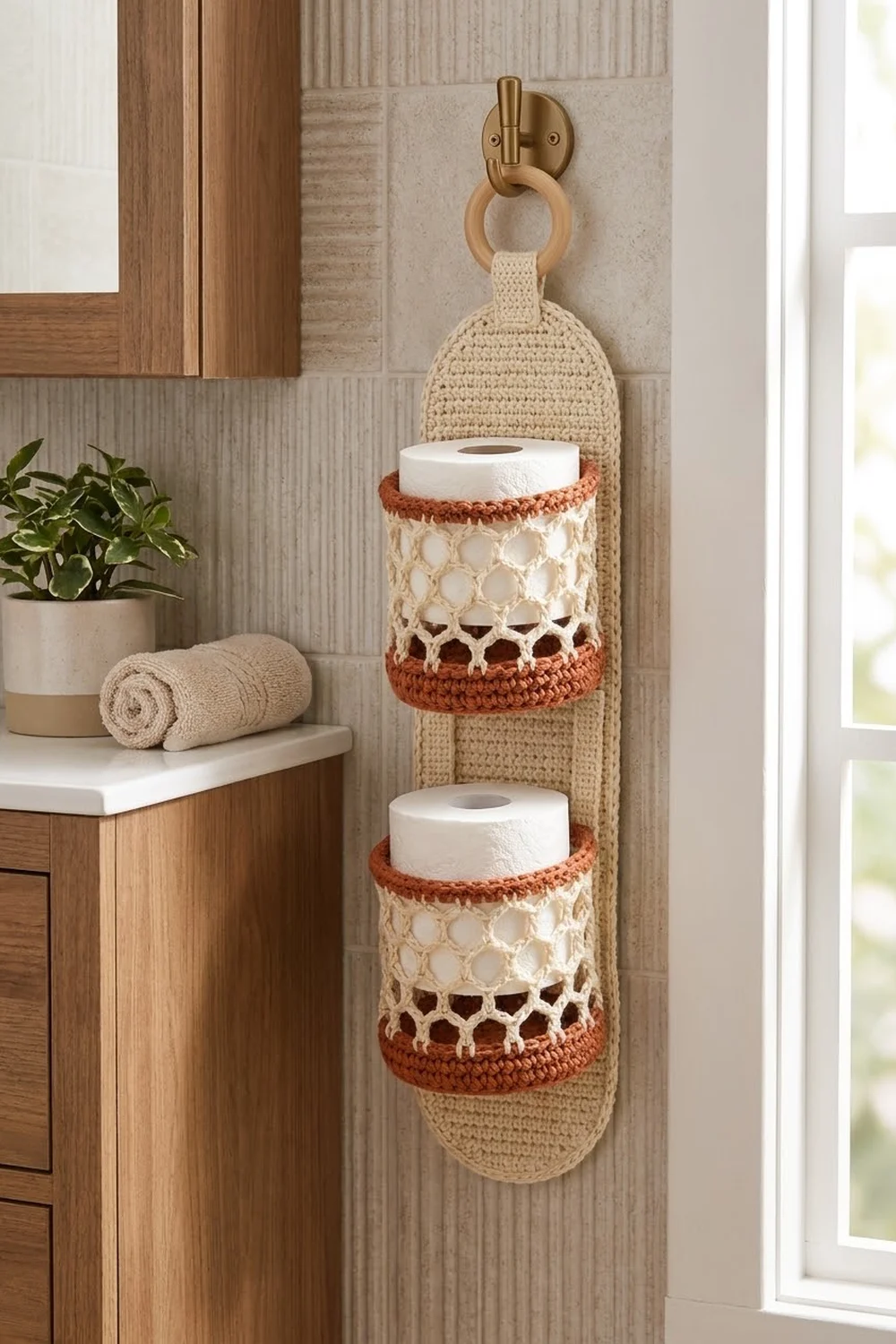
This hanging organizer holds two spare toilet rolls and takes up very little room. A long cream backboard with rounded ends hangs from a wooden ring. Two round baskets are stitched to the front, one above the other.
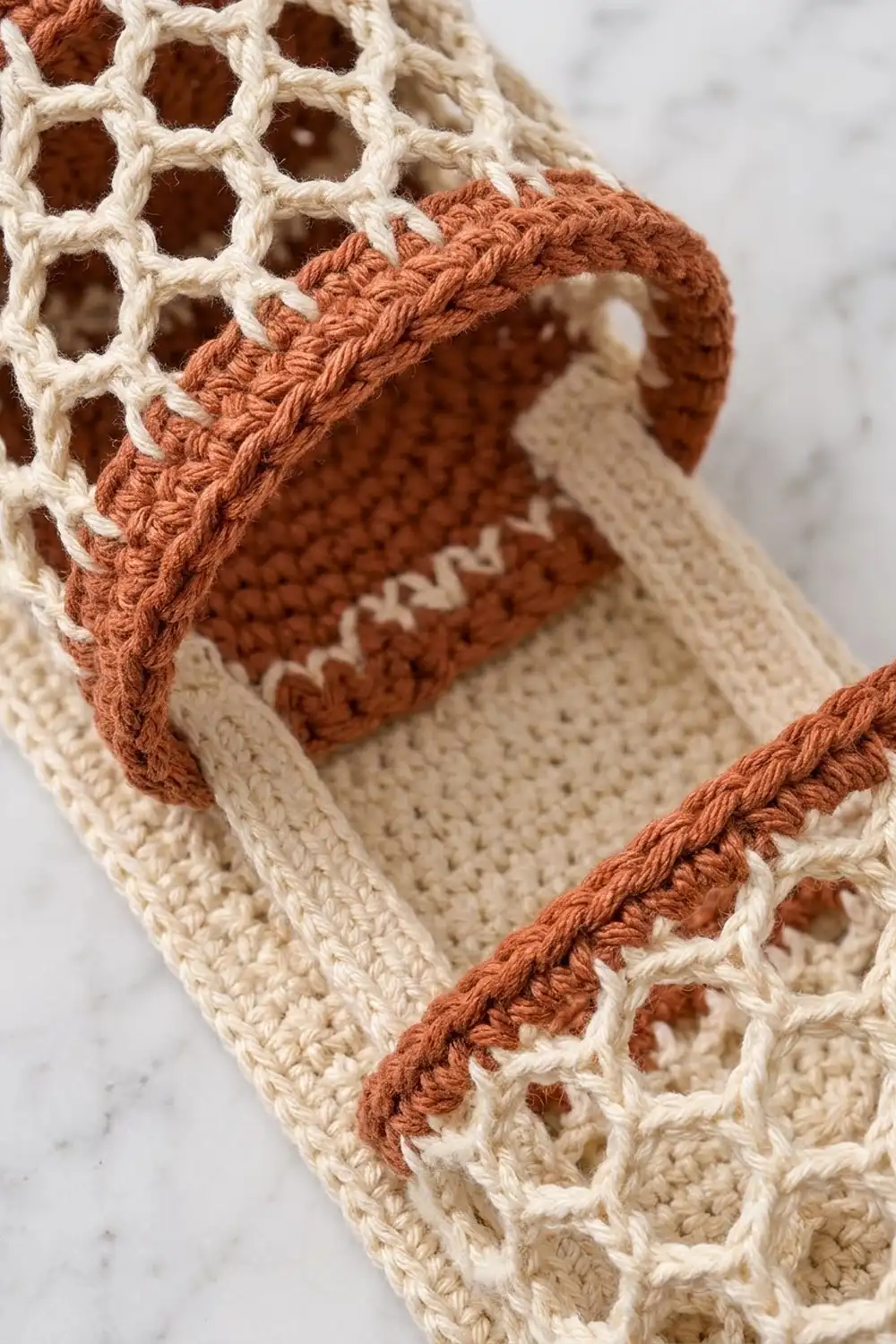
Each basket has a solid terracotta base and bottom band, an open cream honeycomb mesh body, and a terracotta rim with a rope-like crab-stitch edge. The warm rust, natural cream and light wood suit a neutral, boho or Scandinavian bathroom.
This pattern uses US crochet terms. The finished backboard measures 6 in x 19 in (15.2 cm x 48.3 cm). Each basket is 5.25 in (13.3 cm) across and 5 in (12.7 cm) tall. Including the ring, the holder hangs about 22.25 in (56.5 cm) long.
You will make six pieces: one backboard, two baskets (each worked in one piece from base to rim), two support straps and one hanging tab. The backboard is worked in rows with shaped ends, then bordered. The baskets are worked in joined rounds. All the pieces are sewn together at the end.
Finished Size and Construction
- Finished size: backboard 6 in x 19 in (15.2 cm x 48.3 cm); overall hanging length about 22.25 in (56.5 cm)
- Skill level: Easy+ / Intermediate
- Terminology: US crochet terms
- Yarn weight: Worsted (#4) cotton
- Hook: 5 mm (H-8)
- Number of pieces: 6 crocheted pieces plus 1 wooden ring
- Layout: two baskets stacked vertically on one backboard
- Piece sizes: basket 5.25 in (13.3 cm) across x 5 in (12.7 cm) tall; strap 3.5 in x 0.9 in (8.9 cm x 2.3 cm); tab 1.5 in x 4.5 in (3.8 cm x 11.4 cm)
- Backboard before border: 5 in x 18 in (12.7 cm x 45.7 cm)
- Border depth: 0.5 in (1.3 cm) on every side
Materials
Use a smooth worsted-weight cotton or cotton blend. Cotton keeps its shape and copes with bathroom humidity better than acrylic. The amounts below assume a yarn with about 155 m per 100 g.
- Rust / terracotta: 80 g, about 125 m (bases, bands and rims)
- Cream: 115 g, about 180 m (backboard, mesh, straps and tab)
These amounts include a margin of roughly 15–20% for a gauge swatch and for sewing.
Tools:
- 5 mm (H-8) crochet hook
- Wooden ring, 2.5 in (6.4 cm) outer diameter
- Tapestry needle
- 4 locking stitch markers
- Scissors and a tape measure
- Pins and a blocking mat
Abbreviations (US Terms)
- ch: chain
- sl st: slip stitch
- sc: single crochet
- sc2tog: single crochet 2 together
- BLO: back loop only
- MR: magic ring
- st(s): stitch(es)
- RS: right side
- rep: repeat
Special stitch: reverse sc (crab stitch). Work from left to right (if you are right-handed). Insert the hook into the next stitch to the right, yarn over and pull up a loop, then yarn over and pull through both loops. This makes the twisted, rope-like rim.
Gauge and Checkpoints
Gauge: 16 sc x 18 rows = 4 in (10.2 cm) in sc worked in rows.
Make one basket first. It is the quickest way to test your gauge, and the roll has to fit inside it.
Checkpoints:
- After base Round 11, the flat circle measures 5.25 in (13.3 cm) across.
- After Round 16, the rust band is about 1.1 in (2.8 cm) tall.
- After Round 21, the wall is about 4.1 in (10.4 cm) tall.
- The finished basket is 5 in (12.7 cm) tall. A standard roll about 4.5 in (11.4 cm) wide should slide in easily.
- After Row 81, the backboard measures 5 in x 18 in (12.7 cm x 45.7 cm).
- After the border, the backboard measures 6 in x 19 in (15.2 cm x 48.3 cm).
If your piece is too big, go down to a 4.5 mm hook. If it is too small, go up to a 5.5 mm hook. Don’t change the stitch counts, because the counts in each section depend on each other.
Basket (Make 2)
Each basket is worked in joined rounds from the center of the base up to the rim. Do not turn between rounds.
Base
With rust:
Round 1: 6 sc in MR, sl st to first sc. (6)
Round 2: ch 1, 2 sc in each st around, sl st to first sc. (12)
Round 3: ch 1, [sc 1, 2 sc in next] 6 times, sl st to first sc. (18)
Round 4: ch 1, [sc 2, 2 sc in next] 6 times, sl st to first sc. (24)
Round 5: ch 1, [sc 3, 2 sc in next] 6 times, sl st to first sc. (30)
Round 6: ch 1, [sc 4, 2 sc in next] 6 times, sl st to first sc. (36)
Round 7: ch 1, [sc 5, 2 sc in next] 6 times, sl st to first sc. (42)
Round 8: ch 1, [sc 6, 2 sc in next] 6 times, sl st to first sc. (48)
Round 9: ch 1, [sc 7, 2 sc in next] 6 times, sl st to first sc. (54)
Round 10: ch 1, [sc 8, 2 sc in next] 6 times, sl st to first sc. (60)
Round 11: ch 1, [sc 9, 2 sc in next] 6 times, sl st to first sc. (66)
Checkpoint: the base is 5.25 in (13.3 cm) across when laid flat.
Rust Bottom Band
Round 12: ch 1, sc in BLO of each st around, sl st to first sc. (66) The unused front loops leave a neat ridge and turn the work upward into a wall.
Rounds 13–16: ch 1, sc in each st around, sl st to first sc. (66)
Fasten off rust. The band is about 1.1 in (2.8 cm) tall.
Cream Honeycomb Mesh
Round 17: Join cream with a sc in any st. *Ch 5, skip 2 sts, sc in next st; rep from * 20 more times. Ch 5, skip the last 2 sts, sl st to first sc. (22 ch-5 loops)
Check: 22 repeats x 3 sts used (1 sc + 2 skipped) = 66.
Round 18: Sl st in each of the next 3 ch to reach the center of the first loop. Ch 1, sc in the same loop. *Ch 5, sc in next ch-5 loop; rep from * 20 more times. Ch 5, sl st to first sc. (22 loops)
Rounds 19–21: Rep Round 18. (22 loops)
Each sc sits in the middle of the loop below it, so the loops stagger. When the wall is stretched around a roll, the openings pull into six-sided honeycomb cells. Each mesh round adds about 0.6 in (1.5 cm), so the wall is now about 4.1 in (10.4 cm) tall. Fasten off cream.
Rust Rim
Round 22 (conversion round): Join rust with a sl st in any ch-5 loop. Ch 1, 3 sc in each ch-5 loop around, sl st to first sc. (22 loops x 3 sc = 66)
This round brings the top back to the same 66 sts as the base, so the basket stays a straight cylinder.
Rounds 23–24: ch 1, sc in each st around, sl st to first sc. (66)
Round 25: ch 1, reverse sc in each st around, sl st to first st. (66)
Fasten off, leaving a 24 in (61.0 cm) tail for sewing. The basket is now 5 in (12.7 cm) tall.
Backboard (Make 1)
The backboard is worked in rows of sc across its width, with increases at one end and decreases at the other to round them.
With cream, ch 9.
Row 1: sc in 2nd ch from hook and in each ch across, turn. (8)
Row 2: ch 1, 2 sc in each of first 2 sts, sc 4, 2 sc in each of last 2 sts, turn. (12)
Row 3: ch 1, 2 sc in first st, sc 10, 2 sc in last st, turn. (14)
Row 4: ch 1, 2 sc in first st, sc 12, 2 sc in last st, turn. (16)
Row 5: ch 1, sc in each st across, turn. (16)
Row 6: ch 1, 2 sc in first st, sc 14, 2 sc in last st, turn. (18)
Row 7: ch 1, sc in each st across, turn. (18)
Row 8: ch 1, 2 sc in first st, sc 16, 2 sc in last st, turn. (20)
Rows 9–74: ch 1, sc in each st across, turn. (20)
Rows 8–74 are the 67 straight rows, about 14.9 in (37.8 cm) long.
Row 75: ch 1, sc2tog, sc 16, sc2tog, turn. (18)
Row 76: ch 1, sc in each st across, turn. (18)
Row 77: ch 1, sc2tog, sc 14, sc2tog, turn. (16)
Row 78: ch 1, sc in each st across, turn. (16)
Row 79: ch 1, sc2tog, sc 12, sc2tog, turn. (14)
Row 80: ch 1, sc2tog, sc 10, sc2tog, turn. (12)
Row 81: ch 1, [sc2tog] twice, sc 4, [sc2tog] twice. (8) Don’t fasten off.
Rows 75–81 mirror Rows 1–7, so both ends have the same curve. Checkpoint: the board is 5 in x 18 in (12.7 cm x 45.7 cm).
Straps (Make 2) and Hanging Tab (Make 1)
Strap: With cream, ch 15. Row 1: sc in 2nd ch from hook and in each ch across, turn. (14) Rows 2–4: ch 1, sc across, turn. (14) Fasten off with a long tail. The strap measures 3.5 in x 0.9 in (8.9 cm x 2.3 cm).
Tab: With cream, ch 7. Row 1: sc in 2nd ch from hook and in each ch across, turn. (6) Rows 2–20: ch 1, sc across, turn. (6) Fasten off with a long tail. The tab measures 1.5 in x 4.5 in (3.8 cm x 11.4 cm).
Make All Pieces
- Rust plus cream: 2 baskets (base, band and rim in rust; mesh in cream)
- Cream only: 1 backboard, 2 straps, 1 tab
Layout on the finished board (measured down from the top edge):
           ( O )      wooden ring
            | |       tab, 1 in (2.5 cm) above board
    .---------------.  0 in
   /                 \
  |  [ BASKET 1 ]    |  2 in to 7 in (5.1 cm to 17.8 cm)
  |   strap @ 4.5 in |  (11.4 cm)
  |                  |  gap 2.5 in (6.4 cm)
  |  [ BASKET 2 ]    |  9.5 in to 14.5 in (24.1 cm to 36.8 cm)
  |   strap @ 12 in  |  (30.5 cm)
  |                  |  4.5 in (11.4 cm) below
   \                 /
    '---------------'  19 in (48.3 cm)
Border (Backboard)
Border gauge: one sc per row end along the straight sides, and one sc per stitch along the ends, plus the listed increases.
Round 1: Continue from Row 81 with RS facing.
- Top end: 3 sc in the first st of Row 81, sc 6, 3 sc in the last st. (12)
- Shaped side, Rows 81–75: 1 sc in each of the 7 row ends, working 2 sc in the row ends of Rows 80 and 78. (9)
- Long side, Rows 74–8: 1 sc in each row end. (67)
- Shaped side, Rows 7–1: 1 sc in each row end, working 2 sc in the row ends of Rows 4 and 2. (9)
- Bottom end: working in the free loops of the foundation chain, 3 sc in the first loop, sc 6, 3 sc in the last loop. (12)
- Second side: repeat the shaped side (9), long side (67) and shaped side (9) up the other edge.
- Sl st to first sc.
Each end has 9 + 12 + 9 = 30 sts. Total: (2 x 67) + (2 x 30) = 194.
Check: 178 positions worked once each (134 long-side row ends + 28 shaped row ends + 16 end sts) + 16 extra sts (8 on the shaped sides, 8 at the corners) = 194.
Round 2: Ch 1. Work 1 sc in each st along each long side. (67 per side) Around each 30-st end, work [sc 6, 2 sc in next] 4 times, sc 2. (34 per end) Sl st to first sc and fasten off.
Total: 194 sts worked once each + 8 increases = 202, or (2 x 67) + (2 x 34) = 202.
Why the math works: The straight sides need no increases, because one sc per row end keeps the edge flat and slightly firm. The rounded ends get longer with each round outward. Four increases per end in Round 2 add about 1 in (2.5 cm) of length, which matches the larger curve. The two rounds add 0.5 in (1.3 cm) all around, so the board grows from 5 in x 18 in (12.7 cm x 45.7 cm) to 6 in x 19 in (15.2 cm x 48.3 cm).
Joining
Use the long tails and a tapestry needle. Work a whipstitch through both layers.
- Straps: Center each strap across the board at the height shown in the layout. Sew down only its two short ends, through the 4 row ends of each end. This leaves a loop that gives the basket some support.
- Baskets: Mark the center back of each basket with a stitch marker. Center each basket over its strap, with the rim at 2 in (5.1 cm) or 9.5 in (24.1 cm) from the top edge.
- Stitch-to-stitch logic: Basket rounds and board rows both work out to about 4.5 per inch. Sew the center 3 sts of each rust band round to the board, one round to one board row. That is 5 rounds at the bottom and 4 at the rim. Tack the 2 mesh sc nearest the center back to the strap.
- Tab: Fold the tab over the ring. Sew both ends to the back of the board, overlapping it by 1.25 in (3.2 cm), so 1 in (2.5 cm) of the tab shows above the board.
Tension: Pull each stitch snug but not tight. Puckers on the front mean the seam is too tight.
Size checkpoint: The board still measures 6 in x 19 in (15.2 cm x 48.3 cm), and the overall length is about 22.25 in (56.5 cm).
Final Blocking
- Lightly spritz the board with water and pin it to 6 in x 19 in (15.2 cm x 48.3 cm). Smooth both curved ends evenly.
- Put a toilet roll into each basket so the mesh opens into honeycomb cells.
- Steam the baskets lightly from about 1 in (2.5 cm) away without touching them, and let them dry with the rolls inside.
- Leave everything to dry completely, then unpin it.
Final Quality-Control Checklist
- Each base is 66 sts and 5.25 in (13.3 cm) across.
- Each basket has 22 mesh loops in every mesh round and is 5 in (12.7 cm) tall.
- Rows 1–7 and 75–81 mirror each other.
- Border Round 1 has 194 sts and Round 2 has 202.
- Both baskets sit level and centered on the board.
- The tab is secure and the ring hangs straight.
- All ends are woven in.
Troubleshooting
- Base cups: Your tension is too tight. Go up a hook size for Rounds 1–11.
- Base ruffles: Make sure each round has exactly 6 increases.
- Mesh leans or spirals: Start every mesh round from the center of a loop.
- Rim flares: Work 3 sc per loop in Round 22, not 4.
- Board edge waves: Work 1 sc per row end, and no more.
- Curved ends look pointed: Spread the Round 2 increases evenly.
- Basket sags: Add tacking stitches at the strap.
Care
Hand wash in cool water, press out the excess and dry flat with the baskets reshaped around rolls. Don’t tumble dry.
Final Notes
The measurements build on each other: a 66-st base of 5.25 in (13.3 cm) leads to a 66-st band, 22 mesh loops and back to a 66-st rim, giving a basket 5 in (12.7 cm) tall. The 5 in x 18 in (12.7 cm x 45.7 cm) board plus a 0.5 in (1.3 cm) border gives the finished 6 in x 19 in (15.2 cm x 48.3 cm) board, and the tab and ring bring the total length to 22.25 in (56.5 cm). If you check each point as you go, the pieces will fit together.
Happy crocheting!