

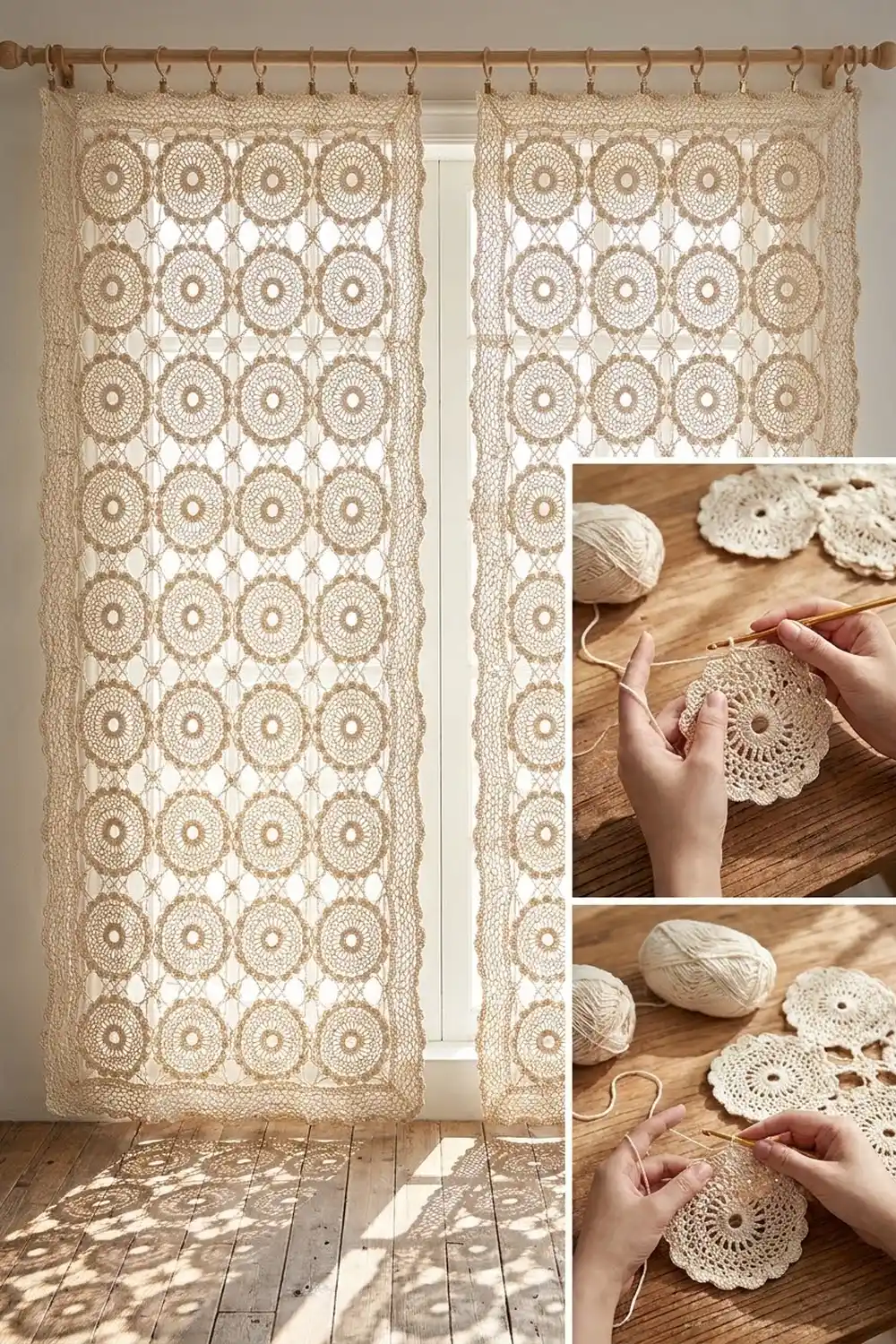
These airy curtain panels are made from round, scalloped mandala motifs joined with an open chain lattice. When the sun comes through, the motifs cast lacy shadows across the floor, which gives the room a warm, cottage feel.
The pair is worked in one natural cream (ecru) cotton. Each motif has a small open center, a ring of dc spokes, two rounds of chain mesh and a final edge of 12 rounded scallops. Between the motifs, crossed chains form small diamonds, and a 4-petal chain star fills each gap where four motifs meet.
The pattern uses US crochet terms. Each finished panel measures about 18.5 in (47.0 cm) wide and 73 in (185.4 cm) long, including the bottom shell edging. The pattern makes a matching pair.
Construction is modular. For each panel you crochet 16 motifs, lay them in a grid 2 wide and 8 tall, and join them with lattices and stars. Next you work a border that turns the scalloped outline into a straight edge. A shell edging finishes the bottom.
Finished Size and Construction
- Finished size (each panel): 18.5 in x 73 in (47.0 cm x 185.4 cm), including the bottom shells
- Skill level: Intermediate
- Terminology: US crochet terms
- Yarn weight: DK (light, 3) cotton
- Hook: 4.0 mm (US G-6)
- Number of pieces: 32 motifs (16 per panel), joined into 2 panels
- Layout: 2 motifs wide x 8 motifs tall per panel
- Motif size: 8 in (20.3 cm) across, measured from scallop tip to scallop tip
- Gap between motifs: 1 in (2.5 cm), filled by the chain lattice
- Size before border: 17 in x 71 in (43.2 cm x 180.3 cm)
- Border depth: 0.75 in (1.9 cm) on the top and sides, plus 0.5 in (1.3 cm) of shells at the bottom
Materials
Choose a smooth, mercerized or combed cotton in DK weight. Cotton keeps the scallops crisp and doesn’t stretch out of shape while the curtain hangs. Avoid fuzzy or splitty yarns, because the chain mesh needs clean stitch definition.
- Natural cream (ecru): 800 g, about 1,680 m (8 balls of 100 g / 210 m)
Tools:
- 4.0 mm (US G-6) crochet hook
- Tapestry needle
- Stitch markers
- Rust-proof pins and blocking mats (or towels on a clean carpet)
- Spray bottle
- Measuring tape
- 8 to 9 curtain clip rings per panel
The yarn quantity includes a margin of about 15 percent for gauge differences and swatching.
Abbreviations (US Terms)
- ch: chain
- sl st: slip stitch
- sc: single crochet
- dc: double crochet
- tr: treble crochet (yo twice)
- trtr: triple treble (yo 4 times, then work the loops off 2 at a time)
- sp: space
- sk: skip
- st(s): stitch(es)
- yo: yarn over
- RS: right side
Special stitch: dtr2tog (double treble 2 together). Yo 3 times, insert the hook in the first indicated st, yo and pull up a loop, then (yo, pull through 2 loops) 3 times. Repeat in the second indicated st. Yo and pull through all 3 loops on the hook. The two legs bridge two separate scallop tips.
Gauge and Checkpoints
Make one complete motif first and block it before you commit to the full set. That motif is your gauge swatch.
- After Round 1: 1.5 in (3.8 cm) across
- After Round 3: 3.5 in (8.9 cm) across
- After Round 5: 6 in (15.2 cm) across
- After Round 7, blocked: 8 in (20.3 cm) across, tip to tip
Border gauge: 19 sc = 4 in (10.2 cm), measured along the straight edge after blocking.
If your motif is larger than 8.25 in (21.0 cm), go down a hook size. If it is smaller than 7.75 in (19.7 cm), go up a hook size. An error of 0.25 in (0.6 cm) per motif adds up to 2 in (5.1 cm) over the 8 motifs of the panel’s length.
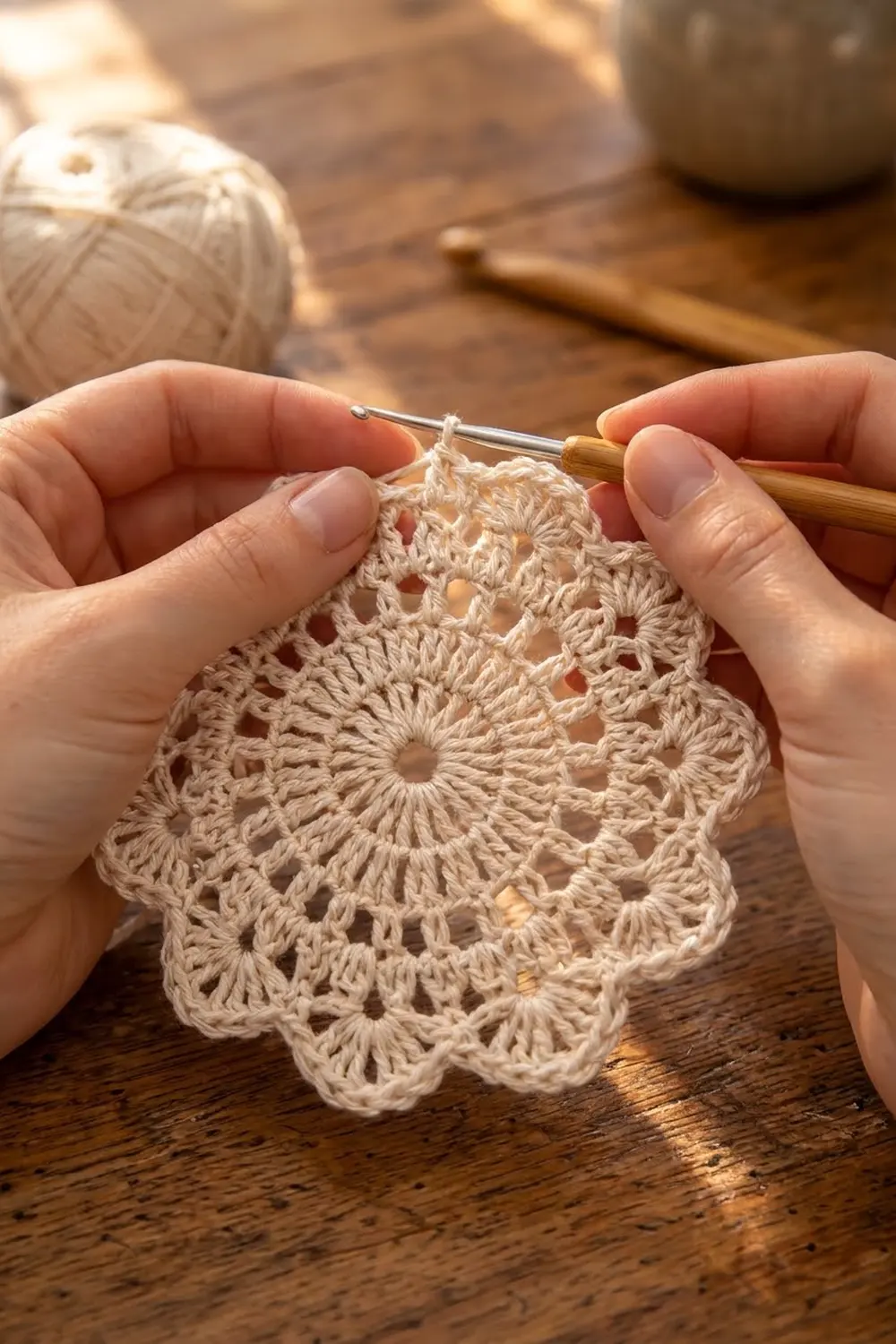
Motif (make 32)
Ch 6 and sl st to the first ch to form a ring.
Round 1: Ch 3 (counts as dc), work 23 dc in the ring, then sl st to the top of the beginning ch-3. (24 dc)
Round 2: Ch 4 (counts as dc + ch 1), (dc in next dc, ch 1) 23 times, then sl st to the 3rd ch of the beginning ch-4. (24 dc, 24 ch-1 sps)
Round 3: Sl st into the next ch-1 sp, ch 3 (counts as dc), dc in the same sp, ch 1, (2 dc in next ch-1 sp, ch 1) 23 times, then sl st to the top of the beginning ch-3. (48 dc, 24 ch-1 sps)
Round 4: Ch 3 (counts as dc), dc in next dc, ch 2, sk the ch-1 sp, (dc in each of next 2 dc, ch 2, sk ch-1 sp) 23 times, then sl st to the top of the beginning ch-3. (48 dc, 24 ch-2 sps) These paired dc make the spokes. The motif should now measure about 4.5 in (11.4 cm).
Round 5: Sl st into the next dc and the next ch-2 sp. Ch 1, sc in the same sp, ch 5, (sc in next ch-2 sp, ch 5) 23 times, then sl st to the first sc. (24 sc, 24 ch-5 loops)
Round 6: Sl st into the first 3 ch of the next loop. Ch 1, sc in the same loop, ch 6, (sc in next loop, ch 6) 23 times, then sl st to the first sc. (24 sc, 24 ch-6 loops) The motif should now measure about 7 in (17.8 cm).
Round 7 (scallops): Sl st into the next loop. Ch 1, sc in the same loop, 9 dc in the next loop, (sc in next loop, 9 dc in next loop) 11 times, then sl st to the first sc. Fasten off. (12 scallops; 12 sc + 108 dc = 120 sts)
The 5th dc of each scallop is the tip, and the sc between two scallops is the valley. Block every motif to 8 in (20.3 cm) before joining.
For joining, picture each motif as a clock face with one tip pointing straight up at 90°. The tips sit every 30°, and each side owns 3 of them:
- Top: 60°, 90° and 120°
- Left: 150°, 180° and 210°
- Bottom: 240°, 270° and 300°
- Right: 330°, 0° and 30°
Make All Pieces
- Panel 1: 16 motifs, ecru
- Panel 2: 16 motifs, ecru
- Total: 32 motifs
Layout for each panel (M = motif, + = chain star):
M | M
  +
M | M
  +
M | M
  +
M | M
  +
M | M
  +
M | M
  +
M | M
  +
M | M
Each panel has 8 side-by-side seams, 14 stacked seams and 7 stars.
Joining
Lay the blocked motifs RS up, leaving 1 in (2.5 cm) between neighboring tips. Each seam connects 3 tips on one motif to the 3 facing tips on its neighbor.
Side-by-side lattice (motif A on the left, motif B on the right):
- Pass 1: Join the yarn with a sc in A’s 30° tip. Ch 8, sc in B’s 180° tip, ch 8, sc in A’s 330° tip. Fasten off.
- Pass 2: Join the yarn with a sc in B’s 150° tip. Ch 4, sl st around the pass-1 chain where the two passes cross, ch 4, sc in A’s 0° tip. Ch 4, sl st around the pass-1 chain at the second crossing, ch 4, sc in B’s 210° tip. Fasten off.
The two zigzags cross twice and form a center diamond, with a triangle above and below it.
Stacked lattice (motif A on top, motif B below): Work it the same way. Pass 1 runs from A’s 240° tip to B’s 90° tip, then to A’s 300° tip. Pass 2 runs from B’s 120° tip to A’s 270° tip, then to B’s 60° tip, with a sl st around pass 1 at each crossing.
Chain star (where 4 motifs meet): In the center of the gap, ch 6 and sl st to form a ring. Then (ch 7, sl st in the facing valley sc of the next motif, ch 7, sl st in the ring) 4 times. Use these valleys:
- 315° on the top-left motif
- 225° on the top-right motif
- 135° on the bottom-right motif
- 45° on the bottom-left motif
Fasten off. (4 petal loops)
Tension: Keep the chains relaxed but not loose, so each lattice lies flat and holds the 1 in (2.5 cm) gap. If a seam ruffles, the chains are too long. If it pulls the scallops into points, they are too short. Change the chain count by 1 on both passes.
Size checkpoint: The joined panel should measure 17 in (43.2 cm) wide and 71 in (180.3 cm) long.
Border
Border gauge: 19 sc = 4 in (10.2 cm).
Round 1 (straightening): Join the yarn at the top-left motif’s 120° tip and work around the panel using the three units below.
- Motif unit: tr in the first tip, ch 7, sc in the middle tip, ch 7, tr in the third tip.
- Seam bridge: ch 10, then a dtr2tog with one leg in the nearest lattice tip of this motif and the other leg in the nearest lattice tip of the next motif (for example, A’s 30° and B’s 150° on the top edge), then ch 10.
- Corner bridge: ch 9, (trtr, ch 3, trtr) in the corner valley sc, then ch 9. The corner valleys are 135° on the top-left motif, 45° on the top-right, 315° on the bottom-right and 225° on the bottom-left.
Sl st to the first st to close the round.
Round 2 (conversion to sc): Ch 1, then work each unit as follows:
- Each motif unit: sc in tr, 8 sc in ch-7 sp, sc in sc, 8 sc in ch-7 sp, sc in tr. (19 sc)
- Each seam bridge: 11 sc in ch-10 sp, sc in dtr2tog, 11 sc in ch-10 sp. (23 sc)
- Each corner bridge: 10 sc in ch-9 sp, sc in trtr, 3 sc in ch-3 sp, sc in trtr, 10 sc in ch-9 sp. (25 sc) The middle sc of the 3-sc group is the corner st.
Sl st to the first sc.
Stitch counts between corner sts (each corner bridge gives 12 sc to each side it touches):
- Top and bottom: (2 x 19) + 23 + (2 x 12) = 85 sc
- Left and right: (8 x 19) + (7 x 23) + (2 x 12) = 152 + 161 + 24 = 337 sc
- Round total: (2 x 85) + (2 x 337) + 4 corner sts = 848 sc
Round 3: Ch 1, sc in each sc, working 3 sc in each corner st, then sl st to the first sc. (848 + 8 = 856 sc)
- Top and bottom: 87 sc between corners, or 89 sc including both corners
- Long sides: 339 sc between corners, or 341 sc including both corners
Fasten off.
Round 4 (bottom edge only): With RS facing, join the yarn with a sc in the bottom-right corner st. (Sk 3 sc, 7 dc in next sc, sk 3 sc, sc in next sc) 11 times, ending in the bottom-left corner st. Fasten off. (11 shells)
Why the math works:
- Each motif unit spans 4 in (10.2 cm) and gets 19 sc, which is exactly the border gauge.
- Each seam bridge spans about 5 in (12.7 cm) and gets 23 sc.
- Each corner bridge adds about 2.5 in (6.4 cm) in each direction.
- The 85 sc across the top measure about 17.9 in (45.5 cm). The corner sts and Round 3 bring the width to 18.5 in (47.0 cm) after blocking.
- The bottom edge has 89 sts, and 89 = (8 x 11) + 1, so the 8-st shell repeat plus 1 fits exactly.
Final Blocking
- Soak each panel in cool water for 15 minutes, then press out the water gently. Don’t wring it.
- Roll the panel in towels to remove extra moisture.
- Lay it flat and pin the border to 18.5 in (47.0 cm) wide and 72.5 in (184.2 cm) long, not counting the shells.
- Pin each motif round so it measures 8 in (20.3 cm) across.
- Pin each lattice diamond open and each star petal into a neat loop.
- Pin the shells into curves, which adds 0.5 in (1.3 cm).
- Let the panel dry completely before unpinning, usually 24 to 48 hours.
Final Quality-Control Checklist
- 32 motifs, each with 12 scallops and 120 sts in Round 7
- Every motif measures 8 in (20.3 cm) after blocking
- 22 lattices and 7 stars in each panel
- Border Round 3 has 856 sc, with 89 sc across the top and the bottom
- 11 shells along each bottom edge
- Each panel measures 18.5 in x 73 in (47.0 cm x 185.4 cm)
- The two panels match in length within 0.5 in (1.3 cm)
- All ends are woven securely along the chains
Troubleshooting
- Motif cups: The Round 6 chains are too tight. Add 1 chain per loop.
- Motif ruffles: Work 1 chain fewer per loop in Round 6.
- Scallops lean: Work all 9 dc into the same loop.
- Lattice sags: Shorten both passes by 1 chain.
- Border waves: Work 1 sc fewer in each seam-bridge space.
- Border pulls in: Work 1 sc more in each seam-bridge space.
- Shells don’t fit: Recount the bottom edge. It needs 89 sts, including both corners.
Care
Hand wash the panels in cool water with a mild detergent and dry them flat. Re-block when needed to keep the motifs round and the lattice open.
Final Notes
Here is how the measurements build: 8 in (20.3 cm) motifs plus 1 in (2.5 cm) gaps make a 17 in x 71 in (43.2 cm x 180.3 cm) panel. The border adds 0.75 in (1.9 cm) per side and the shells add 0.5 in (1.3 cm), for a finished panel of 18.5 in x 73 in (47.0 cm x 185.4 cm). If your first motif is checked and correct, the rest follows.
Happy crocheting!