

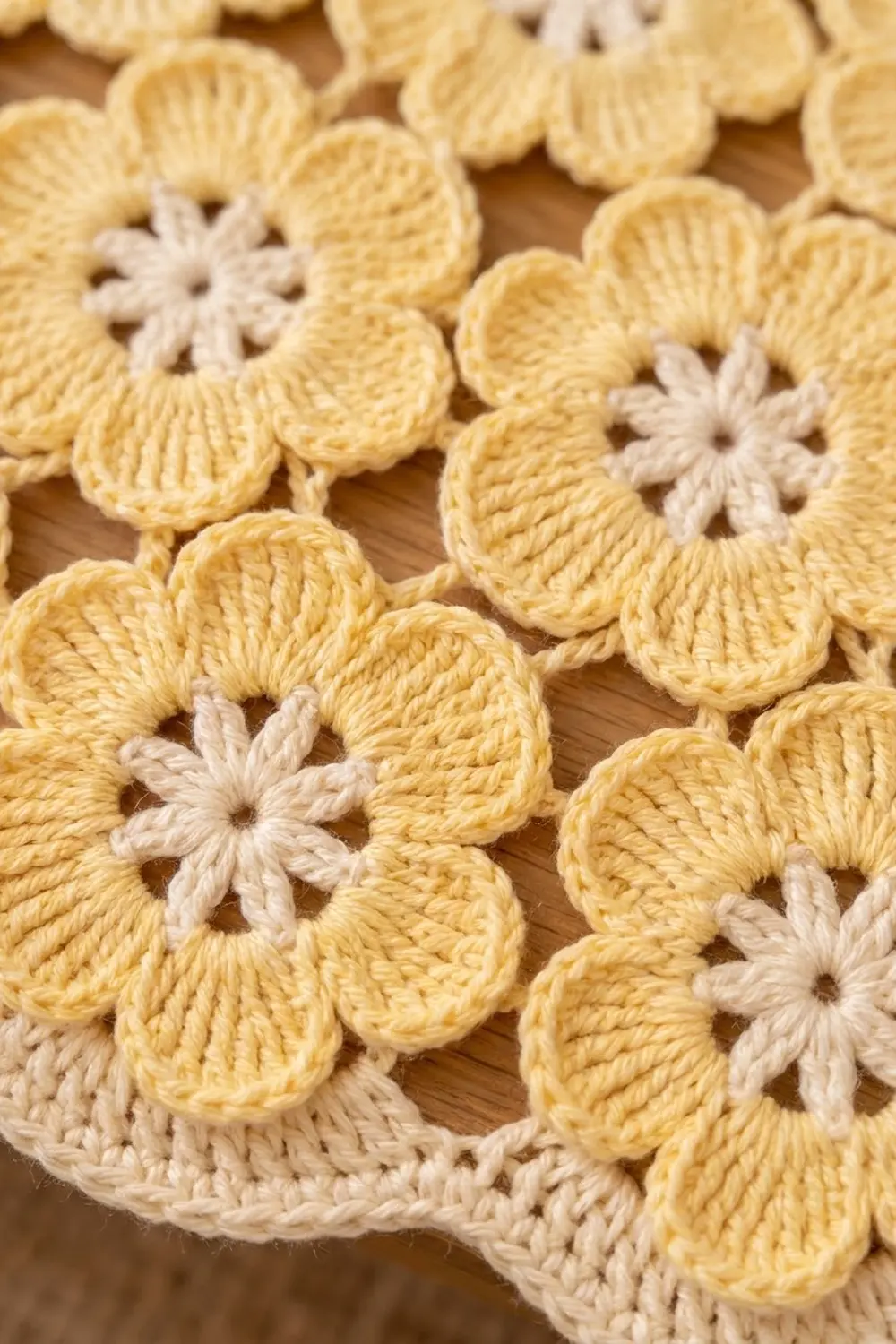
The Buttercup Meadow Bedspread is made from one simple six-petal flower repeated across a whole bed. Each flower has soft butter-yellow petals around a cream star center, and small open spaces between the star’s spokes give the middle a light, airy look.
The palette has just two colors: butter yellow for the petals and cream for the centers. The flowers are joined only at their petal tips, so the finished coverlet looks like an open lace field of blossoms, with a scalloped edge made by the flowers themselves.
This pattern uses US crochet terms. The finished bedspread measures 67.5 in (171.5 cm) wide by 82.4 in (209.3 cm) long, and each blocked flower is 4.5 in (11.4 cm) from petal tip to opposite petal tip.
You’ll make 305 identical flowers, sew them tip to tip in offset rows, then finish the outer edge with one firming round of slip stitches. That round adds no width, so the scalloped flower outline stays as it is.
Finished Size and Construction
- Finished size: 67.5 x 82.4 in (171.5 x 209.3 cm)
- Skill level: Easy-intermediate
- Terminology: US crochet terms
- Yarn weight: Worsted (#4), cotton or cotton blend
- Hook: US H-8 (5.0 mm); US I-9 (5.5 mm) for the edge round
- Number of pieces: 305 flower motifs
- Layout: 21 offset rows, alternating 15 and 14 flowers
- Piece size: 4.5 in (11.4 cm) tip to tip
- Size before border: 67.5 x 82.4 in (171.5 x 209.3 cm)
- Border depth: 0 in (0 cm); the slip-stitch edge round only firms the edge
Materials
Choose a smooth worsted cotton or cotton-acrylic blend with roughly 190 m per 100 g. Cotton gives the petals crisp edges and good stitch definition.
- Butter yellow (petals, joining, edge): 1,500 g / about 2,850 m (fifteen 100 g balls)
- Cream (centers): 400 g / about 760 m (four 100 g balls)
Tools:
- US H-8 (5.0 mm) crochet hook
- US I-9 (5.5 mm) crochet hook
- Tapestry needle
- Scissors
- Locking stitch markers
- Blocking mats, rust-proof pins, and a spray bottle or steamer
- Measuring tape
These quantities include a margin of about 10% for gauge differences, weaving in ends, and a test motif.
Abbreviations (US Terms)
- ch – chain
- sl st – slip stitch
- sc – single crochet
- hdc – half double crochet
- dc – double crochet
- tr – treble crochet
- sp – space
- sk – skip
- st(s) – stitch(es)
- RS / WS – right side / wrong side
Special stitch: tr2cl (treble 2-cluster). *Yarn over twice, insert hook in the stitch, yarn over and pull up a loop, [yarn over and pull through 2 loops] twice; repeat from * once more in the same stitch; yarn over and pull through all 3 loops on hook.
Beginning cluster: Ch 3, then work the first half of a tr in the same stitch (stopping with 2 loops on hook), yarn over and pull through both loops.
Gauge and Checkpoints
Make one complete flower and block it before you commit to all 305. Measure flat, without stretching.
- After Rnd 2 (cream star): 2 in (5.1 cm) across
- After Rnd 3 (yellow ring): 2.5 in (6.4 cm) across
- After Rnd 5 (petals): 4 in (10.2 cm) tip to tip
- After Rnd 6 (petal edge), blocked: 4.5 in (11.4 cm) tip to tip
As a rough guide, 16 sc = 4 in (10.2 cm) with the 5.0 mm hook, but the motif checkpoint matters most.
If your flower is larger than 4.5 in (11.4 cm), go down one hook size. If it’s smaller, go up one size. A difference of just 0.25 in (0.6 cm) per flower becomes 3.75 in (9.5 cm) across a row of 15, so this check is worth doing.
Flower Motif (Make 305)
Center (Cream)
Rnd 1: Make a magic ring. Ch 1, 8 sc in ring. Join with a sl st to the first sc. Pull the ring snug, but leave a small open eye in the middle. (8 sc)
Rnd 2: Beginning cluster in the same st as the join, ch 2, tr2cl in next sc, ch 2; repeat from * 6 more times. Join with a sl st to the top of the beginning cluster. (8 clusters, 8 ch-2 sps)
These eight clusters are the cream star spokes. The ch-2 spaces leave the small open windows between them. Fasten off cream.
Ring (Butter Yellow)
Rnd 3: With RS facing, join yellow in any ch-2 sp. Ch 1, 3 sc in the same sp, then 3 sc in each of the remaining 7 ch-2 sps. Join with a sl st to the first sc. (24 sc: 3 sc in each of 8 sps)
Don’t work into the tops of the clusters. The sc arcs sit over the spaces and leave the spokes standing out.
Petals (Butter Yellow)
Rnd 4: Ch 1, sc in the same st as the join, ch 5, sk 3 sc, sc in next sc, ch 5, sk 3 sc; repeat from * 4 more times. Join with a sl st to the first sc. (6 sc, 6 ch-5 loops)
Check the math: 6 repeats x 4 sts used (1 sc + 3 skipped) = 24, so all of Rnd 3 is accounted for.
Rnd 5: In the next ch-5 loop work (hdc, 2 dc, 5 tr, 2 dc, hdc), sl st in next sc; repeat from * 5 more times, placing the final sl st in the first sc of Rnd 4. (6 petals of 11 sts each = 66 sts, plus 6 sl sts)
Rnd 6 (petal edge): Ch 1. Sc in hdc, sc in each of next 2 dc, 2 sc in each of next 5 tr, sc in each of next 2 dc, sc in hdc, sl st in the sl st between petals; repeat from * 5 more times. Join with a sl st to the first sc. Fasten off, leaving a 12 in (30.5 cm) tail for joining. (16 sc per petal = 96 sc, plus 6 sl sts; 102 sts total)
Each petal edge has 16 sc. Count them 1 to 16. The tip of the petal is sc 8 and 9, the two sc worked into the center tr. Sc 1–7 and 10–16 are the petal’s two sides. With the increases at the tip and plain sc on the sides, each petal comes out round and fan-shaped.
Weave in the cream tails. Keep the yellow tail for joining.
Make All Pieces
- Cream: 305 centers (Rnds 1–2)
- Butter yellow: 305 ring-and-petal sections (Rnds 3–6)
- Total: 305 flowers, all identical
Steam or wet block every flower to 4.5 in (11.4 cm) before joining. Pin each flower so it has one petal pointing straight right and one straight left. Its other four petals will then point toward the diagonal neighbors.
Layout grid (L = long row of 15, S = short row of 14, set in by half a flower):
Row 1  (L): O O O O O O O O O O O O O O O
Row 2  (S):  O O O O O O O O O O O O O O
Row 3  (L): O O O O O O O O O O O O O O O
...
Row 20 (S):  O O O O O O O O O O O O O O
Row 21 (L): O O O O O O O O O O O O O O O
That’s 11 long rows x 15 = 165 flowers and 10 short rows x 14 = 140 flowers, for 305 total.
Joining
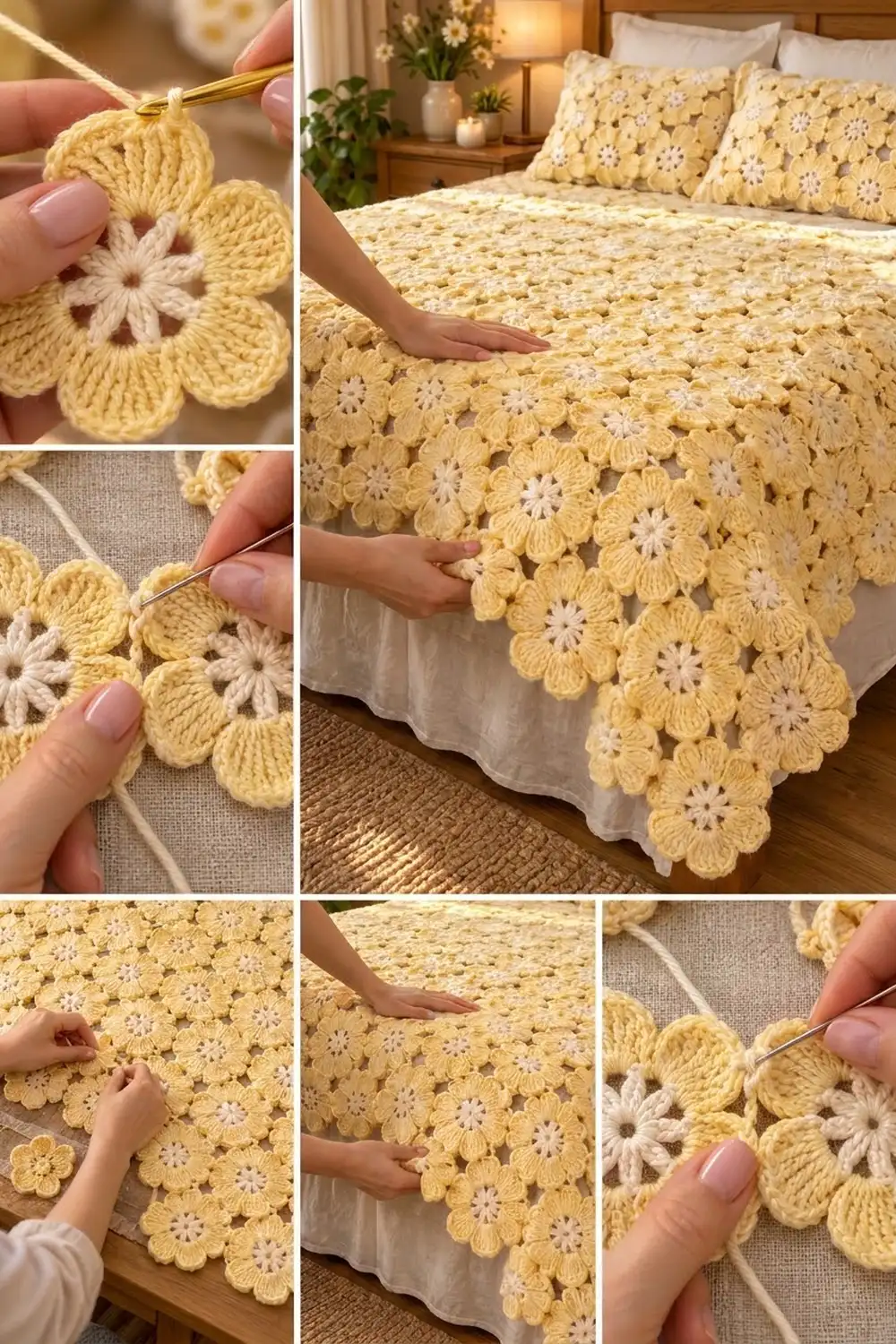
Method: Whipstitch petal tip to petal tip with the yellow tail and a tapestry needle.
Stitch-to-stitch logic: Put two neighboring flowers side by side with RS up, tips touching. Whipstitch sc 8 and sc 9 of one petal to sc 9 and sc 8 of the facing petal through the back loops. Make 3 passes and secure the yarn on the WS. Only those 2 sts per petal are joined. Sc 1–7 and 10–16 stay free, so the open lace look stays intact.
Each flower in the middle of the bedspread is joined at all 6 petal tips. Each joined petal points to a neighbor: left, right, upper-left, upper-right, lower-left, and lower-right.
Order: Join each row into a strip first, tip to tip from left to right. Then join each short row to the long rows above and below it. Each short-row flower joins two flowers above and two below.
Tension: Pull each pass just until the tips touch. If you pull too hard, the flowers pucker. If you leave it too loose, the tips separate and the layout shifts.
Size checkpoints:
– One long row: 15 x 4.5 in = 67.5 in (171.5 cm)
– One short row: 14 x 4.5 in = 63 in (160.0 cm), set in 2.25 in (5.7 cm) on each side
– Each added row adds 3.897 in (9.9 cm) to the length, because offset flowers nest diagonally (4.5 in x 0.866)
– Five joined rows: 4.5 + 4 x 3.897 = 20.1 in (51.1 cm)
– All 21 rows: 4.5 + 20 x 3.897 = 82.4 in (209.3 cm)
Border (Edge-Firming Round)
The scalloped flower outline is the border, just as in the finished design. This one round of slip stitches keeps the outer petals from stretching on the bed and adds no width.
Border gauge: Use the 5.5 mm hook so the sl sts lie flat and match the sc edge. Check that a 4.5 in (11.4 cm) flower still measures 4.5 in (11.4 cm) after its edge is worked.
How the round works: With RS facing and yellow, sl st loosely through both loops of every Rnd 6 st that sits on the outer edge, including the sl st between petals. At each joined tip, don’t work into the joined sc 8–9. Instead, ch 1 across the seam to the next flower.
Going around the outside of an edge flower, from the seam where you enter to the seam where you leave, you work:
7 sts (outer side of the entry petal) + 1 valley sl st + 17 sts for each fully free petal (16 sc + 1 valley) + 7 sts (outer side of the exit petal) = 15 + 17 x (free petals)
- Top/bottom middle flower (2 free petals): 15 + 34 = 49 sl sts
- Corner flower (4 free petals): 15 + 68 = 83 sl sts
- Long-row side flower (3 free petals): 15 + 51 = 66 sl sts
- Short-row side flower (1 free petal): 15 + 17 = 32 sl sts
Rnd 1: Join yellow at the seam between Row 1 flowers 1 and 2. Work to the right along the top edge, then down the right side, along the bottom edge, and up the left side, finishing with the top-left corner flower. The corner flowers are counted with the top and bottom edges.
- Top edge (Row 1, 15 flowers): 2 corners x 83 + 13 x 49 = 803 sl sts, plus 14 ch-1 bridges
- Right side (Rows 2–20, 19 flowers): 9 long-row flowers x 66 + 10 short-row flowers x 32 = 914 sl sts, plus 20 ch-1 bridges
- Bottom edge (Row 21, 15 flowers): 803 sl sts, plus 14 ch-1 bridges
- Left side (Rows 2–20): 914 sl sts, plus 20 ch-1 bridges
Join to the first sl st and fasten off. Total: 3,434 sl sts and 68 ch-1 bridges.
Why the math works: There are 68 flowers on the edge (15 + 15 + 19 + 19), and they form a closed ring, so there are exactly 68 seams to bridge. Every stitch you work already exists in Rnd 6 and no stitches are added, so the edge keeps each flower’s 4.5 in (11.4 cm) size. The finished bedspread stays 67.5 x 82.4 in (171.5 x 209.3 cm).
Final Blocking
- Lay the bedspread flat on a clean floor or bed covered with towels, RS up.
- Lightly mist it with water, or hover a steamer about 1 in (2.5 cm) above the fabric. Never press an iron on the stitches.
- Pin the four corner flowers so the width is 67.5 in (171.5 cm) and the length is 82.4 in (209.3 cm).
- Pin along each edge, one pin per free petal tip, keeping the petals round.
- Run your fingers through the middle so every joined tip lines up and every petal lies flat.
- Let it dry completely before you unpin it, usually 24 hours.
Final Quality-Control Checklist
- All 305 flowers measure 4.5 in (11.4 cm) tip to tip.
- Every center has 8 cream spokes with open windows between them.
- Every petal has 16 sc, with the tip at sc 8–9.
- Rows alternate 15 and 14 flowers, with short rows set in by 2.25 in (5.7 cm).
- Every inside flower is joined at all 6 tips.
- No seams are puckered and no tips have separated.
- The edge round has 3,434 sl sts and 68 bridges, and it lies flat.
- The bedspread measures 67.5 x 82.4 in (171.5 x 209.3 cm).
- All ends are woven in on the WS.
Troubleshooting
Center cups upward: Your Rnd 2 clusters are too tight. Loosen them or use ch 3 between clusters instead of ch 2, then make sure Rnd 3 still has 24 sc.
Petals ruffle: Rnd 6 is too loose, or the tr are too tall. Use a hook 0.5 mm smaller for Rnd 6 only.
Petals curl inward: Rnd 6 is too tight. Work the 2-sc increases more loosely, or go up 0.5 mm.
Open windows close up: You worked Rnd 3 into the cluster tops. Work only into the ch-2 sps.
Rows don’t line up: Some flowers are a different size. Re-block the stray flowers to 4.5 in (11.4 cm).
Edge waves: The sl sts are too loose. Rework that section with the 5.0 mm hook.
Edge pulls in: The sl sts are too tight. Use the 5.5 mm hook and lift each loop a little.
Care
Machine wash cold on a gentle cycle in a large mesh laundry bag, or hand wash. Lay flat to dry and reshape the petals while damp.
Final Notes
The whole bedspread rests on one measurement chain. A 2.5 in (6.4 cm) center grows into a 4.5 in (11.4 cm) flower. Fifteen flowers make a 67.5 in (171.5 cm) row. Each offset row adds 3.897 in (9.9 cm), so 21 rows come to 82.4 in (209.3 cm). The slip-stitch edge finishes it without changing the size. Check the first flower carefully and the rest of the bedspread will follow.
Happy crocheting!