

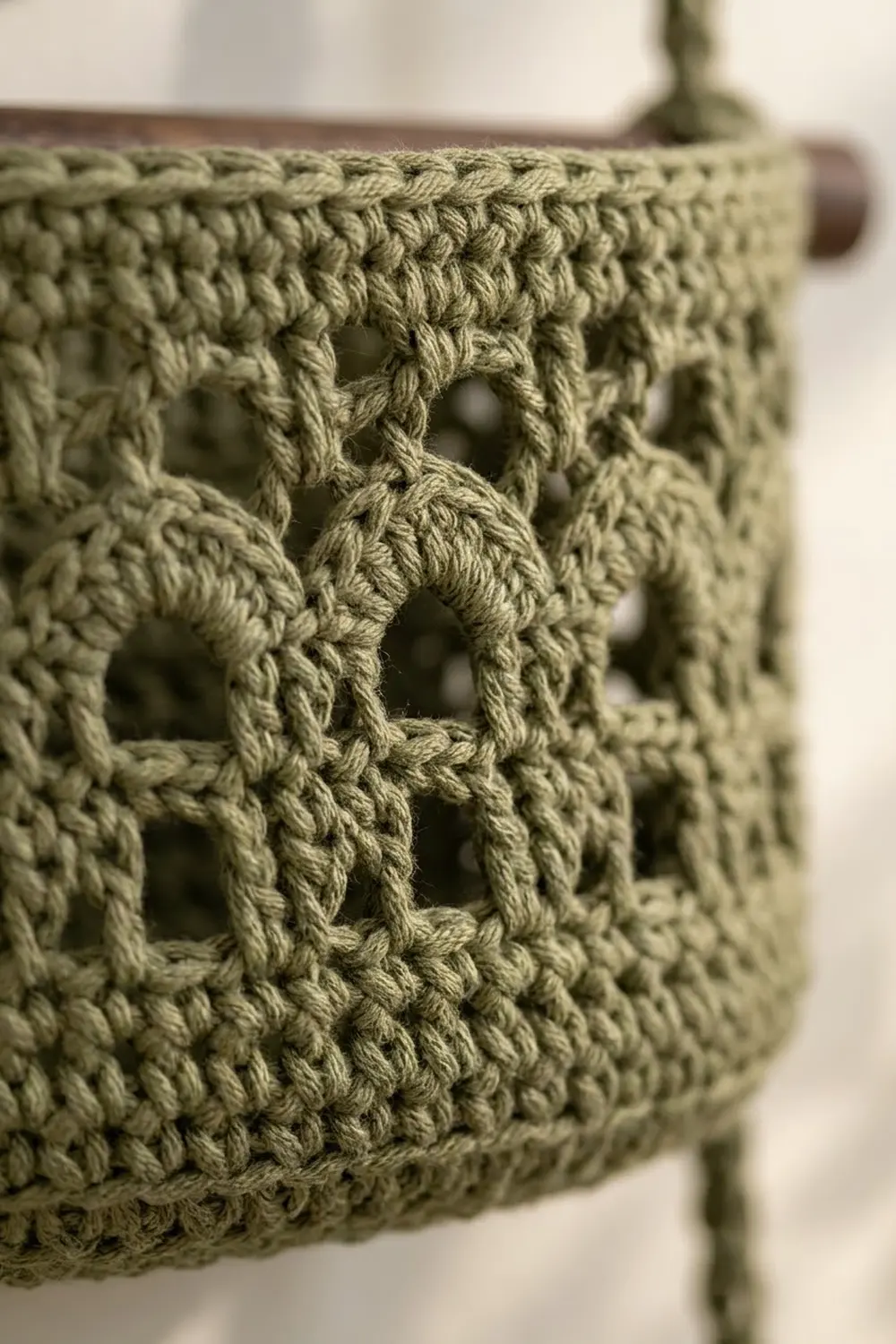
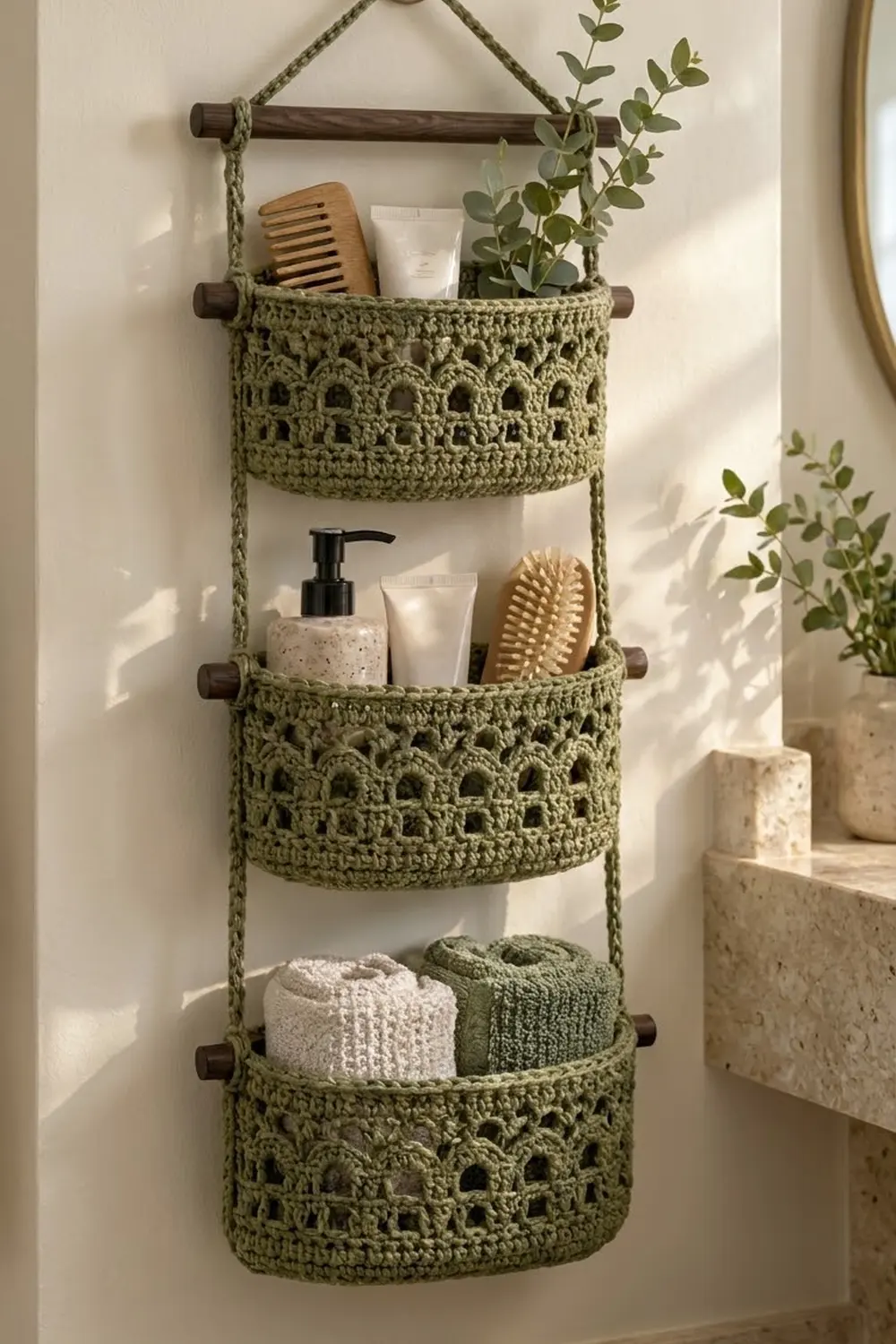
The Olive Arches Hanging Basket Organizer is three oval baskets stacked one above the other and hung from wooden dowels. Each basket has a sturdy solid base, a band of small square windows, and two staggered tiers of rounded arches. A firm rim with a corded edge finishes the top. It suits a bathroom, an entryway or a nursery wall.
The sample uses one olive-green worsted-weight cotton, which keeps the lace pattern easy to see and the baskets firm enough to hold bottles and towels. Four dark wooden dowels and three crocheted cords make the frame. All instructions use US crochet terms.
Each basket is about 10 in (25.4 cm) wide, 4.25 in (10.8 cm) deep and 4.5 in (11.4 cm) tall. Hung, the organizer is about 22 in (55.9 cm) from the top dowel to the bottom of the lowest basket, or about 27 in (68.6 cm) including the hanging loop.
You work each basket in joined rounds. You start with an oval base on a foundation chain, then turn up the wall with a back-loop round. Next come the mesh round and the arch tiers, then a rim with a dowel slot at each short end. Finally, you make three slip-stitch cords and tie everything to the dowels.
Finished Size and Construction
- Finished size (assembled): 12 in (30.5 cm) wide at the dowels × about 27 in (68.6 cm) tall including the hanging loop
- Skill level: Intermediate
- Terminology: US crochet terms
- Yarn weight: Worsted (#4), cotton
- Hook: 5.0 mm (H-8)
- Number of pieces: 3 baskets + 3 cords (2 side cords, 1 hanging cord), plus 4 dowels
- Layout: 1 column × 3 tiers
- Piece size (one basket): 10 in × 4.25 in × 4.5 in (25.4 × 10.8 × 11.4 cm)
- Base size before walls: 10 in × 4.25 in (25.4 × 10.8 cm)
- Rim (“border”) depth: about 1 in (2.5 cm), Rnds 21–25
Materials
Yarn: Use a smooth worsted-weight cotton or cotton blend, about 170 m per 100 g. Cotton gives the arches crisp edges and stops the baskets from sagging. Avoid fuzzy or very stretchy yarns, because they blur the lace and let the baskets droop under weight.
- Olive green: 200 g (340 m / 372 yd)
- Each basket uses about 55 g (94 m). Three baskets use about 165 g (281 m).
- The cords use about 10 g (17 m).
- Total used is about 175 g (298 m).
The quantities above include a margin of about 25 g (42 m) for gauge swatches and tails.
Tools:
– 5.0 mm (H-8) crochet hook
– 4 wooden dowels, 12 in (30.5 cm) long and 3/8 in (1.0 cm) in diameter, stained dark walnut if you like
– 4 locking stitch markers
– Tapestry needle
– Scissors
– Measuring tape
– Wall hook rated for at least 5 lb (2.3 kg)
Abbreviations (US Terms)
- ch – chain
- sl st – slip stitch
- sc – single crochet
- hdc – half double crochet
- dc – double crochet
- BLO – back loop only
- sk – skip
- sp – space
- st(s) – stitch(es)
- rnd(s) – round(s)
- rev sc – reverse single crochet (crab stitch)
Special stitch: rev sc. Do not turn your work. Insert the hook into the next stitch to the right (left-handers work to the left). Yarn over, pull up a loop, then yarn over and pull through both loops. This makes the twisted, corded rim.
Slip-stitch cord. Chain to the length given. Then sl st into the back bump of each chain back along the cord. You get a firm, round cord that does not stretch.
Gauge and Checkpoints
Gauge: 16 sc and 17 rnds = 4 in (10.2 cm) in sc worked in rounds.
Make one complete basket before you start the others. It is your real gauge test, and the other pieces have to match it.
Checkpoints:
– After Rnd 1: the base is about 6.5 in (16.5 cm) long.
– After Rnd 5: the base is about 8.25 in × 2.25 in (21.0 × 5.7 cm).
– After Rnd 9: the base is 10 in × 4.25 in (25.4 × 10.8 cm), with 98 sts.
– After Rnd 14: the wall is about 1.25 in (3.2 cm) tall.
– After Rnd 20: the wall is about 3.25 in (8.3 cm) tall.
– After Rnd 25: the wall is 4.5 in (11.4 cm) tall.
Too big? If the base after Rnd 9 is more than 0.25 in (0.6 cm) too long, change to a 4.5 mm hook.
Too small? If it is more than 0.25 in (0.6 cm) too short, change to a 5.5 mm hook.
Base cupping or rippling? If the base cups, your tension is tight. If it ripples, your tension is loose. Adjust your hook size rather than the stitch counts, because the lace repeat needs exactly 98 sts.
Basket (Make 3)
Oval Base
Join every round with a sl st to the first st. The beginning ch 1 does not count as a stitch.
Rnd 1: Ch 25. Sc in 2nd ch from hook and in next 22 ch, then 3 sc in last ch. Working along the opposite side of the foundation chain, sc in next 22 ch, then 2 sc in the last ch (the same ch as the first sc). Join. (50 sts)
The 3 sc at each end are the “end stitches.” Every increase round puts its increases only into these curved ends.
Rnd 2: Ch 1. Sc in next 23 sts, 2 sc in each of next 3 sts, sc in next 21 sts, 2 sc in each of last 3 sts. Join. (56 sts)
From Rnd 3 on, each round adds 3 increases at each end, for a total of 6 per round. Shift the increases as written so the ends stay round and do not form points.
Rnd 3: Ch 1. Sc in next 23 sts, (sc, 2 sc in next st) 3 times, sc in next 22 sts, (sc, 2 sc in next st) 3 times, sc in last st. Join. (62 sts)
Rnd 4: Ch 1. Sc in next 24 sts, (2 sc, 2 sc in next st) 3 times, sc in next 22 sts, (2 sc, 2 sc in next st) 3 times, sc in last 7 sts. Join. (68 sts)
Rnd 5: Ch 1. Sc in next 24 sts, (3 sc, 2 sc in next st) 3 times, sc in next 22 sts, (3 sc, 2 sc in next st) 3 times, sc in last 10 sts. Join. (74 sts)
Rnd 6: Ch 1. Sc in next 25 sts, (4 sc, 2 sc in next st) 3 times, sc in next 22 sts, (4 sc, 2 sc in next st) 3 times, sc in last 12 sts. Join. (80 sts)
Rnd 7: Ch 1. Sc in next 25 sts, (5 sc, 2 sc in next st) 3 times, sc in next 22 sts, (5 sc, 2 sc in next st) 3 times, sc in last 15 sts. Join. (86 sts)
Rnd 8: Ch 1. Sc in next 26 sts, (6 sc, 2 sc in next st) 3 times, sc in next 22 sts, (6 sc, 2 sc in next st) 3 times, sc in last 17 sts. Join. (92 sts)
Rnd 9: Ch 1. Sc in next 26 sts, (7 sc, 2 sc in next st) 3 times, sc in next 22 sts, (7 sc, 2 sc in next st) 3 times, sc in last 20 sts. Join. (98 sts)
Check the base: it should lie flat and measure 10 in × 4.25 in (25.4 × 10.8 cm).
Solid Lower Wall
Rnd 10: Ch 1. Sc BLO in each st around. Join. (98 sts)
The unused front loops make the crisp bottom edge.
Rnds 11–14: Ch 1. Sc in each st around. Join. (98 sts)
Mesh Window Round
Rnd 15: Ch 4 (counts as dc + ch 1). Sk next st. Dc in next st, ch 1, sk next st; repeat from * 47 more times. Join to 3rd ch of the beginning ch-4. (49 dc + 49 ch-1 sps = 98 sts)
Rnd 16: Ch 1. Sc in each dc and in each ch-1 sp around. Join. (49 + 49 = 98 sc)
Arch Tiers
The arch repeat is 7 sts, and 98 ÷ 7 = 14 arches around the basket.
Rnd 17: Ch 1. Sc in next 2 sts, ch 5, sk next 5 sts; repeat from * 13 more times. Join. (28 sc + 14 ch-5 loops)
Rnd 18: Ch 1. Sc in next 2 sc, 5 hdc in next ch-5 sp; repeat from * 13 more times. Join. (14 × 7 = 98 sts)
Working the hdc around the chain, not into the skipped stitches, leaves an open window under each rounded arch.
Rnd 19 (offset tier): Sl st in next 2 sts (the 2nd sc and the 1st hdc). Ch 1. Sc in next 2 hdc (the 2nd and 3rd hdc of the arch), ch 5, sk next 5 sts (the 4th and 5th hdc, 2 sc, and the 1st hdc of the next arch); repeat from * 13 more times. Join to first sc. (28 sc + 14 ch-5 loops)
The new sc pairs sit over the tops of the arches below, so the second tier is staggered like brickwork.
Rnd 20: Ch 1. Sc in next 2 sc, 5 hdc in next ch-5 sp; repeat from * 13 more times. Join. (98 sts)
Make All Pieces
- Baskets: 3, all from olive green, about 55 g (94 m) each.
- Side cords: 2, each 36 in (91.4 cm) long.
- Hanging cord: 1, 16 in (40.6 cm) long.
To make each cord, chain until the chain measures the given length (about 4.5 ch per inch, or per 2.5 cm). Then work a sl st into the back bump of each chain. Leave 6 in (15.2 cm) tails at both ends.
Layout grid (front view):
         /\          hanging cord
  |=====[ ]=====|    top dowel
  |             |    4 in (10.2 cm)
  |==[Basket 1]==|   dowel 1
  |             |    7 in (17.8 cm)
  |==[Basket 2]==|   dowel 2
  |             |    7 in (17.8 cm)
  |==[Basket 3]==|   dowel 3
  ^ side cord   ^ side cord
Joining
The tiers are joined with dowels and cords, not by sewing stitch to stitch. The stitch logic is all in the slots: each basket has one slot at the center of each short end, exactly opposite each other. The dowel therefore passes straight through, and the basket hangs level.
- Insert the dowels. Slide one dowel through both slots of each basket, so it runs inside the basket along its length. Center it so 1 in (2.5 cm) sticks out on each side.
- Tie on the side cords. Start one side cord at the left end of the top dowel. Tie a clove hitch, leaving the 6 in (15.2 cm) tail.
- Place the first basket. Measure 4 in (10.2 cm) down the cord and clove-hitch it around the left end of the Basket 1 dowel.
- Place the lower baskets. Measure 7 in (17.8 cm) down and hitch around the Basket 2 dowel. Measure another 7 in (17.8 cm) and hitch around the Basket 3 dowel.
- Repeat on the right side. Tie the second side cord to the right ends of all four dowels in the same way.
- Add the hanging cord. Tie each end of the hanging cord to the top dowel, just outside the side cords.
- Secure the tails. Wrap each tail 3 times around its knot, thread it onto the tapestry needle, and weave it back through the cord.
Tension advice: Snug each hitch firmly, but do not crush the cord. Before you tighten the knots for good, hang the organizer and check that every dowel is level. Slide hitches up or down to adjust.
Size checkpoint: The space from the center of one dowel to the center of the next is 7 in (17.8 cm). From the top dowel to the bottom of Basket 3 is about 22 in (55.9 cm).
Border (Rim, Rnds 21–25)
Border gauge: Same as the body, 16 sc = 4 in (10.2 cm).
Flatten the basket so the long sides lie front and back. Put a marker in the stitch at each short-end fold. Each half of the basket, counted from one marker to the next and including its starting marker stitch, has 49 sts.
If the round join is within 2 sts of a marker, sl st forward 4 sts and start Rnd 22 there. This moves where the round starts but does not change any counts.
Rnd 21: Ch 1. Sc in each st around. Join. (98 sc; 49 per half)
Rnd 22 (dowel slots): Ch 2 (does not count). Dc in each st to 1 st before the marker, ch 3, sk 3 sts (the st before the marker, the marker st, and the st after it); repeat from * once more, then dc in each remaining st. Join to first dc. (92 dc + 2 ch-3 sps; 46 dc per half)
Each slot is about 0.75 in (1.9 cm) wide and fits a 3/8 in (1.0 cm) dowel.
Rnd 23: Ch 1. Sc in each dc, and work 3 sc in each ch-3 sp. Join. (92 + 6 = 98 sc; 49 per half)
Rnd 24: Ch 1. Sc in each st around. Join. (98 sc)
Rnd 25: Ch 1. Rev sc in each st around. Join and fasten off. (98 rev sc; 49 per half)
Why the math works:
– 98 = 14 × 7, so the arch repeat closes evenly, and each half holds exactly 7 arches.
– 98 = 2 × 49, so the slots sit exactly opposite each other.
– Each slot skips 3 sts and then gets back exactly 3 sc, so the count stays at 98 above and below the slots.
Final Blocking
- Weave in all ends on the inside of each basket.
- Spray each basket until it is damp, but not dripping.
- Stuff each basket firmly with a rolled towel to make a straight-sided oval about 10 in × 4.25 in (25.4 × 10.8 cm).
- With your fingers, open each arch window and each mesh square and smooth the arch tops into even curves.
- Pinch the bottom ridge from Rnd 10 so it is crisp all the way around.
- Let the baskets dry completely, for 12–24 hours, with the stuffing still in.
- Block the cords by pinning them straight under light tension, then spraying them and letting them dry.
- Assemble the organizer only when everything is fully dry.
Final Quality-Control Checklist
- [ ] All 3 bases measure 10 in × 4.25 in (25.4 × 10.8 cm) and lie flat.
- [ ] Every basket has 14 arches in each tier and 49 mesh windows.
- [ ] The second arch tier is offset over the first.
- [ ] The slots sit exactly opposite each other at the short ends.
- [ ] Every basket wall is 4.5 in (11.4 cm) tall.
- [ ] The dowels stick out 1 in (2.5 cm) on each side.
- [ ] The dowels are spaced 7 in (17.8 cm) apart, and the top gap is 4 in (10.2 cm).
- [ ] All dowels hang level.
- [ ] All ends are woven in and hidden.
Troubleshooting
Base curls up like a bowl. Your tension is tight at the increases. Change up a hook size, or spread the increases more evenly as written.
Base ruffles. Your tension is loose. Change down a hook size.
Wrong count after Rnd 17 or 19. Make sure each ch-5 skips exactly 5 sts. Count your sc pairs: you should have 14.
Arches look flat. Use exactly 5 hdc in each loop, and work them around the chain rather than into it.
Dowel won’t fit. Make the ch-3 at the slots a little looser, or use a 3/8 in (1.0 cm) dowel rather than a thicker one.
Basket tilts forward. The slots are off-center. Recount to the markers, or move the hitches on the cords.
Cords stretch. Use the slip-stitch cord rather than a plain chain, and block the cords under tension.
Care
Hand wash in cool water with mild soap, press out the water in a towel, and dry the baskets flat with something stuffed inside to keep their shape. Remove the dowels before washing.
Final Notes
Everything in this organizer follows from one measurement: a gauge of 16 sc = 4 in (10.2 cm). That gives a 98-stitch base of 10 in × 4.25 in (25.4 × 10.8 cm). The 98 stitches make 14 even arches and two exactly opposite dowel slots. The finished wall is 4.5 in (11.4 cm) tall. Set the dowels 7 in (17.8 cm) apart and the three tiers hang level at about 22 in (55.9 cm). Check each step and the baskets will match.
Happy crocheting!