

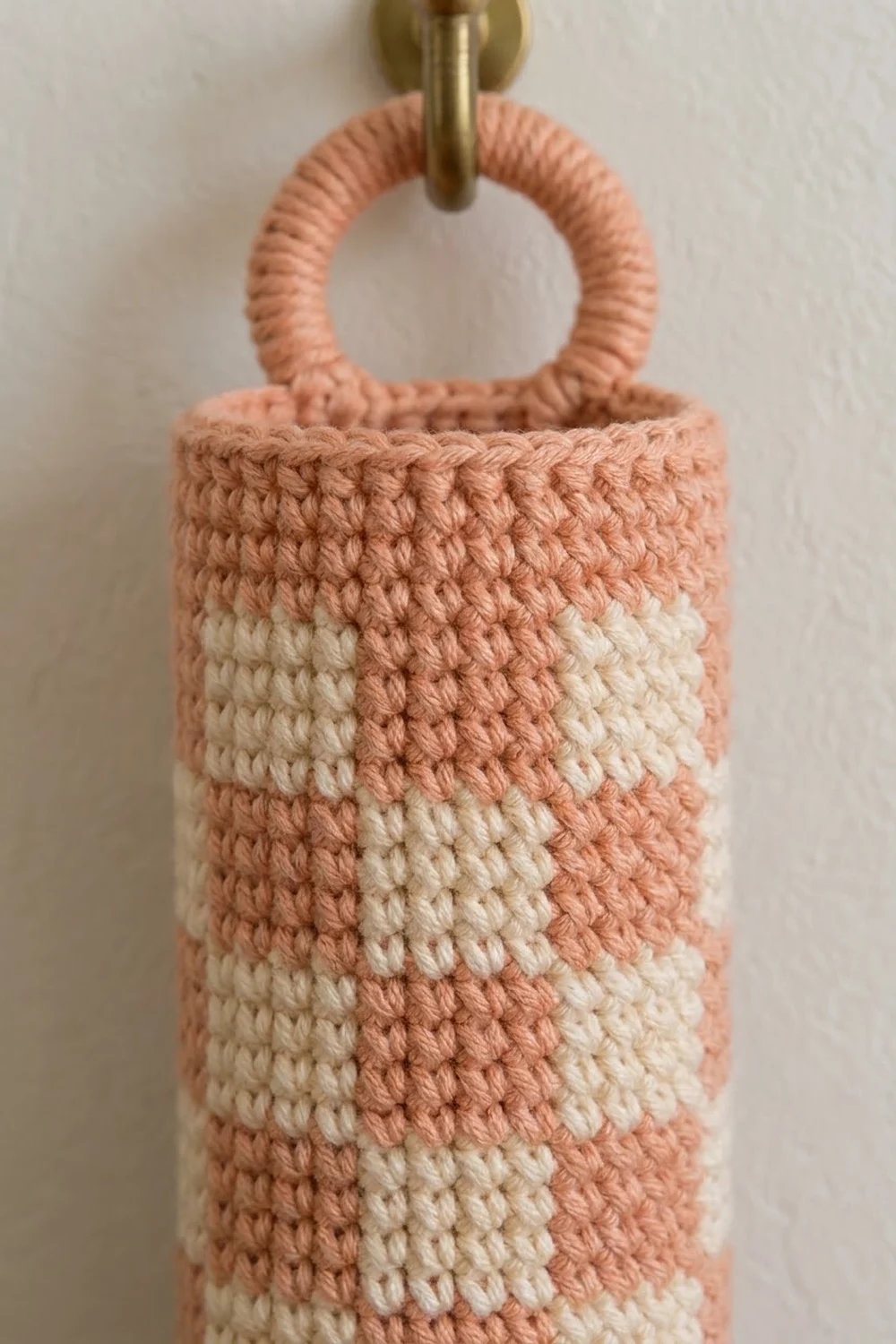
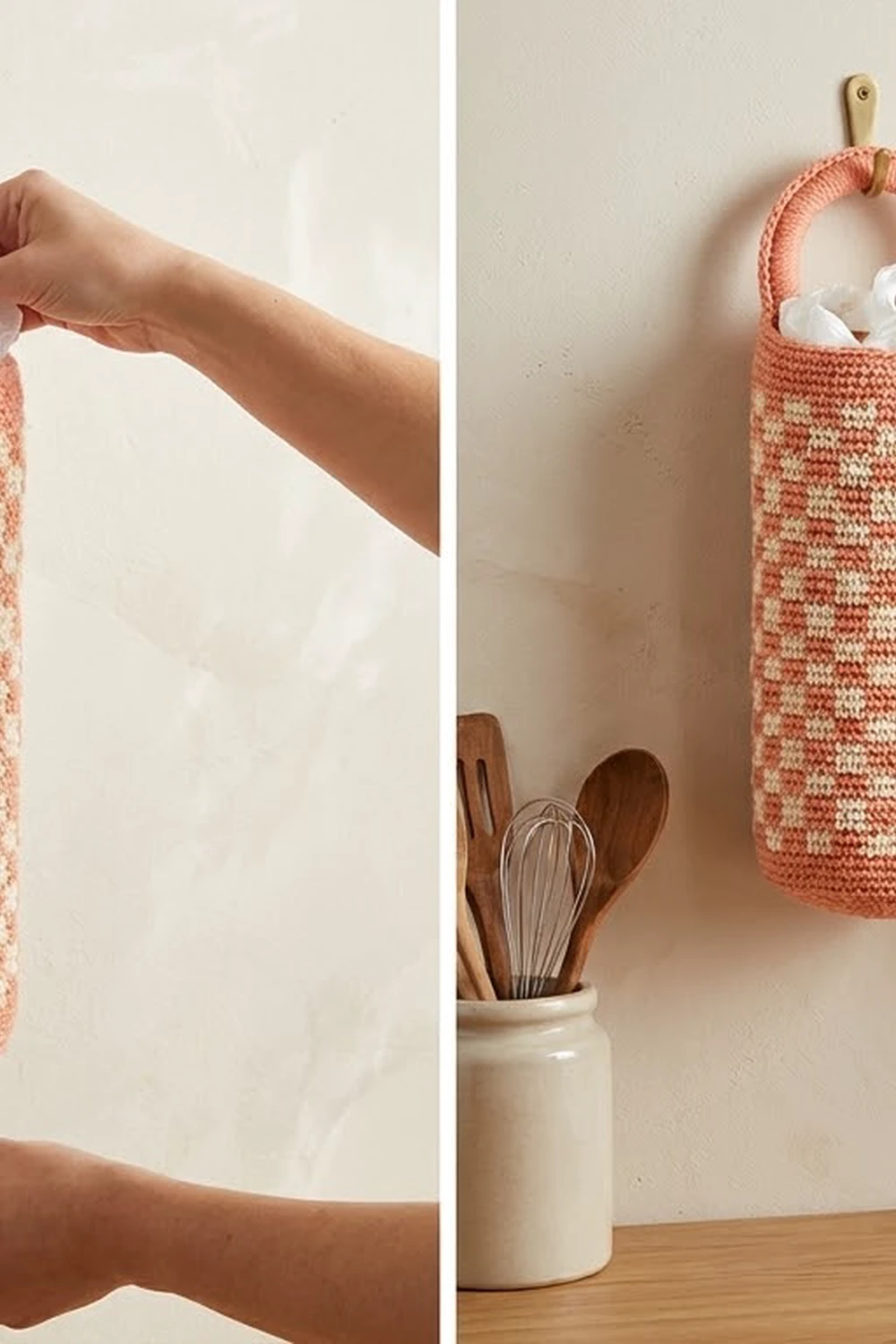
Plastic bags tend to pile up under the sink. This holder keeps them in one neat, cheerful tube. Push bags in at the wide top and pull them out one at a time through the smaller opening at the bottom. The checkerboard gives it a retro, café-kitchen look that suits open shelving and pegboards.
The sample uses warm peach and soft cream. A sage green and cream version looks just as good, so you could make a pair. The pattern uses US crochet terms throughout.
The finished holder measures about 16 in (40.6 cm) tall and 6 in (15.2 cm) wide when laid flat. That is about 3.8 in (9.7 cm) in diameter when filled. A covered ring about 3 in (7.6 cm) across stands up from the back rim for hanging.
The holder is worked bottom-up in joined rounds of single crochet. It starts with a solid peach band and a gentle increase, then moves into tapestry checks of 4 stitches by 4 rounds. It finishes with a solid top band. Last, you cover a ring in single crochet and sew it to the back rim.
Finished Size and Construction
- Finished size: 16 in (40.6 cm) tall × 6 in (15.2 cm) flat width
- Skill level: Intermediate (colorwork with carried yarn)
- Terminology: US crochet terms
- Yarn weight: Worsted (#4), cotton or cotton blend
- Hook: 4.0 mm (G-6)
- Number of pieces: 1 tube, plus 1 covered ring sewn on
- Layout: 12 checks around × 14 check bands tall
- Check size: 4 sts × 4 rnds = 1 in (2.5 cm) square
- Size before border: 15 in (38.1 cm) tall (Rnds 1–60)
- Border depth: about 0.75 in (1.9 cm) at the top, plus a 0.25 in (0.6 cm) edge round at the bottom
- Bottom opening: 9 in (22.9 cm) around, about 2.9 in (7.4 cm) across
Materials
Yarn: Use a smooth worsted-weight cotton or cotton blend. Cotton holds its shape, shows crisp checks, and stands up to frequent handling. Avoid fuzzy or very stretchy acrylic, because the checks blur and the tube sags under the weight of the bags.
- Peach (MC): 170 g / 260 m
- Cream (CC): 130 g / 200 m
- Alternate colorway: sage green for MC and cream for CC, same amounts
These quantities include a margin of about 10–15% for your gauge swatch and the carried strand.
Tools:
- 4.0 mm (G-6) crochet hook
- One metal or plastic ring, 2.5 in (6.4 cm) outer diameter
- 2 stitch markers
- Tapestry needle
- Scissors
- Measuring tape
- A rolled towel or a 4 in (10.2 cm) cardboard tube for blocking
Abbreviations (US Terms)
- ch – chain
- sc – single crochet
- sl st – slip stitch
- st(s) – stitch(es)
- rnd(s) – round(s)
- MC – main color (peach)
- CC – contrast color (cream)
- ( ) ×N – repeat the steps in parentheses N times
Special technique – tapestry color change: Work the last sc before a color change until 2 loops remain on the hook. Drop the old color, yarn over with the new color, and pull through both loops. Lay the unused strand along the top of the round and work over it, so it is carried inside the stitches. Keep the carried strand relaxed so the fabric doesn’t pucker.
Gauge and Checkpoints
Gauge: 16 sc and 16 rnds = 4 in (10.2 cm) in tapestry sc worked in the round.
Tapestry sc is denser than plain sc. Before you start the holder, test your gauge on a small swatch: ch 24, join, and work 12 rounds of checks.
Checkpoints:
- After Rnd 4: The tube is 12 in (30.5 cm) around, which is 6 in (15.2 cm) flat. The tube is 1 in (2.5 cm) tall.
- After Rnd 8 (first check band): Each check is 1 in (2.5 cm) square. The tube is 2 in (5.1 cm) tall.
- After Rnd 32: The tube is 8 in (20.3 cm) tall.
- After Rnd 60: The tube is 15 in (38.1 cm) tall.
If the tube is too big: Go down to a 3.75 mm (F-5) hook, or carry the strand a little more firmly.
If the tube is too small: Go up to a 4.5 mm (7) hook.
Don’t change the stitch count. The 48-stitch round is what makes 12 even checks.
Pattern
All rounds are joined with a sl st to the first sc. Start each round with ch 1, which doesn’t count as a stitch. Joined rounds keep the checks stacked straight. The small join line runs up the back, and the ring will cover it later.
Bottom Band (MC)
Foundation: With MC, ch 36. Join with a sl st to the first ch to form a ring, taking care not to twist the chain.
Rnd 1: Ch 1, sc in each ch around, join. (36 sts)
Rnd 2: Ch 1, sc in each st around, join. (36 sts)
Rnd 3 (conversion): Ch 1, (sc in next 2 sts, 2 sc in next st) ×12, join. (36 + 12 = 48 sts)
Rnd 4: Ch 1, sc in each st around, join. (48 sts)
On the last sc of Rnd 4, pull through with CC so the first stitches of Rnd 5 are ready.
Checkpoint: the tube is 12 in (30.5 cm) around and 1 in (2.5 cm) tall.
Checkerboard Body
Carry the unused color through every stitch in these rounds. Change color on the last yarn over of the stitch before each new block.
Band A (rounds start with MC): Ch 1, (4 sc MC, 4 sc CC) ×6, join. (48 sts: 24 MC, 24 CC)
Band B (rounds start with CC): Ch 1, (4 sc CC, 4 sc MC) ×6, join. (48 sts: 24 CC, 24 MC)
Each band is 4 rounds tall. Work all 4 rounds of a band in the same color order, so each block stacks into a 4 × 4 square. When you switch from Band A to Band B, the colors swap and the checkerboard forms.
Rnds 5–8: Band A
Rnds 9–12: Band B
Rnds 13–16: Band A
Rnds 17–20: Band B
Rnds 21–24: Band A
Rnds 25–28: Band B
Rnds 29–32: Band A
Checkpoint: the tube is 8 in (20.3 cm) tall. Lay it flat. It should still measure 6 in (15.2 cm) wide at every point.
Rnds 33–36: Band B
Rnds 37–40: Band A
Rnds 41–44: Band B
Rnds 45–48: Band A
Rnds 49–52: Band B
Rnds 53–56: Band A
Rnds 57–60: Band B
That makes 14 bands of 4 rounds, for 56 check rounds. Every round has 48 sts. The tube has 12 checks around and 14 checks tall.
At the end of Rnd 60, finish the last stitch with MC. Cut CC, leaving a 6 in (15.2 cm) tail.
Checkpoint: the tube is 15 in (38.1 cm) tall and 6 in (15.2 cm) flat.
Hanging Ring
Ring: Join MC to the 2.5 in (6.4 cm) ring with a sl st. Ch 1, then work 56 sc around the ring, pushing the stitches together so no ring shows. Join with a sl st to the first sc. (56 sts)
If your ring needs a few more or fewer stitches to cover it, adjust the count. Keep the stitches packed snugly.
Fasten off, leaving a 16 in (40.6 cm) tail for sewing. The covered ring measures about 3 in (7.6 cm) across.
Attach the ring after the border is done (see below).
Border
The border covers the top band, a slip-stitch rim, and a firm bottom edge.
Border gauge: The border uses the same 16 sc = 4 in (10.2 cm) gauge, so each round is still 12 in (30.5 cm) around. For counting, think of the round as 4 equal quarters of 12 sts. Each quarter matches 3 checks of 4 sts.
Top Band (MC only)
Rnd 61: Ch 1, sc in each st around, join. (48 sts, 12 per quarter)
Rnd 62: Ch 1, sc in each st around, join. (48 sts)
Rnd 63: Ch 1, sc in each st around, join. (48 sts)
Rnd 64: Sl st loosely in each st around. (48 sl sts) Fasten off.
The 3 sc rounds add 0.75 in (1.9 cm). The slip stitch round firms up the mouth so it doesn’t flare when you push bags in.
Bottom Edge
Bottom Rnd: Turn the tube upside down. Join MC at the back join line in a remaining loop of the foundation chain. Ch 1, then sc in each remaining loop around and join. (36 sts, 9 per quarter) Fasten off.
This round adds 0.25 in (0.6 cm) and gives a smooth, sturdy dispensing edge.
Why the math works:
- 48 sts ÷ 4 sts per check = 12 checks exactly, so the pattern meets itself perfectly at the join line.
- Rnd 3 adds 12 sts, one for every 3. That spreads the narrowing of the bottom opening evenly.
- 36 sts at 16 sts per 4 in gives a 9 in (22.9 cm) opening. That is about 2.9 in (7.4 cm) across: small enough to hold bags in, large enough for a hand to pull them out.
- Height: 4 rnds (bottom band) + 56 rnds (checks) = 60 rnds = 15 in (38.1 cm). Add 0.75 in (1.9 cm) at the top and 0.25 in (0.6 cm) at the bottom for 16 in (40.6 cm) total.
Attach the Ring
- Flatten the tube with the join line centered at the back.
- Pick 6 sts on the covered ring and center them over the 6 back sts of Rnd 63, 3 on each side of the join line. Place the ring on the inside of the rim so it stands straight up.
- With the long tail, whipstitch those 6 ring sts to the 6 rim sts. Go through each pair twice so the seam can carry the weight of the bags.
- Weave in all ends inside the tube.
Final Blocking
- Weave in all remaining tails along matching colors on the inside so they don’t show through.
- Slide a rolled towel or a 4 in (10.2 cm) cardboard tube inside the holder.
- Mist it lightly with water, or hold a steam iron about 1 in (2.5 cm) above the fabric without touching it.
- Gently nudge the checks square and the columns straight.
- Shape the top rim into a round opening and stand the ring upright.
- Let it dry fully on the form, which takes about 4–8 hours.
- Remove the form and measure. You should get 16 in (40.6 cm) tall and 6 in (15.2 cm) flat.
Final Quality-Control Checklist
- [ ] Every round of the body has 48 sts.
- [ ] Each check is 4 sts wide and 4 rnds tall.
- [ ] There are 12 checks around and 14 check bands tall.
- [ ] The colors alternate correctly from band to band.
- [ ] No carried strand shows through on the outside.
- [ ] The top band is 3 sc rounds plus 1 sl st round, all solid MC.
- [ ] The bottom edge has 36 sts and lies smooth.
- [ ] The ring is sewn securely over the back join line and stands upright.
- [ ] All ends are woven in on the inside.
- [ ] The holder is 16 in (40.6 cm) tall and 6 in (15.2 cm) flat.
Troubleshooting
Checks lean diagonally: You are working in a spiral. Join each round with a sl st and ch 1.
Puckered fabric: The carried strand is too tight. Spread the stitches on your hook before each color change.
Carried color peeks through: Keep the carried strand at the very back of the stitch, or switch to a slightly smaller hook.
Jagged color edges: Change color on the final yarn over of the previous stitch, not in the first step of the new one.
Tube too short: Your round gauge is tight. Add a band, but keep the pattern alternating so the top band still sits on a complete band.
Ring flops forward: Sew it to the inside of the rim and go through each stitch twice.
Bags fall out the bottom: Your gauge is loose. Rework the bottom edge with a smaller hook, or work it as sc2tog every 9 sts for 32 sts.
Care
Hand wash in cool water and lay flat or dry on a rolled towel. Cotton can go in a gentle machine wash inside a mesh bag, then reshape while damp.
Final Notes
The size depends on a short chain of measurements:
- 16 sts and 16 rnds give 4 in (10.2 cm).
- Each 4 × 4 check is 1 in (2.5 cm).
- 48 sts make 12 checks and a 12 in (30.5 cm) round, or 6 in (15.2 cm) flat.
- 60 rnds make 15 in (38.1 cm), and the border brings the total to 16 in (40.6 cm).
Check your gauge at each checkpoint and the holder will finish neat, square, and ready for the wall hook. Make a second one in sage and cream for a matching pair.
Happy crocheting!