

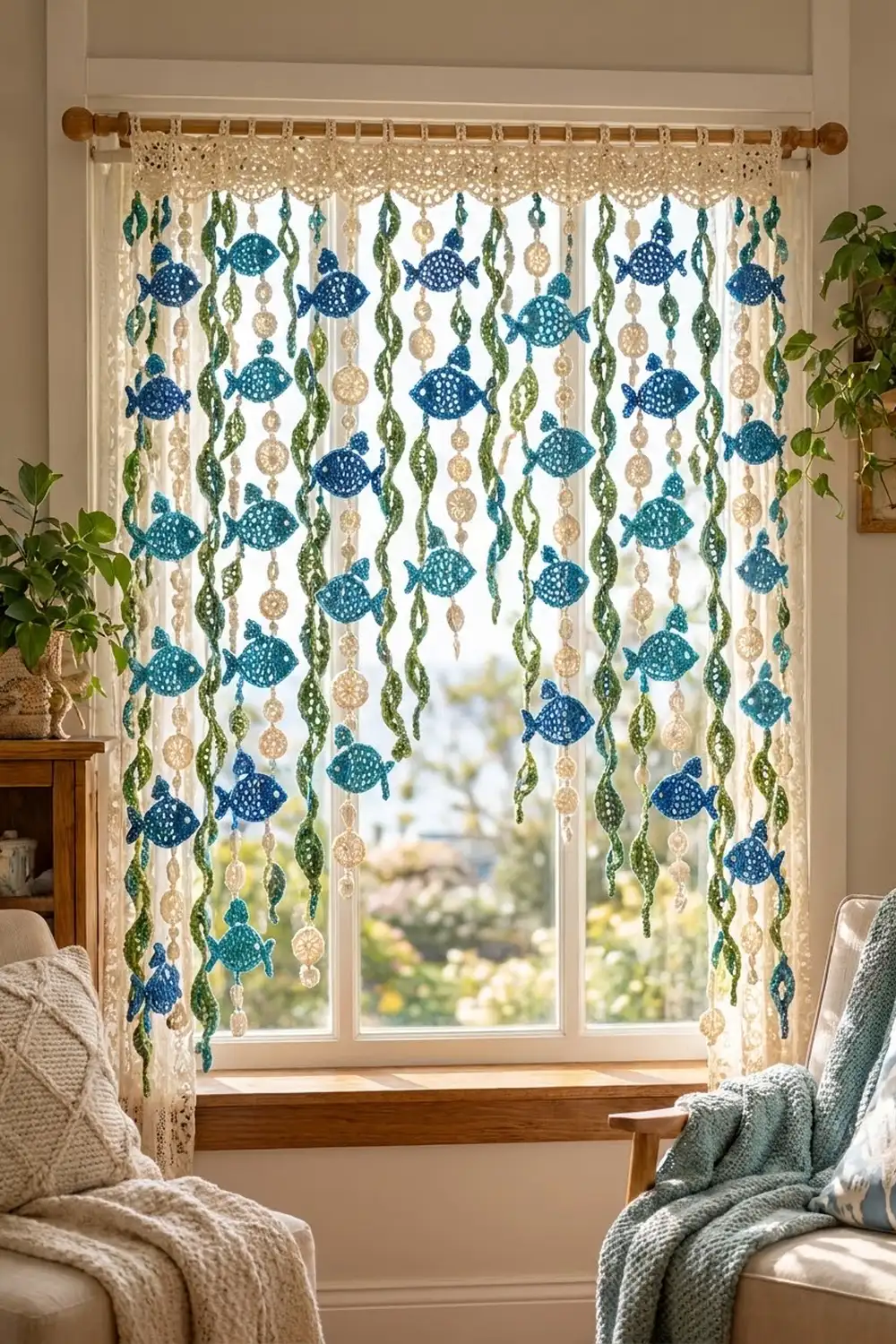
The Seaside Shoal Curtain brings a calm piece of the coast into any window. Turquoise and royal blue fish hang among twisting green seaweed and rows of cream discs like bubbles. Everything hangs from a lacy cream header with soft scallops.
The palette has four colors: cream, turquoise, royal blue and leaf green. With light behind it, the open mesh in each fish glows and the seaweed throws gentle shadows. The style is relaxed and coastal, a little vintage, and easy to live with.
This pattern uses US crochet terms. The finished curtain is 36¼ in (92.1 cm) wide and 42 in (106.7 cm) long: a 4 in (10.2 cm) header plus 38 in (96.5 cm) strands. The rod tabs sit above the header and are not counted in the length.
Work in this order. First make all the discs and fish. Next work the header body and its border (scallops, side trim and tabs). Then crochet the seaweed strands straight off the scallop points. Last, chain the fish strands down from the other scallop points, linking each motif as you go.
Finished Size and Construction
- Finished size: 36¼ in (92.1 cm) wide × 42 in (106.7 cm) long
- Skill level: Intermediate
- Terminology: US
- Yarn weight: DK (3) cotton
- Hook: 3.5 mm (E-4)
- Number of pieces: 1 header, 99 discs, 45 fish, 9 seaweed strands worked in place
- Layout: 18 strands, one from each scallop point, every 2 in (5.1 cm), fish and seaweed in turn
- Piece sizes: disc 1.5 in (3.8 cm); fish 5 in (12.7 cm) long × 2.5 in (6.4 cm) tall; seaweed leaf 3 in (7.6 cm)
- Header size before border: 36¼ in × 2⅔ in (92.1 cm × 6.8 cm)
- Border depth: 1⅓ in (3.4 cm) of scallops on the lower edge
Materials
Use a smooth mercerized or matte DK cotton, about 125 m (137 yd) per 50 g. Cotton hangs straight, holds its shape after blocking and won’t fuzz in sunlight. Avoid acrylic because it stretches under the weight of long strands.
- Cream: 200 g, 500 m (header, tabs, discs, fish-strand cords)
- Turquoise: 60 g, 150 m (23 fish)
- Royal blue: 60 g, 150 m (22 fish)
- Leaf green: 100 g, 250 m (9 seaweed strands)
Tools:
- 3.5 mm (E-4) hook
- Tapestry needle
- Locking stitch markers
- Rust-proof pins and a blocking surface
- Spray bottle
- Measuring tape
- Wooden rod up to 1 in (2.5 cm) across
All quantities include a margin of about 15–20% for gauge swatches and differences in tension.
Abbreviations (US Terms)
- ch – chain
- sl st – slip stitch
- sc – single crochet
- hdc – half double crochet
- dc – double crochet
- tr – treble crochet
- sp – space
- st(s) – stitch(es)
- RS / WS – right side / wrong side
Picot: ch 3, sl st in 3rd ch from hook.
Shell: (3 dc, ch 2, 3 dc) in the same sp.
Gauge and Checkpoints
- Header gauge: 18 dc and 9 dc rows = 4 in (10.2 cm)
- Chain gauge: 4 ch = 1 in (2.5 cm)
Test one of each motif before making the rest:
- Disc: Rnd 1 should measure 1 in (2.5 cm) across and Rnd 2 should measure 1.5 in (3.8 cm).
- Fish: Rnd 1 should be about 2.5 in (6.4 cm) long. After Rnd 3 the body is 3.75 in × 2 in (9.5 cm × 5.1 cm). With the tail it is 5 in (12.7 cm) long.
- Seaweed: one leaf should be 3 in (7.6 cm) long.
If your pieces are too big, go down 0.25 mm. If they are too small, go up 0.25 mm. Chain gauge matters most because it sets the strand lengths. Check that 20 chains measure 5 in (12.7 cm) before you start any strand.
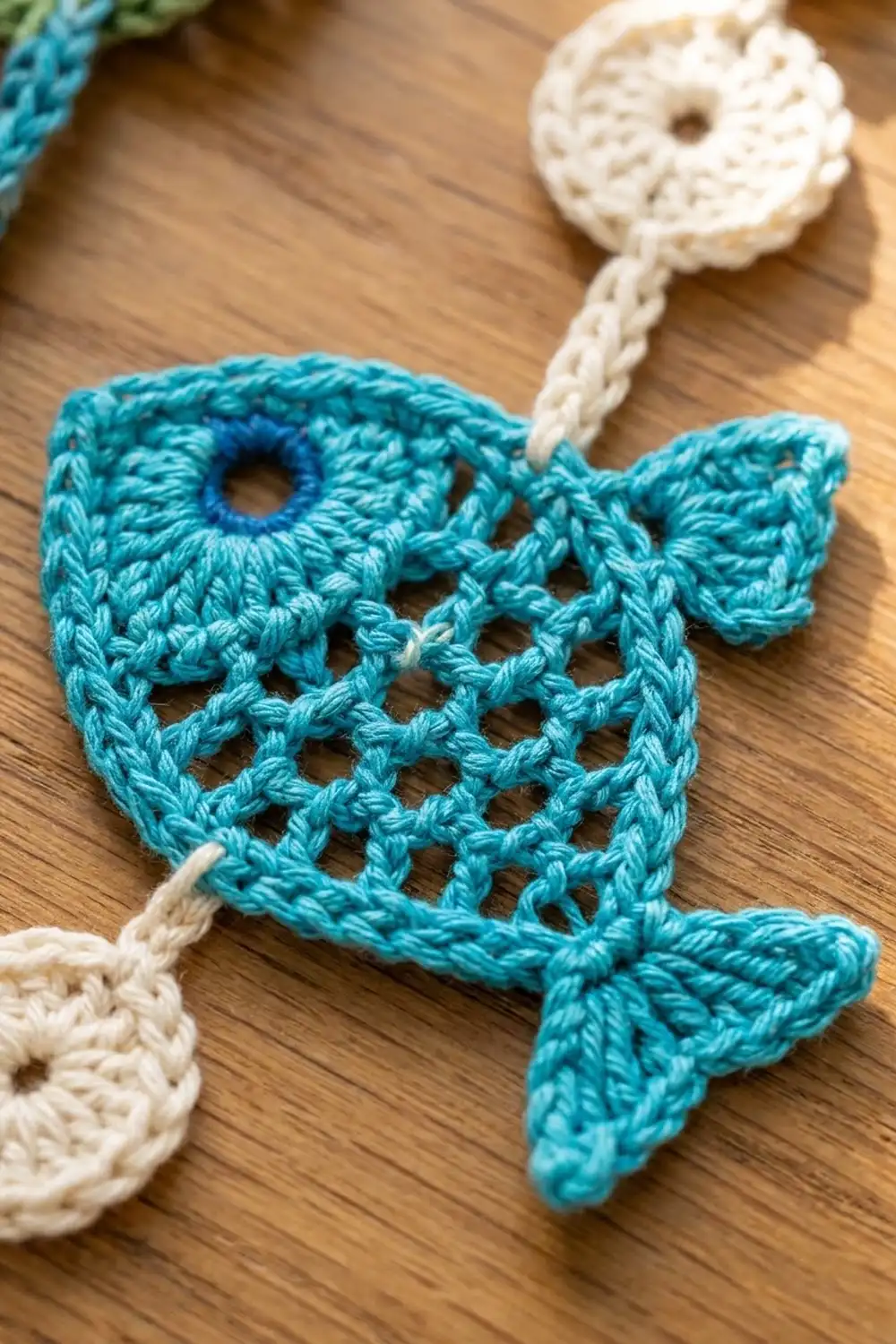
Disc (Make 99, Cream)
Ch 4, sl st in first ch to form a ring.
Rnd 1: Ch 3 (counts as dc), 15 dc in ring, sl st in top of ch-3. (16 dc)
Rnd 2: Ch 1, [sc in next st, 2 sc in next st] 8 times, sl st in first sc. (24 sc)
Fasten off and weave in the ends. The disc is 1.5 in (3.8 cm) across. Its top attachment st is sc 1 and its bottom attachment st is sc 13, directly opposite.
Fish (Make 23 Turquoise, 22 Royal Blue)
Body
Ch 11.
Rnd 1: Sc in 2nd ch from hook and in the next 8 ch (9 sc, belly side). Work 3 sc in the last ch (tail end). Working along the opposite side of the chain, sc in the next 8 ch (back side), then 2 sc in the first ch (nose end). Sl st in first sc. (22 sc)
Rnd 1 positions: sts 1–9 are the belly, 10–12 the tail end, 13–20 the back, and 21–22 plus st 1 the nose.
Rnd 2:
1. Ch 3 (counts as dc), dc in the same st.
2. [Dc, ch 1] in each of the next 8 sts (sts 2–9).
3. [Dc, ch 1, dc, ch 1] in each of the next 3 sts (sts 10–12).
4. [Dc, ch 1] in each of the next 6 sts (sts 13–18).
5. Dc in st 19, ch 3, skip st 20 (this makes the eye).
6. 2 dc in each of the next 2 sts (sts 21–22).
7. Sl st in top of ch-3.
Count: 2 + 8 + 6 + 6 + 1 + 4 = 27 dc, 20 ch-1 sps and 1 ch-3 eye sp.
Rnd 3: Ch 1. Work 1 sc in each dc and in each ch-1 sp, and 3 sc in the eye sp. Work 2 sc in each of the 4 dc made in sts 21–22. Sl st in first sc.
Count: 27 + 20 + 3 = 50 sts worked one per stitch or space, + 4 extra = 54 sc.
The eye sits between Rnd 1 and Rnd 3, so it closes into a neat round hole. The ch-1 spaces become the small eyelets of the mesh. Place markers on the sc above the dc of st 5 (belly center) and above the dc of st 16 (back center).
Tail
The 3 tail-end sts of Rnd 1 became 12 sc in Rnd 3.
Row 1 (RS): Join yarn in the 5th of these 12 sc. Ch 1, sc in the same st and in the next 3 sts. Turn. (4 sc)
Row 2: Ch 3 (counts as dc), dc in the same st, 2 dc in each remaining st. Turn. (8 dc)
Row 3: Ch 3 (counts as dc), dc in the same st, dc in next st, [2 dc in next st, dc in next st] 3 times. Turn. (12 dc)
Row 4: Ch 1, then work these 12 sts across: sc, hdc, 2 dc, hdc, 2 sl st, hdc, 2 dc, hdc, sc. Fasten off. (12 sts)
This last row makes two rounded lobes with a dip in the middle. The tail adds 1.25 in (3.2 cm), so the fish is 5 in (12.7 cm) long.
Fins
Dorsal fin: Join yarn in the back-center sc. Working toward the tail, sl st in this st, hdc in next, (dc, tr) in next, ch 1, sl st in next. Fasten off.
Belly fin: Join yarn 2 sts tail-side of the belly-center marker. Sl st, (hdc, dc, ch 1) in next st, sl st in next st. Fasten off.
The top attachment st is the sc just nose-side of the dorsal fin. The bottom attachment st is the belly-center sc.
Header Body (Cream)
Ch 165.
Row 1: Dc in 4th ch from hook and in each ch across. Turn. (163 sts, counting the skipped ch as 1 dc)
Row 2 (mesh): Ch 5 (counts as dc + ch 2), skip 2 sts, dc in next st, [ch 2, skip 2 sts, dc in next st] across. Turn. (55 dc, 54 ch-2 sps)
Row 3: Ch 3 (counts as dc), work 2 dc in each ch-2 sp and 1 dc in each dc across. Turn.
Count: 55 dc + (54 × 2) = 163 sts.
Rows 4–5: Repeat Rows 2–3.
Row 6: Repeat Row 2. (54 ch-2 sps)
Checkpoint: the header is 36¼ in (92.1 cm) wide and 2⅔ in (6.8 cm) deep. Leave the yarn attached.
Make All Pieces
- Cream: 99 discs and 1 header
- Turquoise: 23 fish
- Royal blue: 22 fish
- Green: 9 seaweed strands, made during joining
Strand order across the curtain, by scallop number:
Scallop:  1  2  3  4  5  6  7  8  9 10 11 12 13 14 15 16 17 18
Strand:   A  S  B  S  A  S  B  S  A  S  B  S  A  S  B  S  A  S
- S = seaweed
- A = fish strand with fish colors T, B, T, B, T (5 strands: 15 turquoise, 10 blue)
- B = fish strand with fish colors B, T, B, T, B (4 strands: 8 turquoise, 12 blue)
Fish-strand sequence from top to bottom:
top link ch 6
disc – link – disc – link – FISH – link   (repeat 5 times)
final disc
Joining
Finish the Border (next section) before you join any strands. Every strand hangs from a scallop picot.
Fish strands (cream):
1. Join cream with a sl st in the picot of scallop 1, then ch 6 for the top link: 1.5 in (3.8 cm).
2. Sl st in the top attachment st of a disc. Ch 5 behind the disc and sl st in its bottom attachment st.
3. Ch 2 for a link: 0.5 in (1.3 cm).
4. Join the second disc the same way, then ch 2.
5. Sl st in the fish’s top attachment st, ch 8 behind the fish, sl st in its belly-center st, then ch 2.
6. Repeat steps 2–5 until 5 fish are joined.
7. Join one final disc, fasten off and weave in the end.
Each repeat is 1.5 + 0.5 + 1.5 + 0.5 + 2.5 + 0.5 = 7 in (17.8 cm). The strand is 1.5 + (5 × 7) + 1.5 = 38 in (96.5 cm).
Seaweed strands (green):
1. Join green with a sl st in the picot of scallop 2. Ch 5 for the stem, 1.25 in (3.2 cm), then ch 13 for the leaf.
2. Work the first side of the leaf: sl st in 2nd ch from hook, sc in next ch, hdc in next 2, dc in next 4, hdc in next 2, sc in next, sl st in next. (12 sts)
3. Work the second side along the opposite loops of the same 12 ch, using the same sequence. Sl st in the tip ch. (12 sts)
4. Turn the work a quarter turn clockwise. Ch 3 (stem, 0.75 in / 1.9 cm), then ch 13 for the next leaf.
5. Repeat steps 2–4 until there are 10 leaves. Fasten off at the last tip.
Length: 1.25 + (10 × 3) + (9 × 0.75) = 38 in (96.5 cm). The quarter turns make the strand spiral.
Tension: Keep the chains behind the motifs slightly snug so each disc and fish lies flat without puckering. Keep the links relaxed.
Size checkpoint: Hang the header and measure each strand before you weave in its end. Every strand should be 38 in (96.5 cm), within ½ in (1.3 cm). Adjust the top link if needed.
Border
The border has three parts: scallops on the lower edge, slip-stitch trim on the sides and rod tabs on the top edge. Border gauge: each scallop covers 3 mesh sps, or 9 sts, which is 2 in (5.1 cm).
Bottom edge, Row 1: Ch 1. [Sc in next ch-2 sp, shell in next ch-2 sp, sc in next ch-2 sp] 18 times. Turn. (36 sc, 108 dc, 18 ch-2 tips)
Bottom edge, Row 2: Ch 1. Repeat 18 times: [sc in sc, hdc in next dc, dc in next 2 dc, (2 dc, picot, 2 dc) in ch-2 tip, dc in next 2 dc, hdc in next dc, sc in sc]. Fasten off. (216 sts and 18 picots)
Side edges: Join cream and work 2 sl st into each row-end, 12 per short side across the 6 body rows. The trim tidies the edge without adding width.
Top edge, tabs: The opposite loops of the foundation chain hold 163 sts. Make 9 tabs, each 3 sts wide, starting at sts 1, 21, 41, 61, 81, 101, 121, 141 and 161.
For each tab:
1. Join cream in the first st of the tab and sc in 3 sts.
2. Work 19 more rows of 3 sc.
3. Fold the strip to the WS and sew it over the same 3 sts.
Each tab is 3.5 in (8.9 cm) long before folding and fits a rod up to 1 in (2.5 cm) across.
Why the math works: 163 = 1 + (3 × 54), so Row 2 makes exactly 54 spaces. 54 ÷ 3 = 18 scallops, and 18 scallops = 18 strands at 2 in (5.1 cm). Across the top, 9 tabs × 3 sts + 8 gaps × 17 sts = 27 + 136 = 163.
Final Blocking
- Before you join any strands, mist the header and pin it to 36¼ in × 4 in (92.1 cm × 10.2 cm). Pin out every scallop point.
- Lay the discs and fish flat, mist them and pat them into shape. Pin open each fish tail and fin.
- Let everything dry completely.
- After joining, hang the curtain and lightly mist the strands. Let them dry while hanging so the seaweed settles into its spiral.
Final Quality-Control Checklist
- [ ] The header is 36¼ in (92.1 cm) wide and 4 in (10.2 cm) deep.
- [ ] There are 18 even scallops, each with a picot.
- [ ] 9 tabs are evenly spaced and firmly sewn.
- [ ] Every strand is 38 in (96.5 cm).
- [ ] Each fish strand has 11 discs and 5 fish in the right color order.
- [ ] Each seaweed strand has 10 leaves.
- [ ] Every fish eye is open and round.
- [ ] All ends are woven in.
Troubleshooting
- The header ruffles: Your chain is too loose. Redo it with a smaller hook.
- The fish body cups: Make sure you worked the 4 extra sc at the nose and that your Rnd 2 dc are not tight.
- The eye has closed up: Work 3 sc, not 2, into the ch-3 space.
- Strands are uneven: Measure each top link as you go and add or remove chains.
- The seaweed hangs flat: Remember the quarter turn before each stem.
- Discs tilt: The behind-chain was attached off-center. Use sc 1 and sc 13.
Care
Hand wash in cool water, roll the curtain in a towel and dry it hanging. Re-mist the strands if they tangle.
Final Notes
Here is the measurement chain:
- 18 dc = 4 in (10.2 cm), so 163 sts give a 36¼ in (92.1 cm) header.
- 54 mesh spaces become 18 scallops at 2 in (5.1 cm) each.
- 18 strands of 38 in (96.5 cm) hang below a 4 in (10.2 cm) header, for a 42 in (106.7 cm) curtain.
Check your gauge, test one motif of each type, and the rest follows.
Happy crocheting!