

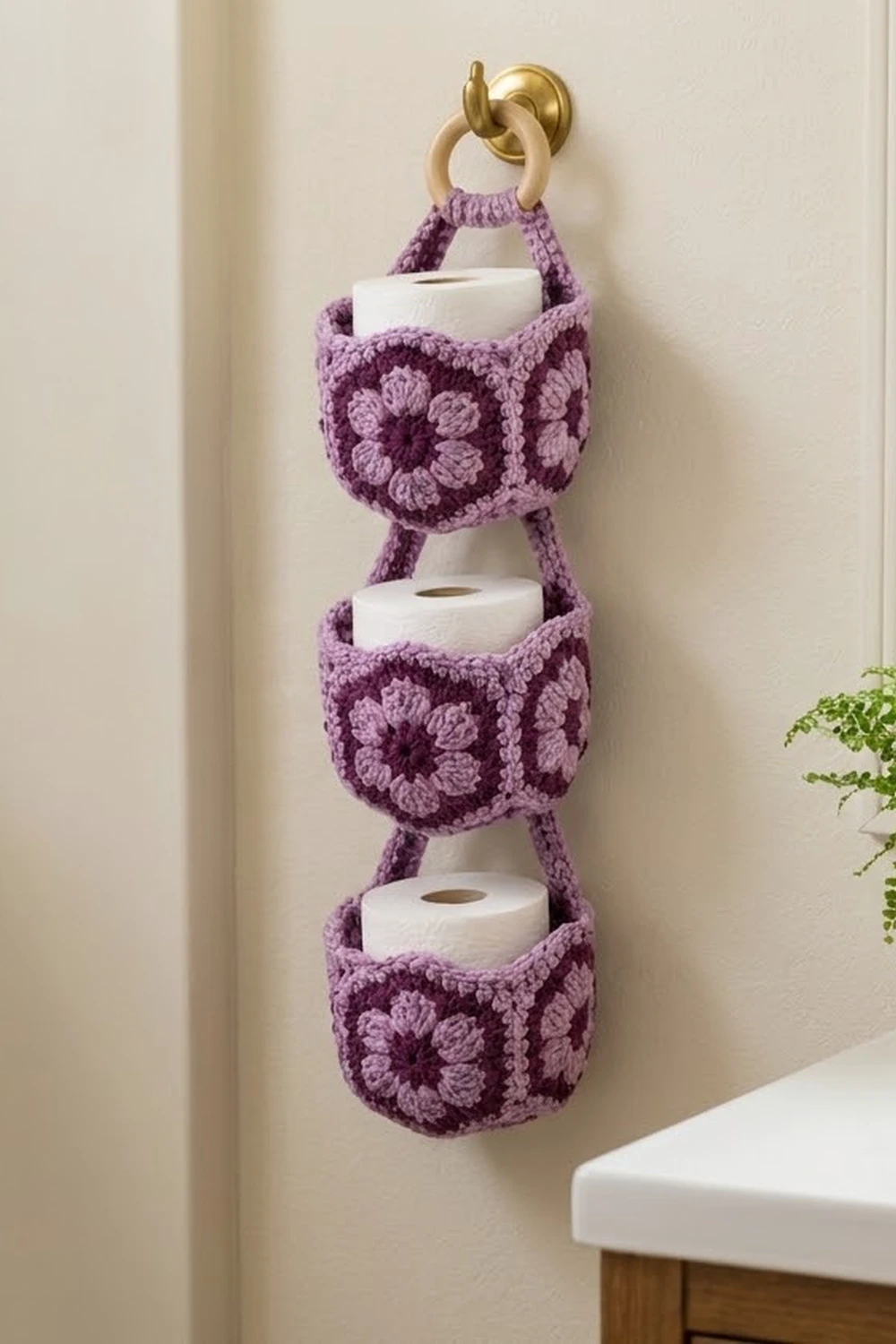
The Lilac Bloom holder is a three-tier hanging basket for spare toilet rolls. Each basket is a ring of African flower hexagons with a flat base. The three baskets hang in a column from a natural wooden ring, so they take up wall space instead of counter space.
The palette uses two purples. Deep plum fills the flower centers, outlines the petals, and makes the bases. Soft lavender covers the puffy petals, the hexagon edges, the seams, the rims, and the straps. The style is cottage and slightly vintage, but the rims and straps keep it tidy.
All instructions use US crochet terms. The finished holder is about 21 in (53.3 cm) long, including the ring. Each basket is 5.75 in (14.6 cm) across and 4.5 in (11.4 cm) tall, and holds one standard roll.
Construction overview: crochet 15 hexagons. Join 5 hexagons into a ring for each basket. Level the zigzag top and bottom edges with two rim rounds, then join a round plum base to the bottom. Connect the baskets with short side straps, and add two long straps that wrap around the wooden ring.
Finished Size and Construction
- Finished size: about 21 in (53.3 cm) long including the ring; each basket is 5.75 in (14.6 cm) across and 4.5 in (11.4 cm) tall
- Skill level: Intermediate
- Terminology: US
- Yarn weight: Worsted (#4), cotton or cotton blend
- Hook: 4.0 mm (G-6)
- Number of pieces: 15 hexagons, 3 bases, 4 connector straps, and 2 hanging straps, plus 1 wooden ring
- Layout: 3 baskets stacked vertically; each basket is a ring of 5 hexagons
- Hexagon size: 3.5 in (8.9 cm) flat side to flat side, 4.0 in (10.2 cm) point to point, 2.0 in (5.1 cm) per side
- Size before rims: a 5-hexagon ring, 17.5 in (44.5 cm) around and 4.0 in (10.2 cm) tall
- Rim depth: 2 rounds at the top and 2 at the bottom, each adding about 0.25 in (0.6 cm) beyond the hexagon points
Materials
Choose a firm worsted cotton or cotton blend with good stitch definition. Cotton holds the basket shape, handles bathroom humidity, and shows off the petal texture. Avoid very soft or splitty acrylic, because it lets the baskets slump under the weight of the rolls.
- Plum (Color A): 90 g, about 180 m
- Lavender (Color B): 120 g, about 240 m
These quantities include a margin of about 20 percent for a test hexagon, gauge swatches, and differences in tension. Buy each color from a single dye lot.
Tools:
- 4.0 mm (G-6) crochet hook
- Wooden ring, 2.5 in (6.4 cm) in diameter
- Tapestry needle
- 4 locking stitch markers
- Scissors and a tape measure
- Blocking mat, rust-proof pins, and a spray bottle
Abbreviations (US Terms)
- ch: chain
- sl st: slip stitch
- sc: single crochet
- hdc: half double crochet
- dc: double crochet
- tr: treble crochet
- sc2tog: single crochet 2 together
- sp: space
- MR: magic ring
- st(s): stitch(es)
- rep: repeat
Long dc (spike): Yarn over and insert the hook into the gap between two 2-dc groups of Round 2 (the gap between petals). Pull up a loop to the height of the current round and finish it as a normal dc.
tr2tog across a valley: Yarn over twice, insert the hook into the first corner ch-2 sp, and pull up a loop. Then (yarn over, pull through 2) twice. Yarn over twice, insert into the second corner ch-2 sp, and pull up a loop. Then (yarn over, pull through 2) twice. Yarn over and pull through all 3 loops on the hook.
Gauge and Checkpoints
Gauge: 10 sc and 10 rows = 2 in (5.1 cm), so 5 sts and 5 rows per 1 in (2.5 cm).
Make one complete hexagon and block it before you make the rest. Every later measurement depends on this piece, so it’s worth the time.
Checkpoints:
- After Round 1: about 1.25 in (3.2 cm) across
- After Round 3: about 2.5 in (6.4 cm) across the petals
- After Round 4: about 3.0 in (7.6 cm) flat to flat
- After Round 5: 3.5 in (8.9 cm) flat to flat, 2.0 in (5.1 cm) per side
If your hexagon measures more than 3.75 in (9.5 cm), go down one hook size. If it measures less than 3.25 in (8.3 cm), go up one hook size. Small errors add up quickly: five hexagons that are each 0.25 in (0.6 cm) off change the basket’s circumference by 1.25 in (3.2 cm).
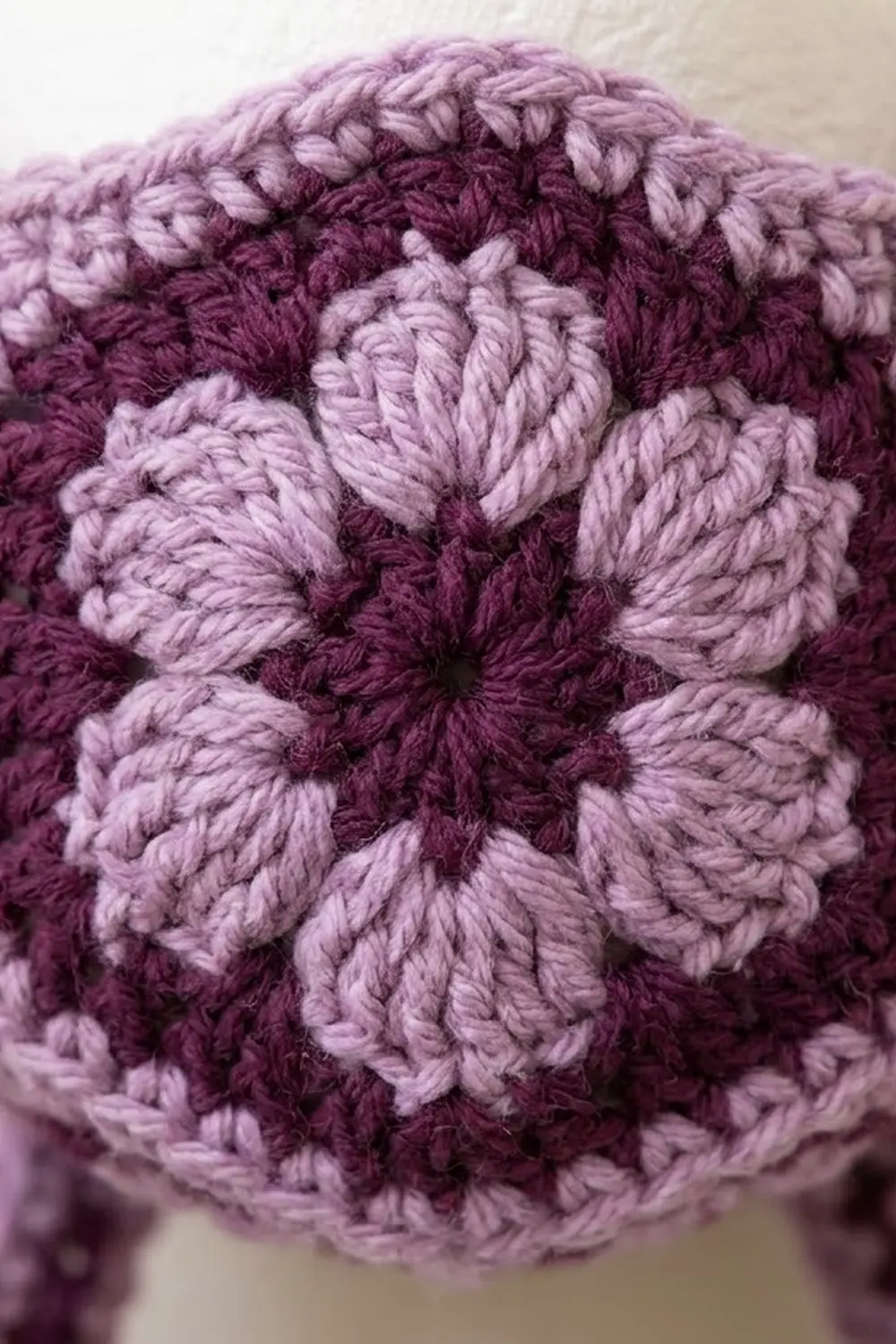
Hexagon Motif (Make 15)
Leave 6 in (15.2 cm) tails at each color change and weave them in as you go. Fifteen motifs make a lot of ends to finish all at once.
Round 1 (Plum): MR, ch 3 (counts as dc), dc in ring, ch 1, 2 dc in ring, ch 1; rep from * 4 more times. Sl st to the top of the ch-3. Fasten off. (12 dc, 6 ch-1 sps)*
Round 2 (Lavender): Join in any ch-1 sp. Ch 3, then (dc, ch 1, 2 dc) in the same sp, (2 dc, ch 1, 2 dc) in the next ch-1 sp; rep from * 4 more times. Sl st to the top of the ch-3. (24 dc, 6 ch-1 sps)*
Round 3 (Lavender): Sl st into the next dc and into the ch-1 sp. Ch 3, 6 dc in the same sp, 7 dc in the next ch-1 sp; rep from * 4 more times. Sl st to the top of the ch-3. Fasten off. (42 dc: 6 petals of 7 dc)*
Round 4 (Plum): Join with sc in the first dc of any petal. Sc in the next 6 dc, long dc between this petal and the next, sc in each of the 7 dc of the next petal, long dc; rep from * 4 more times. Sl st to the first sc. Fasten off. (48 sts: 42 sc + 6 long dc)*
The long dc pulls the plum outline down between the petals, which puffs up the petals and forms the six corners.
Round 5 (Lavender): Join with sc in the first sc of any petal. Sc in the next 6 sc, (sc, ch 2, sc) in the long dc, sc in the next 7 sc, (sc, ch 2, sc) in the long dc; rep from * 4 more times. Sl st to the first sc. Fasten off. (54 sc, 6 ch-2 corner sps)*
Per-side count: Each side has 9 sc between its two corner ch-2 sps: the sc next to each corner plus the 7 sc in between. The ch-2 sps aren’t counted in the 9.
Make All Pieces
| Piece | Qty | Plum | Lavender |
|---|---|---|---|
| Hexagon | 15 | Rounds 1, 4 | Rounds 2, 3, 5 |
| Base | 3 | All rounds | — |
| Seams, rims, straps | — | — | All |
Layout (front view):
          [ wooden ring ]
           /           \
      strap             strap
  [ Basket 1: H-H-H-H-H closed ring ]
      conn              conn
  [ Basket 2: H-H-H-H-H closed ring ]
      conn              conn
  [ Basket 3: H-H-H-H-H closed ring ]
Base (Make 3, Plum): Work in continuous rounds and mark the first st of each round.
- Round 1: MR, 6 sc in the ring. (6)
- Round 2: 2 sc in each st. (12)
- Round 3: (sc, 2 sc in the next st) 6 times. (18)
- Rounds 4–15: (sc in the next X sts, 2 sc in the next st) 6 times, where X is the round number minus 2. Each round’s own total is 6 times the round number: Round 4 has 24, Round 10 has 60, and Round 15 has 90.
Sl st into the next st and fasten off. (90 sc)
Base checkpoints: Round 5 (30 sts) is about 1.9 in (4.8 cm) across, Round 10 (60 sts) is about 3.8 in (9.7 cm), and Round 15 (90 sts) is 5.75 in (14.6 cm).
Joining
Turn each hexagon so it has one point at the top and one at the bottom. It now has a vertical side on its left and right.
Seam method: Hold two hexagons right sides together with their vertical sides lined up. Using Lavender, work sl sts through both layers:
- 1 sl st through the matching corner sps.
- 1 sl st through each of the 9 pairs of sc.
- 1 sl st through the corner sps at the far end.
That’s 11 sl sts per seam.
Stitch-to-stitch logic: The 9 sc on one hexagon meet the 9 sc on the other one-to-one, with nothing skipped or added. The corner sps at the ends of each seam stay open for the rim rounds. Join 5 hexagons in a strip (4 seams), then join the last free vertical side to the first one to close the ring. That’s 5 seams per basket.
Tension: Keep the sl sts as relaxed as the stitches in Round 5. A tight seam makes the ring pucker and shortens its circumference, so the rims won’t match. If your slip stitches tend to be tight, use a 4.5 mm hook for the seams only.
Size checkpoint: The ring should measure 17.5 in (44.5 cm) around at the vertical sides and 4.0 in (10.2 cm) tall from a top point to a bottom point.
Border (Rims)
Border gauge: 5 sc per 1 in (2.5 cm).
The top and bottom edges of the ring zigzag. Each edge has 5 peaks (hexagon points) and 5 valleys (where two hexagons’ corners meet at a seam). Round A uses graduated stitch heights to lift the valleys up to the peaks. Round B then reduces the count to match the ring’s circumference.
Starting count per edge: Each hexagon contributes 2 sloped sides of 9 sc each (18), plus 1 st in its peak corner sp and 1 valley st, which is its seam corner worked together with its neighbor’s corner. That’s 18 + 1 + 1 = 20 per hexagon, and 5 hexagons × 20 = 100.
Top Rim, Round A (Lavender): Join with sc in the peak ch-2 sp of any hexagon. Sc in the next 3 sc, hdc in the next 2, dc in the next 2, tr in the next 2, tr2tog across the two valley corner sps, tr in the next 2, dc in the next 2, hdc in the next 2, sc in the next 3, sc in the next peak ch-2 sp; rep from * around, skipping the final peak sc on the last repeat because the joining sc fills that spot. Sl st to the first sc. (100 sts: 20 per hexagon)*
Top Rim, Round B: Ch 1, sc in the next 8 sts, sc2tog; rep from * 9 more times. Sl st to the first sc. (90 sts = 80 sc worked 1 per st + 10 sc2tog worked over 2 sts each)*
Bottom Rim, Rounds A and B: Turn the ring upside down and work both rounds along the bottom zigzag in the same way. (100 sts, then 90 sts)
Why the math works: The ring is 5 × 3.5 in = 17.5 in (44.5 cm) around. At 5 sts per in, 100 sts would measure 20 in (50.8 cm), and the rim would flare. Ninety sts measure 18 in (45.7 cm), which is within 0.5 in (1.3 cm) of the ring. That leaves a little ease for the roll without any ruffling. The bottom rim’s 90 sts also match the base’s 90 sts exactly.
Attach the base: Hold the base against the bottom rim, wrong sides together. Using Lavender, work 1 sc through both layers in each of the 90 stitch pairs. Sl st to the first sc and fasten off. (90 sc)
Mark the strap positions: Flatten a basket with one hexagon centered on the front and place a marker at each fold. Center 6 sts on each marker. That leaves 39 sts on the front and 39 on the back, because 90 − 12 = 78 = 39 + 39. Mark the base-join round of each basket the same way.
Hanging straps (top rim of Basket 1): Join at the first of the 6 marked sts.
- Row 1: Ch 1, sc in each of the 6 sts.
- Rows 2–28: Ch 1, turn, sc in each sc.
That gives 6 sc per row and 28 rows: 1.2 in (3.0 cm) wide and 5.6 in (14.2 cm) long. Repeat on the other side.
Connector straps (top rims of Baskets 2 and 3): Work 5 rows of 6 sc at each marked position, for a strap about 1.2 in (3.0 cm) wide and 1 in (2.5 cm) long. Leave a 12 in (30.5 cm) tail and whipstitch the last row to the 6 marked sts of the base-join round on the basket above.
Hang: Pass both hanging straps through the wooden ring from front to back. Fold 1.5 in (3.8 cm) of each strap down and whipstitch it securely to the back of the strap. About 4 in (10.2 cm) of each strap stays visible above the top basket.
Final Blocking
- Weave in all remaining ends, passing through at least 3 sts in two directions.
- Mist each basket until it’s damp but not dripping.
- Fill each basket with a roll wrapped in a plastic bag, or with a jar about 5.75 in (14.6 cm) across.
- Smooth each hexagon, pressing the petals into a gentle dome and the plum outline flat.
- Check that the rim is level, then pin each strap flat to the mat at 1.2 in (3.0 cm) wide.
- Leave everything to dry completely, which takes 12–24 hours.
- Remove the forms, add the rolls, and hang the holder.
Final Quality-Control Checklist
- 15 hexagons, each 3.5 in (8.9 cm) flat to flat, with 9 sc per side
- 5 seams per basket, each with 11 sl sts and no puckering
- Every Round A has 100 sts and every Round B has 90 sts
- Each base has 90 sts and measures 5.75 in (14.6 cm) across
- Each basket stands 4.5 in (11.4 cm) tall
- The connector straps line up vertically so the baskets hang straight
- Both hanging straps have 28 rows and match in length
- Overall length is about 21 in (53.3 cm)
Troubleshooting
- The hexagon cups: Round 5 is too tight. Loosen your sc or go up one hook size.
- The hexagon ruffles: Recount Round 3. Each petal should have exactly 7 dc.
- The corners are rounded: Make sure each long dc reaches all the way down to Round 2.
- The rim flares: Round B wasn’t decreased enough. Count until you have 90.
- The rim pulls in: Round B is too tight. Rework it with a larger hook.
- The valleys dip: Make sure each tr2tog catches both corner sps.
- The base doesn’t fit: Recount the base and the rim. Both should have 90 sts.
- The holder tilts: The straps are uneven. Make both hanging straps exactly 28 rows.
- The baskets sag apart: Whipstitch the connector straps across all 6 sts, not just the edges.
Care
Hand wash in cool water, press out the excess water, reshape, and dry flat over a roll. Don’t tumble dry, because heat can distort the hexagons.
Final Notes
Here is the full measurement chain:
- A 3.5 in (8.9 cm) hexagon with 9 sc per side.
- 5 hexagons make a 17.5 in (44.5 cm) ring.
- Round A has 100 sts, and Round B reduces them to 90 for an 18 in (45.7 cm) rim.
- A matching 90-st base.
- Three 4.5 in (11.4 cm) baskets, linked and hung for about 21 in (53.3 cm) overall.
If each checkpoint is right, the next stage will fit.
Happy crocheting!