

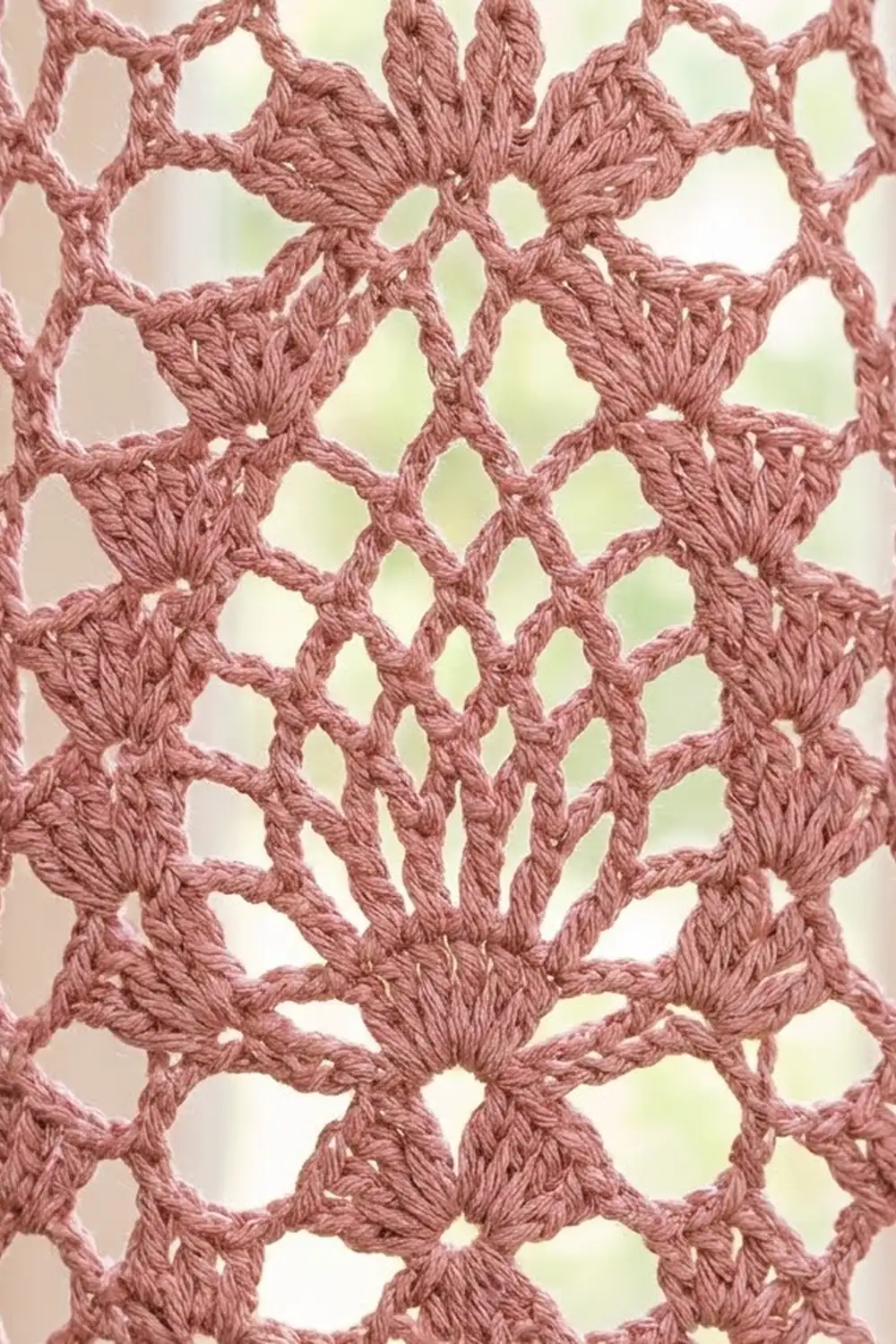
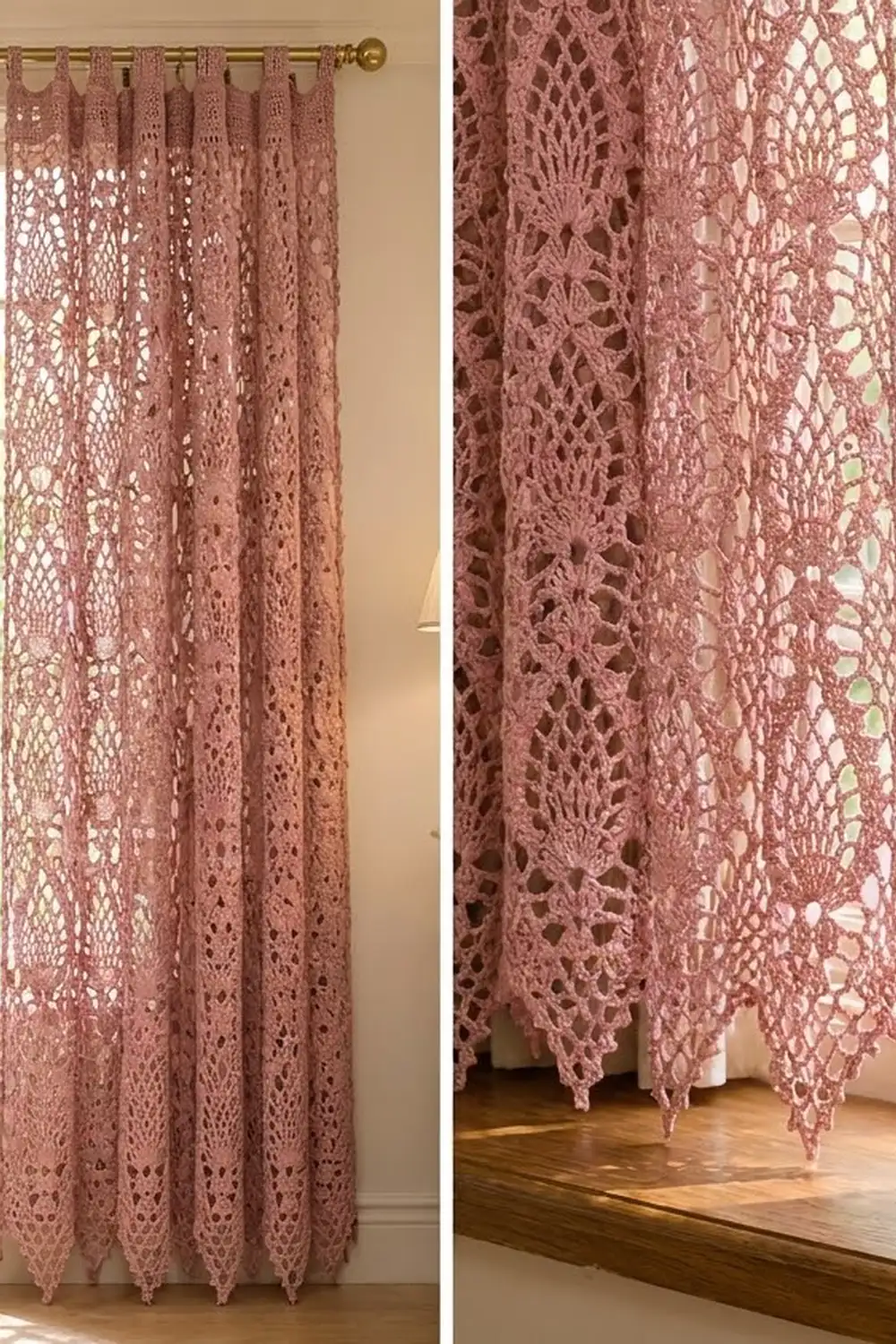
The Rosewood Pineapple Curtain Panel is a tall lace panel made of stacked pineapple columns. Shell columns and chain mesh run between the pineapples, the top has a sturdy band with tabs, and the hem ends in pointed triangles. Worked in one dusty rose cotton, it lets soft light through and looks vintage without feeling fussy.
This pattern uses US crochet terms throughout. Each panel measures 41¼ in (104.8 cm) wide by 78½ in (199.4 cm) long from the top band to the point tips. The tabs add 3 in (7.6 cm), for an overall hanging length of 81½ in (207.0 cm).
The panel is worked in one piece from the top down. You start with a solid header, then work nine tiers of six pineapple columns. A row of chain loops sets up the hem, and you then work the six points one at a time. Last, you add a picot edging to both long sides and a top band with eight tabs.
The photo shows a matching pair. Make two identical panels for a window. They hang separately and are never joined.
Finished Size and Construction
- Finished size: 41¼ x 78½ in (104.8 x 199.4 cm), plus 3 in (7.6 cm) tabs
- Skill level: Intermediate
- Terminology: US
- Yarn weight: DK (#3) cotton
- Hook: 4.5 mm (US 7)
- Number of pieces: 1 per panel (make 2 for a pair, not joined)
- Layout: 6 pineapple columns across, 9 tiers down, 6 hem points
- Piece size before border: 40¼ x 78 in (102.2 x 198.1 cm), including points
- Border depth: ½ in (1.3 cm) on each long side and across the top
Materials
Choose a smooth, mercerized or combed DK cotton. Cotton blocks crisply, holds the pineapple shape and hangs straight. Avoid acrylic for curtains, because it stretches and loses its points in sunlight.
- Dusty Rose: 1,100 g / 2,420 m per panel (2,200 g / 4,840 m for a pair)
These quantities include a margin of about 10 percent. Buy all the yarn from one dye lot.
Tools:
– 4.5 mm (US 7) crochet hook
– Tapestry needle
– Stitch markers
– Rust-proof pins and blocking mats or a clean carpet
– Tape measure
– Spray bottle
Abbreviations (US Terms)
- ch: chain
- sl st: slip stitch
- sc: single crochet
- dc: double crochet
- tr: treble crochet
- sk: skip
- sp: space
- tch: turning chain
- RS / WS: right side / wrong side
Special stitches:
– Shell: (2 dc, ch 2, 2 dc) in the stitch or space given.
– S: shell in the ch-2 sp of the next shell.
– V-st: (dc, ch 3, dc) in the stitch given.
– Picot: ch 3, sl st in the 3rd ch from the hook.
– Side loop: a ch-3 loop between a shell and the pineapple.
Gauge and Checkpoints
Gauge: In the header, 15 dc and 8 rows = 4 in (10.2 cm). One 24-stitch pineapple repeat = 6.4 in (16.3 cm) wide, and one 14-row tier = 8 in (20.3 cm) long, both measured after blocking.
Test one repeat first. Ch 33. Work Rows 1–4 (31 dc), then Rows 5–18 with one pineapple (the * section is worked once). Block the swatch. It should measure about 8¼ in (21.0 cm) wide by 10 in (25.4 cm) long.
Checkpoints:
– After Row 4: 40¼ in (102.2 cm) wide, 2 in (5.1 cm) long
– After Row 18 (1 tier): 10 in (25.4 cm) long
– After Row 74 (5 tiers): 42 in (106.7 cm) long
– After Row 130 (9 tiers): 74 in (188.0 cm) long
– After the hem row: 74½ in (189.2 cm) long
– After the points: 78 in (198.1 cm) long
If your swatch is too big, go down half a hook size. If it is too small, go up half a size. Lace stretches when it hangs, so match the length checkpoints closely.
Header
Ch 153.
Row 1 (RS): Dc in the 4th ch from hook and in each ch across. Turn. (151 dc; the skipped ch count as 1 dc)
Rows 2–4: Ch 3 (counts as dc throughout), dc in each dc across, ending with dc in the top of the tch. Turn. (151 dc)
Pineapple Tier (Rows 5–18)
Odd rows are RS rows. Each tier has 7 shell columns and 6 pineapples.
Row 5 (RS): Ch 3, sk 2 dc, shell in next dc, ch 6, sk 11 dc, V-st in next dc, ch 6, sk 11 dc, shell in next dc; rep from * 5 more times, sk 2 dc, dc in tch. Turn.
(7 shells, 6 V-sts, 12 ch-6 sps. Check: 1 + 2 + 1 + 6 × 24 + 2 + 1 = 151)*
Row 6 (WS): Ch 4 (counts as tr), S, ch 3, sc in ch-6 sp, ch 3, 10 tr in V-st sp, ch 3, sc in ch-6 sp, ch 3, S; rep from * across, tr in tch. Turn.
(Each pineapple: 10 tr, 2 side loops each side)*
Row 7 (RS): Ch 4, S, ch 3, sk next side loop, sc in next side loop, ch 3, tr in first tr, (ch 1, tr in next tr) 9 times, ch 3, sc in next side loop, ch 3, sk last side loop, S; rep from * across, tr in tch. Turn.
(Each pineapple: 10 tr, 9 ch-1 sps, 2 side loops each side)*
Row 8 (WS, gain row): Ch 3, S, ch 3, (sc in next side loop, ch 3) 2 times, sc in first ch-1 sp, (ch 3, sc in next ch-1 sp) 8 times, (ch 3, sc in next side loop) 2 times, ch 3, S; rep from * across, dc in tch. Turn.
(Pineapple: 8 loops, 3 side loops each side)*
From here on, each row uses one of two side rules:
- Even rows (gain): Ch 3, (sc in next side loop, ch 3) across the side. This adds 1 side loop.
- Odd rows (hold): Ch 3, sk the side loop beside the shell, then (sc in next side loop, ch 3) across the side. On the far side, mirror it and skip the last side loop before the shell. The side loop count stays the same.
In every pineapple row, sc in the first pineapple loop, then (ch 3, sc in next loop) across. Each row has 1 loop fewer than the row before.
Rows 9–17: Work these rows from the table, starting each row with ch 3, S, ending each row with S, dc in tch, and turning.
| Row | Side | Pineapple loops | Side loops (each side) | Loops per repeat |
|---|---|---|---|---|
| 9 | RS hold | 7 | 3 | 13 |
| 10 | WS gain | 6 | 4 | 14 |
| 11 | RS hold | 5 | 4 | 13 |
| 12 | WS gain | 4 | 5 | 14 |
| 13 | RS hold | 3 | 5 | 13 |
| 14 | WS gain | 2 | 6 | 14 |
| 15 | RS hold | 1 | 6 | 13 |
| 16 | WS gain | tip | 7 | 14 |
Row 16 tip detail: Ch 3, S, ch 3, (sc in next side loop, ch 3) 6 times, sc in the single pineapple loop, (ch 3, sc in next side loop) 6 times, ch 3, S; rep from * across, dc in tch. Turn. (14 loops per repeat)*
Row 17 (RS, conversion row): Ch 3, 4 dc in first shell sp, (2 dc in next loop, dc in next loop) 7 times, 3 dc in next shell sp; rep from * 4 more times, (2 dc in next loop, dc in next loop) 7 times, 4 dc in last shell sp, dc in tch. Turn.
(Each repeat: 14 loops worked with 1 or 2 dc each = 21 dc, + 3 dc in the shell sp = 24 dc. Total: 1 + 4 + 5 × 24 + 21 + 4 + 1 = 151 dc)*
Wait, the table runs through Row 16. Here is the corrected row order: Rows 9–16 come from the table, Row 17 is the conversion row, and Row 18 closes the tier.
Row 18 (WS): Ch 3, dc in each dc across. Turn. (151 dc)
Rows 5–18 form one tier: 14 rows, 8 in (20.3 cm).
Rows 19–130: Repeat Rows 5–18 eight more times, for 9 tiers in total. Do not fasten off.
Pointed Hem
Row 131 (RS): Ch 1, sc in first dc, ch 5, sk 4 dc, sc in next dc; rep from * 29 more times. (31 sc, 30 ch-5 loops. Check: 1 + 30 × 5 = 151)*
Each point is worked over a group of 5 loops. The 6 points sit under the 6 pineapple columns.
Point Row 1 (WS): Turn, sl st in the first 3 ch of the first loop, ch 1, sc in the same loop, (ch 5, sc in next loop) 4 times. (4 loops)
Point Row 2: Turn, sl st in the first 3 ch, ch 1, sc in the same loop, (ch 5, sc in next loop) 2 times. (3 sc, 2 loops)
Correction for even narrowing, so that each row loses exactly 1 loop: in Point Row 2, work (ch 5, sc in next loop) 3 times, for 3 loops. Use the same method in the next rows.
Point Row 3: As Row 2, working the repeat 2 times. (2 loops)
Point Row 4: As Row 2, working the repeat once. (1 loop)
Point Row 5 (tip): Turn, sl st in the first 2 ch, (2 dc, picot, 2 dc) in the last loop. Fasten off.
With WS facing, join yarn with a sl st in the first loop of the next group of 5. Work Point Rows 1–5 again. Repeat until all 6 points are done. The shared sc between groups forms a V-notch between neighboring points. The points add 3½ in (8.9 cm).
Make the second panel the same way.
Border
Border gauge: 15 sc = 4 in (10.2 cm) along the edges. That works out to 2 sc per dc row-end and 3 sc per tr row-end. One tier has 2 tr rows and 12 dc-height rows, so it takes 2 × 3 + 12 × 2 = 30 sc, which fits its 8 in (20.3 cm) length.
Side Edging (each long side)
Row 1 (RS): With RS facing, join yarn at the top corner of the side. Work 8 sc along the header (2 per row), then 30 sc along each tier (270 sc), then 1 sc in the end of the hem row. Turn. (279 sc)
Row 2: Ch 1, sc in first 3 sc, picot, sc in next 3 sc; rep from * 91 more times. Fasten off. (279 sc, 92 picots)*
Why it works: 8 + 9 × 30 + 1 = 279, and 279 = 3 + 92 × 3. The picots space out evenly and finish with a solid group of 3 sc at the end. The edge stops at the hem row, so the points stay free.
Top Band and Tabs
Row 1 (RS): With RS facing, join yarn at the right top corner. Work 2 sc across the side edging row-ends, 151 sc across the free loops of the foundation chain (150 loops plus 1 at the base of the tch), and 2 sc across the other side edging. Turn. (155 sc)
Row 2: Ch 1, sc in each sc across. Do not turn. Fasten off. (155 sc)
Tabs: Each tab is 8 sc wide, and there are 13 sc between neighboring tabs. Join yarn in sc 1 for Tab 1, sc 22 for Tab 2, and every 21st sc after that, so Tab 8 starts in sc 148.
Each tab: Ch 1, sc in the next 8 sc. Turn. Work 19 more rows of 8 sc (20 rows in total), which makes a 6 in (15.2 cm) strip. Fold the strip to the WS and sew its last row along the base of Row 2. This makes a 3 in (7.6 cm) loop.
Why it works: 8 tabs × 8 sc + 7 gaps × 13 sc = 64 + 91 = 155. Both end tabs sit flush with the corners. Each tab is about 2 in (5.1 cm) wide, with about 3½ in (8.9 cm) between tabs.
Final Blocking
- Weave in all ends along the dc bands or shell columns, where they hide best.
- Soak the panel in cool water with a little wool wash for 15 minutes.
- Press out the water by rolling the panel in towels. Do not wring it.
- Lay the panel flat and pin the top band straight to 41¼ in (104.8 cm).
- Pin both long sides parallel, 78½ in (199.4 cm) from the top band to the point tips.
- Pin each point tip down, then pin the top of each pineapple fan so the columns run straight.
- Pin the tabs flat. Let everything dry completely.
Final Quality-Control Checklist
- Each tier has 6 pineapples that narrow to a single tip.
- Rows 17 and 18 each have exactly 151 dc.
- The hem row has 30 loops, and there are 6 complete points.
- Each side edge has 279 sc and 92 picots.
- The top band has 155 sc and 8 evenly spaced tabs.
- Both panels match in length to within ½ in (1.3 cm).
Troubleshooting
The pineapple pulls narrow: You may be skipping side loops on gain rows. Check your counts against the table.
The edges ripple: Work the side edging more firmly, or use a hook half a size smaller for the border.
The points curl: Re-wet only the hem and pin each tip down until it is dry.
The conversion row is not 151: Recount the side loops in Row 16. There should be 7 on each side of every tip.
One panel is longer than the other: Block both panels together and pin them to the same measurement.
Care
Hand wash cool or machine wash on a gentle cycle in a mesh bag, then reshape and dry the panel flat. Rehang it slightly damp so the lace settles straight.
Final Notes
The measurement chain is:
- 15 dc = 4 in (10.2 cm)
- 151 dc = 40¼ in (102.2 cm) across
- 1 tier = 8 in (20.3 cm), and 9 tiers plus the header and hem = 78 in (198.1 cm)
- The border brings the panel to 41¼ x 78½ in (104.8 x 199.4 cm)
- The tabs add 3 in (7.6 cm)
If you match gauge at the swatch and at each checkpoint, both panels will hang evenly at your window.
Happy crocheting!