

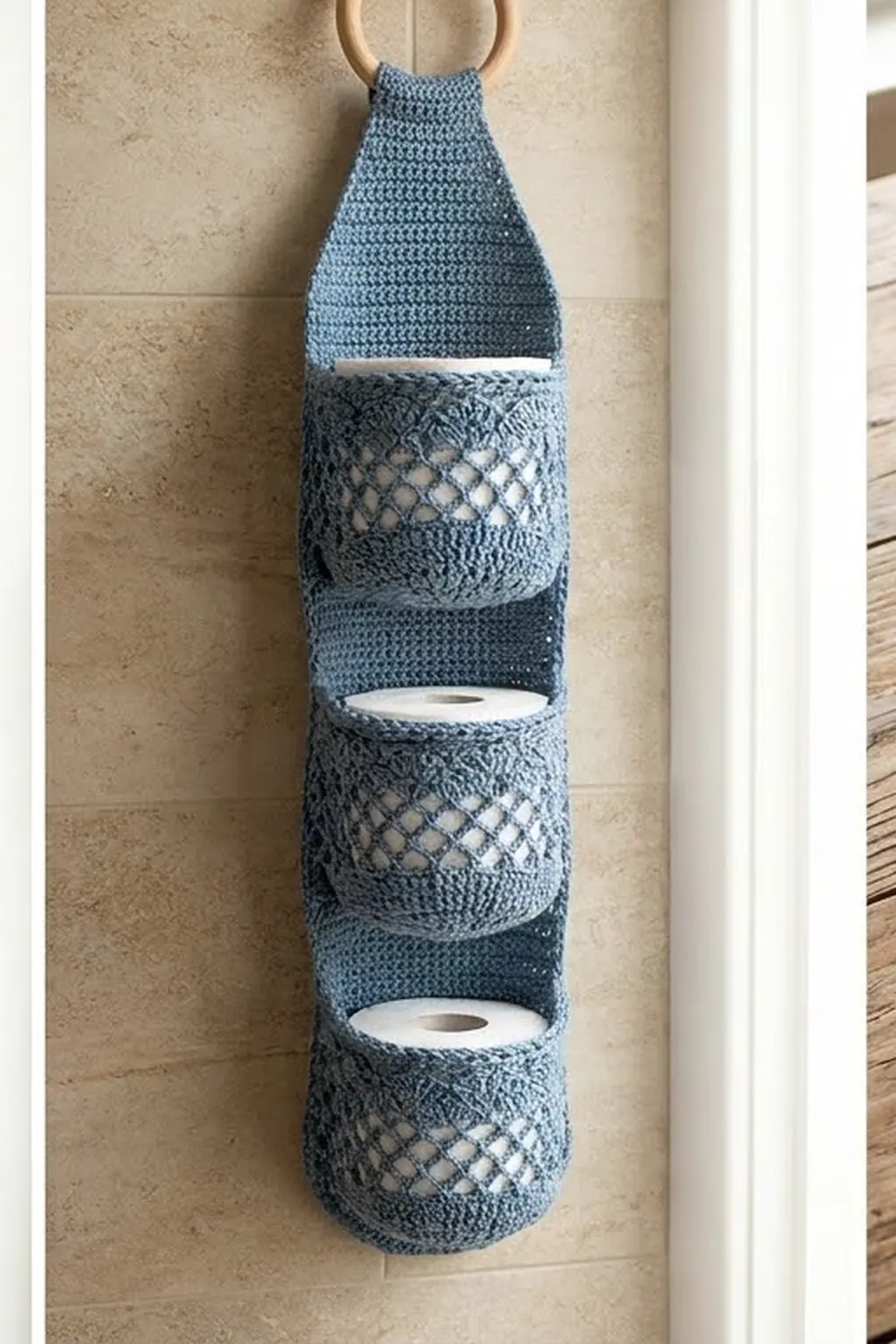
The Seaspray Fan Lace Toilet Paper Holder is a hanging bathroom organizer with three spare rolls held in lacy half-bowl pockets. A solid back panel keeps it neat against the wall, and the pockets add an airy, vintage look.
The whole piece is worked in one color, a soft dusty blue. The panel uses plain single crochet. Each pocket shows the same lace sequence: a small fan at the base, a diamond chain-loop net, a row of dc fans, a second net and fan row, and a corded reverse single crochet rim. A wooden ring at the top is used to hang it.
This pattern uses US crochet terms. The finished back panel measures 5 1/2 in (14.0 cm) wide and 27 1/2 in (69.9 cm) long before the strap is folded. Once it is hanging, it measures about 25 1/4 in (64.1 cm) from the ring to the bottom edge.
The construction is simple. You crochet one back panel in rows. Next you make three flat semicircle pockets in turned rows and sew each one onto the panel in a V shape, which turns it into a cone-shaped pocket. One round of edging locks everything together, and the strap is folded around the ring and sewn down.
Finished Size and Construction
- Finished size: 5 1/2 in (14.0 cm) wide x 27 1/2 in (69.9 cm) long, flat
- Skill level: Intermediate
- Terminology: US crochet terms
- Yarn weight: Worsted (#4), cotton
- Hook: 5.0 mm (H-8)
- Number of pieces: 4 (1 back panel + 3 pockets)
- Layout: 3 pockets stacked vertically, 1 column
- Piece sizes: panel 5 in (12.7 cm) x 27 in (68.6 cm); each pocket is a semicircle 10 in (25.4 cm) across with a 5 in (12.7 cm) radius
- Panel size before border: 5 in x 27 in (12.7 cm x 68.6 cm)
- Border depth: 1/4 in (0.6 cm) per side
Materials
Yarn: Use a smooth worsted-weight cotton or cotton blend. Cotton holds the pocket shape, survives bathroom humidity and washes well. Avoid very stretchy acrylic, because the panel carries the weight of three rolls.
- Dusty blue: 250 g (about 425 m / 465 yd)
Tools:
– 5.0 mm (H-8) crochet hook
– 3 in (7.6 cm) wooden ring
– Tapestry needle
– 8 or more locking stitch markers
– Rustproof pins
– Tape measure
– Scissors
– Spray bottle and blocking surface
Yarn quantities include a margin of about 15% for gauge differences and the gauge swatch.
Abbreviations (US Terms)
- ch – chain
- sl st – slip stitch
- sc – single crochet
- dc – double crochet
- sc2tog – single crochet 2 together
- rev sc – reverse single crochet (crab stitch)
- MR – magic ring
- st(s) – stitch(es)
- sp – space
- tch – turning chain
- RS / WS – right side / wrong side
Special stitches:
- Reverse single crochet (rev sc): Without turning, work from left to right (right-handed). Insert the hook into the next stitch to the right, yarn over, pull up a loop, then yarn over and pull through both loops. This makes the corded rim.
- 5-dc fan: Work 5 dc into the same chain loop.
Gauge and Checkpoints
Panel gauge: 16 sc x 16 rows = 4 in (10.2 cm) square. Because each row is as tall as each stitch is wide, the border later goes in at one sc per row end with no extra math.
Pocket gauge: Make one pocket before you start the panel. Each dc-height row adds about 1/2 in (1.3 cm) of radius.
Checkpoints:
– Panel after Row 16: 5 in (12.7 cm) wide and 4 in (10.2 cm) tall
– Panel after Row 80: 20 in (50.8 cm) tall
– Pocket after Row 3: radius 1 1/2 in (3.8 cm)
– Pocket after Row 6: radius 3 in (7.6 cm)
– Pocket after Row 9: radius 4 1/2 in (11.4 cm)
– Pocket after Row 12: radius 5 in (12.7 cm), straight edge 10 in (25.4 cm), rim 13 in (33.0 cm)
If your pieces are too big: go down 0.5 mm in hook size. If they are too small: go up 0.5 mm. The pocket radius matters more than the exact width. A pocket that is too large will droop, and one that is too small will not fit a standard roll.

Back Panel
Foundation: Ch 21.
Row 1 (RS): Sc in the 2nd ch from the hook and in each ch across. (20 sc)
Rows 2–80: Ch 1, turn, sc in each sc across. (20 sc)
Checkpoint: the panel measures 5 in x 20 in (12.7 cm x 50.8 cm).
Shoulder taper:
Row 81: Ch 1, turn, sc2tog, sc in each sc to the last 2 sts, sc2tog. (18 sc)
Row 82: Ch 1, turn, sc in each sc across. (18 sc)
Rows 83–92: Repeat Rows 81–82 five more times, decreasing 2 sts on each odd row. The odd-row counts are 16, 14, 12, 10 and 8 sc. Row 92 has 8 sc.
Checkpoint: the taper is 12 rows, or 3 in (7.6 cm), tall and narrows from 5 in (12.7 cm) to 2 in (5.1 cm).
Strap:
Rows 93–108: Ch 1, turn, sc in each sc across. (8 sc)
Fasten off and weave in the ends.
Checkpoint: the strap is 4 in (10.2 cm) long. The panel is 108 rows and 27 in (68.6 cm) long in total.
Pocket (Make 3)
Work in turned rows. Each row makes a larger half-circle. The row ends form the straight edge (the diameter), and the last rows form the curved rim.
Row 1: MR, ch 3 (counts as dc), 6 dc in the ring. Pull the ring tight. (7 dc)
Row 2: Ch 4 (counts as dc + ch 1), turn, dc in the next dc, ch 1, repeat from * 4 more times, dc in the top of the tch. (7 dc, 6 ch-1 sps)
Row 3 (center fan): Ch 3 (counts as dc), turn, 3 dc in each of the 6 ch-1 sps, dc in the 3rd ch of the tch. (20 dc: 1 + 18 + 1)
This row makes the small radiating fan at the bottom of the pocket.
Checkpoint: radius 1 1/2 in (3.8 cm).
Row 4 (net): Ch 1, turn, sc in the first dc, ch 5, sc in the center dc of the next 3-dc group, repeat from * 5 more times, ch 5, sc in the top of the tch. (8 sc, 7 ch-5 loops)
Row 5 (net): Ch 1, turn, sc in the first sc, ch 5, sc in the first loop, ch 5, sc in the next loop, repeat from * 5 more times, ch 5, sc in the last sc. (9 sc, 8 ch-5 loops)
Row 6 (fan row): Ch 3 (counts as dc), turn, 5-dc fan in each of the 8 loops, dc in the last sc. (42 dc: 1 + 40 + 1)
Checkpoint: radius 3 in (7.6 cm).
Row 7 (net): Ch 1, turn, sc in the first dc, ch 5, sc in the center (3rd) dc of the next fan, repeat from * 7 more times, ch 5, sc in the top of the tch. (10 sc, 9 ch-5 loops)
Row 8 (net): Ch 1, turn, sc in the first sc, ch 5, sc in the first loop, ch 5, sc in the next loop, repeat from * 7 more times, ch 5, sc in the last sc. (11 sc, 10 ch-5 loops)
Row 9 (fan row): Ch 3 (counts as dc), turn, 5-dc fan in each of the 10 loops, dc in the last sc. (52 dc: 1 + 50 + 1)
Checkpoint: radius 4 1/2 in (11.4 cm).
Rim:
Row 10: Ch 1, turn, sc in each dc across, including the top of the tch. (52 sc)
Row 11: Ch 1, turn, sc in each sc across. (52 sc)
Row 12: Ch 1, do not turn, rev sc in each sc across. (52 rev sc)
Fasten off and leave a 24 in (61.0 cm) tail for sewing.
Checkpoint: radius 5 in (12.7 cm), straight edge 10 in (25.4 cm), rim 13 in (33.0 cm). The 52-st rim is a little shorter than a true flat arc. That is intentional: it pulls the opening in slightly so the rim hugs the roll.
Make All Pieces
All pieces are dusty blue:
- Back panel: 1
- Pockets: 3
Layout (back panel rows counted from the bottom):
          (  RING  )
          [ STRAP  ]   Rows 93–108
         /  TAPER   \  Rows 81–92
   [ POCKET 1 ]  corners Row 74, point Row 57
   |   panel  |
   [ POCKET 2 ]  corners Row 46, point Row 29
   |   panel  |
   [ POCKET 3 ]  corners Row 18, point Row 1
The pockets repeat every 28 rows (7 in / 17.8 cm). The bottom point of each upper pocket sits 11 rows (2 3/4 in / 7.0 cm) above the rim corners of the pocket below. This leaves a strip of panel visible between the pockets.
Joining
Method: Whip stitch the straight edge of each pocket to the RS of the panel, using the pocket’s yarn tail.
Placement (bottom pocket shown):
- Fold the pocket in half at the magic ring. The two halves of the straight edge are the left and right sides of the V.
- Pin the magic ring to the center of panel Row 1, between sts 10 and 11.
- Pin the left rim corner (the ends of Rows 10–12) to st 1 of Row 18. Pin the right rim corner to st 20 of Row 18.
- Pin the end of Row 6 halfway along each side: at Row 11, st 5 on the left and st 16 on the right.
Repeat for the middle pocket (point at Row 29, corners at Row 46, Row 6 ends at Row 39) and the top pocket (point at Row 57, corners at Row 74, Row 6 ends at Row 67).
Stitch-to-stitch logic: Each half of the straight edge has 12 row ends and measures 5 in (12.7 cm). On the panel, the line from the point to a corner rises 17 rows (4 1/4 in / 10.8 cm) and moves about 2 1/2 panel sts sideways, which is also about 5 in long. Make 2 whip stitches into each dc or net row end and 1 into each sc rim row end. Catch one panel st each time, and follow the pinned line.
Tension: Pull each stitch snug but not tight. If the seam puckers, the panel will bow and the pocket will twist.
Size checkpoint: the panel should still lie flat at 5 in x 27 in (12.7 cm x 68.6 cm). Each pocket should cup forward about 4 in (10.2 cm) and reach slightly past the panel edges at the rim.
Border
Border gauge: 4 sc per inch (2.5 cm), along both stitches and row ends.
Round 1 (RS): Join the yarn at the bottom right corner.
- Bottom edge: 1 sc in each foundation ch. (20 sc)
- Bottom left corner: ch 1.
- Left side: 1 sc in each row end of Rows 1–80 (80 sc), then 13 sc evenly along the taper (12 row ends + 1 extra at the midpoint), then 1 sc in each strap row end (16 sc). (109 sc)
- Top left corner: ch 1.
- Strap top: 1 sc in each st. (8 sc)
- Top right corner: ch 1.
- Right side: Work the same as the left side in reverse. (109 sc)
- Bottom right corner: ch 1, sl st to the first sc.
Total: 246 sc (20 + 109 + 8 + 109) plus 4 ch-1 corner sps. The ch-1 corners are not included in the side counts.
At Rows 18, 46 and 74 on each side, work the sc through both the panel row end and the pocket’s rim row ends. This locks the pocket corners in place.
Why the math works: The panel gauge is square (4 sts and 4 rows per inch), so 1 sc per row end matches 1 sc per stitch, and the edges stay flat. The taper is a slant 12 rows tall that moves 1 1/2 in sideways, so its edge is slightly longer than its height. The 1 extra sc covers that difference. The border adds 1 st to each side, so the width goes from 5 in to 5 1/2 in (12.7 cm to 14.0 cm).
Finish: Fasten off. Pass the strap through the ring from front to back. Fold it down 2 in (5.1 cm) and whip stitch the strap end to the back of the panel at Row 92.
Final Blocking
- Spray the whole piece with water until it is damp but not dripping.
- Lay it RS up on a blocking surface, with the pockets lying forward.
- Pin the panel straight at 5 1/2 in (14.0 cm) wide and check that both long edges are parallel.
- Wrap 3 toilet rolls in plastic bags and set one in each pocket to shape the cups.
- Open the net loops gently and spread each fan with your fingers.
- Roll the rev sc rims between your fingers so the corded edge sits upright.
- Let it dry completely, at least 24 hours, before you remove the rolls.
Final Quality-Control Checklist
- Panel is 20 sts wide and 80 body rows long, with 12 taper rows and 16 strap rows
- Every pocket has 52 rim sts and a 5 in (12.7 cm) radius
- Each pocket point is centered on the panel
- Rim corners on each pocket sit on the same row
- Pockets repeat every 28 rows
- Border is 246 sc plus 4 ch-1 corners
- Strap is sewn securely and the ring turns freely
- All ends are woven in through solid sc, not through lace
Troubleshooting
- Pocket ruffles: your ch-5 loops are too loose. Work ch 4 loops, or go down a hook size.
- Pocket curls into a cup before sewing: your fans are too tight. Go up 0.5 mm for Rows 6 and 9.
- Roll does not fit: your radius is short of 5 in (12.7 cm). Add one extra sc row before the rev sc.
- Panel stretches when loaded: your sc is too loose. Go down a hook size, or line the back with felt.
- Border waves: you have too many sc along the row ends. Recount to 109 per side.
- Pocket leans: the V seam is uneven. Re-pin the Row 6 ends and resew.
Care
Hand wash in cool water with mild soap, press out the water in a towel, and lay it flat with a roll in each pocket to dry. Do not tumble dry.
Final Notes
The measurement chain is short and easy to check. The 16-st gauge gives a 5 in (12.7 cm) panel and a 20 in (50.8 cm) body. Twelve taper rows add 3 in (7.6 cm), and 16 strap rows add 4 in (10.2 cm). Twelve pocket rows give a 5 in (12.7 cm) radius and a 52-st rim. The border brings the panel to 5 1/2 in x 27 1/2 in (14.0 cm x 69.9 cm). Check each stage as you go, and the three pockets will hang evenly.
Happy crocheting!