

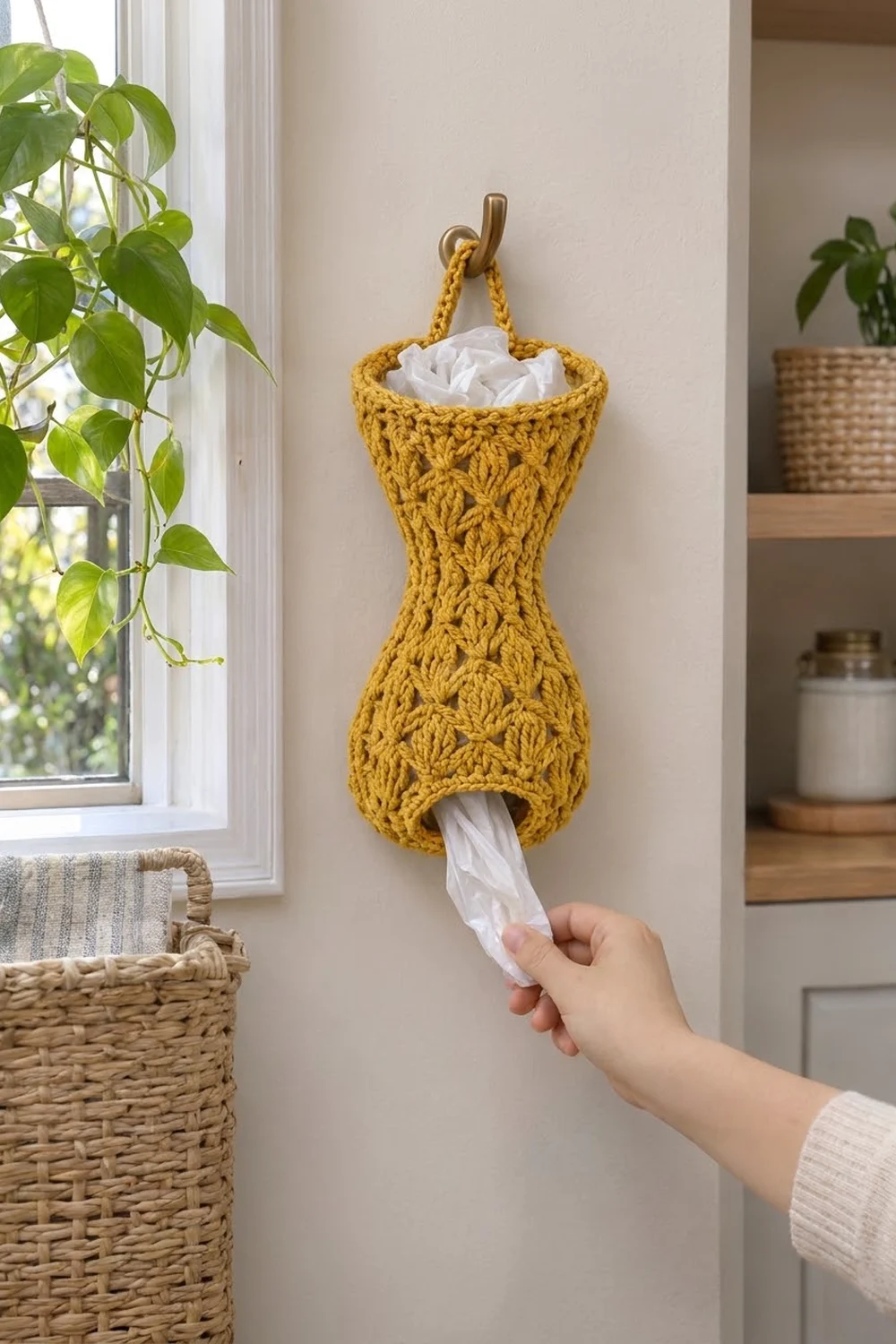
The Marigold Hourglass is a hanging plastic bag holder with a curvy silhouette. It has a rounded bulb at the bottom, a nipped-in waist and a gentle flare up to a ribbed top band. You stuff bags in through the top and pull them out, one at a time, through a round opening in the base.
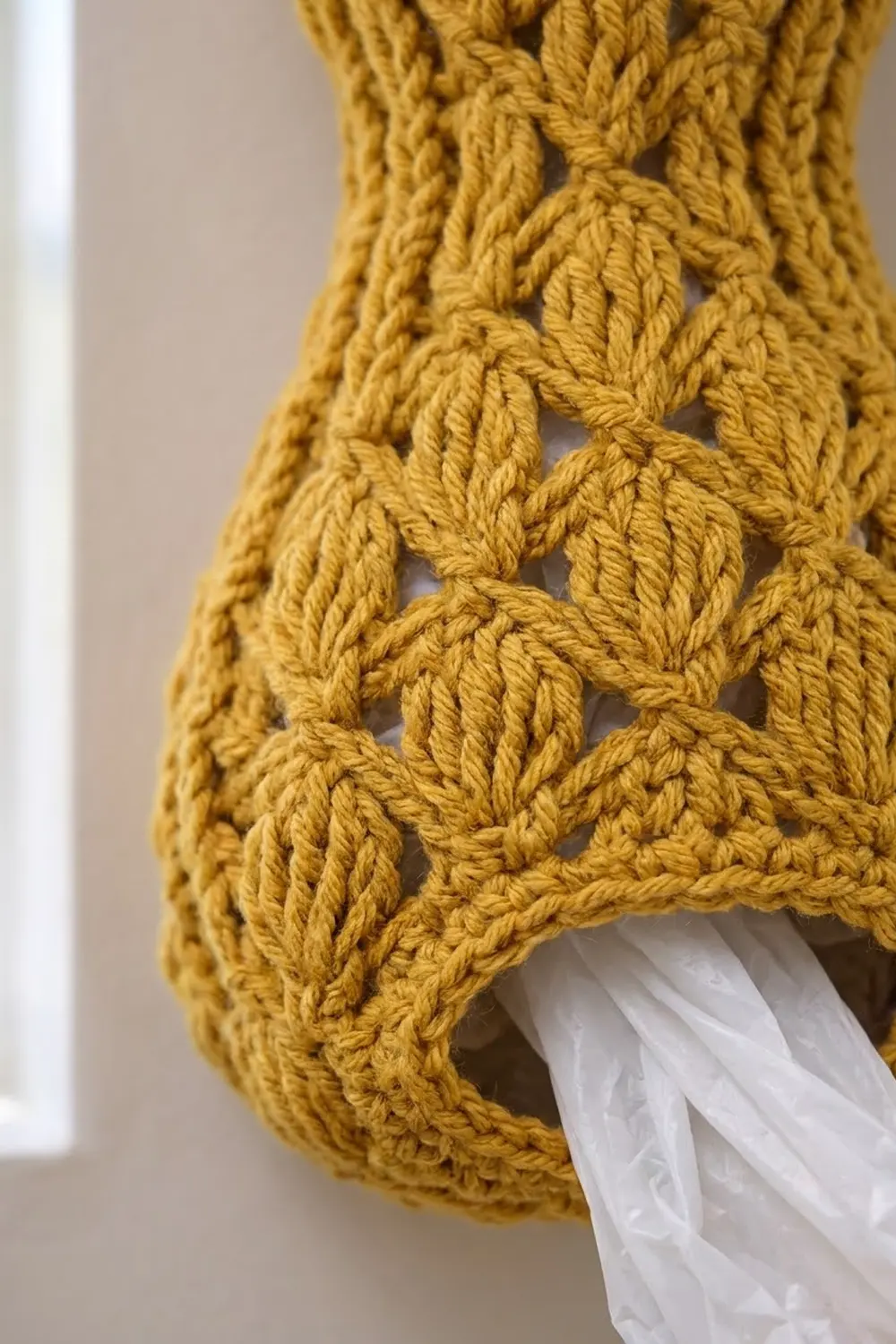
The whole holder is made in one warm mustard yellow. The surface is an open lattice of raised three-double-crochet clusters arranged in offset diamonds, so it looks like rows of little leaves. A firm, knit-look band finishes the top, and a narrow strap at the back hangs it from a hook.
This pattern uses US crochet terms. The finished holder is about 16 in (40.6 cm) tall when hanging, not counting the strap. Lying flat, it measures 7.5 in (19.1 cm) across at the bulb and the top and 4.5 in (11.4 cm) across at the waist.
It is worked in one seamless piece from the bottom up. You start with a chain ring that becomes the dispensing opening, increase a flat base, and then work the cluster lattice in the round. Plain single crochet rounds between the lattice sections change the width. A camel-stitch band, the opening edge and the strap finish it off.
Finished Size and Construction
- Finished size: 7.5 in (19.1 cm) wide x 16 in (40.6 cm) tall, measured flat and hanging, strap not included
- Skill level: Intermediate
- Terminology: US crochet terms
- Yarn weight: Worsted (#4)
- Hook: 5.0 mm (H-8)
- Number of pieces: 1 seamless piece, plus the strap worked directly onto the top edge
- Layout: Tube worked in joined rounds from the bottom up; no seams
- Piece size: 60 sts around at the bulb and the top (15 in / 38.1 cm circumference), 36 sts at the waist (9 in / 22.9 cm circumference)
- Size before border: about 15 in (38.1 cm) tall, measured from the edge of the base to the last leveling round
- Border depth: 1.25 in (3.2 cm) top band; 1 round around the opening
Materials
Yarn: Use a smooth worsted-weight yarn. A cotton blend or a sturdy acrylic works best because the clusters show up clearly and the holder keeps its shape when it’s full. Avoid fuzzy or very stretchy yarn, which blurs the lattice and lets the waist sag.
- Mustard yellow: 160 g, about 275 m (300 yd)
Tools:
- 5.0 mm (H-8) crochet hook
- 6.0 mm (J-10) hook for the foundation chain (optional, keeps the opening stretchy)
- 4.5 mm (G-7) hook (optional, for tension fixes)
- 4 stitch markers
- Tapestry needle
- Scissors
- Measuring tape
- Spray bottle and blocking pins
The yarn quantity includes a margin of about 20% to cover your gauge swatch and small tension differences.
Abbreviations (US Terms)
- ch – chain
- sl st – slip stitch
- sc – single crochet
- sc2tog – single crochet 2 together
- hdc – half double crochet
- dc – double crochet
- st(s) – stitch(es)
- sp – space
- rnd(s) – round(s)
Special stitches
- Cluster (cl): *Yarn over, insert hook in the stitch, pull up a loop, yarn over and pull through 2 loops; repeat from * 2 more times in the same stitch, then yarn over and pull through all 4 loops on the hook.
- Shell: (cl, ch 3, cl) in the same stitch. Each shell counts as 5 sts: 1 cl, 3 ch and 1 cl.
- Camel hdc: An hdc worked into the third loop, the horizontal bar just below the top two loops on the back of the stitch. This pushes the top loops to the front and creates the knit-look rib.
Gauge and Checkpoints
- Sc gauge: 16 sc and 18 rnds = 4 in (10.2 cm)
- Lattice gauge: 1 repeat (6 sts) = 1.5 in (3.8 cm) wide; 4 lattice rnds = 3 in (7.6 cm) tall
Your test piece is the base. Work Rnds 1–6, lay it flat and measure across the outer edge. It should be 4.8 in (12.2 cm) in diameter. If it’s bigger, go down half a hook size. If it’s smaller, go up half a hook size. Then start again.
Checkpoints, measured flat from the outer edge of the base:
- After Rnd 6: base diameter 4.8 in (12.2 cm)
- After the bulb: height about 4.25 in (10.8 cm), width 7.5 in (19.1 cm)
- After the waist: height about 8.75 in (22.2 cm), width 4.5 in (11.4 cm)
- After the upper flare: height about 13.5 in (34.3 cm), width 7.5 in (19.1 cm)
If your lattice is taller than 0.75 in (1.9 cm) per round, work the clusters more firmly or use a smaller hook. If the holder is too wide, go down a hook size. Changing the stitch counts would break the 6-stitch repeat.
Pattern
Round notes: Join each round with a sl st to the first st. The ch 1 at the start of a round does not count as a stitch. In the lattice section, the start of each round moves about 3 sts to the left. That’s normal. The holder has no fixed front until you add the strap.
Base and Opening
Using the larger hook (or your main hook, loosely), ch 30. Join with a sl st to the first ch to form a ring. Don’t twist the chain. Switch to the 5.0 mm hook.
Rnd 1: Ch 1, sc in each ch around. (30 sts)
Rnd 2: Ch 1, *sc in next 4 sts, 2 sc in next st; repeat from * around (6 repeats). (36 sts)
Rnd 3: Ch 1, *sc in next 5 sts, 2 sc in next st; repeat from * around (6 repeats). (42 sts)
Rnd 4: Ch 1, *sc in next 6 sts, 2 sc in next st; repeat from * around (6 repeats). (48 sts)
Rnd 5: Ch 1, *sc in next 7 sts, 2 sc in next st; repeat from * around (6 repeats). (54 sts)
Rnd 6: Ch 1, *sc in next 8 sts, 2 sc in next st; repeat from * around (6 repeats). (60 sts)
The base is now a flat ring 4.8 in (12.2 cm) across with a 2.4 in (6.1 cm) hole in the middle.
Rnds 7–8: Ch 1, sc in each st around. (60 sts)
The edge starts to curl up into the rounded bottom.
Lattice Rounds (used throughout)
Set-up Rnd (worked on a sc round): Ch 1, sc in first st, *skip 2 sts, shell in next st, skip 2 sts, sc in next st; repeat from * around, leaving out the last sc. Sl st to the first sc. Each 6 sts gives 1 sc and 1 shell.
Lattice Rnd: Sl st in top of next cl and into the next ch-3 sp. Ch 1, sc in the same sp, *shell in next sc, sc in next ch-3 sp; repeat from * around, leaving out the last sc, and work the final shell in the sc at the start of the previous round. Sl st to the first sc.
This sets the shells above the single crochets of the previous round and the single crochets in the centers of the shells, which forms the stacked diamonds.
Leveling Rnd: Ch 1, sc in each sc, sc in each cl and 3 sc in each ch-3 sp. That’s 6 sc per repeat.
Bulb
Rnd 9: Set-up Rnd. (10 shells + 10 sc = 60 sts)
Rnds 10–13: Lattice Rnd. (60 sts in each rnd)
Checkpoint: about 4.25 in (10.8 cm) tall and 7.5 in (19.1 cm) wide.
Rnd 14: Leveling Rnd. (60 sts)
Rnd 15 (decrease): Ch 1, *sc in next 3 sts, sc2tog; repeat from * around (12 repeats). (48 sts: 36 sc + 12 sc2tog)
Lower Taper
Rnd 16: Set-up Rnd. (8 shells + 8 sc = 48 sts)
Rnd 17: Lattice Rnd. (48 sts)
Rnd 18: Leveling Rnd. (48 sts)
Rnd 19 (decrease): Ch 1, *sc in next 2 sts, sc2tog; repeat from * around (12 repeats). (36 sts: 24 sc + 12 sc2tog)
Waist
Rnd 20: Set-up Rnd. (6 shells + 6 sc = 36 sts)
Rnds 21–22: Lattice Rnd. (36 sts in each rnd)
Checkpoint: about 8.75 in (22.2 cm) tall and 4.5 in (11.4 cm) wide.
Rnd 23: Leveling Rnd. (36 sts)
Rnd 24 (increase): Ch 1, *sc in next 2 sts, 2 sc in next st; repeat from * around (12 repeats). (36 sts worked 1 per st + 12 added = 48 sts)
Upper Taper
Rnd 25: Set-up Rnd. (8 shells + 8 sc = 48 sts)
Rnd 26: Lattice Rnd. (48 sts)
Rnd 27: Leveling Rnd. (48 sts)
Rnd 28 (increase): Ch 1, *sc in next 3 sts, 2 sc in next st; repeat from * around (12 repeats). (48 sts worked 1 per st + 12 added = 60 sts)
Upper Flare
Rnd 29: Set-up Rnd. (10 shells + 10 sc = 60 sts)
Rnds 30–31: Lattice Rnd. (60 sts in each rnd)
Checkpoint: about 13.5 in (34.3 cm) tall and 7.5 in (19.1 cm) wide.
Rnd 32: Leveling Rnd. (60 sts)
Don’t fasten off. The body measures about 15 in (38.1 cm) from the base edge.
Border: Top Band, Opening Edge and Strap
Border gauge: 16 camel hdc = 4 in (10.2 cm); 4 rnds = 1.25 in (3.2 cm).
Laid flat, the top has 30 sts on the front and 30 sts on the back. That’s 60 sts in total, and both fold points are included in that number, so no corner stitches are added.
Band Rnd 1: Ch 1, hdc in each st around. (60 sts: 30 front, 30 back)
Band Rnds 2–4: Ch 1, camel hdc in each st around. (60 sts in each rnd: 30 front, 30 back)
Band Rnd 5: Ch 1, sl st loosely in each st around. (60 sts) Fasten off.
Why the math works: The band has the same 60 sts as Rnd 32, and 60 sts at the band gauge is 15 in (38.1 cm). That matches the lattice circumference, so the top neither flares nor pulls in. It stays 7.5 in (19.1 cm) wide when flat.
Opening edge: Turn the holder upside down. Join yarn in any free loop of the foundation chain. Ch 1, sc in each free loop around. (30 sts: 15 per side when flattened) Sl st to the first sc and fasten off. This round firms up the edge so bags slide out without stretching the hole.
Strap: Mark the join of Band Rnd 5 and treat it as the center back. Number the band stitches 1–60 counting to the left, so stitch 60 sits just to the right of the join.
Row 1: Join yarn in st 53. Ch 1, sc in sts 53–57. (5 sts) Turn.
Rows 2–36: Ch 1, sc in each st across. Turn. (5 sts in each row)
The strap measures 8 in (20.3 cm). Fasten off, leaving a 12 in (30.5 cm) tail. Without twisting the strap, whipstitch the last row to band sts 4–8. This leaves a 6-st (1.5 in / 3.8 cm) gap centered on the back, and the strap forms an arch that stands about 3.5 in (8.9 cm) above the band.
Final Blocking
- Weave in all ends inside the holder, running each through at least 2 in (5.1 cm) of stitches.
- Stuff the holder firmly with plastic bags or a rolled towel so it takes its hourglass shape.
- Mist it lightly with water until it’s damp but not wet.
- Shape the waist to 4.5 in (11.4 cm) and the bulb and top to 7.5 in (19.1 cm) wide.
- Pull each cluster gently upward with your fingertips so the diamonds open evenly.
- Pin the top band so it stays round. Let the holder dry completely before you remove the stuffing.
Final Quality-Control Checklist
- Height when hanging is 16 in (40.6 cm), without the strap
- Bulb and top are 7.5 in (19.1 cm) wide; waist is 4.5 in (11.4 cm)
- Every lattice round has full repeats with no missing shells
- Diamonds line up in straight vertical columns
- Top band lies flat with no ruffling
- The opening stretches enough for a bag to come out but springs back
- The strap is untwisted and firmly sewn at both ends
- All ends are secured on the inside
Troubleshooting
The opening is too tight. Remake the foundation chain with the larger hook, or work the opening edge in sl sts, which are looser than sc.
The lattice spirals. Make sure every Lattice Rnd starts with the sl st into the ch-3 sp. Starting in the wrong place shifts the shells.
The waist is too wide. Work the clusters more tightly in Rnds 20–22, or use a 4.5 mm (G-7) hook for those rounds only.
The top band flares. Your camel hdc is looser than the lattice. Work the band with a 4.5 mm (G-7) hook.
Shell count is off. Count after each Set-up Rnd. You should have 10, 8 or 6 shells. If not, check that your previous round had a multiple of 6 sts.
The strap stretches. Add a row of sl sts along each long edge, or sew a cotton ribbon behind it.
Care
Hand wash in cool water, press out the water in a towel and dry it flat. Reshape it while damp, stuffed with bags.
Final Notes
The measurement chain is simple. A 4.8 in (12.2 cm) base gives 60 sts, which is 15 in (38.1 cm) around and 7.5 in (19.1 cm) flat. Going down to 48 sts and then 36 sts makes the waist 4.5 in (11.4 cm), and going back up to 60 sts returns the top to 7.5 in (19.1 cm). The 60-st band keeps that width, and the body adds up to about 16 in (40.6 cm) tall when hanging. Check each measurement as you go, and the hourglass will come out right.
Happy crocheting!