

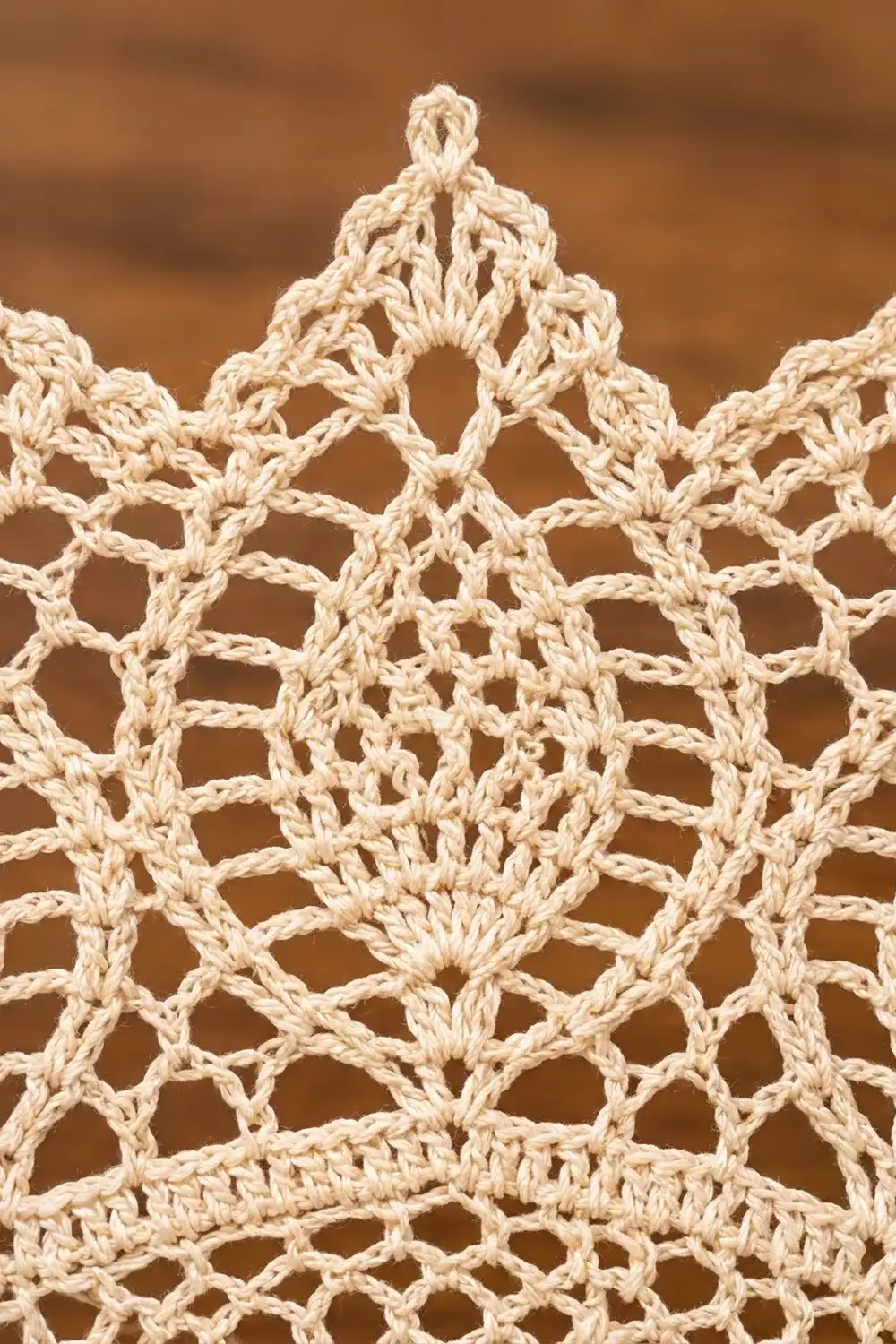
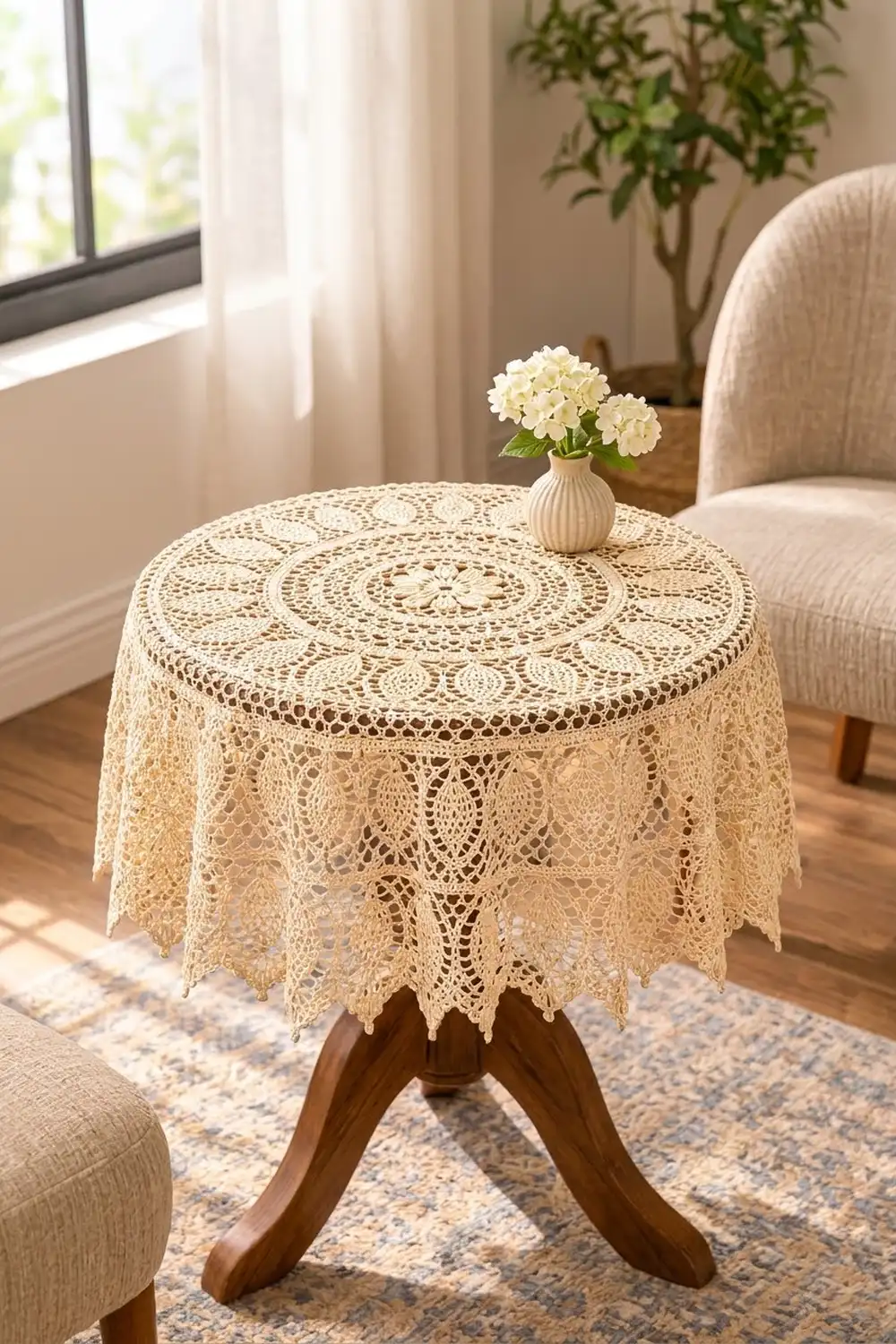
The Ivory Bloom Tablecloth is a round lace cloth worked in one piece from the center out. It starts with a raised eight-petal flower and moves out through open mesh rings. Two rings of pointed pineapple “leaves” follow, and it finishes with a scalloped edge of small picot points.
The whole cloth uses one cream or ivory cotton. With a single color, the texture does the work: solid petals, airy mesh, ridged pineapple leaves and a crisp pointed hem. It suits a cottage, farmhouse or vintage-style room, and it looks lovely draped over a small round side table.
This pattern uses US crochet terms. The finished tablecloth measures 30 in (76.2 cm) across after blocking. On a table top about 20 in (50.8 cm) wide, that gives a drop of about 5 in (12.7 cm) all around.
How it’s built:
– Flower center (Rnds 1–5)
– Mesh ring (Rnds 6–9)
– 16 small pineapples (Rnds 10–17)
– Mesh band (Rnds 18–21)
– 32 large pineapples (Rnds 22–31)
– Three-round picot border (Rnds 32–34)
There is no joining or sewing.
Finished Size and Construction
- Finished size: 30 in (76.2 cm) diameter, blocked
- Skill level: Intermediate
- Terminology: US crochet terms
- Yarn weight: Fingering / size 3 crochet thread (Weight 1), mercerized cotton
- Hook: 2.75 mm (US C-2)
- Number of pieces: 1
- Layout: A single round piece worked in joined rounds
- Size before border: 26 in (66.0 cm) diameter after Rnd 31
- Border depth: 2 in (5.1 cm) all around
Materials
Choose a smooth, mercerized cotton in fingering weight or size 3 thread. It shows the stitches clearly, keeps a crisp point after blocking and washes well. Avoid fuzzy or stretchy blends, because the pineapples lose their shape.
- Cream / ivory: 300 g, about 1,020 m (1,115 yd)
These quantities include a margin of about 15% for your gauge test and differences in tension. Buy all the thread from one dye lot.
Tools:
- 2.75 mm (US C-2) crochet hook
- Tapestry needle
- 4 stitch markers
- Scissors and tape measure
- Blocking mats or a towel-covered surface at least 32 in (81.3 cm) wide
- About 100 rust-proof pins
- Spray bottle with clean water
Abbreviations (US Terms)
- ch: chain
- sl st: slip stitch
- sc: single crochet
- hdc: half double crochet
- dc: double crochet
- tr: treble crochet
- sk: skip
- sp(s): space(s)
- rep: repeat
- st(s): stitch(es)
Special stitches:
- V-st: (dc, ch 3, dc) in the same stitch.
- Shell: (2 dc, ch 2, 2 dc) in the space given. “Shell in shell” means work it in the ch-2 sp of the shell below (or the ch-3 sp of the V-st below).
- Picot: ch 4, sl st in the top of the last stitch made.
Gauge and Checkpoints
Gauge: 24 dc = 4 in (10.2 cm). Rnds 1–5 = 5 in (12.7 cm) across, laid flat without stretching.
Work Rnds 1–5 as your test piece. If it matches the gauge, keep going; it becomes the center of the cloth.
Checkpoints (measured flat and lightly patted, before blocking):
- After Rnd 3 (flower): 3 in (7.6 cm)
- After Rnd 5: 5 in (12.7 cm)
- After Rnd 9: 8 in (20.3 cm)
- After Rnd 17: 14.5 in (36.8 cm)
- After Rnd 21: 18 in (45.7 cm)
- After Rnd 31: 26 in (66.0 cm)
- After Rnd 34 and blocking: 30 in (76.2 cm)
Lace opens up during blocking, so unblocked measurements may be up to 1 in (2.5 cm) under target. If you are more than 1 in (2.5 cm) over, change to a 2.5 mm hook. If you are more than 1 in (2.5 cm) under, change to a 3 mm hook. If the piece ruffles, your chains are too loose. If it cups, they are too tight.
Pattern
Flower Center (Rnds 1–5)
Rnd 1: Make a magic ring. Ch 3 (counts as dc), 15 dc in ring. Sl st to top of ch-3. Pull the ring closed. (16 dc)
Rnd 2: Ch 1, sc in same st, ch 5, sk 1 dc, *sc in next dc, ch 5, sk 1 dc; rep from * 6 more times. Sl st to first sc. (8 sc, 8 ch-5 loops)
Rnd 3 (petals): Sl st into first loop. In each loop around work (sc, hdc, 2 dc, 3 tr, 2 dc, hdc, sc). Sl st to first sc. (8 petals of 11 sts; 88 sts)
Rnd 4: Fold the petals toward you. Working behind them, *ch 7, sc around the post of the next Rnd 2 sc; rep from * around. Work the last sc around the post where you started. (8 ch-7 loops)
Rnd 5: Sl st into first loop. Ch 3 (counts as dc), 11 dc in same loop, 12 dc in each remaining loop. Sl st to top of ch-3. (96 dc)
The petals now sit slightly raised over a flat, solid ring.
Mesh Ring (Rnds 6–9)
Rnd 6: Ch 1, sc in same st, *ch 5, sk 2 dc, sc in next dc; rep from * around, ending ch 5, sk 2 dc, sl st to first sc. (32 ch-5 loops)
Rnd 7: Sl st to center of first loop, ch 1, sc in same loop, *ch 5, sc in next loop; rep from * around, ending ch 5, sl st to first sc. (32 ch-5 loops)
Rnd 8: Work as Rnd 7, but ch 6. (32 ch-6 loops)
Rnd 9: Sl st into first loop. Ch 3 (counts as dc), 4 dc in same loop, 5 dc in each remaining loop. Sl st to top of ch-3. (160 dc)
160 dc = 16 repeats of 10 sts.
Inner Pineapple Ring (Rnds 10–17)
Each pineapple starts as a fan of tr, opens into chain loops, then loses one loop per round until it comes to a point. Shells between the pineapples keep the round going.
Rnd 10: Sl st in next 2 dc. Ch 4 (counts as tr), 6 tr in same st, ch 2, sk 3 dc, V-st in next dc, ch 2, sk 3 dc, *sk 2 dc, 7 tr in next dc, ch 2, sk 3 dc, V-st in next dc, ch 2, sk 3 dc; rep from * 14 more times. Sl st to top of ch-4. (16 fans of 7 tr, 16 V-sts)
Each repeat uses exactly 10 dc: 2 skipped + 1 fan + 3 skipped + 1 V-st + 3 skipped.
Rnd 11: Ch 5 (counts as tr and ch 1), (tr in next tr, ch 1) 5 times, tr in next tr, ch 2, shell in V-st sp, ch 2, tr in next tr, ch 1; rep from * around, ending last rep at *. Sl st to 4th ch of ch-5. (Each pineapple: 7 tr, 6 ch-1 sps; 16 shells)
Rnd 12: Sl st into first ch-1 sp, ch 1, sc in same sp, (ch 3, sc in next ch-1 sp) 5 times, ch 2, shell in shell, ch 2, sc in first ch-1 sp of next pineapple; rep from * around, ending at *. Sl st to first sc. (5 ch-3 loops per pineapple)
Rnd 13: Sl st into first ch-3 loop, ch 1, sc in same loop, (ch 3, sc in next loop) 4 times, ch 3, shell in shell, ch 3, sc in first loop of next pineapple; rep from * around, ending at *. Sl st to first sc. (4 loops per pineapple)
Rnd 14: Work as Rnd 13 with 3 loops per pineapple and ch 4 on each side of the shells.
Rnd 15: Work as Rnd 13 with 2 loops per pineapple and ch 5 on each side of the shells.
Rnd 16: Work as Rnd 13 with 1 loop per pineapple and ch 5 on each side of the shells.
Rnd 17: Sl st into the single loop of the first pineapple, ch 1, sc in same loop (tip), ch 6, shell in shell, ch 6, sc in loop of next pineapple; rep from * around, ending at *. Sl st to first sc. (16 tip sc, 16 shells)
Mesh Band (Rnds 18–21)
Rnd 18: Sl st to center of first ch-6 sp, ch 1, sc in same sp, ch 6, sc in shell’s ch-2 sp, ch 6, sc in next ch-6 sp, ch 6, sc in tip sc, ch 6, sc in next ch-6 sp; rep from * around, ending at *. Sl st to first sc. (4 loops per repeat; 64 ch-6 loops)
Rnd 19: Sl st to center of first loop, ch 1, sc in same loop, *ch 6, sc in next loop; rep from * around, ending ch 6, sl st to first sc. (64 ch-6 loops)
Rnd 20: Work as Rnd 19, but ch 7. (64 ch-7 loops)
Rnd 21: Sl st into first loop. Ch 3 (counts as dc), 4 dc in same loop, 5 dc in each remaining loop. Sl st to top of ch-3. (320 dc)
320 dc = 32 repeats of 10 sts.
Outer Pineapple Ring (Rnds 22–31)
These pineapples start with 9 tr, so they are taller and wider than the inner ones.
Rnd 22: Sl st in next 2 dc. Ch 4 (counts as tr), 8 tr in same st, ch 2, sk 3 dc, V-st in next dc, ch 2, sk 3 dc, *sk 2 dc, 9 tr in next dc, ch 2, sk 3 dc, V-st in next dc, ch 2, sk 3 dc; rep from * 30 more times. Sl st to top of ch-4. (32 fans of 9 tr, 32 V-sts)
Rnd 23: Ch 5 (counts as tr and ch 1), (tr in next tr, ch 1) 7 times, tr in next tr, ch 2, shell in V-st sp, ch 2, tr in next tr, ch 1; rep from * around, ending at *. Sl st to 4th ch of ch-5. (Each pineapple: 9 tr, 8 ch-1 sps; 32 shells)
Rnd 24: Work as Rnd 12 with 7 ch-3 loops per pineapple and ch 2 on each side of the shells.
Rnds 25–30: Work each round as Rnd 13. Each pineapple has one loop fewer than the round before:
| Round | Loops per pineapple | Chain on each side of shells |
|---|---|---|
| Rnd 25 | 6 | ch 3 |
| Rnd 26 | 5 | ch 4 |
| Rnd 27 | 4 | ch 4 |
| Rnd 28 | 3 | ch 5 |
| Rnd 29 | 2 | ch 5 |
| Rnd 30 | 1 | ch 6 |
Rnd 31: Work as Rnd 17, but ch 7 on each side of the shells. (32 tip sc, 32 shells, 64 ch-7 sps)
Checkpoint: 26 in (66.0 cm) across.
Border
The border adds 2 in (5.1 cm) all around. It turns the 32 pineapple repeats into 96 small picot points.
Border gauge: One finished point is about 1 in (2.5 cm) wide along the edge and 0.75 in (1.9 cm) tall.
Rnd 32: Sl st to center of first ch-7 sp, ch 1, sc in same sp, ch 7, sc in shell’s ch-2 sp, ch 7, sc in next ch-7 sp, ch 7, sk tip sc, sc in next ch-7 sp; rep from * around, ending at *. Sl st to first sc. (3 loops per repeat; 96 ch-7 loops)
Rnd 33: Sl st to center of first loop, ch 1, sc in same loop, *ch 8, sc in next loop; rep from * around, ending ch 8, sl st to first sc. (96 ch-8 loops)
Rnd 34 (points): Sl st into first loop. In each loop around work (3 sc, hdc, dc, tr, picot, tr, dc, hdc, 3 sc). Sl st to first sc. Fasten off. (96 points of 12 sts plus 1 picot each; 1,152 sts and 96 picots)
Why the math works: Rnd 31 has 32 repeats. Each repeat has 2 ch-7 sps and 1 shell sp. Rnd 32 puts 1 sc in each of those 3 spaces, which makes exactly 3 loops per repeat: 32 x 3 = 96. Rnd 33 works 1 loop into each loop, so the count stays at 96. Rnd 34 fills every loop the same way, giving 96 matching points. One point sits over each pineapple tip and two sit across each shell section, so the edge stays even.
Final Blocking
- Weave in all ends through solid stitches, not through chain loops.
- Soak the cloth for 15 minutes in cool water with a drop of mild wash.
- Press the water out and roll the cloth in a towel. Do not wring it.
- Lay it flat. Pin the center flower first, then pin Rnd 21 to an 18 in (45.7 cm) circle.
- Pin the Rnd 31 pineapple tips to a 26 in (66.0 cm) circle.
- Pin each picot outward to a 30 in (76.2 cm) circle so every point stays sharp.
- Straighten each pineapple so its ridges run toward its tip.
- Let it dry completely, for at least 24 hours, before you take out the pins.
Final Quality-Control Checklist
- The diameter is 30 in (76.2 cm) in every direction, within 0.5 in (1.3 cm).
- 8 raised petals sit evenly around the center.
- There are 16 inner and 32 outer pineapples, each ending in one tip sc.
- The number of shells matches the number of pineapples in each ring.
- There are 96 points, each with one picot.
- The cloth lies flat, with no ruffling or cupping.
- No knots or tails show on the right side.
Troubleshooting
The center cups. The Rnd 4 chains are too tight. Redo them with a looser ch 7, or use ch 8.
The mesh ruffles. Chain more firmly. If needed, use ch 4 instead of ch 5 in Rnds 6–7.
Pineapples lean sideways. A first or last loop was skipped. Count the loops every round.
Stitch counts drift. Put a marker on each of the first four shells in Rnds 11 and 23, and move the markers up every round.
Points curl. Block again with a pin in every picot, and let it dry fully.
Running low on thread. Join new thread at the start of a round or inside a dc group, never in the middle of a chain.
Care
Hand wash in cool water with mild soap. Roll in a towel and dry flat, pinning the points again if needed. A warm iron through a pressing cloth will freshen up the edge.
Final Notes
Here is the measurement chain:
– Center: 5 in (12.7 cm)
– After the mesh ring: 8 in (20.3 cm)
– After the inner pineapples: 14.5 in (36.8 cm)
– After the mesh band: 18 in (45.7 cm)
– After the outer pineapples: 26 in (66.0 cm)
The border adds 2 in (5.1 cm) on each side, for a finished cloth of 30 in (76.2 cm). Check each stage and count your loops, and the pineapples will fall into place.
Happy crocheting!