

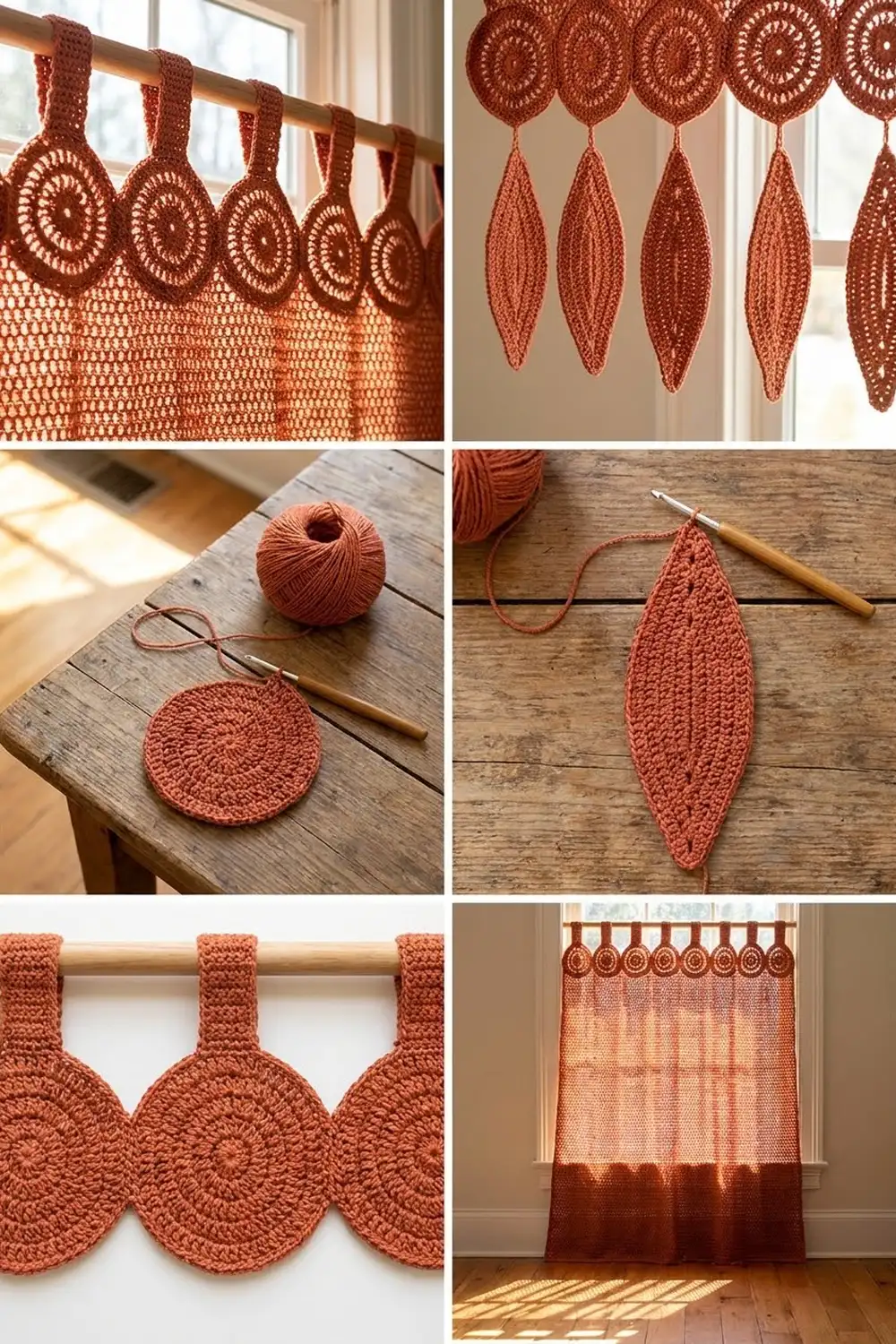
This curtain is a row of lacy wheel medallions, and each one hangs from its own tab loop on a wooden rod. A strand of openwork almond-shaped leaves drops from the bottom of every wheel, so you get vertical lines of lace with light coming through.
It uses one warm terracotta (rust orange) cotton. A single color keeps the look calm and boho and lets the texture do the work. Each wheel has a solid hub, sixteen open spokes, a solid outer band and a beaded chain-loop edge. Every leaf has a center vein with a ladder of openings on both sides.
The pattern uses US crochet terms. The finished curtain is 45 in (114.3 cm) wide. It is 44.5 in (113.0 cm) long from the top of the tab loops to the bottom leaf tip. Add leaves to make it longer.
Each strand is one continuous piece. You work the wheel in rounds, add the tab loop, then crochet the leaf strand down from the wheel. The 10 wheels join to each other during their final edge round.
Finished Size and Construction
- Finished size: 45 in (114.3 cm) wide × 44.5 in (113.0 cm) long
- Skill level: Intermediate
- Terminology: US crochet terms
- Yarn weight: DK (#3) cotton
- Hook: 3.5 mm (E-4)
- Number of pieces: 10 strands. Each strand is one wheel, one tab and 9 leaves.
- Layout: 10 wheels in a single horizontal row, joined side to side, with 1 leaf strand per wheel
- Piece size: The wheel is 4.5 in (11.4 cm) across. Each leaf is 3.25 in (8.3 cm) long × 1.5 in (3.8 cm) wide.
- Size before border: The wheel is 4.25 in (10.8 cm) across after Round 5.
- Border depth: 1/8 in (0.3 cm) per side, which adds 0.25 in (0.6 cm) to the diameter
Materials
Choose a smooth cotton or cotton blend in DK weight. Cotton keeps the spokes crisp and stretches very little under its own weight, which matters for a hanging piece. Avoid fuzzy or very stretchy yarns.
- Terracotta (rust orange): 330 g, about 760 m (831 yd), based on DK cotton at 230 m per 100 g
The quantity includes a margin of about 20%. One finished strand weighs about 27 g, so 10 strands use about 270 g.
Tools:
– 3.5 mm (E-4) crochet hook
– Tapestry needle
– Stitch markers
– Scissors and measuring tape
– Blocking mats, rust-proof pins and a spray bottle
– Curtain rod up to 1.25 in (3.2 cm) in diameter
Abbreviations (US Terms)
- ch: chain
- sl st: slip stitch
- sc: single crochet
- hdc: half double crochet
- dc: double crochet
- tr: treble crochet
- sk: skip
- sp: space
- st(s): stitch(es)
- RS: right side
Special stitch: Joining loop (J-loop). In place of ch 2, work ch 1, sl st into the matching ch-2 loop of the neighboring wheel, then ch 1. This counts as one ch-2 loop.
Gauge and Checkpoints
Gauge: 20 sc and 22 rows = 4 in (10.2 cm). Chain gauge: 6 ch = 1 in (2.5 cm).
Before starting the curtain, make one wheel with its tab and two leaves. Measure them flat without stretching.
Wheel checkpoints:
– After Round 1: 1.25 in (3.2 cm)
– After Round 2: 1.75 in (4.4 cm)
– After Round 3: 3.5 in (8.9 cm)
– After Round 4: 3.75 in (9.5 cm)
– After Round 5: 4.25 in (10.8 cm)
– After Round 6 (border): 4.5 in (11.4 cm)
Strand checkpoints:
– Tab strip: 1 in (2.5 cm) wide and 3.6 in (9.1 cm) long before folding
– Leaf foundation ch 17: about 2.8 in (7.1 cm)
– Finished leaf: 3.25 in (8.3 cm) × 1.5 in (3.8 cm)
– One connector plus one leaf: 4.25 in (10.8 cm)
If your wheel is larger than 4.5 in (11.4 cm), go down a half hook size. If it is smaller, go up a half size. A wheel that cups means the spokes are too short. A wheel that ruffles means Round 4 or 5 is too loose. Small errors add up: an extra 0.5 in (1.3 cm) per wheel makes the curtain 5 in (12.7 cm) wider.
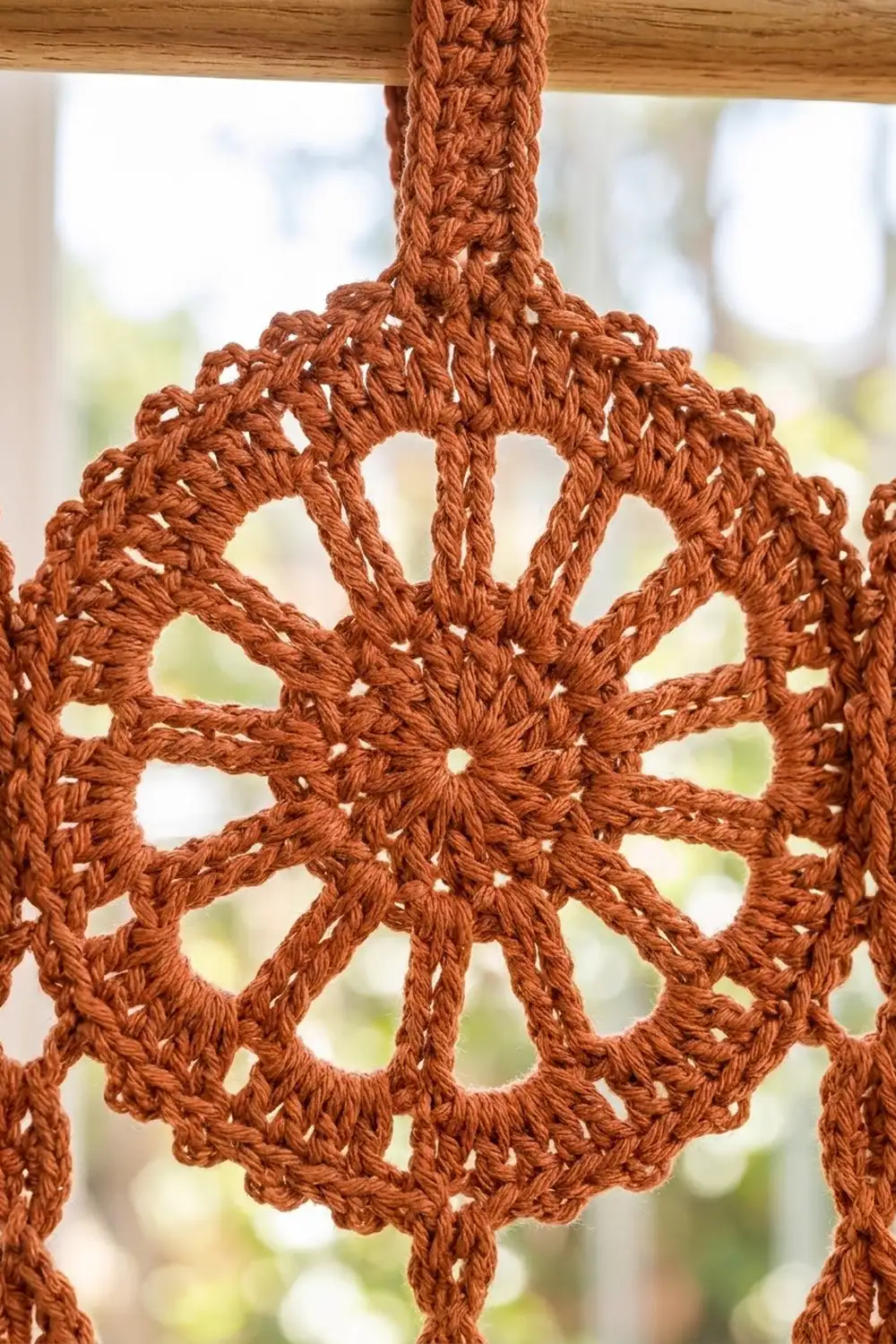
Wheel
Make 10. Work in joined rounds with RS facing and do not turn.
Round 1: Make a magic ring. Ch 3 (counts as dc), 15 dc in ring. Pull the ring closed. Sl st to top of beginning ch-3. (16 dc)
Round 2: Ch 1, 2 sc in each st around. Sl st to first sc. (32 sc)
This dense center is the solid hub.
Round 3 (spokes): Ch 4 (counts as tr), ch 3, sk next st, tr in next st, ch 3, sk next st. Repeat from * 14 more times. Sl st to top of beginning ch-4. (16 tr, 16 ch-3 sps)
Keep each tr the same height so the spokes radiate evenly.
Round 4 (conversion round): Sl st into first ch-3 sp. Ch 1, 4 sc in ch-3 sp, sc in next tr. Repeat from * around. Sl st to first sc. (16 sc worked 1-per-tr + 64 sc worked into the 16 spaces = 80 sc)
Round 5: Ch 3 (counts as dc), dc in each st around. Sl st to top of beginning ch-3. (80 dc)
Rounds 4 and 5 form the solid outer band. Next, work Round 6, which is given in the Border section. Wheels 2–10 join to their neighbor during that round.
Tab Loop
Work the tab after Round 6. Place the wheel RS up with the start of Round 6 at the top.
Row 1: Join yarn in ch-2 loop 40, which sits just before the top center sc. 2 sc in loop 40, sc in sc 1, 2 sc in loop 1. (5 sc)
Rows 2–20: Ch 1, turn, sc in each st across. (5 sc)
Fasten off and leave a 10 in (25.4 cm) tail. Fold the strip to the back and sew Row 20 to the back of Round 5, directly behind Row 1. The loop stands about 1.75 in (4.4 cm) above the wheel.
Leaf Strand
The strand is worked in one go from the bottom of the wheel. Each leaf is crocheted around its own foundation chain.
Start: With RS facing, join yarn in sc 21 of Round 6. This is the bottom center sc, between loops 20 and 21.
Connector: Ch 6. (1 in / 2.5 cm)
Leaf foundation: Ch 17 more. The last 17 ch belong to the leaf.
Leaf Round 1, first side: Work toward the wheel. Sc in 2nd ch from hook, hdc in next ch, dc in next ch, ch 1, sk next ch, dc in next ch, ch 1, sk next ch, tr in next ch, ch 1, sk next ch, tr in next ch, ch 1, sk next ch, dc in next ch, ch 1, sk next ch, dc in next ch, hdc in next ch, sc in next ch. (10 sts, 5 ch-1 sps)
Top tip: 3 sc in the last leaf ch, next to the connector. (3 sc)
Leaf Round 1, second side: Work across the opposite side of the foundation chain, mirroring the first side: sc, hdc, dc, ch 1, sk 1, dc, ch 1, sk 1, tr, ch 1, sk 1, tr, ch 1, sk 1, dc, ch 1, sk 1, dc, hdc, sc. (10 sts, 5 ch-1 sps)
Bottom tip: 2 sc in the skipped turning ch. Sl st to first sc. (Round 1 total: 25 sts, 10 ch-1 sps)
The two tr on each side make the widest point of the leaf. The ch-1 openings form the ladder beside the center vein.
Leaf Round 2 (outline, conversion round): Ch 1, sc in each st and each ch-1 sp around. Work 3 sc in the center sc of the top tip and 3 sc in the second sc of the bottom tip. Sl st to first sc. (25 sc worked 1-per-st + 10 sc worked 1-per-sp + 4 extra at the tips = 39 sc)
You finish at the bottom tip, ready for the next connector.
Next leaves: Ch 6, ch 17, work Leaf Rounds 1 and 2. Repeat from * until the strand has 9 leaves. Fasten off and weave the tail into the outline.
Strand check: 9 × 4.25 in (10.8 cm) = 38.25 in (97.2 cm) below the wheel.
Make All Pieces
All pieces are Terracotta.
- Wheels: 10
- Tab loops: 10
- Leaves: 90 (9 per strand)
- Connectors: 90
Work all wheels through Round 5 and join them with Round 6. Then add the tabs and work the strands.
Layout grid (front view):
Tabs:    T1  T2  T3  T4  T5  T6  T7  T8  T9  T10
Wheels:  W1--W2--W3--W4--W5--W6--W7--W8--W9--W10
Leaves:  |   |   |   |   |   |   |   |   |   |
         L×9 L×9 L×9 L×9 L×9 L×9 L×9 L×9 L×9 L×9
Each “–” is a 2-loop join. The strands hang freely and are not joined to each other.
Joining
The wheels are joined as you go during Round 6. Wheel 1 gets a plain Round 6. Wheels 2–10 each join to the wheel on their left.
Loop numbering: Round 6 has 40 ch-2 loops. Start at top center and number them 1–40 in the order you work them. With RS facing, loops 10–11 sit at the left side point, loops 20–21 at the bottom and loops 30–31 at the right side point.
Stitch-to-stitch logic:
– New loop 10 joins previous loop 31. Both sit just above center.
– New loop 11 joins previous loop 30. Both sit just below center.
Only 2 loops per seam are joined, so the circles touch at one short point. No stitches are added at the seams.
Tension: Make the J-loop chains the same size as your other chains. Tight joins pull the wheels into an overlap. Loose joins open gaps and let the top band sag.
Size checkpoint: 4 joined wheels measure 18 in (45.7 cm). All 10 measure 45 in (114.3 cm).
Border
The border is Round 6 of each wheel: a beaded edge of sc and ch-2 loops.
Border gauge: 1 sc + 1 ch-2 loop covers 2 sts of Round 5 and about 0.35 in (0.9 cm) of edge.
Round 6: Ch 1, sc in first st, ch 2, sk next st, sc in next st, ch 2, sk next st. Repeat from * around. Sl st to first sc. (40 sc, 40 ch-2 loops)
On Wheels 2–10, work J-loops for loops 10 and 11, joining them to loops 31 and 30 of the previous wheel.
Counts per quarter: Each quarter has 10 sc + 10 ch-2 loops, built on 20 sts of Round 5.
- Top: loops 36–40 and 1–5, with the tab centered on sc 1
- Left side: loops 6–15, with the join on loops 10–11
- Bottom: loops 16–25, with the strand starting at sc 21
- Right side: loops 26–35, with the join on loops 30–31
Why the math works: Round 5 has 80 sts. Each repeat (sc, ch 2, sk 1) uses exactly 2 sts, so 80 ÷ 2 = 40 repeats, or 4 quarters × 10. The skipped stitches keep the edge flat, and the chains let it reach 4.5 in (11.4 cm). The joined top edge has 10 wheels × 10 top-quarter loops = 100 loops, with nothing extra at the seams.
Final Blocking
- Weave in all ends.
- Lay the joined wheel row RS up on blocking mats in a straight line.
- Spray until damp, not soaked.
- Pin each wheel to 4.5 in (11.4 cm) at the top, the bottom and both joins.
- Pin the spoke spaces so all 16 are evenly spaced.
- Lay each strand straight below its wheel. Pin each leaf at both tips to 3.25 in (8.3 cm) and open the ladder spaces.
- Check that each connector is 1 in (2.5 cm) and not stretched.
- Let everything dry completely before unpinning.
- Hang the curtain for a day, because cotton settles slightly.
Final Quality-Control Checklist
- [ ] 10 wheels, each 4.5 in (11.4 cm) across, with 16 even spokes and 40 border loops
- [ ] Each seam joins exactly 2 loops (10↔31, 11↔30)
- [ ] The top row measures 45 in (114.3 cm)
- [ ] 10 tabs centered on sc 1 and sewn behind Row 1
- [ ] 10 strands of 9 leaves, each starting at sc 21
- [ ] Every leaf outline has 39 sc and measures 3.25 in (8.3 cm)
- [ ] All strands hang 44.5 in (113.0 cm) from the top of the tab
- [ ] All ends secure
Troubleshooting
Wheel cups: The spokes are too short or Round 4 is tight. Loosen Round 3 or go up a half hook size.
Wheel ruffles: Round 5 is too loose. Use a smaller hook and check that Round 4 has exactly 80 sc.
Wheels overlap at the joins: The J-loop chains are tight. Rework them more loosely.
Lopsided leaves: Both sides of Leaf Round 1 need the same 10 sts and 5 ch-1 sps, in mirror order.
Strands are different lengths: Count the connector chains. One extra chain per connector adds about 1.5 in (3.8 cm) to a strand.
Off-center tab: Row 1 must start in loop 40 and end in loop 1.
Care
Hand wash in cool water with mild soap, roll in a towel and dry flat, reshaping the wheels and leaves. Never hang it wet, or the strands will stretch.
Final Notes
Each wheel grows from 1.25 in (3.2 cm) to 4.25 in (10.8 cm) through Round 5, and the border brings it to 4.5 in (11.4 cm). Ten wheels joined at single points give 45 in (114.3 cm) of width. Each strand adds a 1.75 in (4.4 cm) tab loop above the wheel and 9 leaf units of 4.25 in (10.8 cm) below it, for 44.5 in (113.0 cm) of length. Get the first wheel and the first two leaves right, and the rest will follow.
Happy crocheting!