

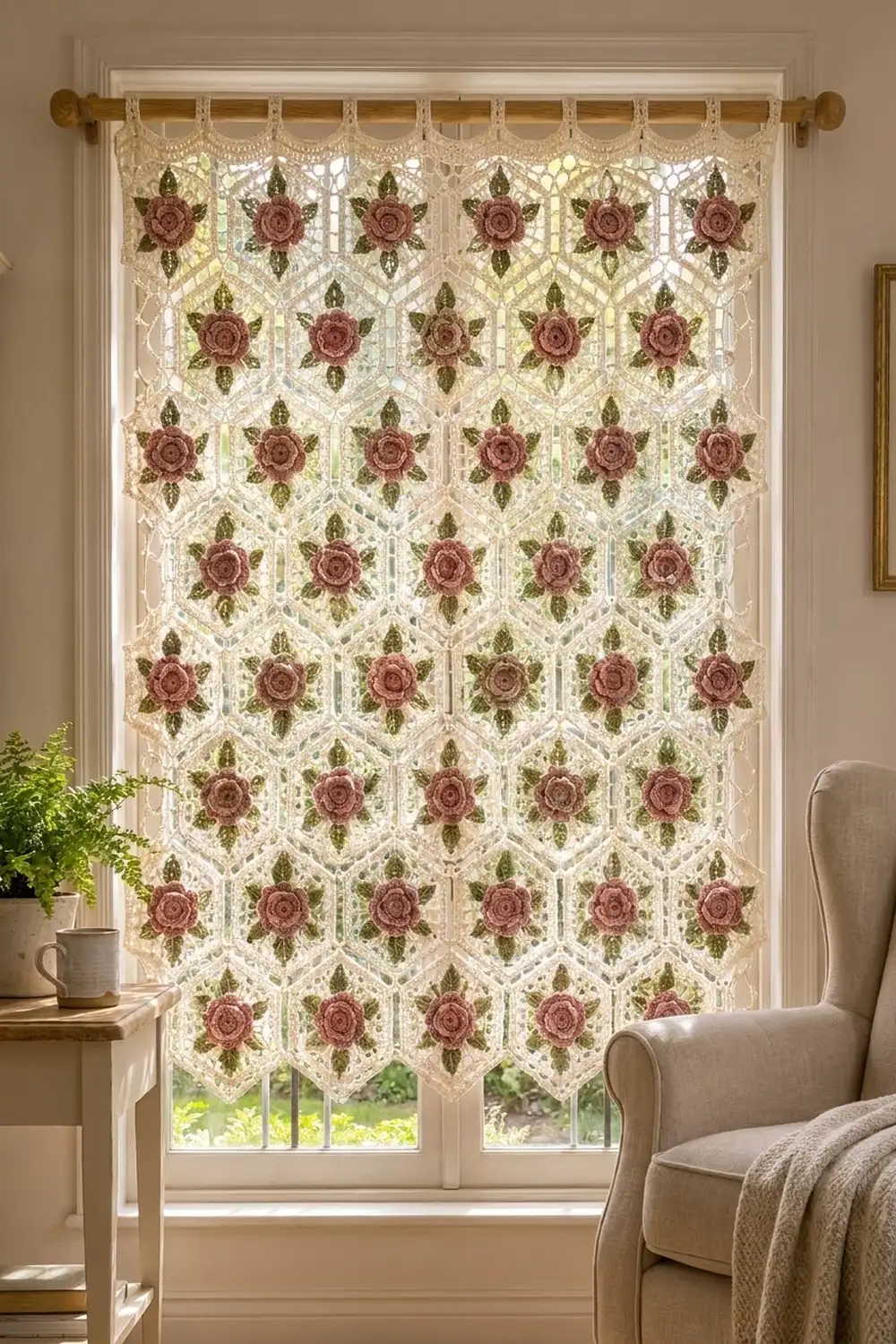
The Cottage Rose Curtain is a light, lacy café-style panel made from cream openwork hexagons. Each hexagon has a raised dusty-pink rose at its center and six small olive-green leaves around it. Light comes through the mesh, and the roses add soft texture without blocking the view.
The palette is cream, dusty rose and olive green, which suits a farmhouse or vintage cottage room. The pattern uses US crochet terms throughout.
The finished panel measures 36.4 in (92.5 cm) wide and 44.25 in (112.4 cm) long from the top of the header to the lowest hexagon points. With the tab loops, the overall length is 46.5 in (118.1 cm).
How it’s built: you make 59 hexagons, 59 roses and 354 leaves, then sew the flowers and leaves onto each hexagon. Next you whipstitch the hexagons into nine staggered rows. Last, you work a header band with arches, add nine tabs, and finish with a single-crochet edging that follows the sides and the pointed bottom.
Finished Size and Construction
- Finished size: 36.4 in x 44.25 in (92.5 cm x 112.4 cm), plus 2.25 in (5.7 cm) tabs
- Skill level: Intermediate
- Terminology: US
- Yarn weight: DK / light worsted (#3), cotton
- Hook: 4.0 mm (G-6)
- Number of pieces: 59 hexagons (plus appliqués)
- Layout: 9 staggered rows that alternate 7 and 6 hexagons
- Piece size: 5.2 in (13.2 cm) flat-to-flat, 6 in (15.2 cm) point-to-point, 3 in (7.6 cm) per side
- Size before border: 36.4 in x 42 in (92.5 cm x 106.7 cm), measured from the top peaks to the bottom points
- Border depth: 2.25 in (5.7 cm) header at the top; one-row edging on the sides and bottom
Materials
Choose a smooth mercerized or matte cotton in DK weight, about 120 m per 50 g. Cotton holds the lace open, keeps the roses crisp and washes well, which matters for a window piece.
- Cream (main color): 450 g / 1,080 m
- Dusty rose (roses): 200 g / 480 m
- Olive green (leaves): 200 g / 480 m
Tools: 4.0 mm (G-6) hook, tapestry needle, scissors, stitch markers, rustproof pins, blocking mats, spray bottle.
All quantities include a margin of about 15–20% for gauge swatches, sewing tails and joining.
Abbreviations (US Terms)
- ch – chain
- sl st – slip stitch
- sc – single crochet
- hdc – half double crochet
- dc – double crochet
- sc2tog – single crochet 2 together
- sp(s) – space(s)
- MR – magic ring
- RS / WS – right side / wrong side
Special stitch: Back-post sc around a stitch. Working from the back of the flower, insert the hook from right to left around the post of the named stitch, then complete a sc. This places a new row of loops behind the petals already made.
Gauge and Checkpoints
Base gauge: 20 sc and 22 rows = 4 in (10.2 cm) in cream.
Make one complete hexagon before you start the batch, and check it at each stage:
- After Round 3: about 2.75 in (7.0 cm) flat-to-flat
- After Round 5: about 4.75 in (12.1 cm) flat-to-flat
- After Round 6, lightly blocked: 5.2 in (13.2 cm) flat-to-flat, and each side 3 in (7.6 cm)
If it’s too big: go down one hook size, or tighten the chain spaces in Rounds 4–5.
If it’s too small: go up one hook size.
A 0.1 in (0.3 cm) error per side grows to about 1.2 in (3.0 cm) across the width, so it’s worth correcting now.

Hexagon (make 59, cream)
Round 1: MR, ch 3 (counts as dc), 11 dc in ring; join with sl st to the top of ch-3. (12 dc)
Round 2: Ch 3 (counts as dc), dc in next st, ch 3, dc in next 2 sts, ch 3; repeat from * 4 more times; join. (12 dc, 6 ch-3 sps)*
Round 3: Ch 3, dc in next dc, (2 dc, ch 2, 2 dc) in ch-3 sp, dc in next 2 dc, (2 dc, ch 2, 2 dc) in next ch-3 sp; repeat from * 4 more times; join. (36 dc, 6 ch-2 corners; 6 dc per side)*
Round 4: Sl st in next 3 dc and into the ch-2 corner sp. Ch 5 (counts as dc + ch 2), dc in same sp, ch 2, skip 2 dc, dc in next 2 dc, ch 2, skip 2 dc, (dc, ch 2, dc) in next corner sp; repeat from * 4 more times, ending ch 2, skip 2, dc in next 2, ch 2, skip 2; join to 3rd ch of ch-5. (24 dc, 12 side ch-2 sps, 6 corner ch-2 sps)*
This round opens two lace windows on each side.
Round 5: Sl st in next corner sp. Ch 6 (counts as dc + ch 3), dc in same sp, ch 2, dc in next ch-2 sp, ch 2, dc in sp between next 2 dc, ch 2, dc in next ch-2 sp, ch 2, (dc, ch 3, dc) in next corner sp; repeat from * 4 more times, ending with the last ch 2; join to 3rd ch of ch-6. (30 dc, 24 ch-2 sps, 6 ch-3 corners; each side reads dc, then 4 ch-2 sps with a dc between each, then dc)*
Round 6: Sl st in corner sp, ch 1, *(sc, ch 2, sc) in corner sp, sc in next dc, [2 sc in next ch-2 sp, sc in next dc] 4 times; repeat from * 5 more times; join to first sc. Fasten off.
Each side has 1 + 1 + 12 + 1 = 15 sc between the ch-2 corner spaces. The corners are ch-2 spaces, not stitches. (90 sc, 6 ch-2 corners)
Rose (make 59, dusty rose)
Round 1: MR, ch 1, 5 sc in ring; join. (5 sc)
Round 2: (sc, 3 dc, sc) in next sc; repeat from * 4 more times; join. (5 petals, 25 sts)*
Round 3: Working behind Round 2, ch 3, back-post sc around next Round 1 sc; repeat from * 4 more times. (5 ch-3 loops)*
Round 4: (sc, 5 dc, sc) in each ch-3 loop; join. (5 petals, 35 sts)
Round 5: Working behind, ch 4, back-post sc around next Round 3 sc; repeat from * 4 more times. (5 ch-4 loops)*
Round 6: (sc, 7 dc, sc) in each ch-4 loop; join. (5 petals, 45 sts)
Fasten off, leaving a 12 in (30.5 cm) tail. The rose measures about 2.25 in (5.7 cm) across, with three stacked tiers of petals.
Leaf (make 354, olive green)
Ch 8. Sc in 2nd ch from hook, hdc in next ch, dc in next 2 ch, hdc in next ch, sc in next ch, sl st in last ch. Working along the opposite side of the foundation chain: sc in next ch, hdc in next ch, dc in next 2 ch, hdc in next ch, sc in next ch, sl st in turning ch to form the tip. (13 sts + tip)
Fasten off, leaving an 8 in (20.3 cm) tail. Each leaf is about 1.5 in (3.8 cm) long.
Assemble Each Motif
- Place 6 leaves on the RS of a hexagon. Tuck each leaf base under the rose area with the tip pointing toward a corner, reaching about Round 4.
- Sew each leaf down its center line with the green tail.
- Center the rose over Rounds 1–2, covering the leaf bases. Sew it through Rounds 1 and 3 of the rose.
Keep the stitches small and tidy, because the back of the curtain shows against the light.
Make All Pieces
- Cream: 59 hexagons
- Dusty rose: 59 roses
- Olive green: 354 leaves (6 per hexagon)
Layout (H = hexagon; even rows are offset half a hexagon):
Row 1:  H H H H H H H
Row 2:   H H H H H H
Row 3:  H H H H H H H
Row 4:   H H H H H H
Row 5:  H H H H H H H
Row 6:   H H H H H H
Row 7:  H H H H H H H
Row 8:   H H H H H H
Row 9:  H H H H H H H
That gives 5 rows of 7 (35) plus 4 rows of 6 (24), for 59 hexagons. All hexagons point up and down.
Joining
Method: whipstitch through the back loops with cream, RS up.
Stitch-to-stitch logic: every shared edge is 15 sc against 15 sc, matched one to one. Start in the matching corner ch-2 spaces, stitch the 15 pairs, and end in the next pair of corner spaces. Never skip or double a stitch; the counts already match.
Order:
- Join the hexagons in each row along their vertical sides. That’s 6 seams in each 7-hexagon row and 5 in each 6-hexagon row.
- Join the rows together. Each hexagon in an even row nests into the dip between two hexagons above, joining along its two upper slanted sides. Do the same for the row below.
Tension: make each whipstitch snug enough that the edges meet flat, but not so tight that the seam puckers. Lay the work flat every few seams.
Size checkpoint: a 7-hexagon row measures 36.4 in (92.5 cm). Rows advance 4.5 in (11.4 cm) each, so the body measures 6 + (8 x 4.5) = 42 in (106.7 cm) from the top peaks to the bottom points.
Border: Header, Tabs and Edging
Border gauge: 5 sc = 1 in (2.5 cm), and 5 dc rows ≈ 1.85 in (4.7 cm).
Header Band
Row 1 (arches): With RS facing, ch 13. Sc in the top-corner ch-2 sp of the first hexagon in Row 1, *ch 25, sc in the top-corner sp of the next hexagon; repeat from * 5 more times, ch 13. Turn.
Count: 13 + 7 sc + (6 x 25) + 13 = 183 sts.
The peaks are 5.2 in (13.2 cm) apart, which equals 26 sts (sc + ch 25), so each chain lies straight. The dips below it become the scalloped arches.
Row 2: Ch 1, sc in each ch and sc across. Turn. (183 sc)
Rows 3–7: Ch 3 (counts as dc), dc in each st across. Turn. (183 dc)
The 183 sts measure about 36.6 in (93.0 cm). Ease them to 36.4 in (92.5 cm) when blocking; the difference is less than 1%. The header is 2.25 in (5.7 cm) deep.
Tabs (make 9)
With RS facing, join in stitch 1 of Row 7. Ch 1, sc in the same st and the next 6 sts. (7 sc)
Work Rows 2–28 as ch 1, turn, sc in each st. (7 sc each row)
Fasten off. Repeat starting in stitches 23, 45, 67, 89, 111, 133, 155 and 177.
The math: 9 tabs x 7 sts = 63, plus 8 gaps x 15 sts = 120, for 183 sts in total. The gaps are each 3 in (7.6 cm).
Fold each tab, which is 5.1 in (13.0 cm) long, to the WS. Sew its last 3 rows to the back of the header so that the loop stands 2.25 in (5.7 cm) tall.
Side and Bottom Edging (one row)
Rules:
- 1 sc in each sc along every exposed hexagon side (15 per side)
- 2 sc in each outward-pointing corner ch-2 sp
- At each inward dip, sc2tog across the two meeting corner spaces
Join cream at the right end of header Row 1. Ch 7 to bridge down to hexagon 7 of Row 1, then sc in its upper-right corner sp. Work down the right side, across the bottom and up the left side by the rules above. End with sc in the upper-left corner sp of hexagon 1, ch 7, and sl st to the first ch of header Row 1. Fasten off.
Counts:
- Each side: 1 starting or ending sc + 17 exposed sides x 15 (255) + 9 outward corners x 2 (18) + 8 sc2tog (8) = 282 sts. Each side also has a ch-7 bridge.
- Bottom: 14 sides x 15 (210) + 7 points x 2 (14) + 6 sc2tog (6) = 230 sts.
- Total: 794 sts plus 2 bridges.
Why it works: the edging matches the hexagon’s own 15 sts per side exactly. Two stitches turn each 60° outward corner without cupping, and sc2tog closes each dip without ruffling.
Final Blocking
- Weave in all ends along seams or under the roses.
- Soak the curtain in cool water for 15 minutes, then press out the water in a towel. Don’t wring it.
- Lay it flat on mats, RS up.
- Pin the header straight to 36.4 in (92.5 cm).
- Pin each bottom point so that the body measures 42 in (106.7 cm) from the peaks to the points.
- Pin the side corners to keep the outline crisp.
- Gently open the mesh with your fingers, and shape the roses and leaves so they sit raised.
- Let it dry completely before you unpin.
Final Quality-Control Checklist
- All 59 hexagons measure 5.2 in (13.2 cm) flat-to-flat
- Every rose is centered and every set of 6 leaves points to the corners
- All seams lie flat, with 15 stitch pairs each
- The header has 183 sts and the tabs are evenly spaced
- The edging totals are 282 / 230 / 282
- The overall size is 36.4 in x 44.25 in (92.5 cm x 112.4 cm), plus the tabs
- No loose ends show from either side
Troubleshooting
- Hexagon cups: chain spaces are too tight; loosen the ch-2s in Rounds 4–5.
- Hexagon ruffles: the corners are too loose; use ch 1 instead of ch 2 in the Round 6 corners and recheck the size.
- Seams gape: whipstitch through both loops, or tighten your tension slightly.
- Header arches sag: your chain is looser than your sc; go down one hook size for Row 1 only.
- Rose looks flat: work the back-post sc rounds tightly so each tier stands behind the last.
- Edging waves: check the corners; use only 2 sc at outward corners and always sc2tog at the dips.
Care
Hand wash cool or machine wash on a gentle cycle in a mesh bag, then reshape and dry flat. Steam the roses lightly if they lose their lift.
Final Notes
The whole curtain depends on one measurement chain. The 15 sc per side gives 3 in (7.6 cm) sides and 5.2 in (13.2 cm) hexagons. Seven hexagons make 36.4 in (92.5 cm) of width, and nine staggered rows make 42 in (106.7 cm) of length. The header adds 2.25 in (5.7 cm), for a body length of 44.25 in (112.4 cm), and the 2.25 in (5.7 cm) tabs bring the total to 46.5 in (118.1 cm). Check your first hexagon carefully, and the rest follows.
Happy crocheting!