

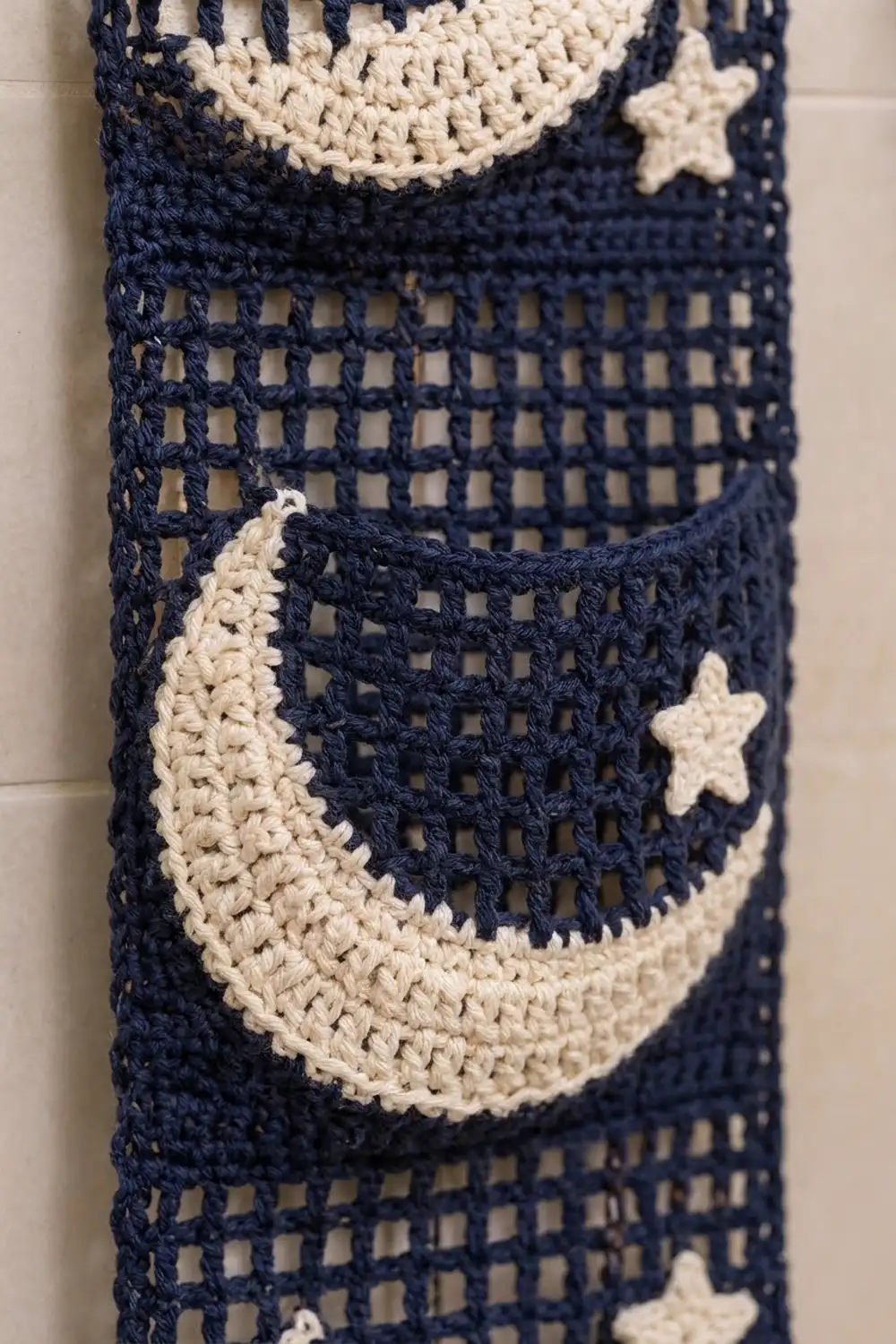
This hanging holder stores three spare toilet paper rolls on a bathroom wall. A long navy filet-mesh panel holds three rounded pockets, and each pocket carries a thick cream crescent moon and a small star. The finished piece looks like a strip of night sky.
There are only two colors, a deep navy and a soft cream. The open mesh keeps the piece light and lets the rolls show through. The solid crescents add texture and contrast. The style is simple and modern, and it suits a seasonal bathroom or works year-round.
The pattern uses US crochet terms. The finished panel measures 8.25 x 26 in (21.0 x 66.0 cm), not counting the hanging tabs. The tabs add about 1.75 in (4.4 cm) above the top edge.
You will crochet one backing panel in rows, then add a two-round border and two hanging tabs. Next you will make three shaped pocket fronts, three crescent moons and three stars. Sew the moons and stars onto the pockets, then sew each pocket onto the panel with a little extra width so it bulges enough to hold a roll.
Finished Size and Construction
- Finished size: 8.25 x 26 in (21.0 x 66.0 cm), plus tabs
- Skill level: Intermediate (filet mesh, simple shaping, seaming)
- Terminology: US
- Yarn weight: Worsted (#4) cotton
- Hook: 5.0 mm (H-8)
- Number of pieces: 10 (1 panel, 3 pocket fronts, 3 crescents, 3 stars)
- Layout: 1 panel with 3 pockets stacked vertically
- Panel before border: 7.25 x 25 in (18.4 x 63.5 cm)
- Pocket front (after edging): 10.75 x 4.25 in (27.3 x 10.8 cm) flat
- Border depth: 0.5 in (1.3 cm)
Materials
Use a smooth worsted-weight cotton or cotton blend. Cotton holds its shape and handles bathroom humidity well. Choose a dark navy and a warm cream or ivory so the moons stand out.
- Navy: about 250 g / 385 m (panel, border, tabs, pocket fronts)
- Cream: about 50 g / 77 m (crescents and stars)
These quantities include a margin of about 15 percent.
Tools:
– 5.0 mm (H-8) crochet hook
– Tapestry needle
– Stitch markers
– Rustproof pins and a blocking mat
– Wooden dowel, 12 in (30.5 cm) long and 3/4 in (1.9 cm) in diameter
– Measuring tape
Abbreviations (US Terms)
- ch – chain
- sl st – slip stitch
- sc – single crochet
- hdc – half double crochet
- dc – double crochet
- sp – space
- st(s) – stitch(es)
- RS / WS – right side / wrong side
Special stitch: Filet mesh. Each mesh is a dc, ch 1, then skip 1 stitch, finishing on the next dc. One mesh is 2 stitches wide. In stitch counts, every dc and every ch-1 counts as 1 stitch.
Gauge and Checkpoints
- Dc gauge: 16 sts x 8 rows = 4 in (10.2 cm)
- Sc gauge: 16 sts x 16 rows = 4 in (10.2 cm)
- Mesh: 1 mesh = 0.5 in (1.3 cm) square
Make one pocket front first and use it as your gauge piece. Row 1 should measure 10.25 in (26.0 cm) across. If it is wider, go down one hook size. If it is narrower, go up one hook size.
Checkpoints:
– Panel after Row 2: 7.25 in (18.4 cm) wide
– Panel after Row 18: 9 in (22.9 cm) tall
– Panel after Row 34: 17 in (43.2 cm) tall
– Panel after Row 50: 25 in (63.5 cm) tall
– Crescent: about 8.5 in (21.6 cm) from tip to tip and 1.5 in (3.8 cm) deep at the center
– Star: 1.5 in (3.8 cm) across
Backing Panel
Use navy. The turning ch-3 counts as a dc. The turning ch-4 counts as a dc plus ch 1.
Foundation: Ch 31.
Row 1 (RS): Dc in 4th ch from hook and in each ch across. Turn. (29 sts)
Row 2: Ch 3, dc in each st across, ending in top of turning ch. Turn. (29 sts)
Row 3 (mesh): Ch 4, skip next st, dc in next st, ch 1, skip next st, dc in next st; repeat from * across, working the last dc in the top of the turning ch. Turn. (29 sts: 15 dc + 14 ch-1 = 14 meshes)*
Rows 4–16: Ch 4, dc in next dc, ch 1, dc in next dc; repeat from * across, working the last dc in the 3rd ch of the turning ch-4. Turn. (29 sts each row)*
Row 17 (solid): Ch 3, dc in next ch-1 sp, dc in next dc; repeat from * across. Turn. (29 sts)*
Row 18: Repeat Row 2. (29 sts) Checkpoint: 9 in (22.9 cm) tall.
Row 19: Repeat Row 3. (29 sts)
Rows 20–32: Repeat Row 4. (29 sts)
Rows 33–34: Repeat Rows 17–18. (29 sts)
Row 35: Repeat Row 3.
Rows 36–48: Repeat Row 4.
Rows 49–50: Repeat Rows 17–18. (29 sts) Do not fasten off.
The panel has four 2-row solid bands (Rows 1–2, 17–18, 33–34, 49–50) and three 14-row mesh sections. Each pocket sits on top of one solid band.
Border
The border uses sc gauge: 4 sc per 1 in (2.5 cm). One dc row end is 0.5 in (1.3 cm) tall, so 2 sc per row end matches the gauge exactly.
Round 1: Ch 1, turn the panel to work down the first long side. Work 3 sc in the first corner. Work 2 sc in each of the 50 row ends (100 sc). Work 3 sc in the bottom corner. Along the foundation chain, sc in each of the next 27 sts (27 sc). Work 3 sc in the next corner. Work 2 sc in each of the 50 row ends (100 sc). Work 3 sc in the top corner. Sc in each of the next 27 sts across Row 50 (27 sc). Join with a sl st to the first sc.
Count: 100 + 27 + 100 + 27 between corners, plus 4 corners x 3 = 12. (266 sts)
Round 2: Ch 1, sc in each st around, working 3 sc in the center st of each corner group. Join.
Count: each side gains 2, so 102 + 29 + 102 + 29 + 12. (274 sts) Fasten off.
Why the math works: The top edge has 29 panel sts. Round 1 puts 27 sc between the corner groups, plus 1 corner st at each end, for 29 sc across the panel’s width. Each round adds 0.25 in (0.6 cm) on every side. Width: 7.25 + 0.5 + 0.5 = 8.25 in (21.0 cm). Length: 25 + 0.5 + 0.5 = 26 in (66.0 cm).
Hanging Tabs
Along the top of Round 2, count the 29 sts between the corner groups.
Tab 1: Join navy in the 3rd st. Row 1: Ch 1, sc in the same st and in the next 4 sts (sts 3–7). Turn. (5 sts)
Rows 2–14: Ch 1, sc in each st. Turn. (5 sts) The tab is 3.5 in (8.9 cm) long and 1.25 in (3.2 cm) wide. Fasten off and leave a 12 in (30.5 cm) tail.
Tab 2: Work the same over sts 23–27.
Each tab has 2 sts between it and its corner group, so the tabs sit symmetrically.
Pocket Front (Make 3)
Use navy. The pocket is worked from the top edge down.
Foundation: Ch 43.
Row 1 (top rim): Dc in 4th ch from hook and in each ch across. Turn. (41 sts) Checkpoint: 10.25 in (26.0 cm).
Row 2: Ch 4, skip next st, dc in next st, ch 1, skip next st, dc in next st; repeat across. Turn. (41 sts: 20 meshes)*
Row 3: Ch 4, dc in next dc, ch 1, dc in next dc; repeat across. Turn. (41 sts)*
Row 4 (decrease 1 mesh each end): Sl st in next ch-1 sp and next dc. Ch 4, dc in next dc, work mesh across until 2 sts remain, leaving the last ch-1 sp and dc unworked. Turn. (37 sts: 18 meshes)
Row 5: Repeat Row 4. (33 sts: 16 meshes)
Row 6: Repeat Row 4. (29 sts: 14 meshes)
Row 7 (decrease 2 meshes each end): Sl st in next 4 sts. Ch 4, dc in next dc, work mesh across until 4 sts remain, leaving them unworked. Turn. (21 sts: 10 meshes)
Row 8: Repeat Row 7. (13 sts: 6 meshes) Do not fasten off.
The pocket is now 4 in (10.2 cm) tall, with a stepped, rounded bottom.
Edging Row: Ch 1, rotate to work up the first shaped side. Along each side, work 2 sc in each of the 8 row ends (16) and 1 sc in each of the 14 exposed step stitches, or into the sl sts that cover them (2 + 2 + 2 + 4 + 4 = 14). Work as follows:
- 30 sc up the first side
- Fasten off, rejoin at the opposite top corner, and work 30 sc down the second side
- 13 sc across Row 8
- Sl st into the first sc of the first side to finish
Count: 30 + 13 + 30. (73 sts) Fasten off and leave a 40 in (101.6 cm) navy tail for sewing.
Alternatively, simply work continuously: 30 sc down one side, 13 sc across the bottom, 30 sc up the other side, for the same 73 sts. The sc edging smooths the steps into a curve.
Size after edging: 10.75 x 4.25 in (27.3 x 10.8 cm).
Crescent Moon (Make 3)
Use cream. The inner, concave edge is Row 1. Increases in the center of each row curve the piece and thicken its middle.
Foundation: Ch 31.
Row 1: Starting in 2nd ch from hook: sl st 1, sc 3, hdc 4, dc 14, hdc 4, sc 3, sl st 1. Turn. (30 sts)
Row 2: Skip the sl st. Sl st 1, sc 2, hdc 4, [2 dc in next st, dc in next st] 7 times, hdc 4, sc 2, sl st 1. Leave the last st unworked. Turn.
Count: 1 + 2 + 4 + 21 + 4 + 2 + 1. (35 sts)
Row 3: Sl st 2, sc 2, hdc 3, [2 hdc in next st, hdc in next 2 sts] 7 times, hdc 3, sc 2, sl st 2.
Count: 2 + 2 + 3 + 28 + 3 + 2 + 2. (42 sts)
Fasten off and leave a 24 in (61.0 cm) tail. The crescent is wide at the center and tapers to points. It measures about 8.5 in (21.6 cm) from tip to tip and 1.5 in (3.8 cm) deep at the center.
Star (Make 3)
Use cream.
Round 1: Magic ring, ch 1, 10 sc in ring, join. (10 sts)
Round 2: Ch 4, sl st in 2nd ch from hook, sc in next ch, hdc in next ch, skip next sc, sl st in next sc; repeat from * 4 more times. The last sl st lands in the joining st. (5 points)*
Fasten off and leave a 10 in (25.4 cm) tail. The star measures 1.5 in (3.8 cm) across.
Make All Pieces
- Navy: 1 backing panel with border and 2 tabs, plus 3 pocket fronts
- Cream: 3 crescents and 3 stars
Layout (front view):
   [tab]                 [tab]
+-------------------------------+
|  solid  Rows 49-50            |
|  mesh   Rows 46-48            |
|  POCKET 3 (moon + star)       |  Rows 34-45
|  solid  Rows 33-34            |
|  mesh   Rows 30-32            |
|  POCKET 2 (moon + star)       |  Rows 18-29
|  solid  Rows 17-18            |
|  mesh   Rows 14-16            |
|  POCKET 1 (moon + star)       |  Rows 2-13
|  solid  Rows 1-2              |
+-------------------------------+
Joining
Appliqués first. Lay each pocket RS up. Place a crescent so its outer edge (Row 3) follows the pocket’s lower curve just inside the edging, with the tips pointing up toward the top corners. Whipstitch around the whole crescent through the mesh posts. Sew a star on the mesh at the upper right, inside the moon’s curve, about 1 in (2.5 cm) below Row 1.
Pockets to panel. Work from the panel’s RS. Each pocket’s 73 edging sts are sewn 1:1 to a U-shaped path of 73 panel sts:
- Bottom: the 13 center sc of the pocket go to sts 9–21 of the solid row under the pocket (Row 2, Row 18 or Row 34)
- Each side (30 sts): 8 pocket sts go to sts 1–8 (or 22–29) of that same solid row. The remaining 22 sts go up the panel’s outermost dc column at 2 sts per row, over 11 rows
The path for each pocket:
– Pocket 1: Row 2, then up Rows 3–13
– Pocket 2: Row 18, then up Rows 19–29
– Pocket 3: Row 34, then up Rows 35–45
The pocket’s top rim is 10.25 in (26.0 cm) wide. The panel is only 7.25 in (18.4 cm) wide, so the top rim bows out by 3 in (7.6 cm). That extra width creates the depth that holds a roll.
Tension: Whipstitch through both loops of the pocket edging and around the end dc post. Pull each stitch snug but not tight, or the panel edge will pucker. Place markers at the bottom center and both top corners before you start, so the counts land exactly.
Size checkpoint: The panel should still lie at 8.25 in (21.0 cm) wide behind the pockets. Each pocket opening should fit a standard roll, about 4.5 in (11.4 cm) across.
Tabs: Fold each tab to the WS. Sew its last row across the back of border Round 1 to form a loop. Slide the dowel through both loops.
Final Blocking
- Remove the dowel.
- Lightly mist the panel, or wet it and press out the water in a towel.
- Pin the panel flat to 8.25 x 26 in (21.0 x 66.0 cm), keeping the mesh squares straight.
- Stuff each pocket with a rolled towel so it dries in its rounded shape.
- Pin the crescent tips and star points flat.
- Let it dry completely, then rehang it on the dowel.
Final Quality-Control Checklist
- Panel is 29 sts wide with 14 square meshes in each mesh row
- Solid bands are at Rows 1–2, 17–18, 33–34 and 49–50
- Border Round 2 totals 274 sts and the corners lie flat
- Tabs are on sts 3–7 and 23–27 and are equal in length
- Each pocket edging has 73 sts and each crescent ends with 42 sts
- Every pocket is sewn 1:1 along its full 73-st path
- Moons face the same way and stars sit at the upper right
- All tails are woven in on the WS
Troubleshooting
- Mesh holes are rectangles, not squares: your dc is too tall. Pull up shorter loops or try a smaller hook.
- Panel edges wave: you worked too many sc into the row ends. Use exactly 2 per row.
- Crescent lies flat instead of curving: the center increases were skipped. Recount Rows 2 and 3.
- Pocket too tight for a roll: the seam was sewn too tightly. Loosen it, or check that Row 1 has 41 sts.
- Holder sags in the middle: the dowel is too thin. Use a 3/4 in (1.9 cm) dowel.
Care
Hand wash in cool water with mild soap and lay flat to dry, reshaping the pockets. Avoid the dryer, which can shrink cotton and distort the mesh.
Final Notes
The measurement chain is simple. Gauge sets the 0.5 in (1.3 cm) mesh. The 29-st panel measures 7.25 x 25 in (18.4 x 63.5 cm) and the 0.5 in (1.3 cm) border brings it to 8.25 x 26 in (21.0 x 66.0 cm). Each 41-st pocket rim adds 3 in (7.6 cm) of ease to hold a roll, and each pocket’s 73 edging sts match its 73-st seam path exactly. Check each stage as you go and the finished holder will hang straight.
Happy crocheting!