

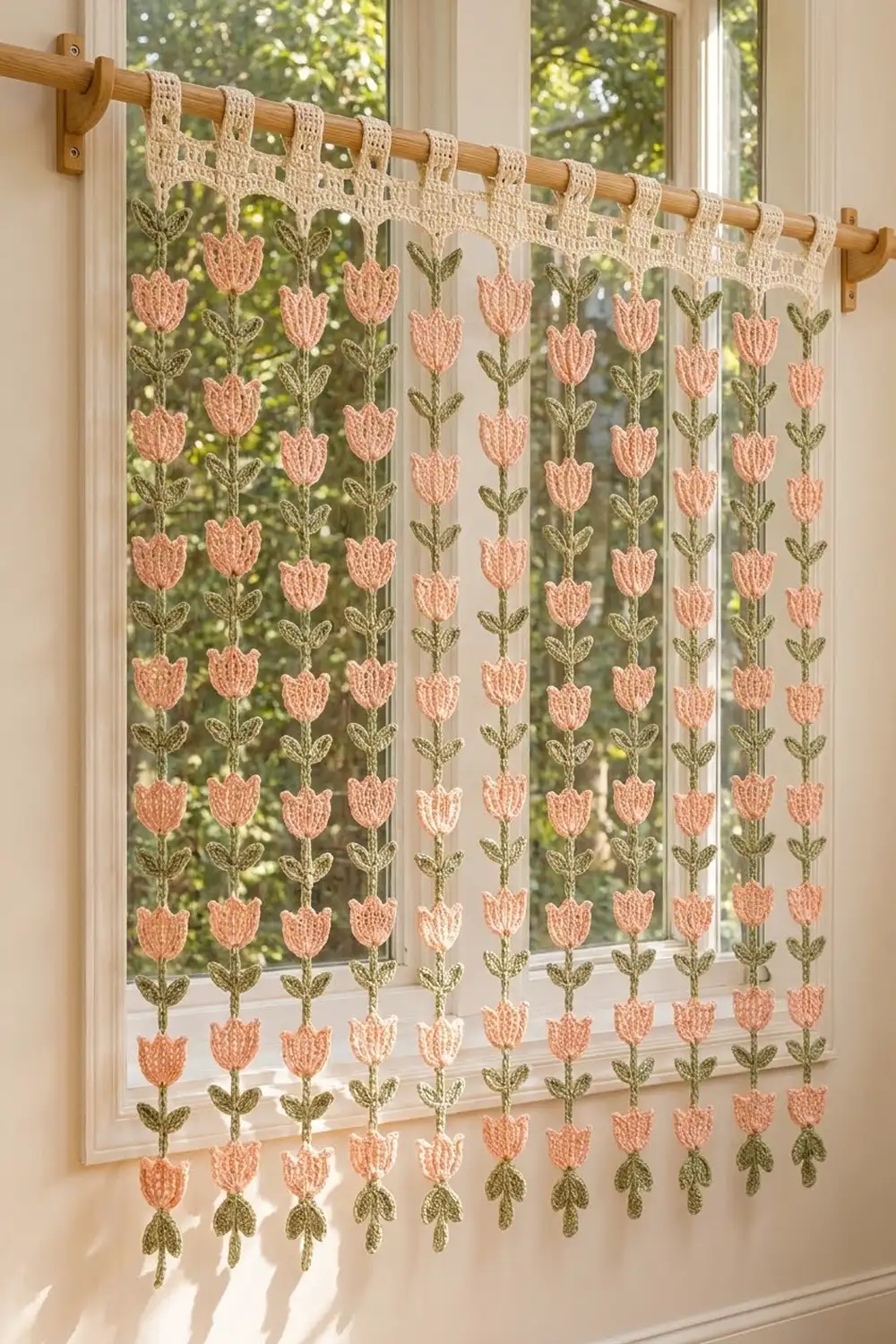
This airy curtain fills a window with tiny tulips. Fourteen strands of peach-pink mesh tulips on sage-green stems hang from a cream filet header, and filet tabs slide over a standard curtain rod. Light passes between the strands, so the curtain covers the window without darkening the room.
The colors are soft and springlike: peach-pink tulip heads, sage-green stems and leaves, and a warm cream header. The style is cottage-romantic, but the construction is simple because the whole curtain is built from one small repeating unit.
All instructions use US crochet terms. The finished curtain is 33.8 in (85.9 cm) wide. Short strands measure 55.25 in (140.3 cm) from the top of the header to the tip of the bottom leaf, and long strands measure 57.75 in (146.7 cm). The tabs add a loop above the header.
You will make 140 tulip heads in pink and link them into 14 strands with green stem-and-leaf sections. Then you crochet one cream header band with tabs and hang the strands from loops built into its scalloped edge.
Finished Size and Construction
- Finished size: 33.8 in (85.9 cm) wide x 55.25-57.75 in (140.3-146.7 cm) long
- Skill level: Intermediate
- Terminology: US crochet terms
- Yarn weight: DK (light worsted, #3), cotton or cotton blend
- Hook: 3.5 mm (E-4)
- Number of pieces: 140 tulip heads, 140 stem sections, 1 header band with 8 tabs
- Layout: 14 strands x 10 tulips, with every other strand hanging 2.5 in (6.4 cm) lower
- Piece size: tulip head 2.25 in (5.7 cm) wide x 2.5 in (6.4 cm) tall; one tulip plus stem is 5 in (12.7 cm)
- Size before border: 14 strands spaced 2.4 in (6.1 cm) apart (one strand pitch)
- Border (header) depth: 2 in (5.1 cm), plus tabs
Materials
Choose a smooth cotton DK, either mercerized or matte. Cotton keeps the petal points crisp and hangs straight. The amounts below assume 50 g / 105 m balls.
- Peach-pink (tulips): 320 g, about 672 m
- Sage green (stems, leaves, hangers): 250 g, about 525 m
- Cream (header and tabs): 100 g, about 210 m
Quantities include a margin of roughly 10-15 percent to cover gauge differences and swatching.
Tools:
– 3.5 mm (E-4) hook
– Tapestry needle
– Stitch markers
– Measuring tape
– Rust-proof pins and a spray bottle
– Scissors
Abbreviations (US Terms)
- ch – chain
- sl st – slip stitch
- sc – single crochet
- hdc – half double crochet
- dc – double crochet
- tr – treble crochet
- sk – skip
- sp – space
- st(s) – stitch(es)
- RS / WS – right side / wrong side
Picot: ch 3, sl st in 3rd ch from hook.
Filet space: ch 2, sk 2 sts, dc in next st (3 sts wide).
Filet block: dc in next 3 sts, or 2 dc in a ch-2 sp and 1 dc in the next dc (3 sts wide).
Loop leaf: Ch 10, then sl st in the 10th ch from the hook to close a long loop. Working into the loop (around the chain), work sc, hdc, dc, dc, hdc, sc, ch 2, sc, hdc, dc, dc, hdc, sc. Sl st in the base st. That makes 12 sts plus a ch-2 tip. The slit inside the loop becomes the leaf’s center vein.
Gauge and Checkpoints
Gauge: 20 dc and 10 rows = 4 in (10.2 cm). Chain gauge: 6 ch = 1 in (2.5 cm), measured relaxed.
Before anything else, make one tulip and one stem section and check them:
- After tulip Row 3: the top edge measures 2.25 in (5.7 cm) across.
- Finished tulip: 2.25 in (5.7 cm) wide x 2.5 in (6.4 cm) tall, from base point to center picot.
- Stem section (ch 3 + ch 12): 2.5 in (6.4 cm).
- One unit (tulip + stem): 5 in (12.7 cm).
If your tulip is wider than 2.25 in (5.7 cm), switch to a 3.25 mm hook, because tulips that are too wide catch on neighboring strands. If it is smaller, switch to a 3.75 mm hook. If only your chains are off, adjust the stem chain counts by 1-2 ch, and use the same counts on every strand.
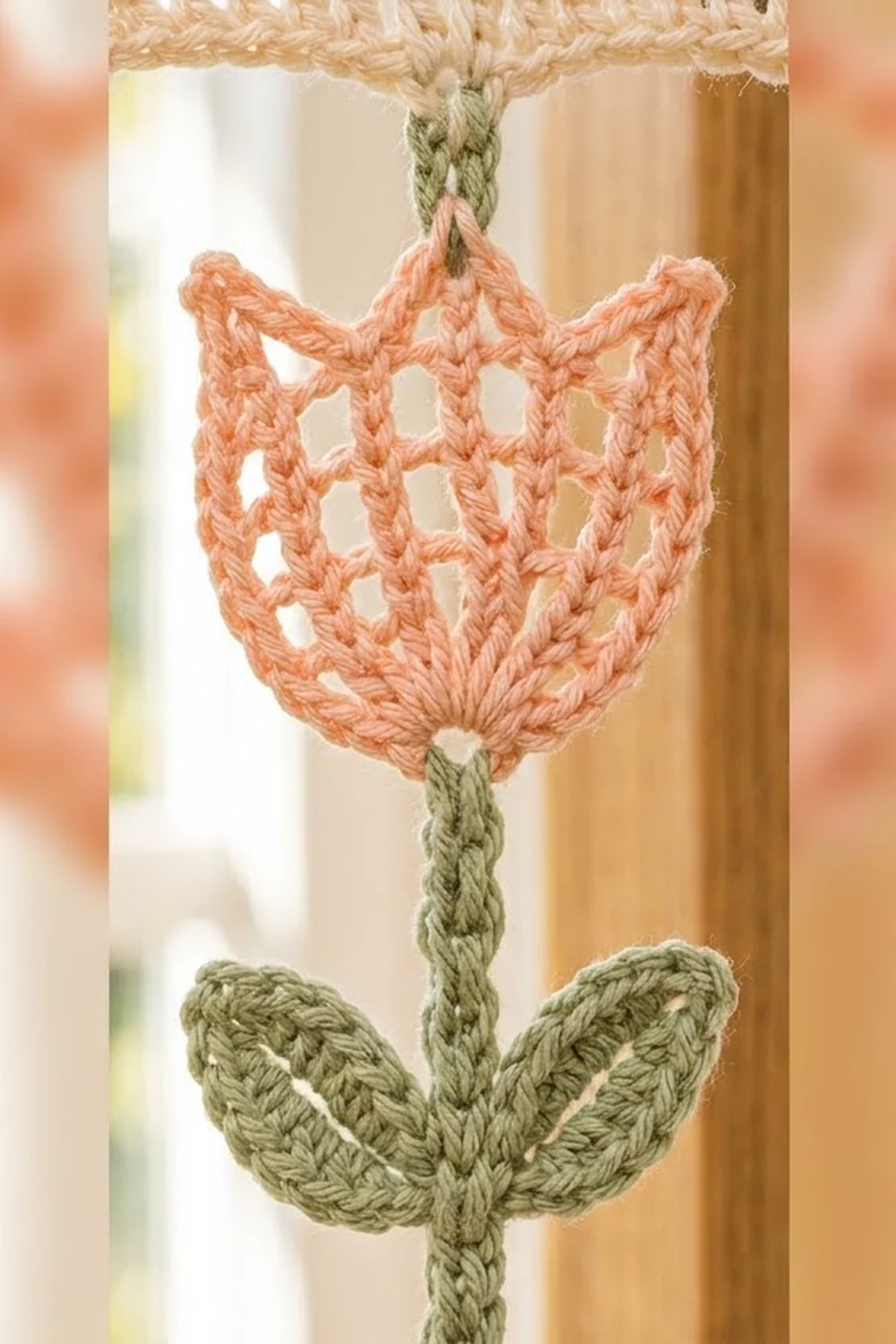
Tulip Head (make 140)
Use peach-pink. Work flat in rows from the base up.
Row 1 (RS): Make a magic ring. Ch 4 (counts as dc + ch 1), [dc, ch 1] 5 times in ring, dc in ring. Pull the ring tight so the stitches fan out from a point. Turn. (7 dc, 6 ch-1 sps)
Row 2: Ch 4 (counts as dc + ch 1), dc in first dc (same st as the turning ch), ch 1, [dc in next dc, ch 1] 5 times, (dc, ch 1, dc) in 3rd ch of turning ch. Turn. (9 dc, 8 ch-1 sps)
Row 3: Ch 4 (counts as dc + ch 1), sk first ch-1 sp, [dc in next dc, ch 1] 7 times, dc in 3rd ch of turning ch. Turn. (9 dc, 8 ch-1 sps)
Row 3 has no increases, which gives the tulip its upright cup. Check that the top edge measures 2.25 in (5.7 cm) now.
Row 4 (petals): Ch 1, sc in first dc. *(Hdc, dc) in next ch-1 sp, (tr, picot, tr) in next dc, (dc, hdc) in next ch-1 sp, sc in next dc, sl st in next ch-1 sp, sc in next dc; repeat from * once more. (Hdc, dc) in next ch-1 sp, (tr, picot, tr) in next dc, (dc, hdc) in next ch-1 sp, sc in last dc. Fasten off and weave in ends.
(3 petals: 6 sc, 6 hdc, 6 dc, 6 tr, 3 picots, 2 sl sts)
Each petal sits over 3 dc of Row 3, and the 2 sl sts pull down the dips between petals. The center picot is where the strand above attaches.
Stem Section with Leaves (make 140)
Use sage green. Hold a tulip with the RS facing you and the base point down.
- Insert the hook through the center of the magic ring at the base point and join green with a sl st.
- Ch 3.
- Work 2 loop leaves into the last ch, one pointing left and one pointing right.
- Ch 12.
The stem is now 15 ch long, or 2.5 in (6.4 cm). The leaves sit off to the sides and do not add length. What you do next depends on where the tulip sits in the strand (see Joining).
Make All Pieces
Each strand uses 10 tulips, 10 stem sections, 1 hanger, and 1 drop leaf on the last stem.
- Peach-pink: 140 tulip heads (14 strands x 10)
- Sage green: 140 stem sections with 280 loop leaves, plus 14 drop leaves and 14 hangers (7 short, 7 long)
- Cream: 1 header band with 8 tabs
Layout grid (S = short hanger, L = long hanger, T = tulip, . = stem and leaves):
Strand:   1  2  3  4  5  6  7  8  9 10 11 12 13 14
Hanger:   S  L  S  L  S  L  S  L  S  L  S  L  S  L
Tier 1:   T  .  T  .  T  .  T  .  T  .  T  .  T  .
          .  T  .  T  .  T  .  T  .  T  .  T  .  T
...repeat for 10 tulips per strand...
Tier 10:  T  .  T  .  T  .  T  .  T  .  T  .  T  .
          .  T  .  T  .  T  .  T  .  T  .  T  .  T
The even-numbered strands sit 2.5 in (6.4 cm) lower. As a result, each tulip hangs next to a pair of leaves on the neighboring strand instead of next to another tulip.
Joining
Join each strand as you go, working from top to bottom. Each stem attaches with a sl st into the center picot of the tulip below it.
Tulips 1-9 of each strand: Work the stem section through step 4. Hold the next tulip with the RS facing you and the petals pointing up. Insert the hook from front to back through its center picot and sl st. Fasten off and weave the tail into the stem chain. The join is one stitch from the stem into one picot, with nothing extra added.
Tulip 10 of each strand: Work the stem section through step 4. Then work 1 loop leaf pointing down, sl st in the base ch, and fasten off. This drop leaf is about 1.25 in (3.2 cm) long.
Tension: Keep your chains at the same relaxed tension throughout. A tight stem shortens the strand and pulls the tulips crooked. Let each tulip hang freely from its picot before you fasten off.
Strand checkpoint: Without the hanger, a finished strand measures 9 units x 5 in (12.7 cm) + 5 in (12.7 cm) + 1.25 in (3.2 cm) = 51.25 in (130.2 cm). All 14 strands should match within 0.5 in (1.3 cm).
Header Band (Border)
Use cream. The header plays the role of a border on a joined project: its stitch count comes directly from the strand layout.
Border gauge: 20 dc = 4 in (10.2 cm), so each dc is 0.2 in (0.5 cm) wide. One strand pitch is 12 sts, or 2.4 in (6.1 cm).
Foundation: Ch 171, or work 169 foundation dc instead.
Row 1 (top edge): Dc in 4th ch from hook and in each ch across. Turn. (169 dc: 168 worked into chains + 1 for the skipped chains, which count as a dc)
Row 2: Ch 3 (counts as dc), [filet space, filet block] 28 times. Turn. (169 sts: 28 spaces and 28 blocks)
Row 3: Ch 3 (counts as dc), [filet block, filet space] 28 times. Turn. (169 sts in a checkerboard)
Row 4: Ch 3 (counts as dc), dc in each dc and 2 dc in each ch-2 sp across. Turn. (169 dc)
Row 5 (scallops and hanging loops): Ch 1, sc in first dc. *Ch 5, sk 3 dc, sc in next 2 dc, (sc, ch 4, sl st) in next dc, sc in next 2 dc, ch 5, sk 3 dc, sc in next dc; repeat from * 13 more times. Fasten off.
(85 sc, 28 ch-5 scallops, 14 ch-4 hanging loops)
Why the math works: Each strand pitch uses 12 sts: 3 under a scallop, 5 sc with a hanging loop on the middle one, 3 under the next scallop, and 1 sc that ends the repeat. Fourteen strands x 12 sts = 168 sts, and the first sc of the row adds 1 more for 169. That extra stitch is the closing edge stitch; there are no added stitches between strands. Rows 2 and 3 use 28 pairs of 6 sts (168) plus the starting dc (169), so the filet grid lines up exactly with the strand pitch. Each hanging loop sits on the 6th st of its pitch. That spaces the strands 2.4 in (6.1 cm) apart, with the outer strands 1.2 in (3.0 cm) from the side edges.
Width check: 169 sts x 0.2 in = 33.8 in (85.9 cm).
Tabs (make 8)
With the RS facing, work into the free loops of the foundation chain. Start the tabs at sts 4, 26, 48, 70, 92, 114, 136, and 158. Each tab is 9 sts wide, with 13 sts between tabs and 3 sts at each end: 8 x 9 + 7 x 13 + 2 x 3 = 169.
Row 1: Join cream in the starting st, ch 3 (counts as dc), dc in next 8 sts. Turn. (9 dc)
Row 2: Ch 3, dc in next dc, ch 2, sk 2, dc in next dc, ch 2, sk 2, dc in last 2 sts. Turn. (5 dc, 2 ch-2 sps)
Row 3: Ch 3, dc in next dc, 2 dc in ch-2 sp, dc in next dc, 2 dc in ch-2 sp, dc in last 2 sts. Turn. (9 dc)
Rows 4-11: Repeat Rows 2-3 four more times. Fasten off, leaving a 12 in (30.5 cm) tail.
Each tab is 4.4 in (11.2 cm) long. Fold it to the WS and sew Row 11 to the back of header Row 2. The loop fits a rod up to 1 in (2.5 cm) thick.
Attach the Strands
Short hangers (strands 1, 3, 5, 7, 9, 11, 13): Join green with a sl st into a hanging loop, ch 9, and sl st through the center picot of tulip 1 from front to back. Fasten off. (1.5 in / 3.8 cm)
Long hangers (strands 2, 4, 6, 8, 10, 12, 14): Work the same way, but ch 24. (4 in / 10.2 cm)
The long hanger is 15 ch longer, which adds 2.5 in (6.4 cm). That is exactly half of a 5 in (12.7 cm) unit, so it creates the stagger.
Length check: header 2 in (5.1 cm) + hanging loop 0.5 in (1.3 cm) + short hanger 1.5 in (3.8 cm) + strand 51.25 in (130.2 cm) = 55.25 in (140.3 cm). Long strands measure 57.75 in (146.7 cm).
Final Blocking
- Weave in all remaining ends, especially at the picot joins.
- Lay the header RS up, pin it to 33.8 in x 2 in (85.9 cm x 5.1 cm), and pin each tab straight.
- Mist the header until it is damp but not soaked, then let it dry completely.
- Lay each strand flat. Pin the three petal points of each tulip and open up the mesh windows.
- Pin each leaf open along its center slit, with the ch-2 tip pointing outward.
- Mist the strands and let them dry flat.
- Hang the curtain on the rod for 24 hours so the strands settle to their final length.
Final Quality-Control Checklist
- All 140 tulips have 9 dc in Row 3 and 3 distinct petals.
- Each tulip measures 2.25 in x 2.5 in (5.7 cm x 6.4 cm).
- Every stem section is 15 ch long and has one pair of leaves.
- Every tulip hangs from its center picot with the RS facing out.
- Hangers alternate short and long across the curtain.
- The header measures 33.8 in (85.9 cm) wide and has 14 evenly spaced hanging loops.
- All 8 tabs are the same length and sewn on level.
- Each strand is within 0.5 in (1.3 cm) of its target length.
Troubleshooting
Tulips twist sideways: Always join through the picot from front to back, and keep all tulips RS facing.
Strands are different lengths: Recount the stem chains and redo any section that is off.
The magic ring loosens: Weave the tail around the base of the ring in a circle, then back through itself.
Leaves curl: The leaf loop is too tight. Chain it more loosely, then pin-block the leaves flat.
The header ripples: The foundation chain was tighter than the dc rows. Use foundation dc instead, or chain with a hook one size larger.
Neighboring tulips tangle: Check that the hangers alternate short and long so the tulips are staggered.
Care
Hand wash in cool water with mild soap. Roll the curtain in a towel to press out the water, then dry it flat with the strands laid straight; don’t wring or tumble dry, because both stretch the chains.
Final Notes
Every measurement in this curtain builds on the one before it. Gauge of 20 dc = 4 in (10.2 cm) and 6 ch = 1 in (2.5 cm) gives a tulip of 2.25 in x 2.5 in (5.7 cm x 6.4 cm) and a 2.5 in (6.4 cm) stem. Together they make a 5 in (12.7 cm) unit, and ten units make a 51.25 in (130.2 cm) strand. Each strand hangs from a 12-st, 2.4 in (6.1 cm) pitch in a 169-st header that is 33.8 in (85.9 cm) wide. If you check each stage before moving on, your curtain will hang straight and even.
Happy crocheting!