

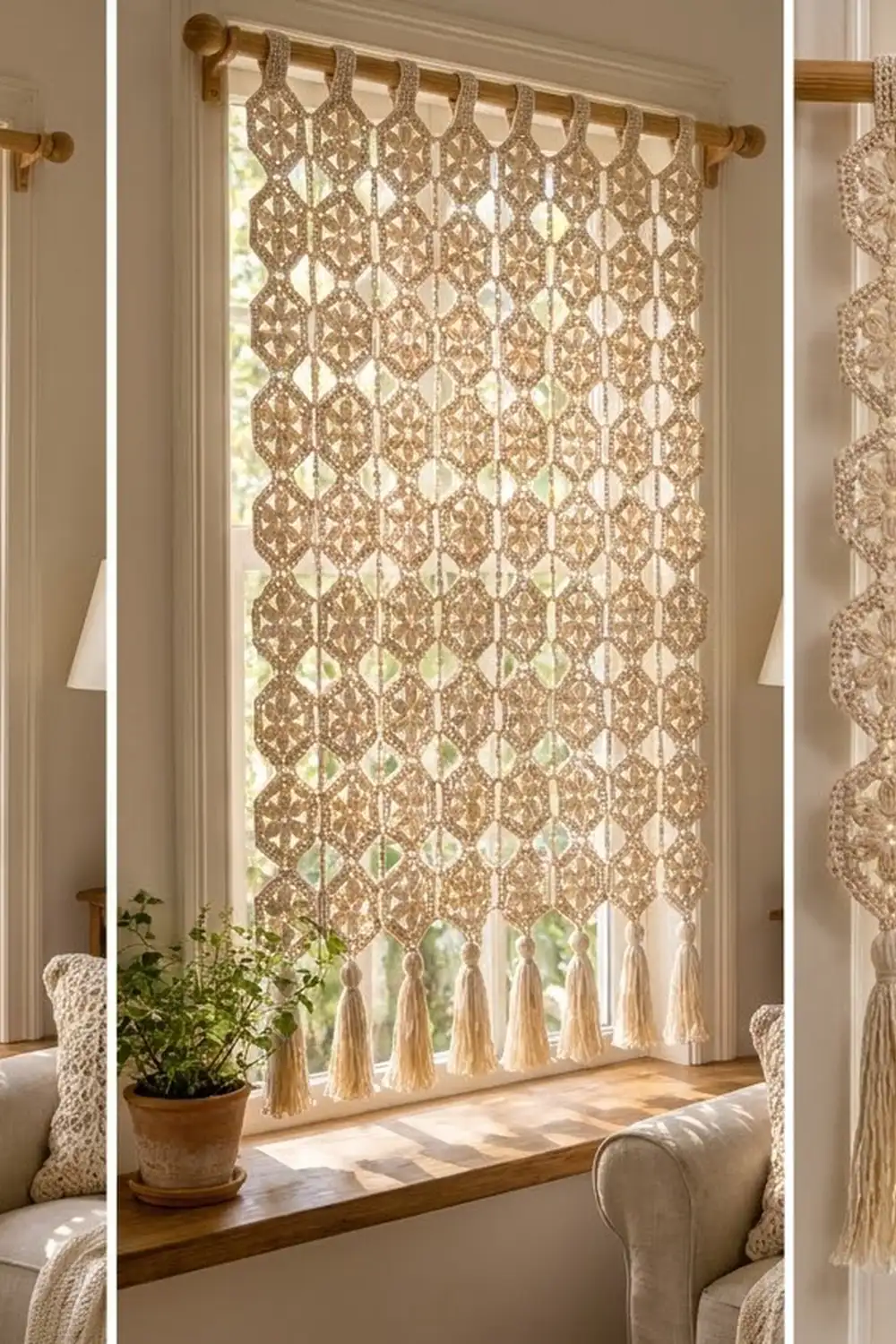
The Cottage Bloom Hexagon Curtain is a light, lacy window panel made from cream hexagons, each with a six-petal puff flower in the center. The hexagons are joined into a lattice with open diamonds between them, so daylight comes through but the window is still softly screened.
All of it is worked in one cream cotton, so the texture does the work: raised puff petals, a smooth double-crochet frame, and a crisp single-crochet edge. A tab-top header band hangs it from a rod, and a tassel finishes the bottom of each strand.
This pattern uses US crochet terms. The finished curtain is 47.3 in (120.1 cm) wide. The hexagon section is 45 in (114.3 cm) tall, or 46.25 in (117.5 cm) with the header band, and 51.25 in (130.2 cm) to the tassel tips.
You’ll make 99 hexagons, join them into 11 columns of 9, then work the header band, add the tabs and tie on the tassels.
Finished Size and Construction
- Finished size: 47.3 in (120.1 cm) wide × 46.25 in (117.5 cm) tall, plus 5 in (12.7 cm) tassels
- Skill level: Intermediate
- Terminology: US
- Yarn weight: DK / light worsted (#3) cotton
- Hook: 4 mm (G-6)
- Number of pieces: 99 hexagons, 1 header band with 11 tabs, 11 tassels
- Layout: 11 columns × 9 rows, hexagons point-up
- Hexagon size: 5 in (12.7 cm) point to point, 4.3 in (10.9 cm) flat side to flat side, 2.5 in (6.4 cm) per side
- Size before border: 47.3 in (120.1 cm) × 45 in (114.3 cm)
- Border (header band) depth: 1.25 in (3.2 cm), with tab loops above it
Materials
Choose a smooth mercerized or matte cotton in DK weight, about 200 m per 100 g. Cotton holds the hexagon points crisply and hangs straight. Avoid fuzzy yarns, which blur the puff petals.
- Cream / ecru: 750 g, approximately 1,500 m
The quantity includes about a 15% margin for your gauge, the tassels and the joining. Buy all of it from one dye lot.
Tools:
– 4 mm (G-6) crochet hook
– Tapestry needle
– Stitch markers
– Sturdy card 5.5 in (14.0 cm) tall for the tassels
– Scissors, measuring tape, rust-proof pins, blocking mats, spray bottle
Abbreviations (US Terms)
- ch – chain
- sl st – slip stitch
- sc – single crochet
- dc – double crochet
- sp – space
- sk – skip
- st(s) – stitch(es)
- RS / WS – right side / wrong side
Puff stitch (puff): [Yarn over, insert hook in stitch, yarn over, pull up a loop about 0.5 in (1.3 cm) tall] 4 times (9 loops on hook). Yarn over, pull through all 9 loops, then ch 1 to close. The closing ch 1 is the top of the puff.
Gauge and Checkpoints
Make one hexagon and block it before starting the rest. Every later measurement depends on it.
Hexagon gauge: 12 sc per side = 2.5 in (6.4 cm), giving a 5 in (12.7 cm) hexagon point to point.
Checkpoints (lightly flattened, not stretched):
– After Round 1: 1.25 in (3.2 cm) across
– After Round 2: 2.25 in (5.7 cm) across the petals
– After Round 3: 3.25 in (8.3 cm) point to point
– After Round 4: 4.5 in (11.4 cm) point to point
– After Round 5: 5 in (12.7 cm) point to point, 4.3 in (10.9 cm) flat to flat
Too big? Go down to a 3.75 mm hook. Too small? Go up to a 4.5 mm hook. Stay within 0.25 in (0.6 cm) of the target. A small error per hexagon adds up to more than 2 in (5.1 cm) across 11 columns.
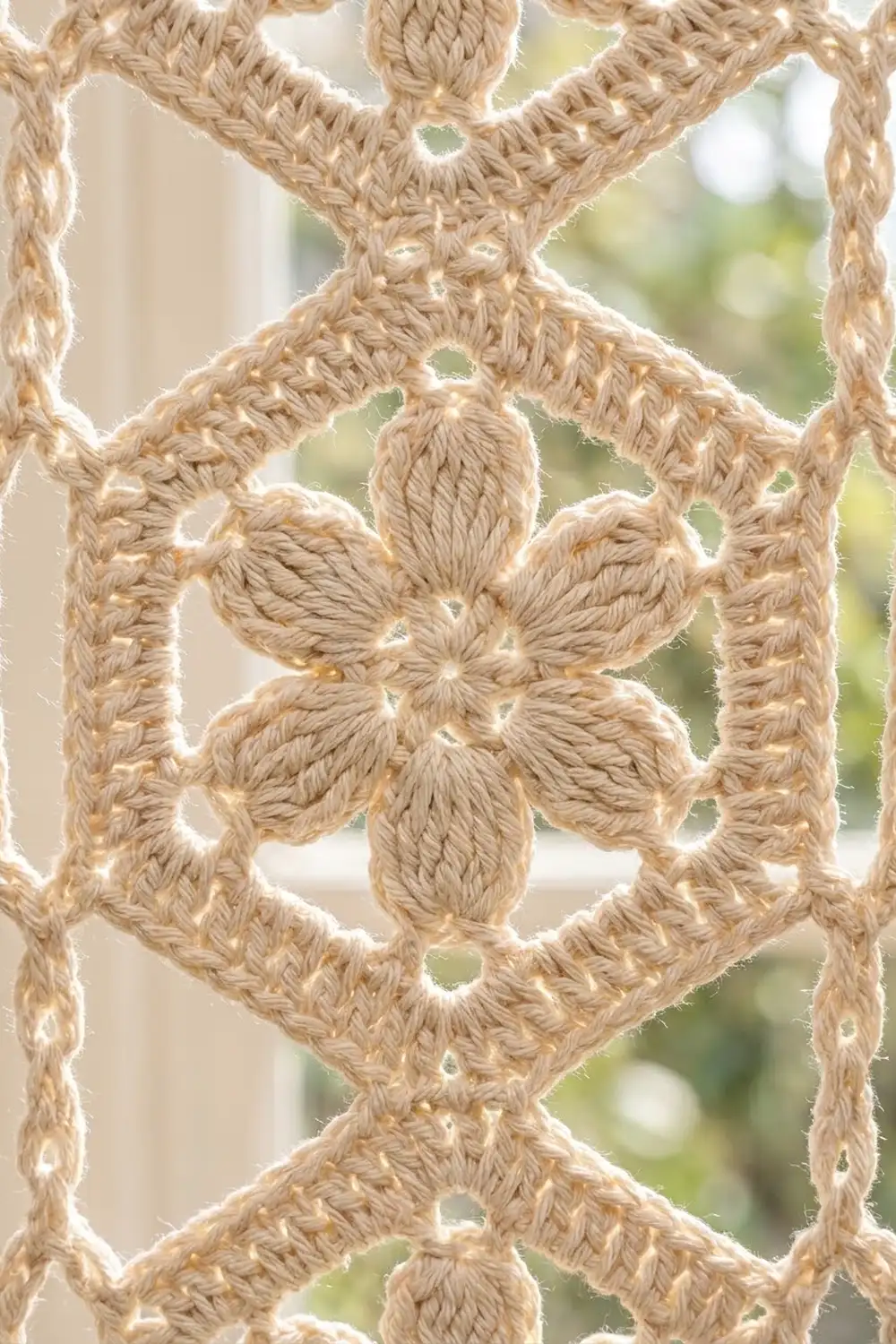
Hexagon Motif (Make 99)
Round 1: Make a magic ring. Ch 3 (counts as dc), 11 dc in ring. Join with sl st to top of ch-3. Pull the ring closed. (12 dc)
Round 2 (petals): Ch 1, puff in same st as join, ch 3, sk next dc, [puff in next dc, ch 3, sk next dc] 5 times. Join with sl st to top of first puff. (6 puffs, 6 ch-3 sps)
The puffs become the six raised petals.
Round 3 (shaping): Sl st into first ch-3 sp. Ch 3 (counts as dc), 3 dc in same sp. (Dc, ch 2, dc) in top of next puff, 4 dc in next ch-3 sp. Repeat from * to * 4 more times. (Dc, ch 2, dc) in top of last puff. Join to top of ch-3. (36 dc, 6 ch-2 corners)
Each corner sits directly above a puff, so every petal points to a corner. Each side has 6 dc between corners.
Round 4 (frame): Ch 3 (counts as dc), dc in next 4 dc. (2 dc, ch 2, 2 dc) in ch-2 corner sp, dc in next 6 dc. Repeat from * to * 4 more times. (2 dc, ch 2, 2 dc) in last corner sp, dc in last dc. Join to top of ch-3.
Count: 36 dc worked one per stitch + 24 dc added at corners = 60 dc, 6 ch-2 corners, with 10 dc per side.
Round 5 (edge): Ch 1, sc in same st and in each dc to the corner. (Sc, ch 2, sc) in corner sp, sc in each dc to the next corner. Repeat around. Join to first sc.
Count: 60 sc worked one per stitch + 12 sc added at corners = 72 sc, 6 ch-2 corners.
In this pattern, “per side” means the 12 sc between two corner ch-2 spaces. The corner spaces are not counted as stitches.
Fasten off, leaving a 6 in (15.2 cm) tail. Weave in the starting tail only, and keep the long tail for joining.
Make All Pieces
Make 99 hexagons, all in cream. Lay them out point-up in 11 columns of 9:
Col: 1  2  3  4  5  6  7  8  9  10 11
R1:  H  H  H  H  H  H  H  H  H  H  H
R2:  H  H  H  H  H  H  H  H  H  H  H
R3:  H  H  H  H  H  H  H  H  H  H  H
R4:  H  H  H  H  H  H  H  H  H  H  H
R5:  H  H  H  H  H  H  H  H  H  H  H
R6:  H  H  H  H  H  H  H  H  H  H  H
R7:  H  H  H  H  H  H  H  H  H  H  H
R8:  H  H  H  H  H  H  H  H  H  H  H
R9:  H  H  H  H  H  H  H  H  H  H  H
Each hexagon is oriented with corners at the top, upper right, lower right, bottom, lower left and upper left. The left and right sides are vertical.
Block all the hexagons to 5 in (12.7 cm) point to point before joining. Joining is much easier when every piece is the same size.
Joining
Step 1 – Columns (point to point). For each column, place the bottom corner of one hexagon against the top corner of the next. Use a tail to whipstitch the two corner ch-2 spaces together with three firm passes, then knot it on the WS.
Each column is 9 × 5 in = 45 in (114.3 cm) long.
Step 2 – Columns side by side. Hold two neighbouring hexagons in the same row WS together, matching the right vertical side of the left hexagon to the left vertical side of the right hexagon. Work through both layers:
- Sl st through both upper corner ch-2 sps
- Sl st through each of the 12 paired sc
- Sl st through both lower corner ch-2 sps
That’s 14 sl sts per seam, one for each pair of stitches. The 12 sc match 12 sc, so you don’t add or skip any stitches. Fasten off after each seam.
Repeat for all 9 rows between each pair of columns: 10 column seams × 9 = 90 short seams. Diamond-shaped openings form between rows, as intended.
Tension: Keep the slip stitches as loose as the sc edge. Tight seams pull the vertical sides in and make the panel pucker. If needed, use a hook one size larger for joining.
Size checkpoint: 11 × 4.3 in = 47.3 in (120.1 cm) wide × 45 in (114.3 cm) tall. Check this before starting the header.
Border: Header Band, Tabs and Tassels
Border gauge: 21 sc = 4.3 in (10.9 cm), and 7 sc rows = 1.25 in (3.2 cm). Check this on a 21-stitch test strip first.
Header Band
Foundation: Ch 232.
Row 1: Sc in 2nd ch from hook and in each ch across. Turn. (231 sc)
Rows 2–7: Ch 1, sc in each sc across. Turn. (231 sc)
Fasten off after Row 7.
Why the math works: The band is 11 sections of 21 stitches, one section per column: 11 × 21 = 231. Each section is 4.3 in (10.9 cm), the flat-to-flat width of one hexagon, so the band is the same 47.3 in (120.1 cm) as the joined panel.
The center of each section is stitch 11, 32, 53, 74, 95, 116, 137, 158, 179, 200 and 221 (stitch 11, then every 21 stitches). Place a marker in each one along the foundation edge.
Attach the band: Line up each top-row hexagon’s top corner under a marker. Sew the corner ch-2 space to the marked stitch and to the stitches on either side of it (3 sts). The triangles between the hexagon points stay open.
Tabs (make 11)
Each tab sits over a column: stitches 8–14 of its 21-stitch section, centered on stitch 11.
Row 1: With RS facing, join yarn in st 8 of the section on Row 7. Ch 1, sc in same st and next 6 sts. Turn. (7 sc)
Rows 2–28: Ch 1, sc in each sc. Turn. (7 sc)
The tab strip is 28 rows = 5 in (12.7 cm). Fold it to the back and sew Row 28 along Row 1 of the band. This makes a loop about 1.875 in (4.8 cm) tall, which fits rods up to about 1 in (2.5 cm) in diameter.
Tassels (make 11)
- Wrap yarn 30 times around the 5.5 in (14.0 cm) card.
- Thread a 12 in (30.5 cm) tie under the top of the wraps and knot it tightly. Cut the bottom loops to get 30 strands of 11 in (27.9 cm), folded in half.
- Wrap a second strand 0.5 in (1.3 cm) below the top and knot it. Bury the ends inside the tassel.
- Use the top tie to sew the tassel to the bottom corner ch-2 space of each Row 9 hexagon.
- Trim the tassel to 5 in (12.7 cm).
Final Blocking
- Lay the curtain flat on mats, RS up.
- Mist it evenly until damp.
- Pin the outer edges to 47.3 in (120.1 cm) × 45 in (114.3 cm), plus the 1.25 in (3.2 cm) band.
- Pin each hexagon’s points in line, and open each diamond gap evenly.
- Shape the puff petals with your fingertips.
- Comb the tassels straight and mist them.
- Let it dry completely before unpinning, then hang it.
Final Quality-Control Checklist
- [ ] All 99 hexagons are 5 in (12.7 cm) point to point, within 0.25 in (0.6 cm)
- [ ] Every hexagon has 72 sc, 12 per side, and 6 corner ch-2 sps
- [ ] Six puff petals point to the corners
- [ ] Every side seam has 14 sl sts and lies flat
- [ ] Panel is 47.3 in (120.1 cm) × 45 in (114.3 cm)
- [ ] Band has 231 sts over 7 rows, sewn at 11 points
- [ ] 11 tabs are centered over the columns, each 7 sts × 28 rows
- [ ] 11 tassels are trimmed to 5 in (12.7 cm)
- [ ] All ends are woven in on the WS
Troubleshooting
Hexagon cups: Round 4 is too tight. Go up half a hook size for Rounds 4–5 only.
Hexagon ruffles: You’ve likely added extra stitches at the corners. Count 10 dc per side on Round 4.
Puffs look flat: Pull each loop up taller, to a full 0.5 in (1.3 cm), before closing.
Point joins gap: Add a fourth whip pass, and pull it snug before knotting.
Band is wider than the panel: Your band gauge is loose. Rework it with a smaller hook so that 21 sts = 4.3 in (10.9 cm).
Curtain hangs crooked: Re-block it, and check that each tab is centered over stitch 11 of its section.
Care
Hand wash in cool water with mild soap, press out the water in a towel, and dry it flat, pinned to size. Comb the tassels while they’re damp.
Final Notes
Everything depends on the first hexagon: 12 sc per side gives a 5 in (12.7 cm) motif that is 4.3 in (10.9 cm) wide. Eleven columns make a 47.3 in (120.1 cm) panel, and nine rows make it 45 in (114.3 cm) tall. The 231-stitch band matches that width at 21 stitches per column, and the tabs and tassels line up with the columns. If your first hexagon matches the gauge, the rest of the curtain will come out to size.
Happy crocheting!