

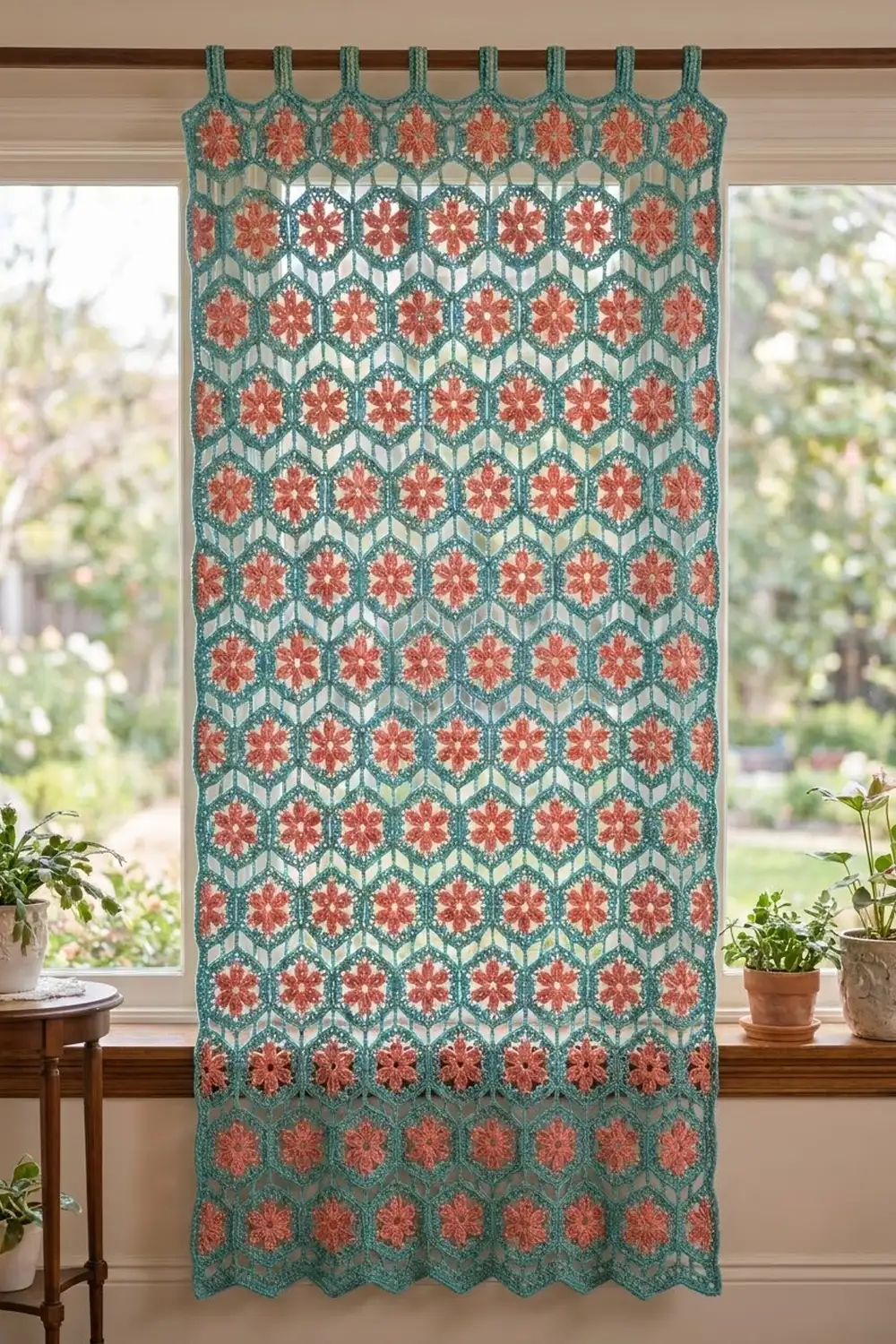
This curtain is a lattice of teal hexagons with a coral six-petal flower in each one. Hung against a sunny window, the open rounds let soft light through, so the flowers seem to float in a sea-glass frame.
You need only two colors. Coral is used for the flower center, and teal is used for the open ring, the solid frame, the border and the hanging tabs. The style is cottage-meets-boho: bright, simple and easy to repeat. Every motif is identical, so this is a good take-along project. You can carry a few balls of yarn and make motifs anywhere, then join them at home.
The pattern uses US crochet terms. The finished panel measures about 44.3 in (112.5 cm) wide and 81 in (205.7 cm) long, measured from point to point and not including the tabs.
Construction is simple. You make 200 hexagon motifs, join them with slip stitches into 21 offset rows, add a two-round border that follows the zigzag outline, and sew on 10 tabs, one at each top point.
Finished Size and Construction
- Finished size: 44.3 in (112.5 cm) wide x 81 in (205.7 cm) long, plus 3 in (7.6 cm) tab loops
- Skill level: Intermediate
- Terminology: US
- Yarn weight: Worsted (#4), cotton or cotton blend
- Hook: 5.0 mm (H-8)
- Number of pieces: 200 hexagon motifs + 10 tabs
- Layout: 21 rows of point-up hexagons, with 10 motifs in odd rows and 9 in even rows, offset by half a motif
- Motif size: 5 in (12.7 cm) point to point, 4.3 in (10.9 cm) flat to flat, 2.5 in (6.4 cm) per side
- Size before border: 43.3 in (110.0 cm) x 80 in (203.2 cm)
- Border depth: 0.5 in (1.3 cm), 2 rounds
Materials
Choose a smooth mercerized or combed cotton. It shows the petals crisply, hangs straight and handles sunlight better than acrylic. Buy all of each color from the same dye lot.
- Teal (Color A): 1,500 g, about 2,850 m (Rounds 3–5 of the motifs, joining, border, tabs)
- Coral (Color B): 700 g, about 1,330 m (Rounds 1–2 of the motifs)
These quantities include a margin of about 10% to allow for gauge differences and swatching.
The finished curtain weighs about 2 kg (4.4 lb). Use a sturdy rod no more than 1.25 in (3.2 cm) thick so the tabs slide easily.
Tools:
- 5.0 mm (H-8) crochet hook
- Tapestry needle
- Stitch markers
- Rust-proof pins and blocking mats
- Measuring tape
- Spray bottle
Abbreviations (US Terms)
- ch – chain
- sl st – slip stitch
- sc – single crochet
- hdc – half double crochet
- dc – double crochet
- tr – treble crochet
- sc2tog – single crochet 2 together
- rev sc – reverse single crochet (crab stitch)
- sp – space
- MR – magic ring
Special stitch – Petal: Ch 6. Working back along the chain, sc in 2nd ch from hook, hdc in next ch, dc in next ch, tr in next 2 ch. The skipped chain at the outer end of the petal is the petal tip.
Corner-to-corner sc2tog (border only): Insert hook in the corner ch-2 sp of the first motif and pull up a loop. Insert hook in the corner ch-2 sp of the neighboring motif and pull up a loop. Yarn over and pull through all 3 loops.
Gauge and Checkpoints
Gauge: 16 sc x 18 rows = 4 in (10.2 cm) in teal.
Make one complete motif first and block it before you make the rest. The whole curtain depends on this one measurement.
- After Round 1: 1.25 in (3.2 cm) across
- After Round 2: about 3 in (7.6 cm) from petal tip to petal tip
- After Round 4: 4.5 in (11.4 cm) point to point
- After Round 5: 5 in (12.7 cm) point to point, 2.5 in (6.4 cm) per side
If your motif is larger than 5.25 in (13.3 cm), go down one hook size. If it is smaller than 4.75 in (12.1 cm), go up one hook size. Small errors add up: 1/4 in (0.6 cm) per motif becomes 2.5 in (6.4 cm) across the width and more than 5 in (12.7 cm) down the length.
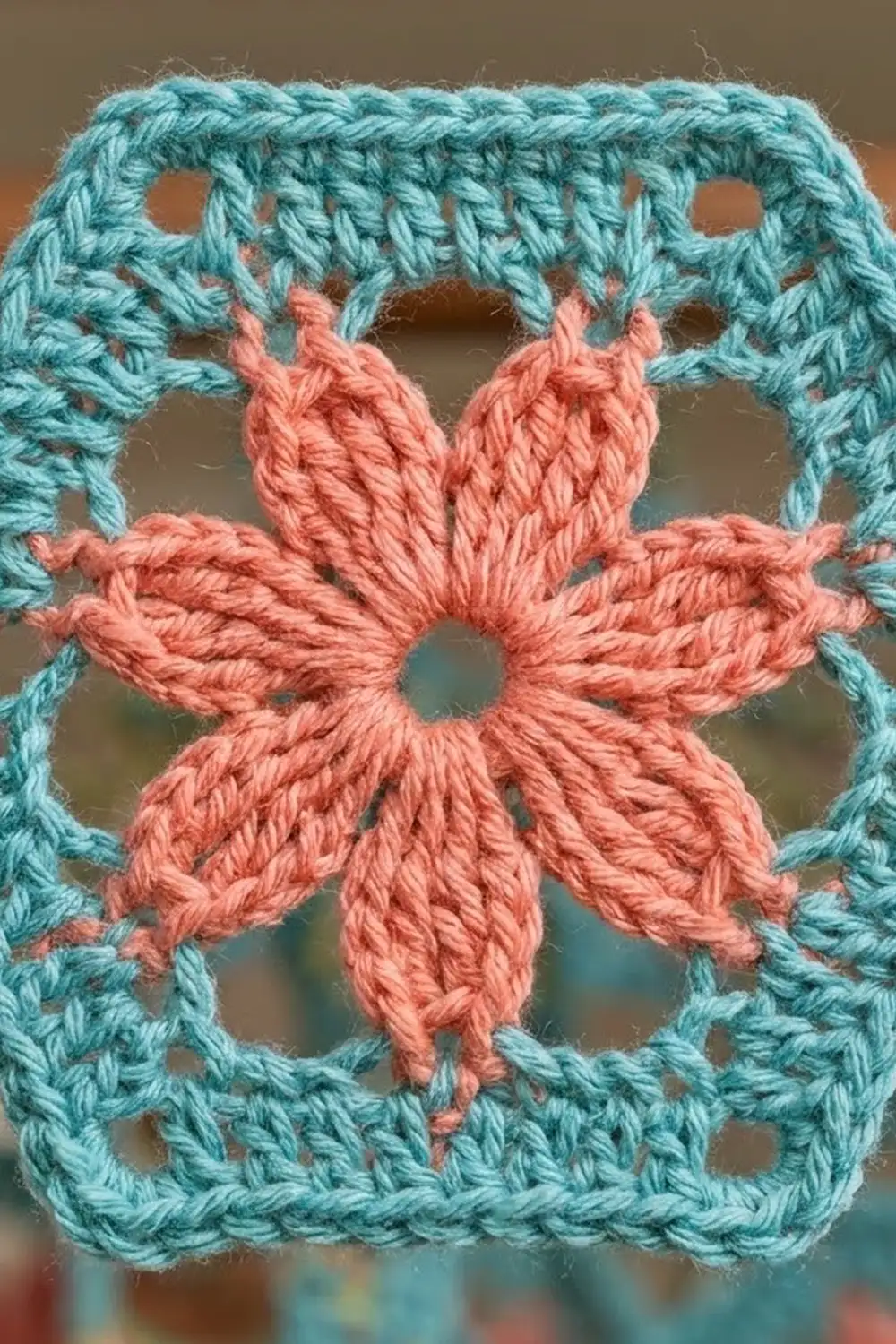
Hexagon Motif (Make 200)
Round 1 (Coral)
MR. Ch 3 (counts as dc), work 11 dc in ring. Join with sl st to top of ch-3. (12 dc)
Round 2 (Coral) – Petals
Ch 1, sl st in same st as join. Work 1 Petal, skip next dc, sl st in next dc. Repeat from * 5 more times. On the last repeat, the final sl st goes into the first sl st. (6 petals)
Each petal uses 2 stitches of Round 1, so 6 petals use all 12. Fasten off coral and weave in the tail.
Round 3 (Teal) – Open Ring
Join teal with sc in the tip of any petal. Ch 5, sc in tip of next petal. Repeat from * 4 more times, then ch 5 and join with sl st to the first sc. (6 sc, 6 ch-5 sps)
The ch-5 loops form the open ring that shows between the flower and the frame.
Round 4 (Teal) – Solid Frame
Ch 3 (counts as dc) in the same sc. (3 dc, ch 2, 3 dc) in next ch-5 sp, dc in next sc. Repeat from * 4 more times, then work (3 dc, ch 2, 3 dc) in the last ch-5 sp. Join to top of ch-3. (42 dc, 6 ch-2 corner sps)
The corners sit between the petals, and each side is centered on a petal tip. Each side has 3 dc + 1 dc + 3 dc = 7 dc.
Round 5 (Teal) – Edge
Ch 1, sc in same st as join and in next 3 dc. (Sc, ch 2, sc) in corner sp. Sc in next 7 dc, (sc, ch 2, sc) in corner sp. Repeat from * 4 more times. Sc in last 3 dc and join to first sc. Fasten off, leaving a 6 in (15.2 cm) tail.
Count: 42 sc (1 in each dc) + 12 corner sc added = 54 sc, plus 6 ch-2 corner sps.
Per side: 1 corner sc + 7 sc + 1 corner sc = 9 sc. In this pattern, “9 sc per side” always includes both corner sc. The ch-2 sps are not counted as stitches.
Make All Pieces
- Motifs: 200, each with Rounds 1–2 in coral and Rounds 3–5 in teal
- Odd rows (1, 3, 5 … 21): 11 rows x 10 motifs = 110
- Even rows (2, 4, 6 … 20): 10 rows x 9 motifs = 90
- Tabs: 10, in teal (instructions below)
Lay out every motif point up. Shift the even rows half a motif to the right so each even-row motif sits in the valley between two motifs in the row above.
Row 1:   O O O O O O O O O O   (10)
Row 2:    O O O O O O O O O    (9)
Row 3:   O O O O O O O O O O   (10)
Row 4:    O O O O O O O O O    (9)
  ... repeat Rows 3-4 ...
Row 20:   O O O O O O O O O    (9)
Row 21:  O O O O O O O O O O   (10)
Joining
Method: Use a teal sl st seam worked from the right side through the outer loops only of both motifs. The inner loops stay visible on the front as a neat line along each seam.
Stitch-to-stitch logic: Place 2 motifs side by side with the edges to be joined touching. Sl st through both corner ch-2 sps together. Then sl st through each matching pair of sc, 9 pairs in all. Finish with a sl st through the next pair of corner ch-2 sps. Every seam matches 9 sc to 9 sc, so no stitches are added and none are skipped.
Order:
- Join each row into a strip along the vertical sides. Odd rows have 9 seams and even rows have 8.
- Join the strips in order. Each seam between rows zigzags along the lower slanted sides of the upper strip and the upper slanted sides of the lower strip. Work it as one continuous seam, slip-stitching into both corner sps wherever 3 motifs meet.
Tension: Keep your sl sts as loose as the sc beneath them. Tight seams make the curtain pucker and shorten. If needed, use a 5.5 mm hook for joining. Weave seam tails along the seams on the back, not through the open ring, where they would show against the light.
Size checkpoint: Lay the joined panel flat without stretching it. An odd row should measure 43.3 in (110.0 cm) from the outer edge of the first motif to the outer edge of the last. The panel should measure 80 in (203.2 cm) from the top point of Row 1 to the bottom point of Row 21. The rows are spaced 3.75 in (9.5 cm) apart.
Border
Border gauge: Same as the motif gauge, 16 sc = 4 in (10.2 cm). Each round adds 0.25 in (0.6 cm).
The outline is not a rectangle. It is made of exposed motif sides that meet at outer points (convex) and inner valleys (concave).
Exposed sides per edge:
- Top edge: 10 motifs x 2 upper sides = 20 sides
- Bottom edge: 10 motifs x 2 lower sides = 20 sides
- Left edge: Row 1 (2 sides) + Rows 3–19 (9 motifs x 3 sides = 27) + even rows (10 motifs x 1 side = 10) + Row 21 (2 sides) = 41 sides
- Right edge: same as left, 41 sides
That makes 122 exposed sides in total, and each one keeps its own 9 sc.
Round 1 (Teal)
Join teal in any sc. Work as follows all the way around:
- Sc in each of the 9 sc on every exposed side
- 3 sc in every convex corner ch-2 sp
- Corner-to-corner sc2tog at every concave corner
Join to the first sc.
Counts per edge:
- Top: 20 sides x 9 = 180 sc + 10 points x 3 = 30 + 9 valleys x 1 = 9 → 219 sts
- Bottom: 180 + 30 + 9 → 219 sts
- Left: 41 sides x 9 = 369 sc + 20 convex corners x 3 = 60 + 20 concave corners x 1 = 20 → 449 sts
- Right: 449 sts
- 4 outer corners (where the side edges meet the top and bottom): 4 x 3 = 12 sts
Total: 219 + 219 + 449 + 449 + 12 = 1,348 sts
Round 2 (Teal)
Ch 1. Working from left to right, rev sc in each st around. Join and fasten off. (1,348 sts)
Why the math works: The seams add no stitches, so every exposed side still has exactly 9 sc. Each convex corner gets 3 sc so the point can turn. Each concave corner gets 1 decrease so the valley doesn’t ruffle. The outline has 64 convex corners and 58 concave corners. Each turn is 60°, so the net turning is (64 – 58) x 60° = 360°, exactly one full turn, which confirms that the outline closes. Crab stitch is worked 1 for 1, so Round 2 needs no corner changes.
Tabs (Make 10)
With teal, ch 6.
Row 1: Sc in 2nd ch from hook and in each ch across. (5 sc)
Rows 2–27: Ch 1, turn, sc in each sc. (5 sc)
Each tab measures 1.25 in (3.2 cm) x 6 in (15.2 cm). Center one tab on each top point of Row 1. Fold it in half over the top edge, with one end on the front of the curtain and the other on the back. Whipstitch both ends to the border. This makes a 3 in (7.6 cm) loop.
Final Blocking
- Weave in all remaining ends along the seams.
- Soak the curtain in cool water for 15 minutes, then gently press out the water. Do not wring it.
- Roll it in towels to remove more water.
- Lay it flat on blocking mats. If space is limited, block one section at a time.
- Pin the top points in a straight line, 4.3 in (10.9 cm) apart.
- Pin the sides and bottom out to 44.3 in (112.5 cm) x 81 in (205.7 cm).
- Open each flower and straighten the petals with your fingers.
- Let the curtain dry completely before unpinning it.
Final Quality-Control Checklist
- Every motif has 6 petals, 42 dc in Round 4 and 54 sc in Round 5.
- Every motif is placed point up.
- All seams lie flat, with 9 sc pairs per side.
- Border Round 1 has 1,348 sts.
- The 10 tabs are evenly spaced and all the same length.
- The final size is within 1/2 in (1.3 cm) of the target.
- No loose ends show on the front.
Troubleshooting
- Petals curl: Your tr stitches are too tight. Loosen your tension or steam-block the motif.
- Motif cups: The ch-5 loops are too short. Chain 6 instead, but do the same on every motif.
- Motif ruffles: Your Round 4 dc are too loose. Try a smaller hook for Round 4 only.
- Side count is off: Count the stitches between the corner sps. Each side must have exactly 9 sc. Fix this before joining.
- Rows don’t nest: Check that the even rows are shifted by half a motif, not a full motif.
- Seams pucker: Rework them with a larger hook.
- Border waves at the valleys: Make sure you worked a sc2tog at each valley, not a single sc.
- Curtain stretches when hung: Cotton stretches under its own weight. Block it again and let it dry flat.
Care
Hand wash in cool water with a mild detergent and dry flat. Don’t hang the curtain while it’s wet, because the weight of the water will stretch it.
Final Notes
The measurements build in a simple chain. One motif is 2.5 in (6.4 cm) per side and 5 in (12.7 cm) point to point. Ten motifs across give 43.3 in (110.0 cm), and 21 offset rows give 80 in (203.2 cm). The border adds 0.5 in (1.3 cm) all around, for a finished panel of 44.3 in (112.5 cm) x 81 in (205.7 cm). If your first motif measures correctly, everything after it will fit.
Happy crocheting!