

This bag holder is a tall, soft tube in lavender shell lace. A solid cream band finishes the top, and a cream strap loops around a wooden ring so the holder hangs from a wall hook. Near the bottom on the front is a round dispensing hole edged in cream, and two small yellow butterflies are sewn on the front.
The palette is lavender, cream and a warm buttery yellow. It looks fresh and a little cottagey, and the open fans let you see how many bags are left inside. Stuff bags in at the top and pull them out one at a time through the hole near the bottom.
This pattern uses US crochet terms. The finished body measures about 6 in (15.2 cm) wide when flattened and 18 in (45.7 cm) tall from the bottom to the top edge. The strap and ring sit above that.
You work it all in one piece from the bottom up. A small sc base cups into a rounded bottom. Then you work a two-round fan lace in joined rounds. For six rows you turn and work back and forth to leave the dispensing hole open, then close it with a chain and go back to rounds. A cream band, a strap, a hole edging and two butterfly appliqués finish the piece.
Finished Size and Construction
- Finished size: 6 in (15.2 cm) wide flat x 18 in (45.7 cm) tall, plus strap and ring
- Skill level: Intermediate
- Terminology: US
- Yarn weight: Worsted (#4) cotton or cotton blend
- Hooks: 5.0 mm (H-8) for body; 3.75 mm (F-5) for butterflies
- Number of pieces: 1 body (base, lace, band, strap and hole edging all worked on) + 2 butterfly appliqués
- Layout: Single tube, hung vertically; hole centered on the front
- Piece size: 12 in (30.5 cm) around, 6 in (15.2 cm) flat
- Size before border (top band): 6 in (15.2 cm) x 16.5 in (41.9 cm)
- Border depth: top band 1.5 in (3.8 cm); hole edging 0.5 in (1.3 cm)
Materials
Go with a smooth mercerized or soft-spun cotton. Cotton holds the fan shapes well, stands up to kitchen use and doesn’t stretch much under the weight of the bags.
- Lavender: 120 g / 204 m (body)
- Cream: 25 g / 43 m (top band, strap, hole edging)
- Yellow: 10 g / 17 m (two butterflies)
These amounts include roughly a 15% margin for your gauge swatch and weaving in ends.
Tools:
– 5.0 mm (H-8) and 3.75 mm (F-5) crochet hooks
– 3 in (7.6 cm) wooden ring
– Tapestry needle
– 4–6 stitch markers
– Scissors
– Fabric stiffener or a drop of clear craft glue (optional, for antennae)
Abbreviations (US Terms)
- ch – chain
- sl st – slip stitch
- sc – single crochet
- dc – double crochet
- tr – treble crochet
- sc2tog – single crochet 2 together
- rev sc – reverse single crochet (crab stitch)
- MR – magic ring
- st(s) – stitch(es)
- sp – space
- RS / WS – right side / wrong side
Special stitch – Shell: 7 dc in the same stitch. The 4th dc of a shell is its center.
Mesh repeat: dc, ch 2, sc, ch 2. Every ch counts as a stitch, so one mesh repeat is 6 sts.
Gauge and Checkpoints
- Sc gauge (5.0 mm hook): 16 sts x 16 rnds = 4 in (10.2 cm)
- Lace gauge: 1 repeat = 1.5 in (3.8 cm) wide; 2 lace rounds (shell + mesh) = 1 in (2.5 cm) tall
Before you commit, work the base and Rnds 7–8 as your test piece. Then check:
- After Rnd 6: base is about 3 in (7.6 cm) across, slightly cupped.
- After Rnd 8: the tube is 6 in (15.2 cm) wide when flattened and the lace is 1 in (2.5 cm) tall.
- After Row 14: the hole opening is about 3 in (7.6 cm) wide x 3 in (7.6 cm) tall.
- After Rnd 36: the body is 16.5 in (41.9 cm) tall, flat.
- After Rnd 42: the body is 18 in (45.7 cm) tall.
If the tube is wider than 6 in (15.2 cm), go down half a hook size. If it’s narrower, go up half a size. Change the hook, not the stitch count. The 48-stitch count is what makes the 8 lace repeats work.
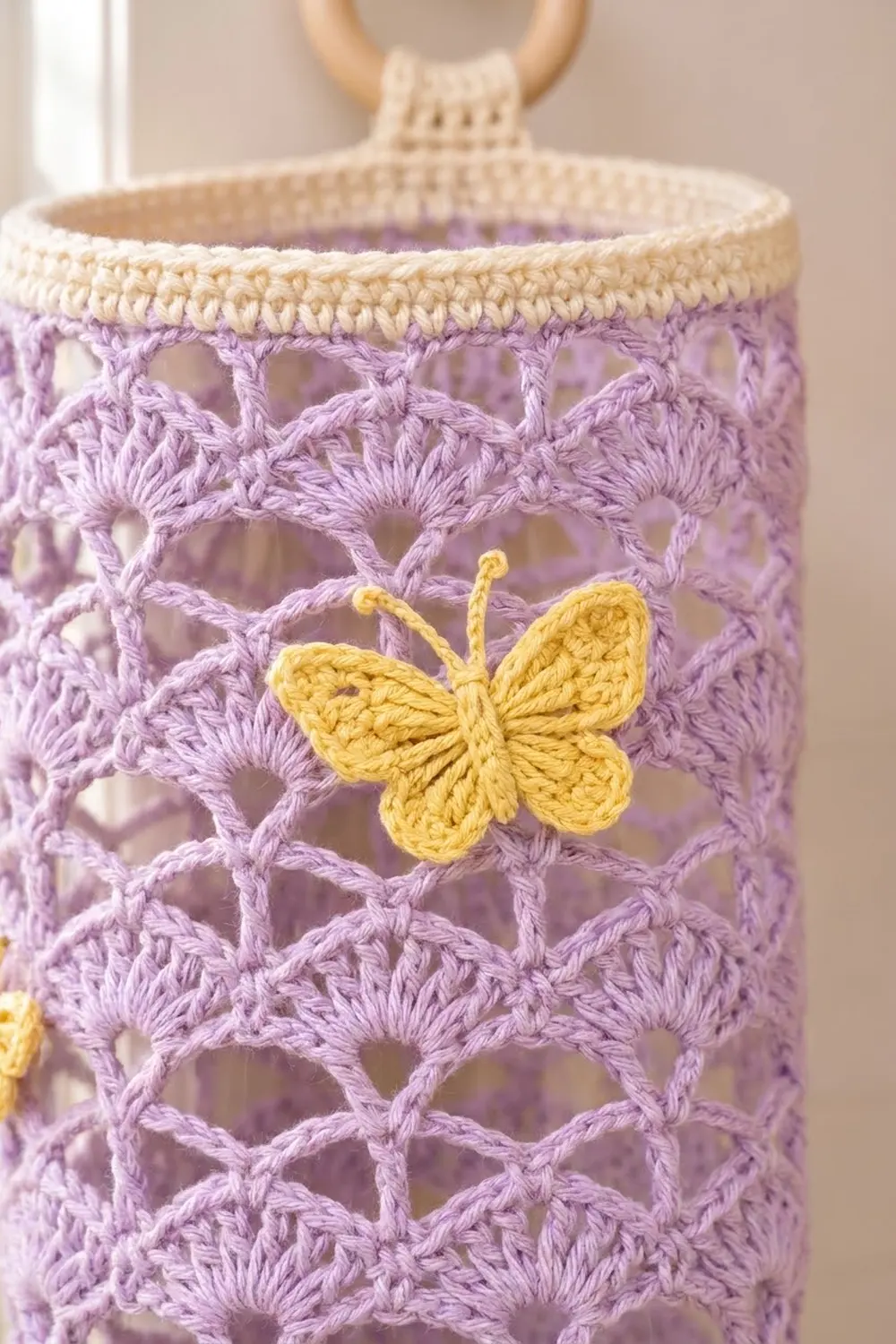
Pattern: Body
Base (lavender, 5.0 mm hook)
Work in joined rounds and don’t turn.
Rnd 1: 8 sc in MR, sl st to first sc. (8 sts)
Rnd 2: Ch 1, 2 sc in each st, sl st to first sc. (16 sts)
Rnd 3: Ch 1, sc in next st, 2 sc in next st; rep around, join. (24 sts)
Rnd 4: Ch 1, sc in next 2 sts, 2 sc in next st; rep around, join. (32 sts)
Rnd 5: Ch 1, sc in next 3 sts, 2 sc in next st; rep around, join. (40 sts)
Rnd 6: Ch 1, sc in next 4 sts, 2 sc in next st; rep around, join. (48 sts)
Eight increases per round make the base cup a little. That cup is what gives you the rounded bottom.
Lace Rounds
Rnd 7 (shell): Ch 1, sc in first st, skip 2 sts, shell in next st, skip 2 sts, sc in next st; rep from * 6 more times, skip 2 sts, shell in next st, skip 2 sts, sl st to first sc. (8 shells + 8 sc = 64 sts)
Rnd 8 (mesh): Ch 5 (counts as dc + ch 2), sc in center dc of next shell, ch 2, dc in next sc, ch 2, sc in center dc of next shell, ch 2; rep from * 6 more times, sl st to 3rd ch of beg ch-5. (8 dc + 8 sc + 32 ch = 48 sts)
Place a marker in this join. It’s dc 1, and this point is called P.
Dispensing Hole (turned rows)
Row 9 (RS): Ch 1, sc in same st, shell in next sc, sc in next dc; rep from * 5 more times. The last sc goes into dc 7, so mark it as point Q. Leave the rest unworked. Turn. (6 shells + 7 sc = 49 sts)
Row 10 (WS): Ch 5 (counts as dc + ch 2), sc in center dc of first shell, ch 2, dc in next sc, ch 2, sc in center dc of next shell, ch 2; rep from * 4 more times, dc in last sc. Turn. (7 dc + 6 sc + 24 ch = 37 sts)
Row 11 (RS): Ch 1, sc in first dc, shell in next sc, sc in next dc; rep from * 5 more times. The last sc goes into the 3rd ch of the turning ch-5. Turn. (49 sts)
Rows 12 and 14: Work as Row 10. (37 sts)
Row 13: Work as Row 11. (49 sts)
When you finish Row 14, you’re back at P. Ch 11, then sl st to the 3rd ch of Row 14’s beginning ch-5 (at Q). Turn so the RS faces you.
The 11 chains replace exactly the 11 stitches left unworked in Rnd 8 between dc 7 and dc 1: ch 2, sc, ch 2, dc 8, ch 2, sc, ch 2. That means 37 + 11 = 48, the same as a full mesh round.
Close the Round and Continue
Rnd 15 (shell, RS): Ch 1, sc in same st, shell in 3rd ch, sc in 6th ch, shell in 9th ch, sc in last dc of Row 14 (at P), shell in next sc, sc in next dc; rep from * 4 more times, shell in last sc, sl st to first sc. (8 shells + 8 sc = 64 sts)
Rnd 16 (mesh): Work as Rnd 8. (48 sts)
Rnds 17–36: Alternate Rnd 7’s shell pattern and Rnd 8’s mesh. On odd rounds, work the shells into the sc and the sc into the dc: ch 1, sc in same st, shell in next sc, sc in next dc; end with shell, sl st to first sc. On even rounds, work as Rnd 8. Fasten off lavender after Rnd 36.
Checkpoint: 64 sts on shell rounds, 48 sts on mesh rounds. The body should be 16.5 in (41.9 cm) tall and 6 in (15.2 cm) wide when flattened.
Butterflies (make 2, yellow, 3.75 mm hook)
Rnd 1: In MR work [ch 3, 3 tr, ch 3, sl st in ring] twice for the upper wings, then [ch 2, 3 dc, ch 2, sl st in ring] twice for the lower wings. Pull the ring closed.
Rnd 2: For each upper wing, work 2 sc along the ch-3, 2 sc in each tr, 2 sc along the ch-3 and a sl st between wings (10 sc). For each lower wing, work 2 sc along the ch-2, 2 sc in each dc, 2 sc along the ch-2 and a sl st (10 sc). (40 sc total) Fasten off and leave a 12 in (30.5 cm) tail.
Body: Wrap the tail 4 times vertically around the center, pulling firmly so the wings pinch. Thread two 2 in (5.1 cm) strands under the wraps at the head for antennae. Knot each end, trim, and curl them with a dab of stiffener. Each butterfly is about 2 in (5.1 cm) wide x 1.75 in (4.4 cm) tall.
Attach the Butterflies
Flatten the body with the hole centered on the front. Sew one butterfly about 4 in (10.2 cm) below the top edge, right of center, angled slightly. Sew the second about 1 in (2.5 cm) above the hole on the left. Stitch through the body and the butterfly at the center, then tack each wing tip so it doesn’t flip up.
Border: Top Band, Strap and Hole Edging
Border gauge: 16 sc = 4 in (10.2 cm), the same as the base. The flattened tube has two sides, front and back, with 24 sts each. 24 sts ÷ 4 sts per inch = 6 in (15.2 cm), which matches the lace width exactly.
Top Band (cream, 5.0 mm hook)
Rnd 37 (conversion): Join cream in any dc of Rnd 36. Ch 1, sc in each dc and each sc, and 2 sc in each ch-2 sp. (16 sc in sts + 32 sc in sps = 48 sts: every stitch of the 48-st mesh round worked once, + 0 extra.) Join. That gives 24 sts front and 24 sts back.
Rnds 38–41: Ch 1, sc in each st, join. (48 sts: 24 per side)
Rnd 42: Ch 1, rev sc in each st, join. (48 sts: 24 per side) Fasten off.
The band is 6 rounds = 1.5 in (3.8 cm). With 16.5 in (41.9 cm) plus 1.5 in (3.8 cm), you get 18 in (45.7 cm).
Why the math works: 48 = 8 repeats x 6 sts. Since the band keeps the same 48 sts at the same 4 sts per inch, it measures 12 in (30.5 cm) around and doesn’t flare or pull in.
Strap
Place a marker at the center back of Rnd 42, opposite the hole. Join cream 3 sts to the right of the marker.
Row 1: Ch 1, sc in next 6 sts. Turn. (6 sts)
Rows 2–20: Ch 1, sc in each st. Turn. (6 sts)
The strap is 1.5 in (3.8 cm) wide x 5 in (12.7 cm) long. Slip it through the wooden ring and fold the end to the inside of the band. Sew Row 20 across Rnds 38–39 on the inside. The loop rises about 1.5 in (3.8 cm) above the band.
Hole Edging (cream, 5.0 mm hook)
Rnd 1: With RS facing, join cream in the first ch-2 sp after dc 7 (at Q, bottom corner). Work 11 sc along the bottom edge (2 sc in each ch-2 sp, 1 sc in each sc and dc). Along the side edge, work 9 sc: 2 sc around each mesh-row dc and 1 sc in each shell-row sc. Along the top, work 11 sc into the free loops of the 11 chains. Work 9 sc along the second side. Join. (11 + 9 + 11 + 9 = 40 sts)
Rnd 2: Ch 1, [sc 9, sc2tog, sc 7, sc2tog] twice, join. (36 sts) Fasten off.
Each sc2tog falls at a corner, which rounds the square opening into a circle. The cream ring is about 3.5 in (8.9 cm) across on the outside, and the clear opening is about 2.75 in (7.0 cm).
Final Blocking
- Weave in all ends along the stitch paths on the WS.
- Mist the whole holder until it’s evenly damp. Don’t soak it.
- Slide a 6 in (15.2 cm) wide piece of cardboard, wrapped in plastic, inside the tube.
- Pat the fans open so each shell spreads evenly.
- Shape the hole edging into a round with your fingers.
- Pin each butterfly’s wings flat and curl the antennae.
- Let it dry completely before you remove the board.
Final Quality-Control Checklist
- Body is 6 in (15.2 cm) wide and 18 in (45.7 cm) tall
- Shell rounds have 64 sts; mesh rounds have 48 sts
- Fans line up in an even, offset lattice all the way around
- Hole is centered on the front with 36 sts on the edging
- Band has 48 sts and lies flat
- Strap is sewn securely and centered on the back
- Butterflies are firmly tacked at center and wing tips
- All ends are woven in and secured
Troubleshooting
Tube is too wide: Your tension is loose. Go down half a hook size and check your shells. Seven dc in one stitch should fan out, not ripple.
Shells don’t line up: Make sure every shell goes into a sc and every sc goes into a dc.
Hole looks square: Make sure the sc2tog falls exactly at each corner in Rnd 2, then block it round.
Band flares: You probably worked 3 sc in a ch-2 sp. Recount Rnd 37 to 48.
Gap at hole corners: Use the tail to close the gap with a stitch or two on the WS.
Butterfly wings curl: Block them flat and tack each wing tip.
Care
Hand-wash in cool water with mild soap and lay flat to dry, reshaping the hole while it’s damp. Take out the wooden ring before washing.
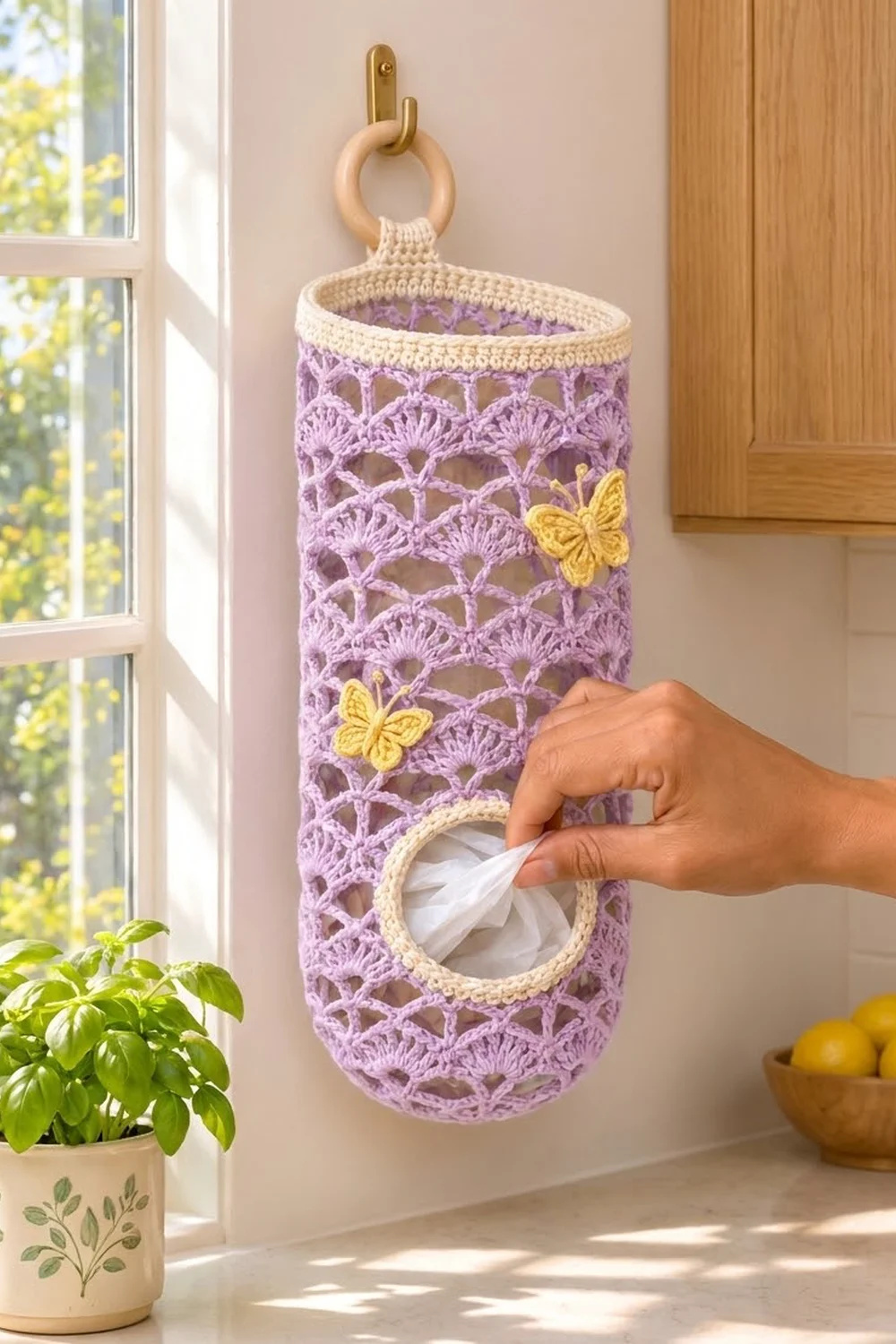
Final Notes
The measurement chain is simple. 48 sts = 12 in (30.5 cm) around = 6 in (15.2 cm) flat. That width stays the same from the base through the lace and into the band. The 3 in (7.6 cm) base cups to form about 1.5 in (3.8 cm) of rounded bottom, and the 30 lace rounds add 15 in (38.1 cm). That brings the body to 16.5 in (41.9 cm), and the 1.5 in (3.8 cm) band takes it to 18 in (45.7 cm). Check those numbers as you go and the holder will hang straight and neat.
Happy crocheting!