

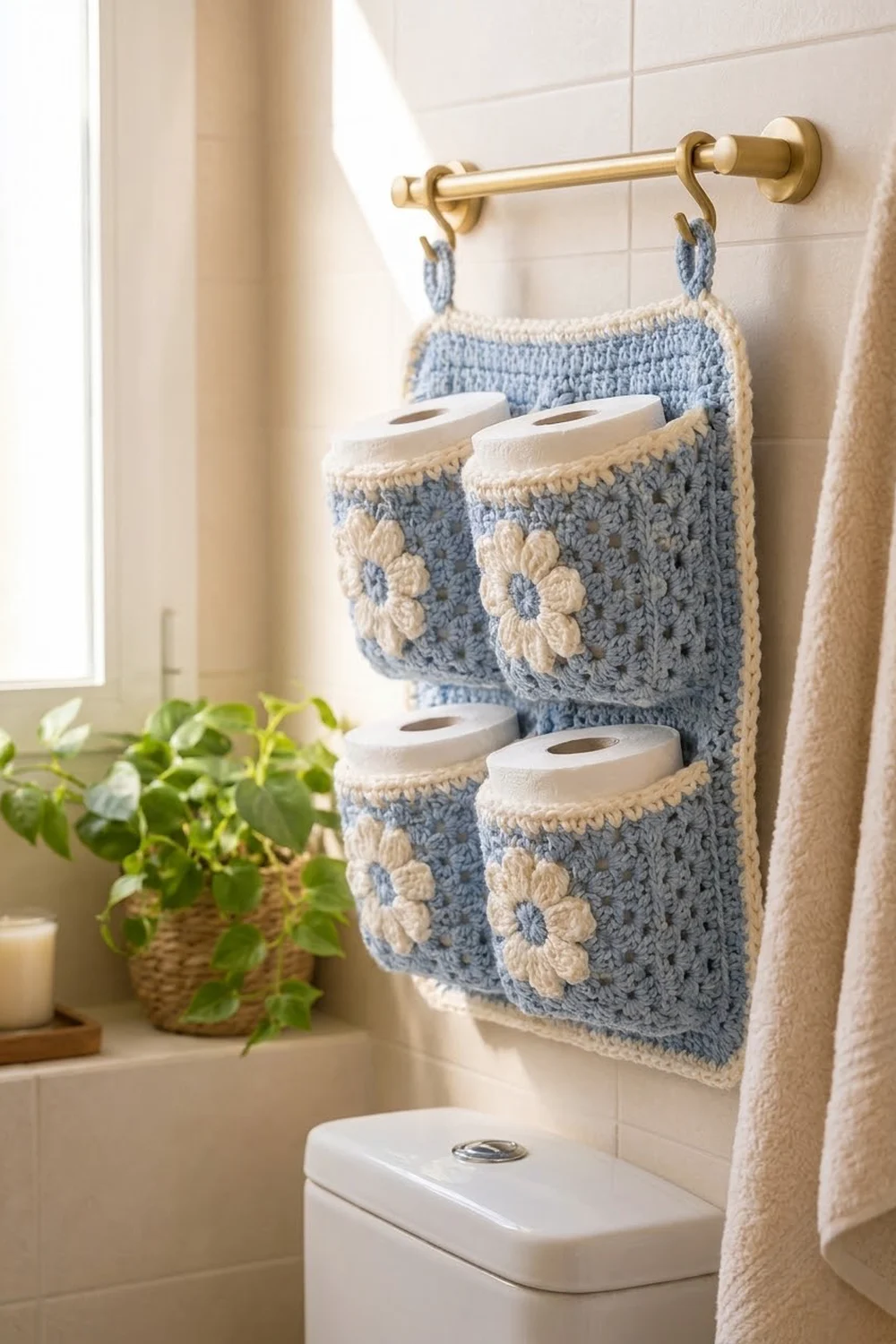
The Bluebell Daisy Toilet Paper Holder is a soft, practical bathroom organizer. A light-blue backing panel holds four deep granny-square pockets, and each pocket fits one standard toilet roll. A raised cream daisy sits on the front of every pocket. A cream rim on each pocket opening and a cream border around the panel tie the look together.
The colors are calm: light blue with cream. The style is classic cottage, with granny clusters, chunky petals and tidy single crochet. It hangs from a towel bar, a hook or the back of a door by two small loops.
This pattern uses US crochet terms. The finished holder measures about 14 in wide x 15.4 in tall (35.6 x 39.1 cm), not counting the hanging loops.
You make one backing panel in single crochet rows and four pockets. Each pocket is a flower granny square with a gusset worked straight off three of its sides, plus a cream rim. You sew the pockets to the panel, add a two-round border, then add the loops.
Finished Size and Construction
- Finished size: 14 x 15.4 in (35.6 x 39.1 cm), plus loops
- Skill level: Intermediate
- Terminology: US
- Yarn weight: Worsted (#4), cotton or cotton blend
- Hook: 5.0 mm (H-8)
- Number of pieces: 5 (1 backing panel, 4 pockets)
- Layout: 2 x 2 pockets on one panel
- Pocket front size: 5.5 x 5.5 in (14.0 x 14.0 cm)
- Pocket depth: about 2.4 in (6.1 cm)
- Panel size before border: 13 x 14.4 in (33.0 x 36.6 cm)
- Border depth: about 0.5 in (1.3 cm) per side
Materials
Choose a smooth worsted-weight cotton with about 170 m per 100 g. Cotton holds its shape, so the pockets stay open and the panel hangs flat.
- Light Blue (A): 250 g / 425 m
- Cream (B): 100 g / 170 m
Tools:
- 5.0 mm (H-8) crochet hook
- Tapestry needle
- 12 to 16 locking stitch markers or pins
- Measuring tape
- Blocking mat and rust-proof pins
- Spray bottle
The quantities include a margin of about 15 to 20 percent for gauge swatches and small differences in tension.
Abbreviations (US Terms)
- ch – chain
- sl st – slip stitch
- sc – single crochet
- hdc – half double crochet
- dc – double crochet
- tr – treble crochet
- BLO – back loop only
- sp(s) – space(s)
- st(s) – stitch(es)
- rep – repeat
- RS / WS – right side / wrong side
Special stitch – Petal: (hdc, dc, 2 tr, dc, hdc) all in the same stitch.
Cluster: 3 dc worked together into one space. This is a group, not a decrease.
Gauge and Checkpoints
Single crochet gauge: 16 sc and 18 rows = 4 in (10.2 cm), worked in rows.
Make one pocket front (Rounds 1 to 8) before anything else. It is your best gauge test.
Checkpoints for the pocket front:
- After Round 3 (flower): about 3 in (7.6 cm) across, tip to tip
- After Round 5: about 3.75 in (9.5 cm) square
- After Round 6: about 4.5 in (11.4 cm) square
- After Round 7: about 5.25 in (13.3 cm) square
- After Round 8: 5.5 in (14.0 cm) square
Checkpoint for the panel: 52 sts = 13 in (33.0 cm) wide, and 65 rows = 14.4 in (36.6 cm) tall.
If your square is too big, go down 0.5 mm. If it is too small, go up 0.5 mm. Fix your gauge now, before you go on, because the pocket layout depends on these sizes.

Backing Panel
With A, ch 53.
Row 1 (RS): Sc in 2nd ch from hook and in each ch across, turn. (52 sc)
Rows 2–65: Ch 1 (does not count as a st), sc in each sc across, turn. (52 sc)
Fasten off and weave in the ends.
Checkpoint: 13 x 14.4 in (33.0 x 36.6 cm).
Pocket (Make 4)
Flower
Round 1: With A, make a magic ring. Ch 1, 8 sc in ring, join with sl st to first sc. (8 sc)
Round 2: Ch 1, 2 sc in each sc around, join. (16 sc) Fasten off A.
Round 3: Join B in any sc. *Sl st in next sc, Petal in next sc; rep from * 7 more times, join with sl st to first sl st. (8 petals, 8 sl sts) Fasten off B.
Granny Frame
Round 4: Working behind the petals, join A with sc in any sl st between petals. *Ch 5, skip the petal, sc in next sl st between petals; rep from * 6 more times, ch 5, join to first sc. (8 sc, 8 ch-5 sps) The chains sit behind the petals, so the flower stays raised.
Round 5: Sl st into first ch-5 sp. Ch 3 (counts as dc), then (2 dc, ch 2, 3 dc) in the same sp for a corner. *Ch 1, 3 dc in next sp, ch 1, (3 dc, ch 2, 3 dc) in next sp; rep from * 2 more times, ch 1, 3 dc in last sp, ch 1, join to top of ch-3. (36 dc: 3 clusters per side, 4 corner ch-2 sps, 8 ch-1 sps)
Round 6: Sl st to the corner ch-2 sp. Work (3 dc, ch 2, 3 dc) in each corner sp and 3 dc in each ch-1 sp, with ch 1 between all groups. (48 dc: 4 clusters per side, 12 ch-1 sps)
Round 7: Rep Round 6. (60 dc: 5 clusters per side, 16 ch-1 sps)
Round 8: Ch 1. Sc in each dc and in each ch-1 sp, and work (sc, ch 2, sc) in each corner ch-2 sp, join. Each side has 15 sc over the dc, 4 sc in the ch-1 sps and 1 corner sc at each end. That makes 21 sc per side, counted between the corner ch-2 sps. (84 sc, 4 corner ch-2 sps)
Checkpoint: 5.5 in (14.0 cm) square. Fasten off.
Gusset
Hold the square with the RS facing you and the flower upright. The top edge stays open.
Row 1 (RS): Join A in the first sc after the top-left corner sp, ch 1. Working in BLO of each sc, sc in the same sc and in the next 20 sc down the left side, sc in corner sp, sc in 21 bottom sc, sc in corner sp, sc in 21 sc up the right side, turn. (65 sc)
The BLO row makes a fold line, so the gusset stands up from the square like the wall of a box.
Rows 2–11: Ch 1, sc in each sc across, turn. (65 sc)
Fasten off, leaving a 40 in (101.6 cm) tail of A for sewing.
Checkpoint: the gusset is about 2.4 in (6.1 cm) deep.
Cream Rim
Row 1 (RS): With the flower facing you, join B at the outer top corner of the right gusset. Ch 1. Working across the 11 gusset row ends, (sc in next 5 row ends, skip 1 row end, sc in next 5 row ends). Sc in the top-right corner ch-2 sp, sc in 21 top sc, sc in the top-left corner sp, then work the left gusset row ends the same way, turn. (10 + 1 + 21 + 1 + 10 = 43 sc)
Skipping 1 of the 11 row ends keeps the rim flat, because sc rows are shorter than sc stitches are wide.
Row 2: Ch 1, sc in each sc across. (43 sc) Fasten off and weave in B.
Make All Pieces
- Backing panel: make 1 in A.
- Pockets: make 4. Each uses A for the flower center, granny frame and gusset, and B for the petals and rim.
Layout on the panel: rows are counted up from Row 1 at the bottom, and stitch columns are counted across the row. The layout is symmetrical.
Rows 58–65   [ top margin, 8 rows                 ]
Rows 33–57   [ 3 ][ Pocket 1 ][ 2 ][ Pocket 2 ][ 3 ]
Rows 30–32   [ gap, 3 rows                        ]
Rows 5–29    [ 3 ][ Pocket 3 ][ 2 ][ Pocket 4 ][ 3 ]
Rows 1–4     [ bottom margin, 4 rows              ]
Columns:       1–3   4–25    26–27  28–49   50–52
Each pocket takes up 22 sts x 25 rows on the panel, about 5.5 x 5.5 in (14.0 x 14.0 cm). Check: 3 + 22 + 2 + 22 + 3 = 52 sts, and 4 + 25 + 3 + 25 + 8 = 65 rows.
Joining
Use the A tail and a whipstitch. Sew the last row of each gusset to the panel so the pocket stands out about 2.4 in (6.1 cm).
- Pin Pocket 3 first. Its bottom gusset section is the 21 bottom sc plus the 2 corner sc, 23 sts in all. Lay it along Row 5 across columns 4–25.
- Pin each 21-st side section up the column lines (column 4 and column 25) from Row 5 to Row 29. The gusset row ends meet the rim at Row 29.
- Along the bottom, whipstitch one gusset stitch to one panel stitch, easing the 23 gusset sts over 22 panel sts.
- On the sides, whipstitch the 21 gusset sts over 25 panel rows. Pick up one extra panel row about every fifth stitch.
- Sew Pocket 4, then Pockets 1 and 2, the same way.
Keep the sewing tension firm but not tight. If the panel puckers behind a pocket, the stitches are too short. Loosen them and redo that section.
Checkpoint: the panel still measures 13 x 14.4 in (33.0 x 36.6 cm) and lies flat.
Border
Border gauge: the border uses the same sc gauge, 4 sts per in and 4.5 rounds per in.
Round 1: With RS facing, join B in the top-right corner st.
- Top edge: (Sc, ch 2, sc) in the corner st, sc in next 50 sts, (sc, ch 2, sc) in the last st. That gives 52 sc between the corner sps.
- Each side: Work over the row ends of Rows 2–64 (63 row ends). *Sc in next 8 row ends, skip 1 row end; rep from * 6 more times. (56 sc) With the corner sc at each end, each side has 58 sc.
- Bottom edge: Work into the free loops of the foundation chain, the same way as the top. (52 sc)
Join to the first sc. (52 + 58 + 52 + 58 = 220 sc, 4 corner ch-2 sps)
Round 2: Ch 1, sc in each sc, (sc, ch 2, sc) in each corner sp, join. (Top and bottom 54 sc each, sides 60 sc each: 228 sc) Fasten off.
Why the math works: The top has 52 panel sts, so it gets 52 border sts, one for each. The sides have 65 rows at 4.5 rows per in, which is 14.4 in (36.6 cm). Working 8 sc over every 9 row ends gives 56 sc. Adding the 2 corner sc makes 58 sc, and at 4 sts per in that is 14.5 in (36.8 cm). That is within 0.1 in (0.3 cm) of the row height, so the edge stays flat.
Hanging Loops (Make 2)
Count from the top-right corner sp along Round 2. Join A in the 5th sc, ch 12, skip next sc, sl st in next sc. Work 18 sc into the ch-12 loop, sl st into the base and fasten off. Join B and sl st in each of the 18 sc around the outer edge. Repeat at the top-left corner, counting from that corner sp.
Final checkpoint: 14 x 15.4 in (35.6 x 39.1 cm).
Final Blocking
- Spray the holder evenly until it is damp, not soaked.
- Lay it RS up on the mat.
- Pin the outer corners to 14 x 15.4 in (35.6 x 39.1 cm).
- Pin the straight edges every 2 in (5.1 cm).
- Stuff each pocket lightly with a rolled towel so it dries open.
- Shape each flower so the petals lie evenly.
- Let it dry completely before you remove the pins.
Final Quality-Control Checklist
- Each pocket front is 5.5 in (14.0 cm) square with 8 even petals
- Every gusset has 65 sc and is 11 rows deep
- Each rim has 43 sc and sits flat
- The pockets line up, with matching margins
- Border counts: 220 sc after Round 1, 228 sc after Round 2
- Both loops are the same size and the same distance from their corners
- All ends are woven in securely
Troubleshooting
- Square cups: Check Round 4. The ch-5 sps may be too short, so try ch 6.
- Square ruffles: Your dc are too loose. Go down one hook size.
- Petals flop forward: Work Round 3 more tightly, or use a smaller hook for the petals only.
- Gusset will not stand up: Make sure Row 1 is worked in BLO.
- Side border waves: Check the 8-in-9 repeat. Too many sc cause ripples.
- Holder sags under the rolls: Sew the gusset bottoms with a double strand of yarn.
Care
Hand wash in cool water, or machine wash on gentle in a laundry bag. Reshape while damp and dry flat.
Final Notes
Each measurement leads to the next. A 5.5 in (14.0 cm) pocket front takes up 22 sts by 25 rows on the panel. Four pockets plus the margins fill a 52-st by 65-row panel of 13 x 14.4 in (33.0 x 36.6 cm). The two-round border adds about 0.5 in (1.3 cm) per side, for a final size of 14 x 15.4 in (35.6 x 39.1 cm). Check each of these measurements as you go, and the holder will hang straight and hold four rolls neatly.
Happy crocheting!