

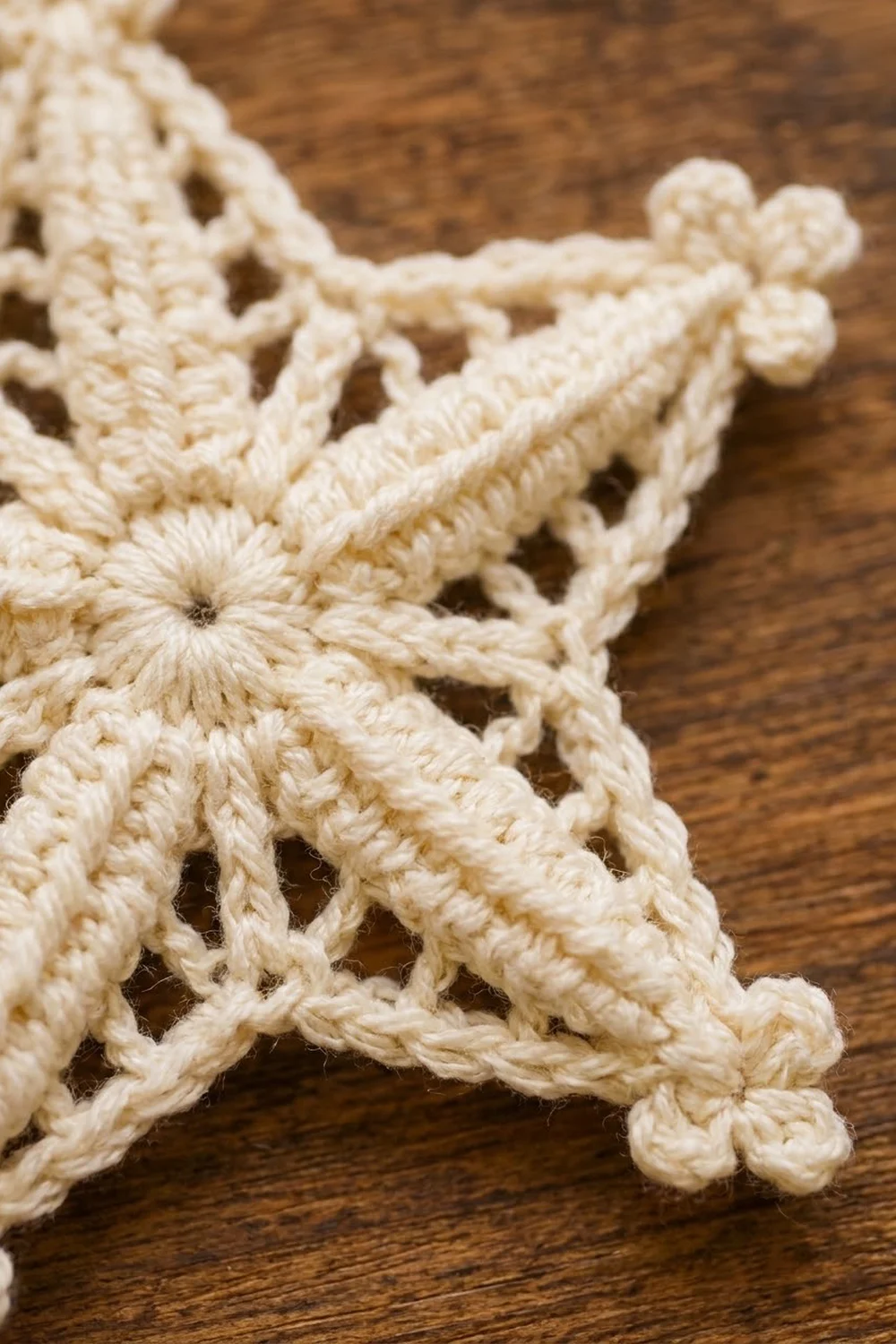
This little star is a single lace motif in one creamy ivory color. Five raised, ribbed spokes radiate from a small center ring, open lace fills the spaces between them, and each point ends in a cluster of three tiny picots. A slim crocheted loop at the top point lets the star hang straight on a branch.
The look is classic and wintery, like frosted snowflake lace but with a clear five-point star outline. Because it uses only one color, it looks elegant up close and from across the room. One star makes a lovely gift-tag topper. Several identical stars spread across a tree make a calm, unified display.
The pattern uses US crochet terms. The finished star measures about 5 in (12.7 cm) wide from point to point and about 4.75 in (12.1 cm) tall, not counting the hanging loop. The loop adds about 2 in (5.1 cm).
You work the star in the round as one piece, starting from the center. First you make a 15-stitch center and add five tapered chain spokes. Next you outline each spoke in back-loop single crochet, which gives it a ribbed ridge. Then you work a lace round of chain spaces and finish with a single crochet border with picot points. The hanging loop goes on last.
Finished Size and Construction
- Finished size: 5 in (12.7 cm) wide, 4.75 in (12.1 cm) tall, plus a 2 in (5.1 cm) loop
- Skill level: Intermediate (easy to follow if you can keep track of stitch counts)
- Terminology: US crochet terms
- Yarn weight: Sport weight (#2) mercerized cotton
- Hook: 2.75 mm (C-2)
- Number of pieces: 1
- Layout: Single star motif, worked in joined rounds
- Piece size: 5 in (12.7 cm) point to point
- Size before border: about 4.4 in (11.2 cm) point to point after Round 5
- Border depth: about 0.3 in (0.8 cm) on each edge (Round 6 plus picots)
Materials
Choose a smooth, mercerized cotton in sport weight. Cotton keeps the spoke ridges crisp and blocks into sharp points. Avoid fuzzy or very soft acrylic, which blurs the lace.
- Ivory / cream: 8 g, about 25 m (27 yd) per star
These amounts include a margin of about 25 percent for a test swatch, the hanging loop and weaving in ends. If you’re making a set, multiply by the number of stars.
Tools:
- 2.75 mm (C-2) crochet hook
- Tapestry needle
- Scissors
- Stitch marker
- Rustproof pins and a foam blocking mat
- Spray starch or fabric stiffener (optional)
Abbreviations (US Terms)
- ch – chain
- sl st – slip stitch
- sc – single crochet
- hdc – half double crochet
- dc – double crochet
- tr – treble crochet
- blo – back loop only
- sk – skip
- sp(s) – space(s)
- st(s) – stitch(es)
Special stitch – picot: Ch 3, sl st in the 3rd ch from the hook. Each picot makes one tiny round bump.
Special stitch – tip cluster: In the same ch-3 sp, work (sc, picot, sc, picot, sc, picot, sc). This makes the three-bump trefoil at each point: 4 sc and 3 picots.
Gauge and Checkpoints
Exact gauge isn’t critical for an ornament, but it controls the final size and how flat the lace lies. Make one test star before starting a set.
- After Round 2: the center disc measures 1 in (2.5 cm) across.
- After Round 3: each spoke measures about 2 in (5.1 cm) from the center disc to its tip.
- After Round 4: the center of the star to any tip measures about 2.25 in (5.7 cm), and point to point is about 4.3 in (10.9 cm).
- After Round 5: point to point measures about 4.4 in (11.2 cm).
- After Round 6: point to point measures 5 in (12.7 cm).
If your star is too big: switch to a 2.5 mm hook, or make your chains tighter. Loose chains are the most common cause of floppy spokes.
If your star is too small or cupping: switch to a 3 mm hook. If only the lace round pulls in, chain a little more loosely in Round 5.
Pattern
Round 1 (center ring)
Make a magic ring. Ch 1 (does not count as a st), then work 10 sc in the ring. Pull the ring closed and sl st to the first sc. (10 sc)
Pull the tail firmly so only a small eye shows in the center, like the finished star.
Round 2 (increase)
Ch 1. Sc in next st, 2 sc in next st; repeat from * 4 more times. Sl st to the first sc. (15 sc)*
Place a marker in the first sc. The 15 sts divide into five groups of 3, one group for each arm.
Round 3 (spokes)
Ch 1. *Sc in next st, ch 14. Now work back along the chain toward the center: sk the first ch from the hook (this ch becomes the tip), sl st in next ch, sc in next 2 ch, hdc in next 3 ch, dc in next 4 ch, tr in next 3 ch. Sk next st of Round 2, sl st in next st. Repeat from * 4 more times.
Each spoke has 13 sts on 13 worked chains (1 sl st + 2 sc + 3 hdc + 4 dc + 3 tr = 13). The stitches get taller toward the center, so each spoke tapers: narrow at the tip, wide at the base.
Count: 5 spokes of 13 sts each. Each spoke is anchored by 1 sc and 1 sl st within its own 3-st group from Round 2. All 15 sts are used (5 x 3 = 15), so the round closes neatly. Do not fasten off.
Round 4 (ribbed spoke outline)
Sl st in the sc at the base of the first spoke.
*Work up the first side of the spoke: sc blo in each of the 13 sts of the spoke, from the tr at the base to the sl st at the tip. In the skipped tip ch, work (sc, ch 2, sc). Work down the other side: sc in each of the 13 free loops of the foundation chain. Sl st in the sl st at the base of the spoke, then sl st in the sc at the base of the next spoke. Repeat from * 4 more times. End with the last sl st in the first sl st of the round. Fasten off.
The unused front loops on the first side line up to form a raised ridge along each spoke. This ridge is the ribbed texture, and the outline gives each spoke its leaf shape.
Count per spoke: 13 + 2 + 13 = 28 sc and 1 ch-2 tip sp. Round total: 140 sc and 5 ch-2 tip sps.
Round 5 (lace)
For this round, number the 13 sc on each side of a spoke s1 to s13, starting from the tip. s1 is next to the tip, and s13 is at the base.
Join yarn with a sl st in the ch-2 tip sp of any spoke (spoke A). Ch 1.
In the tip sp, work (sc, ch 3, sc).
Down spoke A: ch 3, sk s1 and s2, sc in s3; ch 3, sk s4 and s5, sc in s6; ch 3, sk s7 and s8, sc in s9.
Valley bridge: ch 7, then sc in s9 on the facing side of the next spoke (spoke B).
Up spoke B:* ch 3, sk s8 and s7, sc in s6; ch 3, sk s5 and s4, sc in s3; ch 3, sk s2 and s1.
Spoke B now becomes spoke A for the next repeat. Repeat from * 4 more times. On the last repeat, the final ch 3 ends at the first tip: sl st in the first sc of the round.
Leave s10 to s13 unworked. This creates the open window between neighboring spokes near the center. The ch-7 bridge forms the star’s inner corner.
Count per arm: 8 sc (2 at the tip, 3 down, 3 up), 6 side ch-3 sps, 1 tip ch-3 sp and 1 ch-7 sp.
Round total: 40 sc, 30 side ch-3 sps, 5 tip ch-3 sps and 5 ch-7 sps (40 chain spaces in all).
Checkpoint: 4.4 in (11.2 cm) point to point. The lace should lie flat without rippling.
Border
The border is Round 6. It firms up the outline, tightens the inner corners and adds the picot clusters.
Border gauge: Put 3 sc in each ch-3 sp and 5 sc in each ch-7 sp. Stick to this ratio exactly, even if the chains feel roomy.
Round 6 (border and picot points)
Sl st into the next tip ch-3 sp. Ch 1.
*In the tip ch-3 sp, work 1 tip cluster: (sc, picot, sc, picot, sc, picot, sc). Sk the next sc.
[3 sc in next ch-3 sp, sc in next sc] 3 times.
5 sc in the ch-7 sp.
[Sc in next sc, 3 sc in next ch-3 sp] 3 times. Sk the next sc.
Repeat from * 4 more times. Sl st to the first sc. Do not fasten off.
Count per side (from one tip cluster to the next):
- Tip cluster: 4 sc and 3 picots
- Down the spoke: 3 x (3 + 1) = 12 sc
- Valley: 5 sc
- Up the next spoke: 3 x (1 + 3) = 12 sc
- Total per side: 4 + 12 + 5 + 12 = 33 sc and 3 picots
Round total: 5 x 33 = 165 sc and 15 picots.
Why the math works: Each ch-3 sp is 3 chains long, so 3 sc lie flat along the straight spoke edges. The 7-chain bridge gets only 5 sc, which pulls it in slightly and keeps the inner corner sharp and concave. At the tip, 4 sc and 3 picots spread around a short ch-3 sp, so the point flares into a trefoil without cupping. You skip the 2 sc at each Round 5 tip because the tip cluster covers that spot.
Hanging loop
Choose the top point. Sl st along the border to the middle picot of that point’s tip cluster, then sl st into the top of that picot.
Ch 24, then sl st in the same picot to form the loop. Ch 1, work 30 sc into the ch-24 loop, then sl st in the same picot. Fasten off.
The 30 sc pack tightly over the 24 chains, so the loop turns firm and rope-like. It stands about 2 in (5.1 cm) above the point.
Weave in all ends along the back of the spokes, where the thick stitches hide them.
Final Blocking
- Wet the star in cool water, or mist it heavily if you prefer.
- Roll the star in a towel and press out the water. Do not wring it.
- Lay the star right side up on the blocking mat.
- Pin the 5 tips first, spaced evenly on a 5 in (12.7 cm) circle. Pin through the middle picot of each cluster.
- Pin each inner corner at the middle of its ch-7 bridge so all five inner corners match.
- Open each lace window with your fingers and pin the side ch-3 loops straight.
- Pinch each spoke ridge upward so the ribbed texture stands out.
- For a stiff ornament, spray with starch or stiffener. Leave it to dry fully, about 12 hours.
- Unpin, then straighten the hanging loop so it stands directly above the top point.
Final Quality-Control Checklist
- Round 2 has 15 sc, and each spoke sits on its own group of 3.
- Each spoke has 13 sts in Round 3, then 28 sc plus a ch-2 tip in Round 4.
- Each spoke has a ribbed ridge down one side, on the right side of the star.
- Round 5 has 40 sc and 40 chain spaces.
- Round 6 has 165 sc and 15 picots, with 33 sc per side.
- All five points have the same three-picot cluster.
- The star measures 5 in (12.7 cm) wide and 4.75 in (12.1 cm) tall.
- The loop measures about 2 in (5.1 cm) and sits above the center of the top point.
- All ends are woven in and can’t be seen from the front.
Troubleshooting
Spokes twist or curl. The foundation chain was twisted. Keep the chain flat and work into the same part of each chain every time.
Spokes are different lengths. Recount the chains in Round 3. Each spoke needs exactly ch 14.
Lace ripples. The Round 5 chains are too loose. Chain more firmly, or use a 2.5 mm hook for that round only.
Inner corners look rounded. Check that each ch-7 sp has exactly 5 sc, not 7.
Points look blunt. Check the tip cluster count, and pin through the middle picot when blocking.
Ridges look flat. Make sure the Round 4 sc on the first side of each spoke were worked in back loops only.
Center hole is large. Pull the magic ring tail tighter before weaving it in.
Care
Hand wash in cool water with mild soap, then dry flat with the points pinned out again. Starch again after washing if you want the ornament stiff.

Final Notes
Here is how the size builds at each stage. The center starts at 1 in (2.5 cm), and each spoke adds about 2 in (5.1 cm). After the spokes are outlined, the star is about 4.3 in (10.9 cm) across. The lace round brings it to 4.4 in (11.2 cm), and the border and picots bring it to 5 in (12.7 cm). The hanging loop adds 2 in (5.1 cm) on top. Check each stage, and every star you make will match the first.
Happy crocheting!