

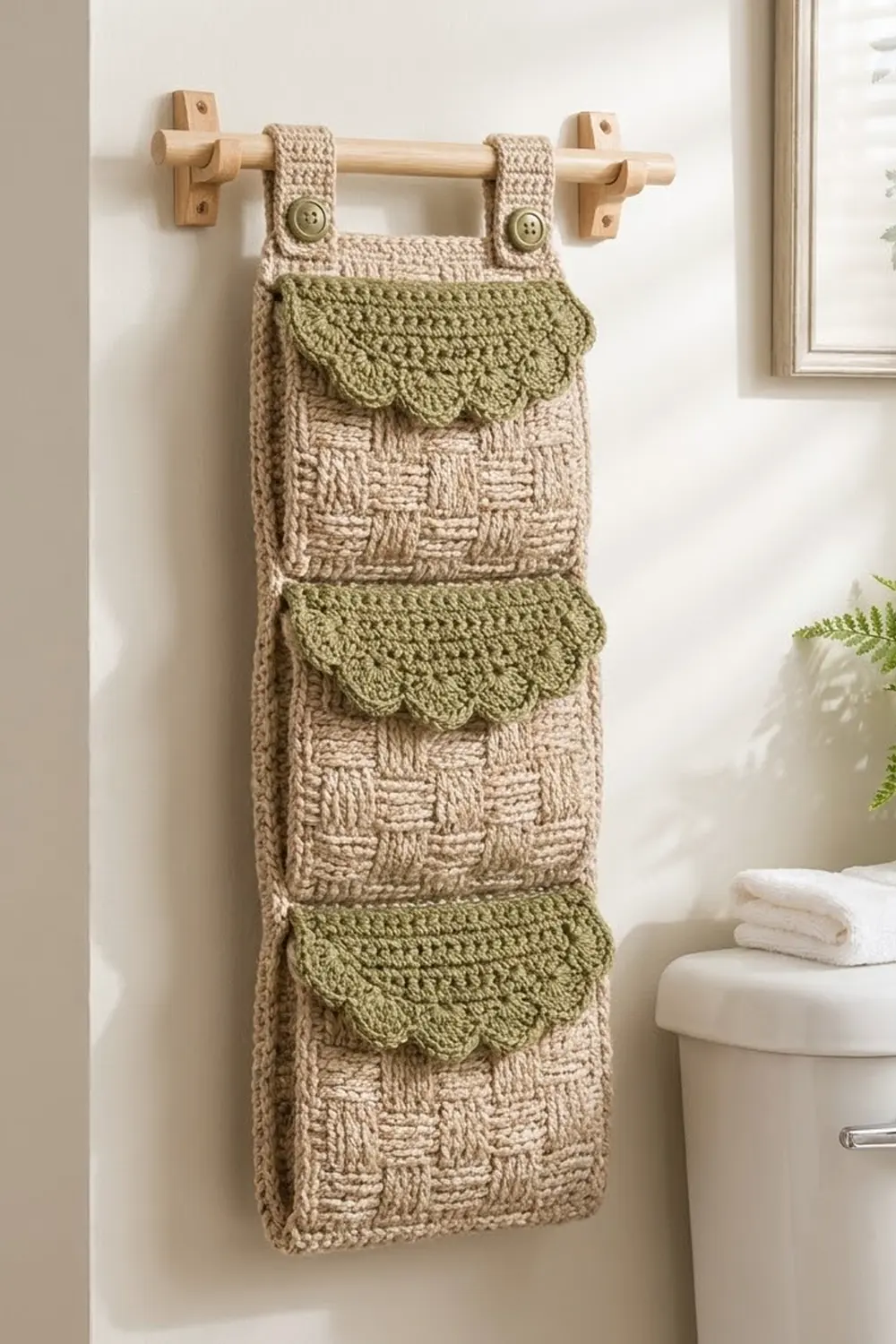
This hanging organizer pairs a deep oatmeal basketweave with soft sage-green scalloped flaps. Three stacked pockets hang from a natural wooden dowel on two buttoned tabs.
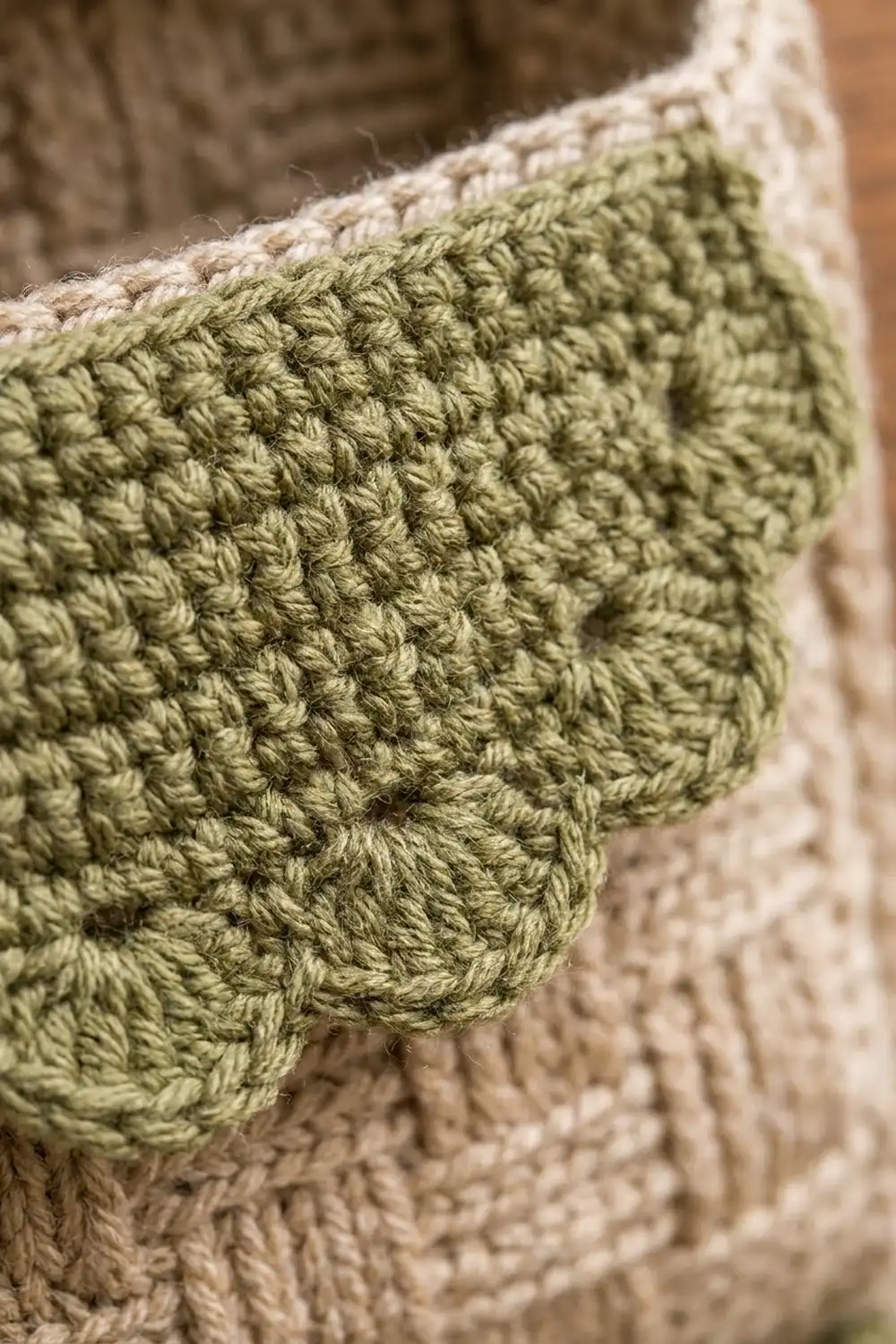
The palette is calm on purpose: one warm beige for the pockets and tabs and one muted olive-sage for the half-moon flaps. The raised basketweave gives the beige a woven, basket-like texture, and the green scallops add a softer, vintage touch.
The pattern uses US crochet terms. The finished organizer measures 10 in (25.4 cm) wide and 21 in (53.3 cm) tall across the three pockets, or about 22.5 in (57.2 cm) tall including the hanging tabs.
Construction is simple. Each pocket is worked in the round from a foundation chain as a flat tube with a closed bottom, so the front and back are made in one piece. You then make three scalloped flaps and two tabs, sew each flap just inside the back rim of its pocket, stack the pockets, and hang the organizer from the dowel.
Finished Size and Construction
- Finished size: 10 in (25.4 cm) wide x 21 in (53.3 cm) tall (pockets only); about 22.5 in (57.2 cm) with tabs
- Skill level: Intermediate (post stitches, working in the round, simple seaming)
- Terminology: US
- Yarn weight: Worsted (#4)
- Hook: 5.0 mm (H-8)
- Number of pieces: 8 (3 pockets, 3 flaps, 2 tabs)
- Layout: 3 pockets stacked in a single vertical column
- Pocket size: 10 in (25.4 cm) wide x 7 in (17.8 cm) tall, measured flat
- Pocket size before rim: 10 in (25.4 cm) x 6.75 in (17.1 cm)
- Rim depth: 0.25 in (0.6 cm), 1 round of reverse single crochet
- Flap size: about 10 in (25.4 cm) across x 3.25 in (8.3 cm) deep
Materials
Choose a smooth worsted-weight cotton or cotton blend. Cotton holds the basketweave crisply, doesn’t stretch much under weight, and copes well with bathroom humidity.
- Color A, warm beige/oatmeal: 300 g, about 465 m (pockets and tabs)
- Color B, sage/olive green: 60 g, about 93 m (flaps)
These amounts include a margin of roughly 10–15 percent. Post stitches use a lot of yarn, so don’t buy too little Color A.
Tools:
- 5.0 mm (H-8) crochet hook
- Tapestry needle
- 2 buttons, 0.75 in (1.9 cm), wood or beige
- Wooden dowel, 14 in (35.6 cm) long and 0.75 in (1.9 cm) in diameter
- Stitch markers
- Measuring tape
- Pins and blocking mat
Abbreviations (US Terms)
- ch: chain
- sl st: slip stitch
- sc: single crochet
- dc: double crochet
- sc2tog: single crochet 2 together
- BLO: back loop only
- st(s): stitch(es)
- RS / WS: right side / wrong side
- rnd(s): round(s)
Special stitches:
- FPdc (front post double crochet): Yarn over, insert the hook from front to back to front around the post of the stitch below, then finish as a dc. The stitch stands out on the side facing you.
- BPdc (back post double crochet): Yarn over, insert the hook from back to front to back around the post, then finish as a dc. The stitch sinks back on the side facing you.
- Reverse sc (crab stitch): Working left to right (if you’re right-handed), insert the hook into the next stitch to the right, pull up a loop, yarn over and pull through both loops. This makes a firm, corded edge.
Gauge and Checkpoints
- Basketweave (pockets): 14 sts and 8 rnds = 4 in (10.2 cm)
- Single crochet (flaps and tabs): 15 sts and 16 rows = 4 in (10.2 cm)
Test one pocket first. It’s the largest piece and sets the size for everything else. Measure it flat, without stretching.
Checkpoints:
- After Rnd 1: the flat foundation is 10 in (25.4 cm) long.
- After Rnd 2: the pocket is 0.75 in (1.9 cm) tall.
- After Rnd 8: the pocket is 3.75 in (9.5 cm) tall. Each basketweave block is about 1.4 in (3.6 cm) wide x 1.5 in (3.8 cm) tall.
- After Rnd 14: the pocket is 6.75 in (17.1 cm) tall.
- After the rim: the pocket is 10 in (25.4 cm) x 7 in (17.8 cm).
If your pocket is too wide, go down a hook size to 4.5 mm. If it’s too narrow, go up to 5.5 mm. Don’t change the stitch counts, because the basketweave repeat depends on exactly 35 stitches per side.
Pocket (Make 3, Color A)
Each pocket is a flat tube with 35 stitches across the front and 35 across the back, for 70 stitches per round. The bottom is closed because you work along both sides of the foundation chain. Join every round with a sl st to the first stitch. The ch-2 at the start of a round doesn’t count as a stitch. Don’t turn.
Foundation: With Color A, ch 36.
Rnd 1: Sc in 2nd ch from hook and in each ch across (35 sc). Rotate the work without turning it, then sc in the free loop of each ch along the other side (35 sc). The last sc goes into the same ch as the first sc. Join. (70 sc)
Place markers in the 1st and 36th stitches. They mark the two sides of the pocket.
Rnd 2: Ch 2, dc in each st around. Join. (70 dc)
Rnd 3: Ch 2, FPdc around each of next 5 sts, BPdc around each of next 5 sts; repeat from * 6 more times (7 repeats in total). Join. (70 sts: 35 FPdc, 35 BPdc)*
Rnds 4–5: Repeat Rnd 3, working FPdc around each FPdc and BPdc around each BPdc. (70 sts in each rnd)
Rnd 6: Ch 2, BPdc around each of next 5 sts, FPdc around each of next 5 sts; repeat from * 6 more times. Join. (70 sts)*
This round swaps the blocks: raised blocks now sit above sunken ones, which creates the woven checkerboard.
Rnds 7–8: Repeat Rnd 6, working FPdc around each FPdc and BPdc around each BPdc. (70 sts in each rnd)
Rnds 9–11: Repeat Rnd 3. (70 sts in each rnd)
Rnds 12–14: Repeat Rnd 6. (70 sts in each rnd)
Don’t fasten off. Continue with the rim in the Border section.
Each side has 7 blocks across (5 x 7 = 35), so the block edges line up exactly with the sides of the pocket.
Flap (Make 3, Color B)
Each flap is a half-moon worked flat in rows from the straight top edge downward. The scallop edging along the curved sides and bottom is in the Border section.
Foundation: With Color B, ch 34.
Row 1 (RS): Sc in 2nd ch from hook and in each ch across. Turn. (33 sc)
Rows 2–3: Ch 1, sc in each st across. Turn. (33 sc in each row)
Row 4: Ch 1, sc2tog, sc in next 29 sts, sc2tog. Turn. (31 sts)
Row 5: Ch 1, sc2tog, sc in next 27 sts, sc2tog. Turn. (29 sts)
Row 6: Ch 1, sc2tog, sc in next 25 sts, sc2tog. Turn. (27 sts)
Row 7: Ch 1, [sc2tog] twice, sc in next 19 sts, [sc2tog] twice. Turn. (23 sts)
Row 8: Ch 1, [sc2tog] twice, sc in next 15 sts, [sc2tog] twice. Turn. (19 sts)
Row 9: Ch 1, [sc2tog] twice, sc in next 11 sts, [sc2tog] twice. Fasten off. (15 sts)
Checkpoint: The flap body is 8.8 in (22.4 cm) across Row 1 and 2.25 in (5.7 cm) deep. Row 9 is about 4 in (10.2 cm) wide.
Tab (Make 2, Color A)
Foundation: Ch 7.
Row 1: Sc in 2nd ch from hook and in each ch across. Turn. (6 sc)
Rows 2–18: Ch 1, sc in BLO of each st across. Turn. (6 sc in each row)
Fasten off, leaving a 12 in (30.5 cm) tail for sewing. The tab measures 1.6 in (4.1 cm) x 4.5 in (11.4 cm) and has a fine ribbed texture.
Make All Pieces
- Color A: 3 pockets and 2 tabs
- Color B: 3 flaps
Layout (front view, top to bottom):
   [Tab]             [Tab]
 ====== wooden dowel ======
 | Flap 1   (sage)       |
 | Pocket 1 (beige)      |
 |-----------------------|
 | Flap 2   (sage)       |
 | Pocket 2 (beige)      |
 |-----------------------|
 | Flap 3   (sage)       |
 | Pocket 3 (beige)      |
Finish the pocket rims and flap edgings (Border section), then block every piece before joining. Edges are much easier to match and sew when they lie flat.
Joining
Use whipstitch and a long tail of Color A, sewing one stitch to one stitch. Keep the tension snug but not tight. The seam should lie flat and stay the same width as the fabric, without pulling it in.
1. Attach the flaps. Turn each pocket so you’re looking at the inside face of its back layer. Hold a flap upside down, with the scallops pointing up and its RS facing the inside of the back layer. Line up the flap’s foundation edge (33 sts) with Rnd 14 of the back layer. Center it so 1 st stays free at each side of the pocket (1 + 33 + 1 = 35). Whipstitch the 33 foundation loops to the 33 matching posts, one to one. Fold the flap down and forward over the front rim. Its RS now faces out and covers the top of the pocket.
2. Attach the tabs to Pocket 1. Fold each tab in half around the dowel. Place one tab 1.5 in (3.8 cm) in from each side of the pocket. Put the back end of the tab on the wall side of the back layer and the front end on the inside face, so the rim sits between them. Sew through all layers along Rnd 14. Sew a button to the front end of each tab, 0.75 in (1.9 cm) above the rim, through both tab layers.
3. Stack the pockets. Lay Pocket 2 below Pocket 1. Whipstitch the 35 Rnd 1 sts on the back layer of Pocket 1 (its closed bottom edge) to the 35 rim sts on the back layer of Pocket 2, one to one. Sew from side to side without adding stitches, then reinforce each corner with 2 extra passes. Join Pocket 3 to Pocket 2 the same way.
Each flap is sewn just below its rim on the inside face, so the seam between pockets runs above the flap and doesn’t catch it.
Size checkpoint: The joined column should measure 10 in (25.4 cm) wide x 21 in (53.3 cm) tall, which is 3 pockets x 7 in (17.8 cm). If it’s narrower at the seams, the whipstitch is too tight. Take it out and sew it again more loosely.
Border
In this design, the border is the finished edge on each piece: a corded rim on every pocket and a scalloped edge on every flap.
Border gauge: Reverse sc is worked 1 per stitch and adds 0.25 in (0.6 cm) of height.
Pocket Rim (Rnd 15): Continue from Rnd 14: ch 1, then reverse sc in each st around. Join and fasten off. (70 sts: 35 on the front, 35 on the back)
Flap Edging, Row 1 (RS): With the RS facing you, join Color B in the row end of Row 1 at one top corner of the flap.
- Side 1: 1 sc in each row end of Rows 1–6, then 2 sc in each row end of Rows 7–9. (12 sts)
- Bottom: 3 sc in first st of Row 9, sc in next 13 sts, 3 sc in last st. (19 sts)
- Side 2: 2 sc in each row end of Rows 9–7, then 1 sc in each row end of Rows 6–1. (12 sts)
Turn. (43 sts: 12 + 19 + 12)
Flap Edging, Row 2 (scallops): Ch 1, sc in first st, skip 2 sts, 5 dc in next st, skip 2 sts, sc in next st; repeat from * 6 more times. Fasten off. (7 scallops: 35 dc and 8 sc)*
Why the math works: The pocket rim keeps the same 70 stitches as Rnd 14, so it neither ruffles nor pulls in. Each side stays at 35 sts and 10 in (25.4 cm). On the flap, each scallop uses 6 sts (2 skipped + 1 for the shell + 2 skipped + 1 for the sc), plus the 1 sc at the start: 7 x 6 + 1 = 43. The 3-sc corners give the curve enough room to bend without cupping.
Final Blocking
- Weave in all ends except the long sewing tails.
- Spray each piece lightly with water until it’s damp but not soaked.
- Pin each pocket flat to 10 in (25.4 cm) x 7 in (17.8 cm), with the sides straight and the rim level.
- Pin each flap with its top edge straight at 8.8 in (22.4 cm), and shape each of the 7 scallops into an even arc.
- Pin the tabs to 1.6 in (4.1 cm) x 4.5 in (11.4 cm).
- Let everything dry completely before joining.
Final Quality-Control Checklist
- Each pocket measures 10 in (25.4 cm) x 7 in (17.8 cm).
- The basketweave blocks line up at the sides of the pocket on every round.
- Each pocket rim has 70 reverse sc and lies flat.
- Each flap has 7 even scallops, and its RS faces out when folded down.
- The flaps are centered, with 1 rim st free at each side.
- The pocket seams are sewn 35 sts to 35 sts with no puckers.
- The joined column measures 10 in (25.4 cm) x 21 in (53.3 cm).
- The tabs sit 1.5 in (3.8 cm) in from each side, and the buttons are secure.
- The organizer hangs straight on the dowel.
Troubleshooting
- The blocks shift sideways: A stitch was skipped or doubled at the join. Count 70 sts at the end of every round.
- The pocket gets wider toward the top: Post stitches tend to loosen as you go. Check your gauge at Rnd 8 and tighten slightly if needed.
- The flap cups or curls: The decreases are too tight or the edging is too short. Check that there are 3 sc in each bottom corner.
- The scallops are uneven: Recount Edging Row 1. It must have exactly 43 sts.
- The organizer hangs crooked: The tabs aren’t evenly spaced. Measure 1.5 in (3.8 cm) from each side again.
Care
Hand wash in cool water with mild detergent, gently press out the water, and dry flat, reshaping the pieces to size. Take the organizer off the dowel before washing.
Final Notes
Here’s how the measurements build. A gauge of 14 sts = 4 in (10.2 cm) gives 35 sts = 10 in (25.4 cm) per side. Fourteen rounds plus the rim give 7 in (17.8 cm) per pocket. Three stacked pockets give 21 in (53.3 cm), and the tabs bring the total to about 22.5 in (57.2 cm). If your first pocket matches its checkpoints, the rest of the project will follow.
Happy crocheting!