

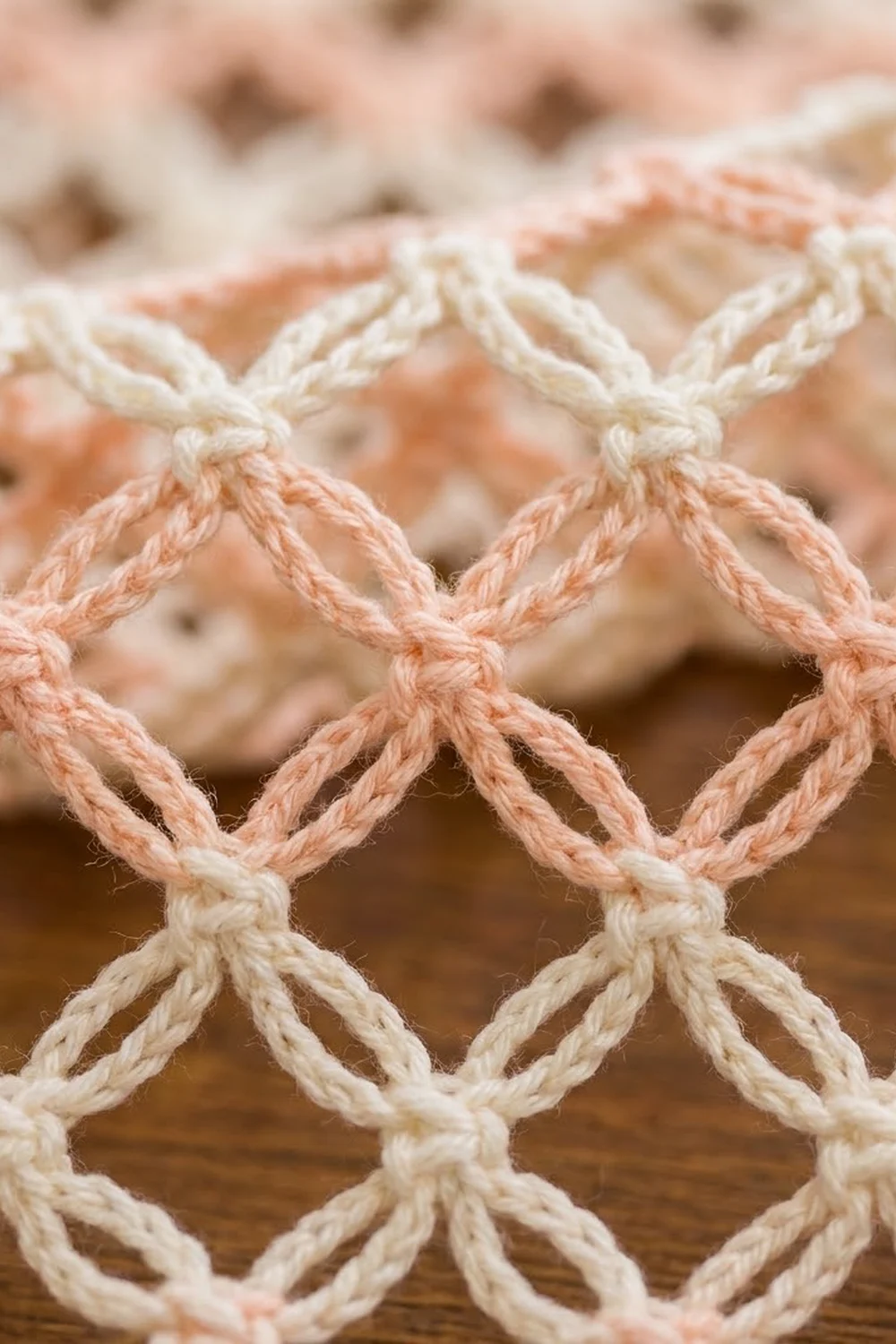
This curtain panel is an open diamond lattice. Chain arcs cross at small picot knots, and the result reads as rows of soft, rounded diamonds. Light comes through easily, but the panel still gives the window a gentle screen.
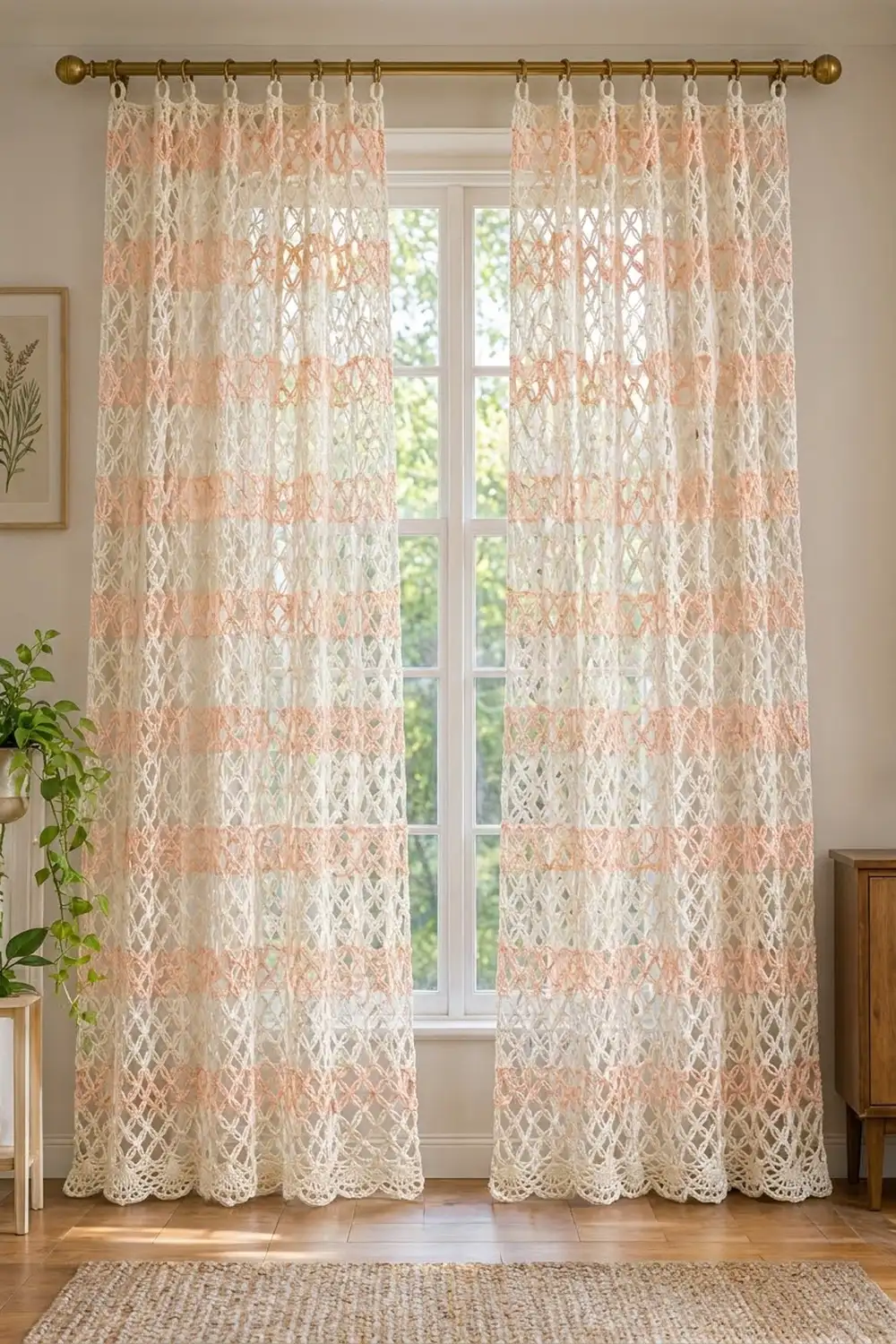
The panel is cream with peach stripes. Wide cream bands alternate with narrower peach bands from the hem up to the header. A solid cream header carries eight covered rings that slide straight onto a curtain rod, and a cream shell edging scallops the hem. The style is light and a little vintage, and it suits a bright living room or bedroom.
This pattern uses US crochet terms. The finished panel measures 39.2 in (99.6 cm) wide and about 81 in (205.7 cm) from the top of the rings to the scallop tips. The body alone, before borders, measures 38.7 in x 78.3 in (98.3 cm x 198.9 cm).
You work the panel in one piece from the bottom up. Start with a base row of single crochet, work 96 rows of picot-knot lattice in stripes, flatten the top into a single crochet header, then add the ring tabs. Finally, add a single crochet border to each long side and a shell edging along the hem. The photos show two identical panels hung as a pair. This pattern makes one panel, so make a second one the same way for a pair.
Finished Size and Construction
- Finished size: 39.2 in x 81 in (99.6 cm x 205.7 cm), rings and scallops included
- Skill level: Easy-intermediate
- Terminology: US
- Yarn weight: DK / light (#3), cotton or cotton blend
- Hook: 4.0 mm (G-6)
- Number of pieces: 1 panel (make 2 for a pair)
- Layout: One rectangle worked in rows from the bottom up, with no joining
- Piece size before border: 38.7 in x 78.3 in (98.3 cm x 198.9 cm)
- Border depth: 0.25 in (0.6 cm) on each long side; 1.25 in (3.2 cm) of scallops at the hem; 1.5 in (3.8 cm) of rings above the header
Materials
Choose a smooth, mercerized or matte cotton in DK weight. Cotton drapes well, keeps the lattice crisp, and holds up to washing and sunlight better than acrylic. Avoid fuzzy yarns, because they blur the picot knots.
Yarn (one panel):
– Color A, Cream: 250 g / 625 m (683 yd)
– Color B, Peach: 150 g / 375 m (410 yd)
These amounts assume a yarn of about 125 m per 50 g and include a margin of roughly 25%. Double them for a pair of panels.
Tools:
– 4.0 mm (G-6) crochet hook
– Tapestry needle
– Stitch markers
– Rust-proof pins and a large blocking surface (foam mats or a carpeted floor covered with a towel)
– Measuring tape
– Spray bottle
Abbreviations (US Terms)
- ch: chain
- sc: single crochet
- dc: double crochet
- sl st: slip stitch
- sk: skip
- st(s): stitch(es)
- sp: space
- RS / WS: right side / wrong side
Special stitch: scp (single crochet picot knot). Sc in the indicated loop, ch 3, then sl st in the top of the sc you just made. This makes the small round knot where the lattice arcs cross.
Color changes: Work the last stitch of the old color until 2 loops remain on the hook, then finish it with the new color. Every stripe has an even number of rows, so all color changes happen at the same edge. Carry the unused yarn loosely up that side. The side border will cover it.
Gauge and Checkpoints
Gauge (blocked):
– Sc: 15 sts and 16 rows = 4 in (10.2 cm)
– Lattice: 1 repeat (sc to sc, 6 base sts) = 1.6 in (4.1 cm) wide; 1 lattice row = 0.8 in (2.0 cm) tall
Test piece first. Ch 26.
Row 1: Sc in the 2nd ch from the hook and in each ch across. (25 sc, 6.7 in / 17.0 cm wide)
Row 2: Ch 1, sc in the first st, ch 7, sk 5, scp in the next st; repeat from * 2 more times, then ch 7, sk 5, sc in the last st. (4 ch-7 loops)
Rows 3–11: Alternate Rows B and A from the main pattern. (10 lattice rows total)
Pin the swatch out, mist it, and let it dry. The 4 loops should measure 6.4 in (16.3 cm) and the 10 lattice rows 8 in (20.3 cm).
- Too big: go down to a 3.5 mm hook, or keep your ch-7 loops a little snugger.
- Too small: go up to a 4.5 mm hook. Tight chains are the usual cause, so relax your chain tension first.
Checkpoints on the panel:
– After Row 1: 145 sc, 38.7 in (98.3 cm) wide
– After Row 7: about 5 in (12.7 cm) long
– After Row 17: about 13 in (33.0 cm)
– After Row 57: about 45 in (114.3 cm)
– After Row 97: about 77 in (195.6 cm)
– After Row 102: 78.3 in (198.9 cm), not counting the rings
Measure the work flat and lightly opened, the way you blocked your swatch.
Panel Body
Stripe sequence:
– Rows 1–7: Cream (base row plus 6 lattice rows)
– Rows 8–11: Peach (4 rows)
– Rows 12–17: Cream (6 rows)
– Keep alternating 4 peach rows and 6 cream rows. The last peach band is Rows 88–91 and the last cream band is Rows 92–97.
That gives 9 peach bands of 3.2 in (8.1 cm) each and 10 cream bands of 4.8 in (12.2 cm) each. One stripe repeat is 8 in (20.3 cm).
Foundation: With Cream, ch 146.
Row 1: Sc in the 2nd ch from the hook and in each ch across. Turn. (145 sc)
Row 2 (set-up lattice row, Row A pattern): Ch 1, sc in the first st, ch 7, sk 5, scp in the next st; repeat from * 22 more times, then ch 7, sk 5, sc in the last st. Turn. (24 ch-7 loops, 23 scp, 2 edge sc)
Check: 1 + (23 x 6) + 6 = 145 base sts used.
Row B (all odd rows from 3 to 97): Ch 5 (counts as dc + ch 2), scp in the first ch-7 loop, ch 7, scp in the next ch-7 loop; repeat from * 22 more times, then ch 2, dc in the last sc. Turn. (24 scp, 23 ch-7 loops, 2 ch-2 half-loops)
The half-loops at each end keep the side edges straight while the diamonds shift half a repeat.
Row A (all even rows from 4 to 96): Ch 1, sc in the first dc, ch 7, scp in the next ch-7 loop; repeat from * 22 more times, then ch 7, sc in the 3rd ch of the turning ch-5. Turn. (24 ch-7 loops, 23 scp, 2 edge sc)
Each scp sits in the center of an arc from the row below. That is what forms the diamonds and puts a knot at every crossing.
Rows 3–97: Alternate Row B and Row A, following the stripe sequence. Row 97 is a Row B. You will have 96 lattice rows measuring 76.8 in (195.1 cm), plus the base row.
Header and Ring Tabs
Work all of this in Cream.
Row 98 (flattening row): Ch 1, sc in the first dc, 2 sc in the ch-2 sp, sc in the first scp, 5 sc in the next ch-7 loop, sc in the next scp; repeat from * 22 more times, then 2 sc in the ch-2 part of the turning ch, sc in the 3rd ch of the turning ch. Turn. (145 sc)
Check: 1 + 2 + 1 + (23 x 6) + 2 + 1 = 145. This matches Row 1 exactly, so the top and bottom are the same width.
Rows 99–100: Ch 1, sc in each st across. Turn. (145 sc)
Row 101 (ring loops): Ch 1, sc in the first 2 sts, (sc, ch 24, sc) in the next st, sc in the next 19 sts; repeat from * 6 more times, then (sc, ch 24, sc) in the next st, sc in the last 2 sts. Turn. (153 sc, 8 ch-24 loops)
The loops sit in sts 3, 23, 43, 63, 83, 103, 123, and 143, so they are 20 sts apart, with 2 sts left at each end. Check: 2 + (8 x 2) + (7 x 19) + 2 = 153 sc.
Row 102 (cover rings): Ch 1, sc in each sc across, and work 32 sc around each ch-24 loop as you reach it. Fasten off. (153 sc along the header plus 256 sc on the rings, 409 sts total)
The packed sc stiffen each loop into a firm ring about 1.5 in (3.8 cm) across. It fits rods up to 1.25 in (3.2 cm) in diameter. The header (Row 1 plus Rows 98–102, 6 sc rows in all) adds 1.5 in (3.8 cm) of solid fabric.
Border
Work the whole border in Cream. The border gauge is the same as the sc gauge: 3.75 sc per inch (15 sc = 4 in / 10.2 cm).
Side borders (one row on each long side): With the RS facing, join yarn at one corner. Work along the row ends:
– 1 sc in each sc row end (Row 1 and Rows 98–102: 6 sc)
– 3 sc around the edge post or turning chain of each lattice row (96 rows x 3 = 288 sc)
Fasten off. Each side: 294 sc. Repeat on the other long side, covering the carried yarn as you go.
Why the math works: 294 sc ÷ 3.75 = 78.4 in (199.1 cm), and the edge measures 78.3 in (198.9 cm). That difference of 0.1 in (0.3 cm) disappears in blocking, so the edge neither ruffles nor pulls in. With only 2 sc per lattice row, you would have 198 sc, which covers just 52.8 in (134.1 cm) and would pull the edge in hard.
Hem scallops, Row 1: Turn the panel upside down. With the RS facing, join Cream in the first unused loop of the foundation chain. Ch 1, sc in the same ch, sk 2 ch, 7 dc in the next ch, sk 2 ch, sc in the next ch; repeat from * 23 more times. Turn. (24 shells, 25 sc, 193 sts)
Check: 1 + (24 x 6) = 145 foundation chs, the same as the Row 1 count. That gives exactly one shell under every lattice repeat.
Hem scallops, Row 2: Ch 1, sc in the first sc, sc in the next 3 dc, (sc, ch 3, sc) in the next dc, sc in the next 3 dc, sc in the next sc; repeat from * 23 more times. Fasten off. (217 sc, 24 ch-3 picots)
Check: 1 + (24 x 9) = 217. Each picot sits on the center dc of its shell.
Final Blocking
- Weave in all ends along solid sc sections or through scp knots, never across open chain arcs.
- Soak the panel in cool water with a little wool wash for 15 minutes. Press the water out gently without wringing.
- Roll the panel in towels to remove extra water.
- Lay it flat on the blocking surface. Pin the top and bottom edges first, at 38.7 in (98.3 cm) between the side borders.
- Pin the long sides straight at 78.3 in (198.9 cm), placing a pin every 2 in (5.1 cm).
- Open each diamond evenly with your fingers. Pin every scallop point and shape each ring into a circle.
- Let the panel dry completely. Hanging it to finish drying will also help it drape.
Final Quality-Control Checklist
- Row 1, Row 98, and Rows 99–100 each have 145 sc
- Every A row has 24 loops; every B row has 24 scp and 2 half-loops
- There are 9 peach bands of 4 rows and 10 cream bands of 6 rows
- 8 rings, evenly spaced and all the same size
- Each side border has 294 sc and lies flat
- 24 scallops, each with a centered picot
- The blocked body is 38.7 in x 78.3 in (98.3 cm x 198.9 cm)
- Both panels match in length if you are making a pair
Troubleshooting
- Diamonds slant or lean: You worked into the wrong loop at the edge. Make sure each B row starts with scp in the first full ch-7 loop, not the end sc.
- Edges wave in and out: The turning chains are too tight or too loose. Count your ch 5 and finish every B row with the dc.
- Panel narrows as you go: Your chain tension is creeping tighter. Measure a loop against your swatch at every stripe.
- Header ruffles: Recount Row 98. It should have exactly 5 sc per loop.
- Rings are floppy: Pack the sc tighter, or add 2 more sc per ring.
- Hem flares: Use a 3.5 mm hook for the scallop rows.
Care
Hand wash or machine wash on a cool, gentle cycle in a mesh bag, then lay flat or hang to dry. Re-pin the panel lightly if the diamonds need reshaping.
Final Notes
Each measurement builds on the one before it. The 145 base sts set a width of 38.7 in (98.3 cm): 24 lattice repeats of 1.6 in (4.1 cm) plus the edge stitches. Next, 96 lattice rows of 0.8 in (2.0 cm) and 6 sc rows bring the body to 78.3 in (198.9 cm). The 294-st side borders, each 0.25 in (0.6 cm) deep, make the panel 39.2 in (99.6 cm) wide. The scallops and rings bring the total length to about 81 in (205.7 cm). Check your swatch and each checkpoint, and the panel will hang straight and even.
Happy crocheting!