

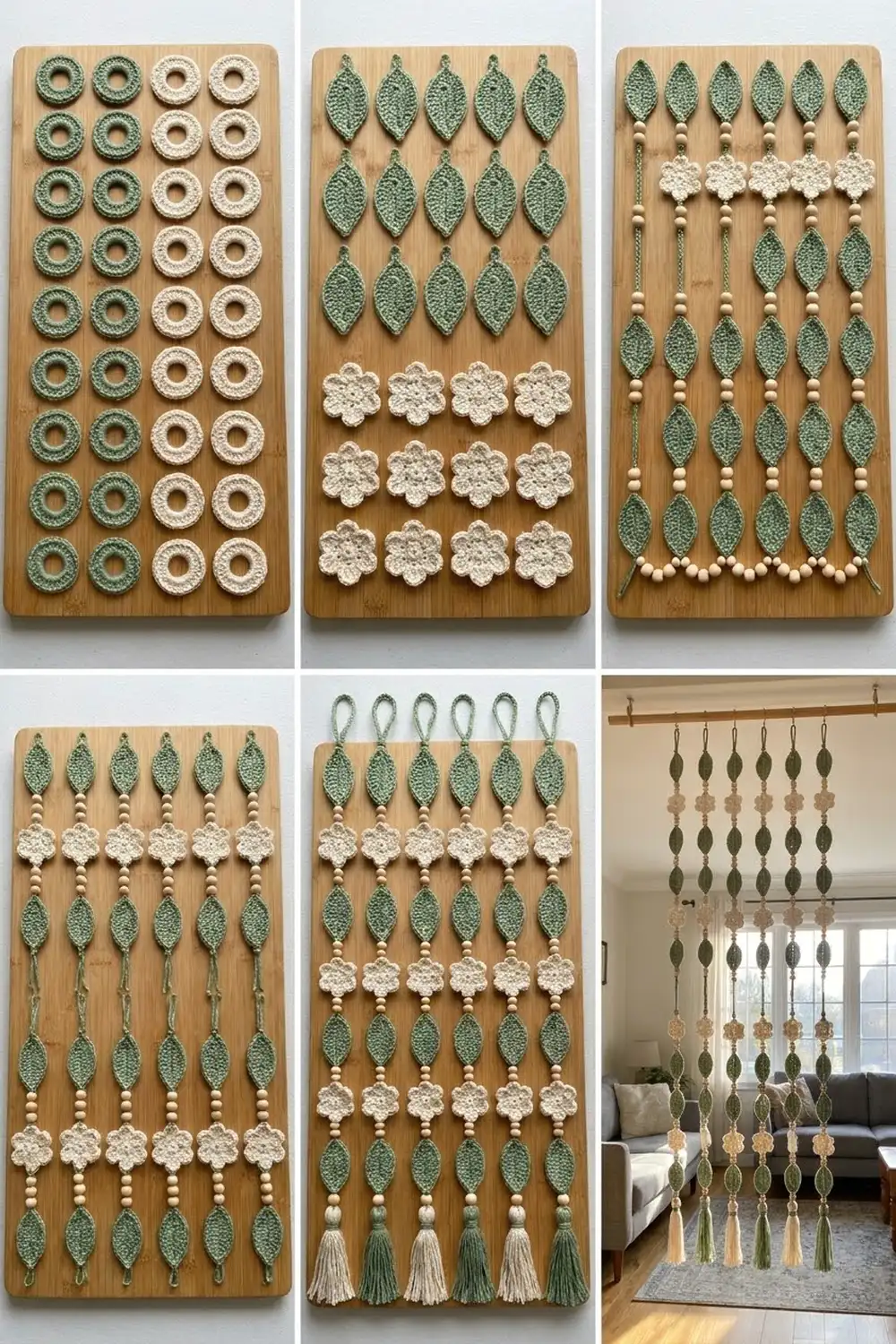
This curtain is made of six hanging strands of small lace motifs. Each strand has three sage green leaves and two cream six-petal flowers, linked by short green cords with natural wooden beads. Each strand hangs from a crochet loop at the top and ends in a full yarn tassel at the bottom.
The palette is soft and botanical: sage leaves, cream flowers, raw wood beads, and tassels that alternate green and cream. Each leaf is a pointed oval with an open center of radiating spokes and a solid single crochet rim. Each flower has a small open center and six rounded petals.
The pattern uses US terms. Each strand is 29.8 in (75.7 cm) long and 2 in (5.1 cm) wide. With the strands spaced 3 in (7.6 cm) apart on the rod, the curtain is 17 in (43.2 cm) wide.
You’ll make 18 leaves and 12 flowers, each starting from a chain ring. Then you join them into strands with beaded chain connectors and add the loops and tassels.
Finished Size and Construction
- Finished size: 17 in (43.2 cm) wide x 29.8 in (75.7 cm) long, hung
- Skill level: Intermediate
- Terminology: US crochet terms
- Yarn weight: DK / light worsted (#3) cotton
- Hook: 3.5 mm (E-4)
- Number of pieces: 30 motifs (18 leaves, 12 flowers), plus 6 tassels
- Layout: 6 strands, each reading leaf, flower, leaf, flower, leaf
- Piece size: leaf 3.5 x 2 in (8.9 x 5.1 cm); flower 2.25 in (5.7 cm)
- Size before border: joined motif section 21.4 in (54.4 cm) long
- Border depth: 3.4 in (8.6 cm) at the top (loop and bead) and 5 in (12.7 cm) at the bottom (bead and tassel)
In this pattern, the “border” is the top and bottom finish of each strand.
Materials
Choose a smooth, mercerized or combed cotton. It shows the stitches crisply, holds the leaf points well after blocking, and won’t stretch under the beads. The amounts below assume about 120 m (131 yd) per 50 g.
- Sage green: 100 g, about 240 m (262 yd), for the leaves, connectors, loops, and 3 tassels
- Cream: 50 g, about 120 m (131 yd), for the flowers and 3 tassels
These quantities include a margin of about 30% for swatching and fuller tassels.
Tools and notions:
- 3.5 mm (E-4) hook
- 6 natural wooden beads, 10 mm
- 24 natural wooden beads, 8 mm
- 6 natural wooden beads, 12 mm
- Bead holes of at least 3 mm
- Tapestry needle and a dental floss threader
- Card 4 in (10.2 cm) wide, for the tassels
- Scissors, rust-proof pins, blocking mat, spray bottle
- 6 curtain hooks or S-hooks and a rod
Abbreviations (US Terms)
- ch chain
- sl st slip stitch
- sc single crochet
- hdc half double crochet
- dc double crochet
- tr treble crochet
- trtr triple treble crochet: yo 4 times, insert hook, pull up a loop (6 loops on hook), [yo, pull through 2 loops] 5 times
- sp space
- st(s) stitch(es)
- yo yarn over
Slide bead: push one pre-threaded bead up against the hook, then work the next chain behind it to lock the bead in place.
Gauge and Checkpoints
Chain gauge: 6 ch = 1 in (2.5 cm). This gauge sets the length of every connector and loop.
Before making the rest, make one leaf and one flower and measure them unblocked:
- Leaf, Round 1: ring 0.8 in (2.0 cm)
- Leaf, Round 2: 3 x 1.5 in (7.6 x 3.8 cm) across the spoke tips
- Leaf, Round 3: 3.5 x 2 in (8.9 x 5.1 cm)
- Flower, Round 1: 0.8 in (2.0 cm)
- Flower, Round 2: 1.5 in (3.8 cm)
- Flower, Round 3: 2.25 in (5.7 cm), measured from a petal tip to the opposite petal tip
Too big? Switch to a 3.25 mm (D-3) hook. Too small? Switch to a 3.75 mm (F-5) hook. If the leaf width is right but the length is short, you’re probably compressing the trtr spokes. Pull up the first loop of each tall stitch to its full height.
Leaf (Make 18, Sage Green)
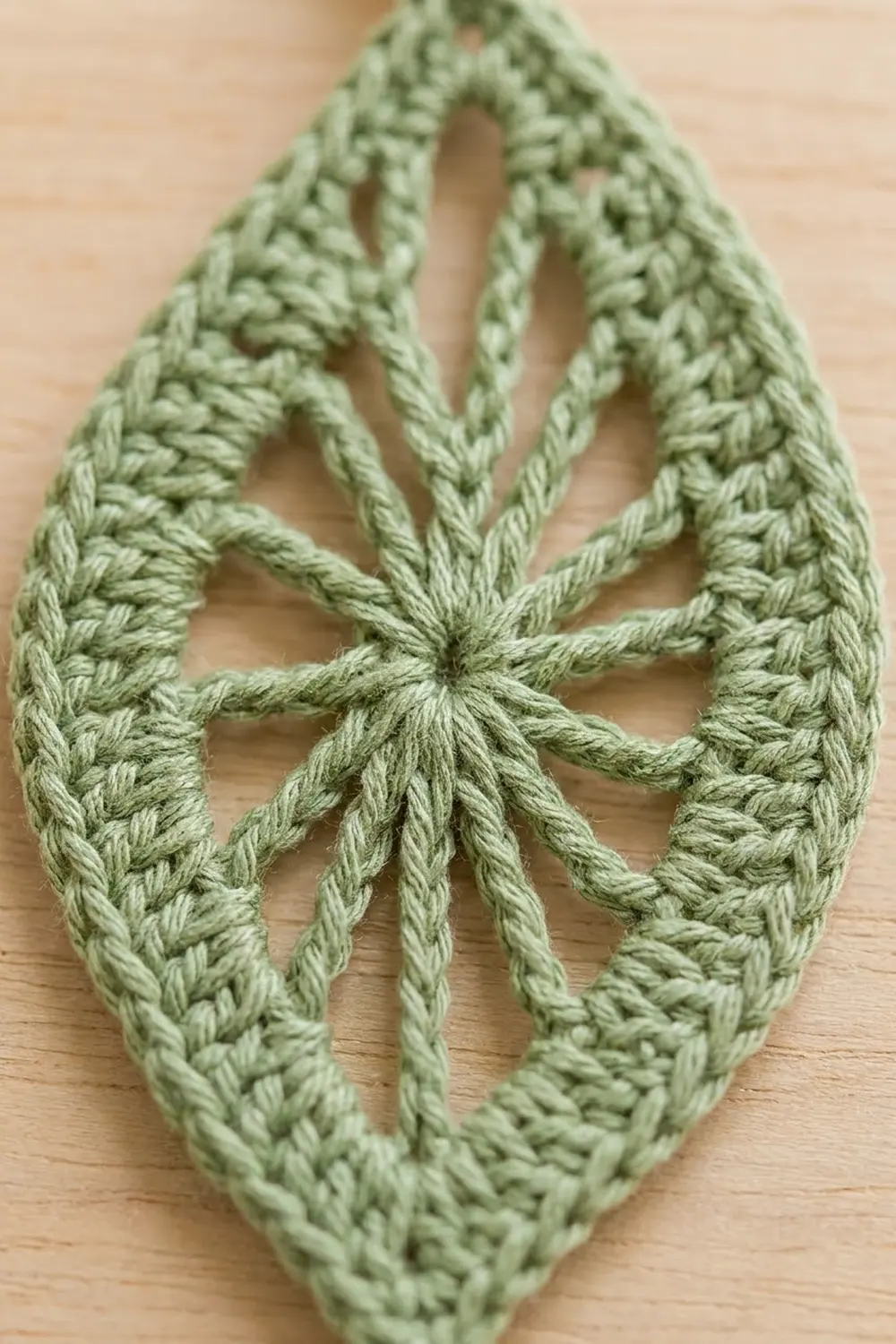
The leaf is worked in the round. Twelve spokes of graded height sit on a 12-sc ring: hdc at the sides, building up to trtr at the two tips. This grading creates the pointed oval. The two long tip spokes line up to form the center vein.
Round 1: Ch 5, sl st in the first ch to form a ring. Ch 1, work 12 sc in the ring, sl st in the first sc. (12 sc)
Number the sc 1 to 12. Sc 1 is the top tip and sc 7 is the bottom tip.
Round 2 (spokes): Ch 6 (counts as trtr in sc 1), ch 5, tr in sc 2, ch 4, dc in sc 3, ch 3, hdc in sc 4, ch 3, dc in sc 5, ch 4, tr in sc 6, ch 5, trtr in sc 7, ch 5, tr in sc 8, ch 4, dc in sc 9, ch 3, hdc in sc 10, ch 3, dc in sc 11, ch 4, tr in sc 12, ch 5, sl st in the 6th ch of the beginning ch-6. (12 spokes: 2 trtr, 4 tr, 4 dc, 2 hdc; 12 ch-sps totaling 48 ch)
The chain spaces run 5, 4, 3, 3, 4, 5 on each half, for 24 ch per half. The spaces near the tips are longer because the outline is farthest from the center there.
Round 3 (rim): Ch 1, (sc, ch 2, sc) in the same st as the join (top tip). 6 sc in the ch-5 sp, sc in tr, 5 sc in the ch-4 sp, sc in dc, 4 sc in the ch-3 sp, sc in hdc, 4 sc in the ch-3 sp, sc in dc, 5 sc in the ch-4 sp, sc in tr, 6 sc in the ch-5 sp, (sc, ch 2, sc) in trtr (bottom tip). Repeat from * to ** once more, then sl st in the first sc. Fasten off. (74 sc and 2 tip ch-2 sps)*
Count check:
– Spaces: 2 x (6 + 5 + 4 + 4 + 5 + 6) = 60 sc
– Side spokes: 10 sc
– Tips: 2 sc each, 4 sc total
– Total: 60 + 10 + 4 = 74 sc
Each space gets one more sc than its chain count, which keeps the rim flat.
Flower (Make 12, Cream)
Round 1: Ch 5, sl st in the first ch to form a ring. Ch 1, work 12 sc in the ring, sl st in the first sc. (12 sc) The ring stays open as the center hole.
Round 2: Ch 3 (counts as dc), dc in the same st, 2 dc in each sc around, sl st in the top of the ch-3. (24 dc)
Round 3 (petals): Ch 1. Sc in the next st, (hdc, 2 dc) in the next st, ch 1, (2 dc, hdc) in the next st, sc in the next st. Repeat from * 5 more times, then sl st in the first sc. Fasten off. (6 petals; 48 sts + 6 tip ch-1 sps)*
Count check: each petal uses 4 stitches of Round 2 and makes 8 stitches (1 + 3 + 3 + 1) plus a ch-1 tip. Six petals x 4 = 24, which matches Round 2. Petals 1 and 4 sit directly opposite each other, and their tip spaces are the joining points.
Make All Pieces
Make 18 sage green leaves and 12 cream flowers. Block them flat before you join them.
Layout grid (strands 1 to 6, left to right):
Loop:   O  O  O  O  O  O
Row 1:  L  L  L  L  L  L
Row 2:  F  F  F  F  F  F
Row 3:  L  L  L  L  L  L
Row 4:  F  F  F  F  F  F
Row 5:  L  L  L  L  L  L
Tassel: G  C  G  C  G  C
Key: L = leaf, F = flower, O = loop, G = green tassel, C = cream tassel.
Joining
Each strand has 4 beaded connectors, so you need 24 in total. Use sage green throughout.
Connector:
1. Thread one 8 mm bead onto the yarn.
2. Join with a sl st in the bottom tip of the upper motif (a leaf’s bottom ch-2 sp or a flower’s petal 4 ch-1 sp).
3. Ch 4, slide bead, ch 4.
4. Sl st in the top tip of the lower motif (a leaf’s top ch-2 sp or a flower’s petal 1 ch-1 sp).
5. Fasten off and weave the ends back through the chain.
Stitch logic: 8 ch is 1.33 in (3.4 cm). Add the bead, 0.31 in (0.8 cm), and each connector is about 1.6 in (4.1 cm). Because you join only into tip spaces, every leaf hangs vertically and each flower has one petal pointing straight up and one pointing straight down.
Tension: match your gauge chain. Tight chains shorten the strand, and loose ones let the beads sag. After each connector, hold the strand up and check that it hangs straight.
Size checkpoint: 3 leaves (10.5 in / 26.7 cm) + 2 flowers (4.5 in / 11.4 cm) + 4 connectors (6.4 in / 16.3 cm) = 21.4 in (54.4 cm). All six strands should be within 0.25 in (0.6 cm) of each other.
Border: Hanging Loops and Tassel Ends
Border gauge: the same 6 ch = 1 in (2.5 cm). The top edge gets 6 loops of 24 ch, one per strand. The bottom edge gets 6 tassels of 30 wraps each.
Top edge (6 loops, sage green): Thread one 10 mm bead onto the yarn. Join with a sl st in the top ch-2 sp of the top leaf. Ch 3, slide bead, ch 3, then ch 24. Sl st in the 3rd ch above the bead to close the loop, then fasten off. (30 ch per top section: 3 + 3 + 24)
The 24-ch loop is 4 in (10.2 cm) around and hangs 2 in (5.1 cm) tall, which fits a curtain hook easily. The ch 3, bead, and ch 3 add 1.4 in (3.6 cm), so the top section is 3.4 in (8.6 cm).
Bottom edge (6 beads, sage green): Thread one 12 mm bead. Join with a sl st in the bottom ch-2 sp of the bottom leaf, ch 3, slide bead, ch 1 firmly. Fasten off, leaving an 8 in (20.3 cm) tail. This section is about 1 in (2.5 cm).
Tassels (3 green, 3 cream):
1. Wrap the yarn 30 times around the 4 in (10.2 cm) card.
2. Pass the bead tail under the wraps at the top edge and tie it tightly.
3. Slide the wraps off the card and cut the bottom loops, which gives 60 strands.
4. Wrap a 20 in (50.8 cm) length of matching yarn around the bundle, 0.75 in (1.9 cm) below the top, to form the head. Knot it and bury the ends inside the tassel.
5. Trim the tassel to 4 in (10.2 cm).
Use green tassels on strands 1, 3, and 5 and cream tassels on strands 2, 4, and 6.
Why the math works: 3.4 in (8.6 cm) top + 21.4 in (54.4 cm) motifs + 1 in (2.5 cm) bead + 4 in (10.2 cm) tassel = 29.8 in (75.7 cm). For the width, five 3 in (7.6 cm) gaps + one 2 in (5.1 cm) strand = 17 in (43.2 cm).
Final Blocking
- Mist each strand until it is damp but not dripping.
- Lay it straight on a blocking mat.
- Pin each leaf to 3.5 x 2 in (8.9 x 5.1 cm), with a pin at each tip.
- Ease the spoke spaces open so they spread evenly.
- Pin each flower to 2.25 in (5.7 cm), with a pin in every petal tip.
- Straighten the connectors so the beads sit centered.
- Finger-comb the tassels and mist them.
- Let everything dry fully, then trim the tassels evenly.
Final Quality-Control Checklist
- 18 leaves, 74 sc each, 3.5 x 2 in (8.9 x 5.1 cm)
- 12 flowers, 6 even petals, 2.25 in (5.7 cm)
- Every strand reads leaf, flower, leaf, flower, leaf
- 4 connectors per strand, each 1.6 in (4.1 cm) with an 8 mm bead
- A 10 mm bead and a 24-ch loop at every top
- A 12 mm bead and a 4 in (10.2 cm) tassel at every bottom
- Tassel colors alternate
- All strands 29.8 in (75.7 cm) long, within 0.25 in (0.6 cm) of each other
- Ends woven in securely
Troubleshooting
Leaf is round, not pointed: the tip spokes are too short. Complete all 4 yarn overs on each trtr.
Leaf rim ruffles: you have too many sc in the spaces. Recheck the counts: 6, 5, 4, 4, 5, 6 per half.
Leaf rim cups: Round 3 is too tight. Go up 0.25 mm for the rim only.
Petals curl: re-block with a pin in every petal tip.
Bead won’t thread: use a floss threader, or cut the yarn end at a sharp angle.
Strands differ in length: count the connector chains. One extra chain in each of the 4 connectors adds 0.67 in (1.7 cm) to the strand.
Strand twists: a connector is joined off the tip. Undo it and rejoin it exactly in the tip space.
Care
Hand wash cool with mild soap, roll it in a towel to remove water, and dry it flat. Re-block as needed, and keep the wooden beads out of long soaks.
Final Notes
Each measurement depends on the one before it, so check each stage before moving on:
- Leaf: 3.5 x 2 in (8.9 x 5.1 cm)
- Flower: 2.25 in (5.7 cm)
- Connectors: 1.6 in (4.1 cm) each, which gives a 21.4 in (54.4 cm) motif section
- Top: 3.4 in (8.6 cm), plus the 5 in (12.7 cm) bead and tassel, for a 29.8 in (75.7 cm) strand
- Width: six strands 3 in (7.6 cm) apart give a 17 in (43.2 cm) curtain
Happy crocheting!