

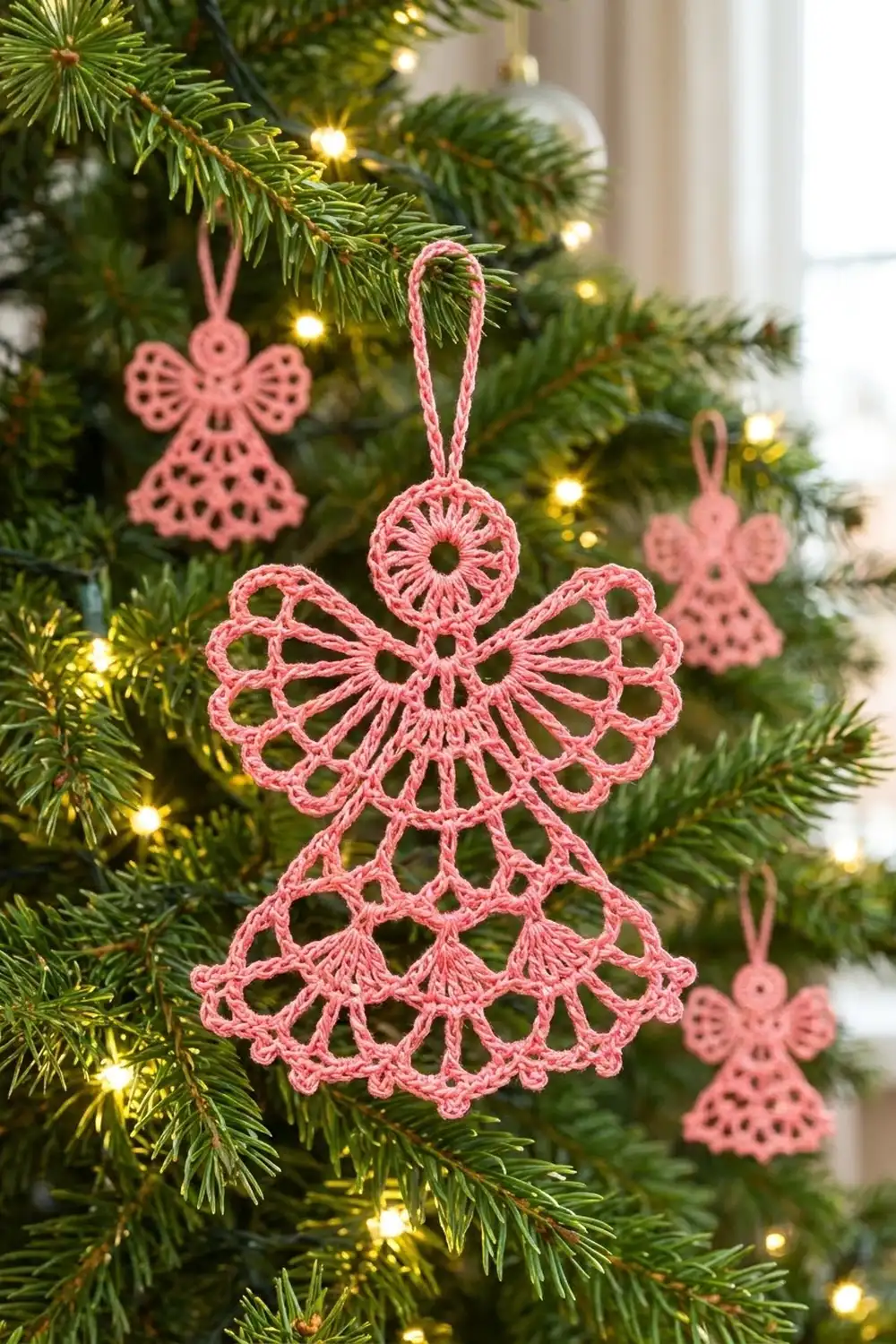
The Rosebud Angel is a small, lacy thread ornament for the Christmas tree. It has a round wheel-style head, two fan wings with scalloped edges, and a flared skirt that ends in a row of picot-trimmed fans. It is worked in one soft coral-pink, so the openwork does all the decorating.
The style is classic heirloom thread crochet: open chain loops, treble spokes, and shells that open up when you block them. Starch makes it lie flat and keep its shape on a branch.
This pattern uses US crochet terms. The finished angel is 3.5 in (8.9 cm) tall without the hanging loop, 3.5 in (8.9 cm) wide at the hem, and 3.75 in (9.5 cm) across the wings. With the hanging loop it is 5 in (12.7 cm) tall.
Construction is one piece with no sewing. You work the head in the round, then a neck row of chain loops under it. Each wing grows out of an end loop, and the skirt hangs from the three center loops. A picot hem finishes the skirt, and you add the hanging loop last.
Finished Size and Construction
- Finished size: 3.5 in (8.9 cm) tall x 3.75 in (9.5 cm) wingspan; 5 in (12.7 cm) tall with loop
- Skill level: Intermediate (thread crochet)
- Terminology: US terms
- Yarn weight: Size 10 crochet cotton thread (Lace weight, 0)
- Hook: 1.75 mm steel hook
- Number of pieces: 1 (single ornament, worked continuously with rejoins)
- Layout: Head at top, wings left and right of the neck, skirt below
- Head size: 1 in (2.5 cm) diameter
- Size before border: 3.25 in (8.3 cm) tall x 3.25 in (8.3 cm) wide at the hem
- Border (picot hem) depth: 0.25 in (0.6 cm)
Materials
Use a mercerized size 10 cotton thread. It has crisp stitch definition and takes starch well. Steer clear of acrylic or blends, since they won’t hold a blocked shape.
- Coral pink, size 10 cotton: 3 g, approximately 25 m (27 yd)
Quantities include a generous margin for the swatch, weaving in ends and the hanging loop. One full ball will make many angels.
Tools:
– 1.75 mm steel crochet hook
– Fine tapestry needle
– Small sharp scissors
– Blocking board or foam mat
– Rustproof pins
– Spray starch or fabric stiffener
– Ruler marked in inches and cm
Abbreviations (US Terms)
- ch – chain
- sl st – slip stitch
- sc – single crochet
- hdc – half double crochet
- dc – double crochet
- tr – treble crochet
- sp(s) – space(s)
- st(s) – stitch(es)
- RS – right side
Special stitch – picot: Ch 3, sl st in the 3rd ch from hook.
Gauge and Checkpoints
Gauge matters less for an ornament than for a garment, but it controls the final size. Make one head (Rounds 1–2) as your test piece before going on.
- Chain gauge: 10 ch = 1 in (2.5 cm)
- Head after Round 1: 0.75 in (1.9 cm) across
- Head after Round 2: 1 in (2.5 cm) across
- Each wing after Row 3: 1.5 in (3.8 cm) from neck to tip
- Skirt after Row 3: 2.5 in (6.4 cm) wide
- Before border (after Skirt Row 5): 3.25 in (8.3 cm) tall x 3.25 in (8.3 cm) wide
- Finished, blocked: 3.5 in (8.9 cm) tall x 3.5 in (8.9 cm) at hem, 3.75 in (9.5 cm) wingspan
If your head is bigger than 1 in (2.5 cm): Switch to a 1.5 mm hook, or tighten your chains.
If it is smaller than 1 in (2.5 cm): Switch to a 2.0 mm hook.
Measure unblocked work lightly flattened. Blocking opens the lace by about 0.25 in (0.6 cm) overall.
Head
Ch 6, sl st in first ch to form a ring.
Round 1 (RS): Ch 4 (counts as dc + ch 1), (dc, ch 1) 15 times in ring, sl st in 3rd ch of beginning ch-4. (16 dc, 16 ch-1 sps)
The dc posts are the radiating spokes, and the ch-6 ring leaves the small open center.
Round 2: Sl st in first ch-1 sp, ch 1, 2 sc in same sp, 2 sc in each remaining ch-1 sp around, sl st in first sc. (32 sc)
Checkpoint: 1 in (2.5 cm) across.
Number the sts of Round 2 from the joining sc: that sc is st 1 and sits at top center. St 17 is bottom center.
Neck Row
This row makes five chain loops across the bottom third of the head.
Sl st in next 11 sc, so you are now at st 12.
Neck Row: Ch 1, sc in same st (st 12), (ch 5, skip 1 sc, sc in next sc) 5 times. (6 sc in sts 12, 14, 16, 18, 20 and 22; 5 ch-5 loops)
Fasten off.
Call the loops L1 to L5 from right to left with RS facing. L1 and L5 hold the wings. L2, L3 and L4 hold the skirt, and L3 is centered under st 17.
Wings (Make 2)
Right Wing
With RS facing, join thread in L1.
Row 1: Ch 4 (counts as tr), (ch 3, tr) 5 times in L1. (6 tr, 5 ch-3 sps)
The trebles fan outward and upward away from the head and make the long wing spokes.
Row 2: Turn, ch 1, sc in first tr, (ch 5, sc in next ch-3 sp, ch 5, sc in next tr) 5 times. (11 sc, 10 ch-5 loops)
Row 3 (scallop edge): Turn, ch 1, (sc, hdc, 2 dc, hdc, sc) in each ch-5 loop across. (60 sts, 10 scallops)
Fasten off.
Checkpoint: 1.5 in (3.8 cm) from neck to wing tip.
Left Wing
With RS facing, join thread in L5. Work Rows 1–3 as for the Right Wing. (Row 1: 6 tr, 5 ch-3 sps; Row 2: 11 sc, 10 ch-5 loops; Row 3: 60 sts, 10 scallops)
Fasten off.
Checkpoint: 3.75 in (9.5 cm) from wing tip to wing tip, gently flattened.
Skirt
The skirt is worked downward in turned rows. Each mesh row adds loops so the skirt flares into a triangle.
With RS facing, join thread in L2.
Row 1: Ch 1, (sc, ch 6, sc) in L2, ch 6, (sc, ch 6, sc) in L3, ch 6, (sc, ch 6, sc) in L4. (6 sc, 5 ch-6 loops)
Row 2: Turn, sl st in first 3 ch of first loop, ch 1, sc in same loop, [ch 6, (sc, ch 6, sc) in next loop] 3 times, ch 6, sc in last loop. (8 sc, 7 ch-6 loops)
Row 3: Turn, sl st in first 3 ch of first loop, ch 1, sc in same loop, [ch 6, (sc, ch 6, sc) in next loop] 5 times, ch 6, sc in last loop. (12 sc, 11 ch-6 loops)
Checkpoint: 2.5 in (6.4 cm) wide.
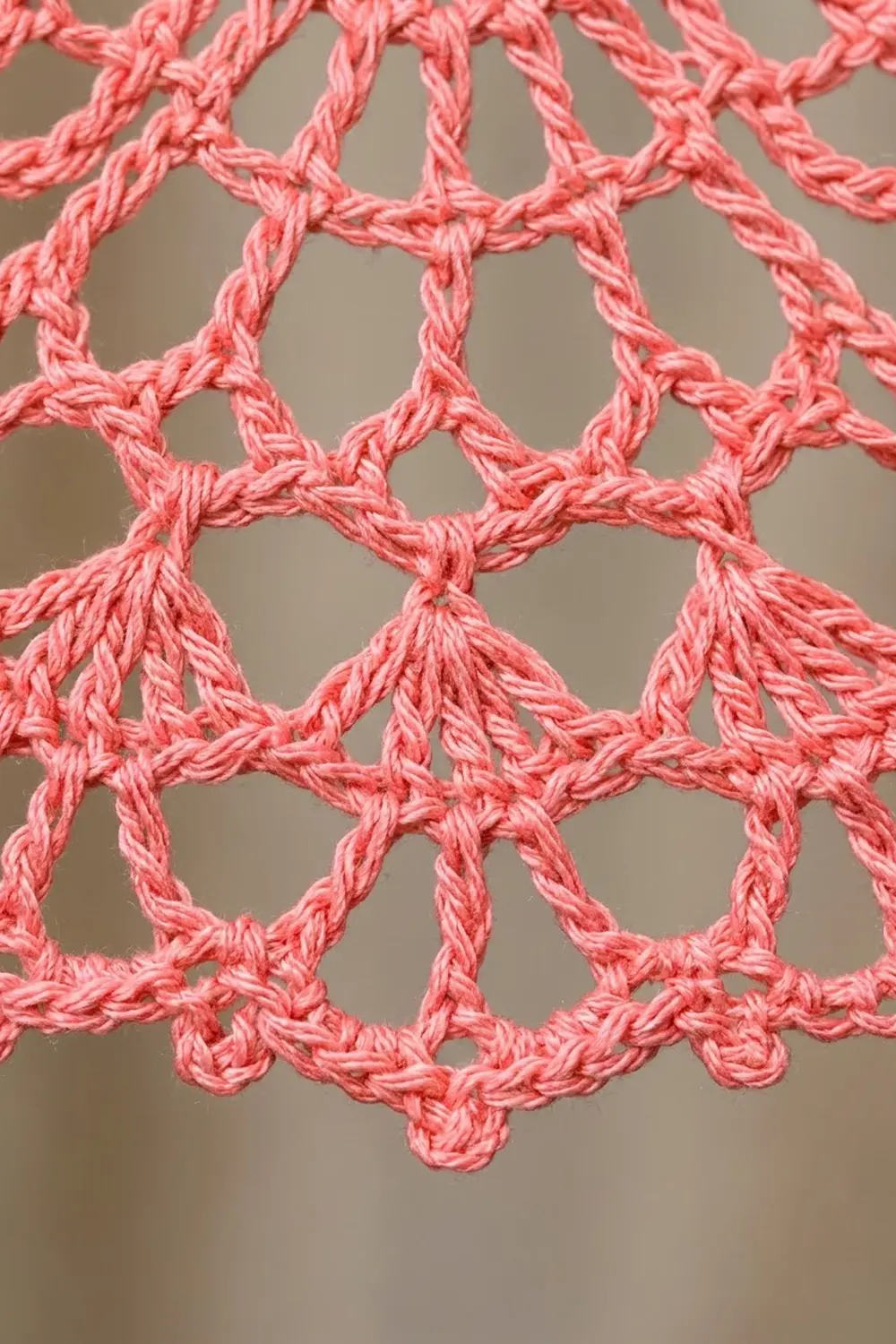
Row 4 (shell fans): Turn, sl st in first 3 ch of first loop, ch 1, sc in same loop, ch 2, 7 dc in next loop, ch 2, sc in next loop 5 times. (5 fans of 7 dc = 35 dc, 6 sc, 10 ch-2 sps)
Loop check: 1 loop takes the starting sc, and 10 loops alternate fan and sc, so all 11 loops are used.
Row 5 (open fans): Turn, ch 1, sc in first sc, ch 2, skip ch-2 sp, (dc in next dc, ch 1) 6 times, dc in next dc, ch 2, skip ch-2 sp, sc in next sc 5 times. (35 dc, 30 ch-1 sps, 10 ch-2 sps, 6 sc)
This row is a trim round: every dc is worked 1-per-existing-dc (35 + 0), and only the ch-1 spaces between them are added. That spreads each fan into the wide scallops of the hem.
Checkpoint (before border): 3.25 in (8.3 cm) wide at hem, 3.25 in (8.3 cm) from top of head to hem.
Do not fasten off.
Border (Picot Hem)
The border runs along the hem only, which is the skirt’s one bottom “side”. The skirt’s side edges and the wing edges are already finished by their own rows.
Border gauge: One picot per ch-1 sp, so 6 picots per fan. The hem adds 0.25 in (0.6 cm) of depth and about 0.125 in (0.3 cm) on each side.
Row 6 (picot edge): Turn, ch 1, sc in first sc, 2 sc in next ch-2 sp, (sc in next dc, picot, sc in next ch-1 sp) 6 times, sc in next dc, 2 sc in next ch-2 sp, sc in next sc 5 times. Fasten off.
Count per fan: 2 + 12 + 1 + 2 + 1 = 18 sc and 6 picots.
Total: 1 starting sc + (5 x 18) = 91 sc, 30 picots.
Why the math works: Row 5 gives each fan exactly 7 dc and 6 ch-1 sps. Every dc gets 1 sc, every ch-1 sp gets 1 sc with a picot before it, and every ch-2 sp gets 2 sc. Nothing is skipped or doubled, so the hem lies flat. Each fan is mirror-symmetrical, with 3 picots on each side of its center. The fans meet at the 6 single sc, which become the small dips between scallops.
Hanging Loop
With RS facing, join thread in st 1 at the top center of the head. Ch 30, sl st in the same st. Fasten off.
The loop is 1.5 in (3.8 cm) long when folded.
Weave in all ends along stitch posts. Trim them close only after blocking.
Final Blocking
- Hand-wash the angel in cool water with a drop of mild soap, then rinse.
- Roll it in a towel to remove excess water. Do not wring.
- Lay it RS up on your blocking board.
- Pin the head into a 1 in (2.5 cm) circle with the center ring open.
- Pin each wing: one pin at the tip of each of the 6 tr spokes, then one at the center of each of the 10 scallops. Each wing should reach 1.5 in (3.8 cm) from the neck.
- Pin the skirt into a triangle 3.5 in (8.9 cm) wide at the hem, with the top of the head 3.5 in (8.9 cm) above the hem.
- Pin out every picot on the hem, 30 pins in all.
- Spray generously with starch, or brush with diluted stiffener.
- Let it dry completely, at least 12 hours.
- Unpin, trim the ends, and check the measurements again.
Final Quality-Control Checklist
- Head is 1 in (2.5 cm) across with 16 even spokes
- Neck has 5 loops and they are centered under the head
- Each wing has 6 tr spokes and 10 scallops
- The two wings match in size and angle
- Skirt has 5 fans in Row 4 and 5 open fans in Row 5
- Hem has 30 picots, 6 per fan
- Height is 3.5 in (8.9 cm) and hem width is 3.5 in (8.9 cm)
- Wingspan is 3.75 in (9.5 cm)
- Hanging loop is 1.5 in (3.8 cm) and sits at top center
- No visible tails, and the piece lies flat and stiff
Troubleshooting
Head cups or ruffles: A head that cups is too tight in Round 2, so loosen it slightly. A head that ruffles is too loose, so try 1 sc in one ch-1 sp per quarter (only a last resort).
Wings are uneven: Count the Row 1 trebles in both wings. You need exactly 6, all worked into the same loop.
Skirt narrows or curls: Check that Rows 2 and 3 each have the bracketed (sc, ch 6, sc) increase in every middle loop. The loop counts are 5, 7, then 11.
Hem waves: You may have worked 2 sc into a ch-1 sp. Each ch-1 sp takes only 1 sc.
Hem pulls in: Your picots may be too tight. Make the ch-3 picots slightly looser.
Angel is too large overall: Remake it with a 1.5 mm hook. The pattern stays the same and the size shrinks evenly.
Hanging loop leans: Rejoin it exactly in st 1, the joining sc of Round 2.
Care
Hand-wash gently in cool water, then re-block and starch to restore the shape. Store flat between tissue paper so the wings and picots don’t crush.
Final Notes
The measurement chain is simple. Your 1 in (2.5 cm) head sets the scale. The wings grow to 1.5 in (3.8 cm) each for a 3.75 in (9.5 cm) span. The skirt reaches 2.5 in (6.4 cm) wide after Row 3 and 3.25 in (8.3 cm) before the border. The picot hem adds 0.25 in (0.6 cm), for a finished angel 3.5 in (8.9 cm) tall and wide, or 5 in (12.7 cm) with the loop. If each checkpoint matches, the final angel will match too.
Happy crocheting!