

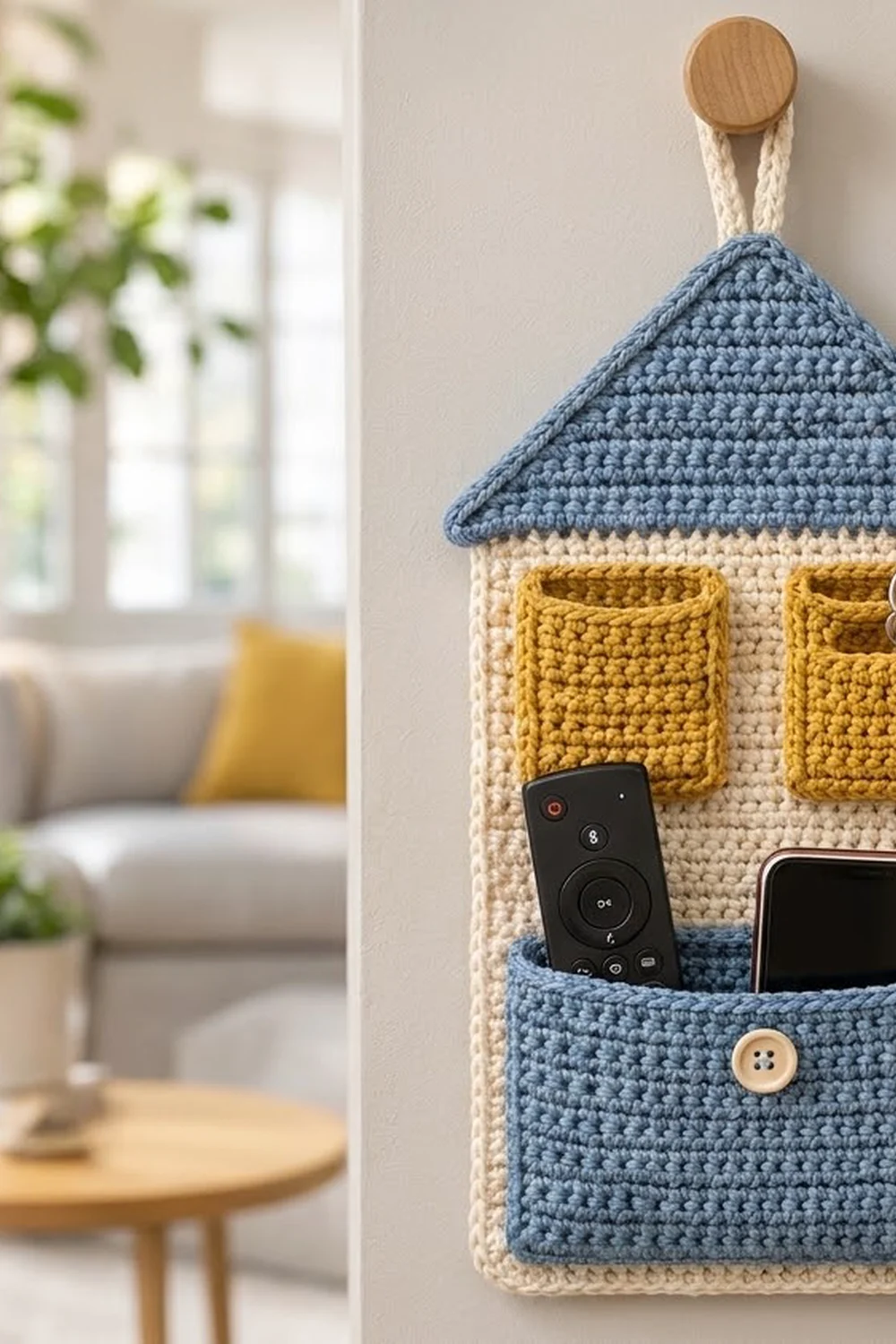
This little house keeps small things in one place. A cream body, a dusty blue roof, two mustard “window” pockets, and one wide blue “door” pocket give you a home for keys, remotes, a phone, glasses, or chargers. A cream loop at the peak lets you hang it on a peg or hook by the door.
Every part is plain single crochet, so the fabric is firm, flat, and strong enough to hold weight. The cream, denim blue, and mustard colors suit a modern farmhouse or Scandinavian room. One wooden button on the big pocket finishes the look.
The pattern uses US crochet terms. The finished organizer is 9.5 in (24.1 cm) wide at the roof and 15 in (38.1 cm) tall from the bottom edge to the roof peak, not counting the hanging loop.
You’ll make six parts: the body, the roof, two small pockets, one large pocket, and a loop. Each part is worked flat in rows and gets a one-round edging. Then you sew the roof to the top of the body, sew the pockets on along their sides and bottoms, and add the loop and button.
Finished Size and Construction
- Finished size: 9.5 in (24.1 cm) wide x 15 in (38.1 cm) tall, loop not included
- Skill level: Easy
- Terminology: US
- Yarn weight: Worsted (#4), cotton or cotton blend
- Hook: 3.75 mm (F-5)
- Number of pieces: 6 (body, roof, 2 small pockets, 1 large pocket, loop)
- Layout: Roof on top of the body; 2 small pockets side by side in the upper body; 1 large pocket across the lower body
- Body size before border: 8 in (20.3 cm) wide x 9 in (22.9 cm) tall
- Body size after border: 8.4 in (21.3 cm) wide x 9.2 in (23.4 cm) tall
- Roof size after edging: 9.5 in (24.1 cm) wide x 5.8 in (14.7 cm) tall
- Border depth: 1 row of sc, about 0.2 in (0.5 cm)
Materials
Pick a smooth worsted-weight cotton or cotton blend. Cotton holds its shape when the pockets are full, and the stitches stay crisp. Acrylic also works, but the organizer will be softer and may sag a little.
- Cream (body, border, loop): 70 g, about 126 m
- Denim blue (roof, large pocket): 60 g, about 108 m
- Mustard yellow (small pockets): 20 g, about 36 m
These amounts assume a yarn with about 180 m per 100 g. They include about 20 percent extra for your gauge swatch and sewing tails.
Tools:
– 3.75 mm (F-5) crochet hook
– Tapestry needle
– Locking stitch markers or straight pins
– One cream or wooden button, about 0.8 in (2.0 cm) across
– Sewing thread and needle for the button
– Ruler or tape measure
– Blocking mat and spray bottle
Abbreviations (US Terms)
- ch: chain
- sc: single crochet
- sc2tog: single crochet 2 together. Insert hook in next st, yarn over, pull up a loop; insert hook in following st, yarn over, pull up a loop; yarn over and pull through all 3 loops (1 st decreased)
- sl st: slip stitch
- st(s): stitch(es)
- RS / WS: right side / wrong side
Special technique (back-bump slip stitch cord): Work each sl st into the bump on the back of the chain, not into the front loops. This makes a round, firm cord.
The turning ch 1 never counts as a stitch.
Gauge and Checkpoints
Gauge: 16 sc and 20 rows = 4 in (10.2 cm) in sc worked in rows.
Make one small pocket first as your test piece. It takes about 20 minutes and shows your gauge right away. Before the edging, it should measure 2.5 in (6.4 cm) wide x 2.4 in (6.1 cm) tall. If it does, keep that hook and go on.
Checkpoints:
– Body after Row 20: 8 in (20.3 cm) wide x 4 in (10.2 cm) tall
– Body after Row 45: 8 in (20.3 cm) x 9 in (22.9 cm)
– Roof after Row 1: 9 in (22.9 cm) wide
– Roof after Row 27: 5.4 in (13.7 cm) tall
– Large pocket before edging: 7 in (17.8 cm) x 4.2 in (10.7 cm)
If your piece is too big, go down half a size to a 3.5 mm hook. If it’s too small, go up to a 4.0 mm (G-6) hook. Change the hook, not the stitch counts. The joins only line up if the counts stay exactly as written.
Body (Cream)
The body is worked from the bottom up.
Ch 33.
Row 1 (RS): Sc in 2nd ch from hook and in each ch across. (32 sc)
Rows 2–45: Ch 1, turn, sc in each st across. (32 sc)
Check the size after Row 20 and again after Row 45. The body should measure 8 in (20.3 cm) wide x 9 in (22.9 cm) tall. Fasten off and weave in the tail.
Roof (Blue)
The roof is worked from the wide base up to the peak. You decrease on two of every three rows, which makes a slope steeper than 45 degrees.
Ch 37.
Row 1: Sc in 2nd ch from hook and in each ch across. (36 sc)
Row A (decrease): Ch 1, turn, sc2tog, sc in each st to last 2 sts, sc2tog. (2 sts fewer)
Row B (decrease): Work the same as Row A. (2 sts fewer)
Row C (plain): Ch 1, turn, sc in each st across. (no change)
Rows 2–25: Work Rows A, B and C, 8 times in total. Each row’s own count:
- Rows 2, 3, 4: 34, 32, 32
- Rows 5, 6, 7: 30, 28, 28
- Rows 8, 9, 10: 26, 24, 24
- Rows 11, 12, 13: 22, 20, 20
- Rows 14, 15, 16: 18, 16, 16
- Rows 17, 18, 19: 14, 12, 12
- Rows 20, 21, 22: 10, 8, 8
- Rows 23, 24, 25: 6, 4, 4
Row 26: Ch 1, turn, sc2tog twice. (2 sts)
Row 27: Ch 1, turn, sc2tog. (1 st)
Don’t fasten off. The roof should be 9 in (22.9 cm) wide at the base and 5.4 in (13.7 cm) tall. The edging is in the Border section below.
Small Pockets (Mustard): Make 2
Ch 11.
Row 1: Sc in 2nd ch from hook and in each ch across. (10 sc)
Rows 2–12: Ch 1, turn, sc in each st across. (10 sc)
The pocket should measure 2.5 in (6.4 cm) x 2.4 in (6.1 cm).
Edging round: Ch 1, turn.
– Top: 3 sc in first st (corner), sc in next 8 sts, 3 sc in last st (corner).
– Side: 10 sc down the side, one in each row end from Row 11 to Row 2.
– Bottom: 3 sc in first foundation ch (corner), sc in next 8 ch, 3 sc in last ch (corner).
– Side: 10 sc up the other side, one in each row end.
– Sl st to the first sc to join.
That gives 48 sc: 8 + 8 + 10 + 10 along the edges, plus 4 corners of 3.
Fasten off and leave a 24 in (61.0 cm) tail. Each finished pocket is 2.9 in (7.4 cm) wide x 2.8 in (7.1 cm) tall. The edging forms the firm raised rim.
Large Pocket (Blue)
Ch 29.
Row 1: Sc in 2nd ch from hook and in each ch across. (28 sc)
Rows 2–21: Ch 1, turn, sc in each st across. (28 sc)
The pocket should measure 7 in (17.8 cm) x 4.2 in (10.7 cm).
Edging round: Ch 1, turn.
– Top: 3 sc in first st, sc in next 26 sts, 3 sc in last st.
– Side: 19 sc down the side (row ends of Rows 20 to 2).
– Bottom: 3 sc in first foundation ch, sc in next 26 ch, 3 sc in last ch.
– Side: 19 sc up the other side.
– Sl st to the first sc to join.
That gives 102 sc: 26 + 26 + 19 + 19 along the edges, plus 4 corners of 3. Fasten off and leave a 36 in (91.4 cm) tail. The finished pocket is 7.4 in (18.8 cm) x 4.6 in (11.7 cm).
Hanging Loop (Cream)
Ch 26. Sl st in the back bump of the 2nd ch from hook and in each ch across. (25 sl st)
The cord should be about 6 in (15.2 cm) long. Leave both tails long.
Make All Pieces
Before you start putting it together, check that you have:
- Cream: 1 body, 1 loop
- Blue: 1 roof, 1 large pocket
- Mustard: 2 small pockets
Layout grid (front view):
              [ loop ]
                /\
               /  \
              /ROOF\         blue, 9.5 in wide
             /______\
            |  Y    Y |      2 mustard pockets
            |         |
            | [BLUE  o]|     large blue pocket + button
            |_________|      cream body, 8.4 in wide
Placement on the bordered body, which is 8.4 in (21.3 cm) wide:
– Large pocket: 0.5 in (1.3 cm) in from each side and 0.5 in (1.3 cm) up from the bottom edge. Check: 0.5 + 7.4 + 0.5 = 8.4 in.
– Small pockets: 0.8 in (2.0 cm) in from each side, with 1.0 in (2.5 cm) between them. Check: 0.8 + 2.9 + 1.0 + 2.9 + 0.8 = 8.4 in. Their bottom edges sit 0.9 in (2.3 cm) above the large pocket, which leaves 0.4 in (1.0 cm) of space below the roof.
Border
Border gauge: One row of sc worked into row ends adds about 0.2 in (0.5 cm) to each edge. Work 1 sc in each row end. Rows are 0.2 in tall and sc stitches are 0.25 in wide, so one sc per row end lies flat along these short edges.
Body border (cream): With the RS facing, join cream at the top right corner of the body.
– Right side: 45 sc, one in each row end (Rows 45 to 1)
– Bottom right corner: 3 sc in the first foundation ch
– Bottom edge: 30 sc, one in each of the next 30 ch
– Bottom left corner: 3 sc in the last foundation ch
– Left side: 45 sc, one in each row end (Rows 1 to 45)
Total: 45 + 3 + 30 + 3 + 45 = 126 sc. Fasten off. Don’t work across the top, because the roof covers it. The body is now 8.4 in (21.3 cm) x 9.2 in (23.4 cm).
Why the math works: The foundation has 32 ch. Two of them hold the corner groups, which leaves 30 for the bottom edge. You worked 45 rows, so each side has exactly 45 row ends. The top of the body now has 34 stitch columns: the 32 sts of Row 45 plus 1 border st at each end.
Roof edging (blue): Pick up the live loop at the peak and ch 1.
– Peak: 3 sc in the single st of Row 27
– Right slope: 26 sc, one in each row end (Rows 26 to 1)
– Base corner: 3 sc in the first foundation ch
– Base: 34 sc, one in each of the next 34 ch
– Base corner: 3 sc in the last foundation ch
– Left slope: 26 sc, one in each row end (Rows 1 to 26)
Join with a sl st. Total: 3 + 26 + 3 + 34 + 3 + 26 = 95 sc. Fasten off and leave a 30 in (76.2 cm) tail. The roof now measures 9.5 in (24.1 cm) x 5.8 in (14.7 cm).
The 34 base sts between the roof’s corner groups match the 34 top columns of the bordered body exactly. The two 3-sc corner groups stay free and form the overhang, about 0.5 in (1.3 cm) on each side.
Joining
Roof to body: Lay the roof above the body with both pieces RS up. Use the blue tail to whipstitch the 34 roof base sts to the 34 body top sts, one to one. Go through the back loop of the roof edging and both loops of the body stitch. Leave the corner groups free. Pull each stitch snug but not tight, so the seam lies flat and doesn’t pucker. The total height should now be 9.2 + 5.8 = 15 in (38.1 cm).
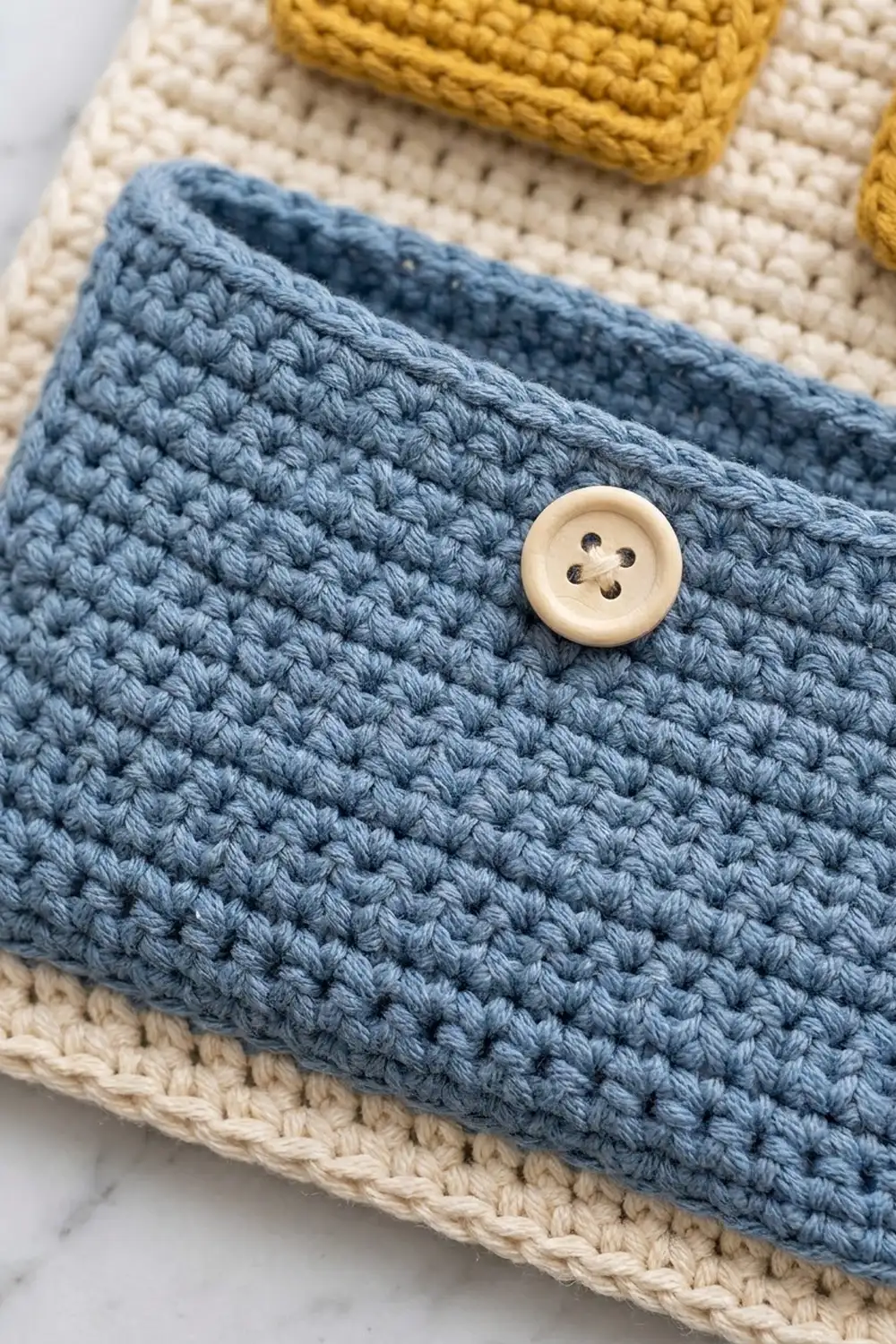
Pockets: Pin each pocket in place using the placement guide. Whipstitch through the outer loop of the pocket edging and into the body underneath. Sew down one side, across the bottom and up the other side, and leave the top open.
– Along the sides: take one stitch per body row. The large pocket’s 4.6 in (11.7 cm) sides cover 23 body rows.
– Along the bottom: take one stitch per body stitch.
Go over each pocket’s top corners 2 extra times, because they take the most strain.
Loop: Fold the cord in half and sew both ends to the WS of the roof, 1 in (2.5 cm) below the peak. About 2.5 in (6.4 cm) of loop should show above the peak.
Button: Sew the button to the large pocket, centered side to side and 1.2 in (3.0 cm) below its top edge. Sew through the pocket front only, so the pocket stays open.
Size checkpoint: The organizer should measure 9.5 in (24.1 cm) at its widest x 15 in (38.1 cm) tall, within 0.2 in (0.5 cm).
Final Blocking
- Lay the organizer RS up on a blocking mat.
- Pin the bottom corners, the roof corners and the peak to the finished size.
- Use a ruler to pin the sides straight.
- Mist it evenly until it’s damp, not soaked.
- Pat the pocket fronts flat and smooth the roof slopes into straight lines.
- Let it dry completely, at least 12 hours.
- Unpin it and measure again.
Final Quality-Control Checklist
- The body has 32 sts and 45 rows.
- The body border has 126 sc, with rounded corners.
- The roof edging has 95 sc, with a sharp peak.
- Each small pocket edging has 48 sc, and the large pocket edging has 102 sc.
- The roof seam is flat, and the overhang is even on both sides.
- The pockets are level and match the placement measurements.
- The pocket tops are open, and their top corners are reinforced.
- The loop is secure and centered behind the peak.
- The button is sewn to the pocket front only.
- All ends are woven in on the WS.
Troubleshooting
- The body edges slant inward: you’re missing the last stitch of some rows. Count to 32 every few rows.
- The roof slopes look wavy: the decrease rows are out of order. Keep the A, B, C rhythm exactly.
- The roof is too wide for the body: your roof gauge is looser. Make it again with a hook half a size smaller.
- The border ripples: you worked too many sts. Work exactly one per row end.
- The pockets gape at the top: reinforce the top corners more firmly.
- The organizer bows when full: use cotton, and don’t overload the small pockets.
Care
Hand wash in cool water, reshape while damp and lay flat to dry. Don’t tumble dry, because heat can shrink cotton and pucker the seams.
Final Notes
Here’s how the measurements build on each other. A gauge of 16 sc and 20 rows = 4 in (10.2 cm) gives a body of 8 in (20.3 cm) x 9 in (22.9 cm). The border brings it to 8.4 in (21.3 cm) x 9.2 in (23.4 cm). The 34-stitch roof base matches the 34-column body top, and the 5.8 in (14.7 cm) roof brings the height to 15 in (38.1 cm). The pockets add up to exactly the body width. Check each step as you go, and the parts will fit together cleanly.
Happy crocheting!